



Wnt
The Wnt signaling pathways are a group of signal transduction pathways made of proteins that pass signals from outside of a cell through cell surface receptors to the inside of the cell. Three Wnt signaling pathways have been characterized: the canonical Wnt pathway, the noncanonical planar cell polarity pathway, and the noncanonical Wnt/calcium pathway. All three Wnt signaling pathways are activated by the binding of a Wnt-protein ligand to a Frizzled family receptor, which passes the biological signal to the protein Dishevelled inside the cell. The canonical Wnt pathway leads to regulation of gene transcription, the noncanonical planar cell polarity pathway regulates the cytoskeleton that is responsible for the shape of the cell, and the noncanonical Wnt/calcium pathway regulates calcium inside the cell. The clinical importance of Wnt signaling pathway has been demonstrated by mutations that lead to a variety of diseases, including breast and prostate cancer, glioblastoma, type II diabetes.
Wnt Isoform Specific Products
All Product Categories
-
Wnt Related Products (458)
Related Products (458)

-
Antibodies (26)
-
Wnt Isoform Comparison
-
L-Quebrachitol (Standard)
 0 ImagesL-Quebrachitol is a methoxy analog of inositol that can be isolated from plants. L-Quebrachitol has free-radical scavenging, gastroprotection, anti-platelet aggregation and anti-diabetic activity. L-Quebrachitol promotes osteoblastogenesis by uppregulation of BMP-2, runt-related transcription factor-2 (Runx2), MAPK (ERK, JNK, p38α), and Wnt/β-catenin signaling pathway.
-
5T4_0108
 0 ImagesCat. No.: HY-P991410Purity: 99.50%Synonyms: MEDI0641 antibody5T4_0108 (MEDI0641 antibody) is a human monoclonal antibody (mAb) targeting TPBG. 5T4_0108 can be used in breast and prostate cancer research.
-
IWP-12 (Standard)
 0 ImagesCat. No.: HY-107570RCAS No.: 688353-45-9
-
Nimbolide (Standard)
 0 ImagesCat. No.: HY-116035RCAS No.: 25990-37-8Nimbolide (Standard) is the analytical standard of Nimbolide. This product is intended for research and analytical applications. Nimbolide is a triterpene compound that can be isolated from neem (Azadirachta indica), possesses anticancer and antiproliferative activity. Nimbolide induces tumor cell apoptosis by inhibiting NF-κB and CDK4/CDK6 kinase. Nimbolide suppresses the Wnt, PI3K-Akt, MAPK and JAK-STAT signaling pathways.
-
Cyflumetofen (Standard)
 0 ImagesCyflumetofen (Standard) is the analytical standard of Cyflumetofen (HY-W663938). This product is intended for research and analytical applications. Cyflumetofen is a non-systemic acylacetonitrile Acaricide. Cyflumetofen interferes with the Wnt/β-catenin signaling pathway, induces Apoptosis, and reduces the level of tight junction proteins. Cyflumetofen upregulates the expression of Pink1, Parkin and Lrrk2 genes associated with the pathogenesis of Parkinson's disease in zebrafish larvae. Cyflumetofen induces developmental toxicity and oxidative stress in zebrafish larvae, damages neurons, reduces motor activity, alters brain tissue structure, and disrupts blood-brain barrier structure. Cyflumetofen exhibits acaricidal activity against spider mites. Cyflumetofen can be used in studies related to Parkinson's disease and infestations by spider mites (Tetranychus urticae, Tetranychus kanzawai, Panonychus citri).
-
Paeonoside
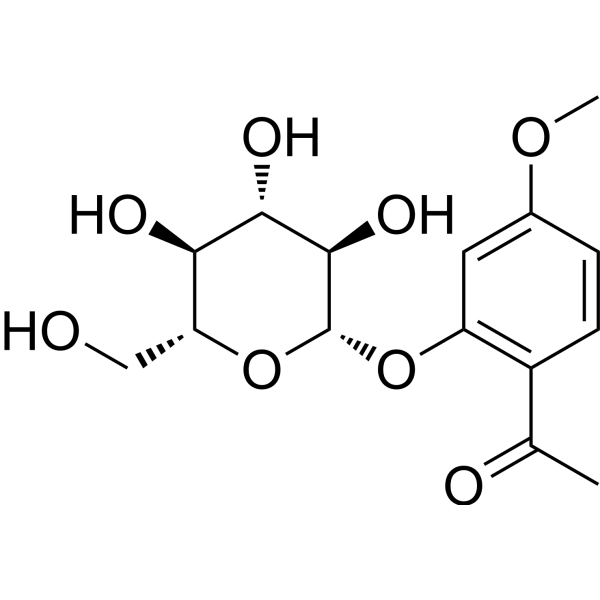 0 ImagesPaeonoside is a bioactive compound identified in P. suffruticosa that promotes wound healing and migration in osteoblast differentiation. Paeonoside has also been reported to have some antidiabetic activity and may prevent sepsis-induced lethality.
-
Notum-IN-2
 0 ImagesCat. No.: HY-182402CAS No.: 2411969-28-1Notum-IN-2 is a partially brain-penetrant Notum carboxyl-esterase inhibitor with an IC50 of 18 nM. Notum-IN-2 can be used as a chemical tool for exploring Wnt signalling in cells.
-
WAY-262611 (Standard)
 0 ImagesCat. No.: HY-11035RCAS No.: 1123231-07-1WAY-262611 (Standard) is the analytical standard of WAY-262611 (HY-11035). This product is intended for research and analytical applications. WAY-262611 is a Wnt/β-Catenin agonist that increases bone formation rate with an EC50 of 0.63 μM in TCF-Luciferase assay. WAY-262611 is also a Dkk1 inhibitor.
-
Tizanidine hydrochloride (Standard)
 0 ImagesTizanidine hydrochloride (Standard) is the analytical standard of Tizanidine hydrochloride (HY-B0194A). This product is intended for research and analytical applications. Tizanidine hydrochloride, a skeletal muscle relaxant, is an orally effective central α2-adrenoceptor agonist (IC50 = 6.9 nmol). Tizanidine hydrochloride primarily exerts muscle relaxation effects by inhibiting the release of excitatory amino acids (glutamate and aspartate) from the presynaptic terminals of spinal cord interneurons. Tizanidine hydrochloride has anti-injury activity and can inhibit gastrointestinal (GI) transport. Tizanidine hydrochloride can inhibit the proliferation, migration, and invasion of lung cancer cells and induce cell apoptosis by upregulating Nischarin and inhibiting the AKT and Wnt3a/β-catenin signaling pathways. Tizanidine hydrochloride can be used to treat spasticity caused by diseases such as multiple sclerosis (MS), stroke, and spinal cord injury (SCI).
-
EMT inhibitor-1 (Standard)
 0 ImagesCat. No.: HY-101275RCAS No.: 1638526-21-2EMT inhibitor-1 (Standard) is the analytical standard of EMT inhibitor-1 (HY-101275). This product is intended for research and analytical applications. EMT inhibitor-1 is an inhibitor of of Hippo, TGF-β, and Wnt signaling pathways with antitumor activities.
-
WAY 316606 (Standard)
 0 ImagesCat. No.: HY-10858RCAS No.: 915759-45-4WAY 316606 (Standard) is the analytical standard of WAY 316606 (HY-10858). This product is intended for research and analytical applications. WAY 316606 is an inhibitor of the secreted protein sFRP-1, an endogenous antagonist of the secreted glycoprotein Wnt. The affinity of WAY-316606 for sFRP-1 is determined using the FP binding assay with IC50 of 0.5 μM.
-
BMD4503-1
 0 ImagesCat. No.: HY-169508CAS No.: 301357-76-6BMD4503-1 is a quinoxaline derivative. BMD4503-1 can inhibit the LRP5/6-Sclerostin interaction and regulate the Wnt signaling pathway.
-
Salinomycin (Standard)
 0 ImagesCat. No.: HY-15597RCAS No.: 53003-10-4Synonyms: Procoxacin (Standard)Salinomycin (Standard) is the analytical standard of Salinomycin. This product is intended for research and analytical applications. Salinomycin (Procoxacin), a polyether potassium ionophore antibiotic, selectively inhibits the growth of gram-positive bacteria. Salinomycin is a potent inhibitor of Wnt/β-catenin signaling, blocks Wnt-induced LRP6 phosphorylation. Salinomycin shows selective activity against human cancer stem cells[1][2][3].
-
1,11b-Dihydro-11b-hydroxymedicarpin
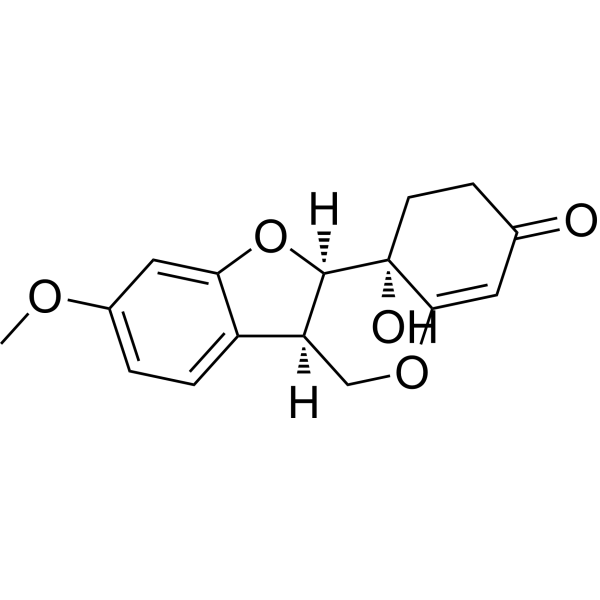 0 ImagesCat. No.: HY-N0976CAS No.: 210537-04-5Synonyms: 11b-Hydroxy-11b,1-dihydromedicarpin1,11b-Dihydro-11b-hydroxymedicarpin (11b-Hydroxy-11b,1-dihydromedicarpin) is a pterocarpan from Ononis viscosa subsp. breviflora is a Medicarpin derivative. Medicarpin, a natural pterocarpan, heals cortical bone defect by activation of Notch and Wnt canonical signaling pathways. Medicarpin prevents arthritis in post-menopausal conditions by arresting the expansion of TH17 cells and pro-inflammatory cytokines. Medicarpin down-regulates pro-inflammatory cytokines like TNF-α, IL-6 and IL-17A, while up-regulates anti-inflammatory cytokine IL-10 in arthritis (CIA) model of mice.
-
SKL2001 (Standard)
 0 ImagesSKL2001 (Standard) is the analytical standard of SKL2001 (HY-101085). This product is intended for research and analytical applications. SKL2001 is an agonist of the Wnt/β-catenin pathway, with anti-cancer activity. SKL2001 stabilizes intracellular β-catenin via disruption of the Axin/β-catenin interaction.
-
iCRT3 (Standard)
 0 ImagesCat. No.: HY-103705RCAS No.: 901751-47-1
-
JW67 (Standard)
 0 ImagesCat. No.: HY-108442RCAS No.: 442644-28-2JW67 (Standard) is the analytical standard of JW67 (HY-108442). This product is intended for research and analytical applications. JW67 inhibits the canonical Wnt signaling with an IC50 of 1.17μM. JW67 affects the multiprotein complex consisting of β-catenin/GSK-3β/AXIN/APC/CK1 that rapidly reduces active β-catenin with a subsequent downregulation of Wnt target genes. JW67 also inhibits colorectal cancer cell growth.

-
IWP-2 (Standard)
 0 ImagesCat. No.: HY-13912RCAS No.: 686770-61-6IWP-2 (Standard) is the analytical standard of IWP-2 (HY-13912). This product is intended for research and analytical applications. IWP-2 is an inhibitor of Wnt processing and secretion with an IC50 of 27 nM. IWP-2 targets the membrane-bound O-acyltransferase porcupine (Porcn) and thus preventing a crucial Wnt ligand palmitoylation. IWP-2 is also an ATP-competitive CK1δ inhibitor with an IC50 of 40 nM for the gatekeeper mutant M82FCK1δ.
-
Laduviglusib trihydrochloride (Standard)
 0 ImagesSynonyms: CHIR-99021 trihydrochloride (Standard); CT99021 trihydrochloride (Standard)Laduviglusib (trihydrochloride) (Standard) is the analytical standard of Laduviglusib (trihydrochloride). This product is intended for research and analytical applications. Laduviglusib (CHIR-99021) trihydrochloride is a potent and selective GSK-3α/β inhibitor with IC50s of 10 nM and 6.7 nM. Laduviglusib trihydrochloride shows >500-fold selectivity for GSK-3 over CDC2, ERK2 and other protein kinases. Laduviglusib trihydrochloride is also a potent Wnt/β-catenin signaling pathway activator. Laduviglusib trihydrochloride enhances mouse and human embryonic stem cells self-renewal. Laduviglusib trihydrochloride induces autophagy.




