



ACSL Family Activator
-
Ferroptosis inducer-9
 0 ImagesCat. No.: HY-175698
Ferroptosis inducer-9 is a ferroptosis inducer and colchicine site tubulin polymerization inhibitor. Ferroptosis inducer-9 inhibits MCF-7 cell growth with an IC50 of 14 nM and inhibits [3H]colchicine binding. Ferroptosis inducer-9 reduces expression of GPX4 and FTH, increases COX2 and ACSL4, lowers GSH, NADP+, and NADPH levels, increases LPO, MDA, and Fe(II) levels, and decreases SOD concentrations. Ferroptosis inducer-9 demonstrates significant anti-tumor efficacy in HCT116 CRC xenograft model. Ferroptosis inducer-9 can be used for the study of triple negative breast cancer (TNBC) and colorectal cancer (CRC).
-
Ferroptosis inducer-8
 0 ImagesCat. No.: HY-174345CAS No.: 3097194-74-3
Ferroptosis inducer-8 is a ferroptosis inducer with high selectivity for other cell death mechanism. Ferroptosis inducer-8 induces ferroptosis by affecting ACSL4, GPX4, and FTH1, thereby disrupting intracellular iron homeostasis and the GSH/GPX4 antioxidant defense system, ultimately leading to the accumulation of lipid peroxidation. Ferroptosis inducer-8 also induces ROS production. Ferroptosis inducer-8 inhibits tumor growth and can be used for research of triple-negative breast cancer (TNBC).
-
Ferroptosis/apoptosis inducer-5
 0 ImagesCat. No.: HY-183791ACAS No.: 2243423-32-5
Ferroptosis/apoptosis inducer-5 is an orally active inducer of Ferroptosis and Apoptosis. Ferroptosis/apoptosis inducer-5 downregulates GPX4, upregulates ACSL4, promotes ROS production, activates the Caspase cascade, induces Mitochondrial dysfunction, and alters the Bcl-2/Bax balance. Ferroptosis/apoptosis inducer-5 significantly inhibits tumor growth in a pancreatic cancer xenograft mouse model. Ferroptosis/apoptosis inducer-5 can be used for the research of pancreatic cancer.
-
Lepadin E
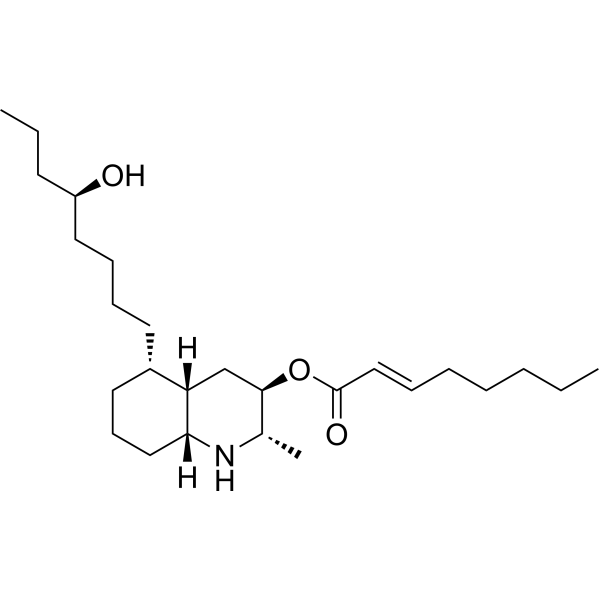 0 ImagesCat. No.: HY-155851CAS No.: 444914-19-6
Lepadin E is a significantly cytotoxic ferroptosis inducer that induces iron death through the classical p53-SLC7A11-GPX4 pathway. Lepadin E promoted p53 expression, decreases SLC7A11 and GPX4 levels, and leads to increased ROS and lipid peroxide production, and upregulated ACSL4 expression, thus causes cell death. Lepadin E has significant antitumor effect.
-
Lepadin H
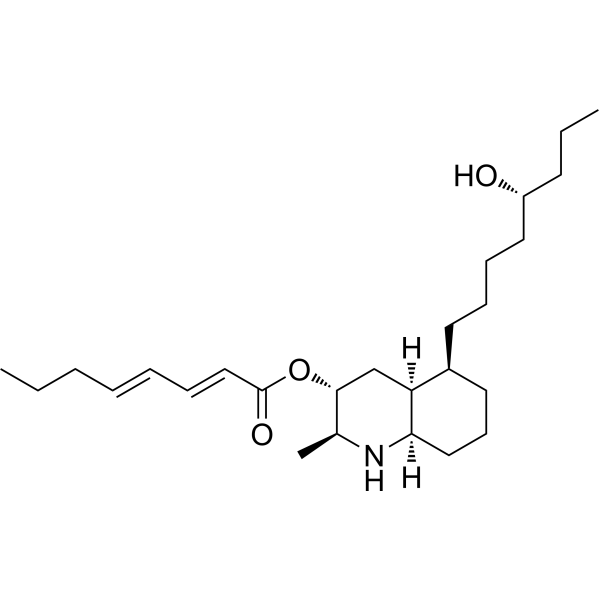 0 ImagesCat. No.: HY-155852CAS No.: 412328-25-7
Lepadin H is a ferroptosis inducer and apoptosis inducer with in vitro cytotoxicity and in vivo antitumor efficacy against cancer cells. Lepadin H reduces GPX4 and SLC7A11 levels, increases p53 and ACSL4 expression, drives lipid hydroperoxide production, elevates reactive oxygen species (ROS) levels, reduces cellular glutathione (GSH) levels, induces lipid peroxidation and G2/M phase cell cycle arrest, and suppresses clonogenic growth and migration of cancer cells.Lepadin H can be used for the research of melanoma.
-
PROTAC FSP1 degrader 1
 0 ImagesCat. No.: HY-179384CAS No.: 3096510-51-6
PROTAC FSP1 degrader 1 is a highly efficient and selective PROTAC degrader targeting FSP1. PROTAC FSP1 degrader 1 significantly induces the accumulation of intracellular lipid peroxides. PROTAC FSP1 degrader 1 exhibits synergistic induction of ferroptosis with GPX4 inhibitors. PROTAC FSP1 degrader 1 can induce ROS production. PROTAC FSP1 degrader 1 upregulates the mRNA expression of ferroptosis-related proteins (GPX4, FTH1, ACSL4, TfR1, FSP1). PROTAC FSP1 degrader 1 can be used for the study of triple-negative breast cancer.
-
Fluorofenidone (Standard)
 0 Images
Fluorofenidone (Standard) is the analytical standard of Fluorofenidone (AKF-PD) (HY-121246). This product is intended for research and analytical applications. Fluorofenidone is an orally active compound with anti-fibrotic, antioxidant, and anti-inflammatory pharmacological effects. Fluorofenidone downregulates the expression of ACSL4, upregulates GPX4 expression and inhibits the NF-κB signaling pathway to alleviate inflammation and fibrosis. Fluorofenidone ameliorates cholestasis and fibrosis by inhibiting hepatic Erk/-Egr-1 signaling and Tgfβ1/Smad pathway in mice. Fluorofenidone demonstrates protective effects against chronic lung injury in mice. Fluorofenidone can be used for the study of chronic obstructive pulmonary disease (COPD), pulmonary interstitial fibrosis (PIF) and non-small cell lung cancer (NSCLC).



