



Hsp90-targeting Chimeras
Hsp90 is a molecular chaperone and key regulator of proteostasis under physiological and stress conditions[1]. Mechanistically, mammalian cytosolic Hsp90α and Hsp90β interact with a large fraction of the proteome, but disease-state cells may depend more strongly on one isoform[1]. This isoform distinction matters because Hsp90β is constitutively expressed and essential for early mouse development, whereas Hsp90α is stress-inducible and not necessary for survivability[1]. Compared with related isoforms, selective design remains difficult because Hsp90α and Hsp90β share 95% identity in the N-terminal ATP-binding site and differ by only two amino acid residues[2]. In breast cancer models, BP3 used a PROTAC strategy to induce potent, selective, CRBN-dependent HSP90 degradation and inhibit human breast cancer cell growth[3]. X10g further refined this approach by selectively degrading Hsp90α without affecting Hsp90β while maintaining antitumor activity in breast cancer models[4]. For experimental applications, HEMTACs bridge target proteins to HSP90 to drive intracellular protein degradation[5]. HIM-PROTACs extended this concept by degrading GPX4 through HSP90-mediated ubiquitin-proteasomal degradation to trigger ferroptosis in HT-1080 cells[6].
References:
- [1]. Maiti S, et al. Cytosolic Hsp90 Isoform-Specific Functions and Clinical Significance. Biomolecules. 2022 Aug 23;12(9):1166. [Content Brief]
- [2]. Dernovšek J, et al. Following the design path of isoform-selective Hsp90 inhibitors: Small differences, great opportunities. Pharmacol Ther. 2023 May;245:108396. [Content Brief]
- [3]. Liu Q, et al. Discovery of BP3 as an efficacious proteolysis targeting chimera (PROTAC) degrader of HSP90 for treating breast cancer. Eur J Med Chem. 2022 Jan 15;228:114013. [Content Brief]
- [4]. Jiang Q, et al. Discovery of X10g as a selective PROTAC degrader of Hsp90α protein for treating breast cancer. Eur J Med Chem. 2023 Nov 15;260:115690. [Content Brief]
- [5]. Li Z, et al. Targeted Protein Degradation Induced by HEMTACs Based on HSP90. J Med Chem. 2023 Jan 12;66(1):733-751. [Content Brief]
- [6]. Dong J, et al. Heat Shock Protein 90 Interactome-Mediated Proteolysis Targeting Chimera (HIM-PROTAC) Degrading Glutathione Peroxidase 4 to Trigger Ferroptosis. J Med Chem. 2024 Sep 26;67(18):16712-16736. [Content Brief]
-
Hsp90-targeting Chimeras Related Products (3)
Related Products (3)

-
HEMTAC CDK4/6 degrader 1
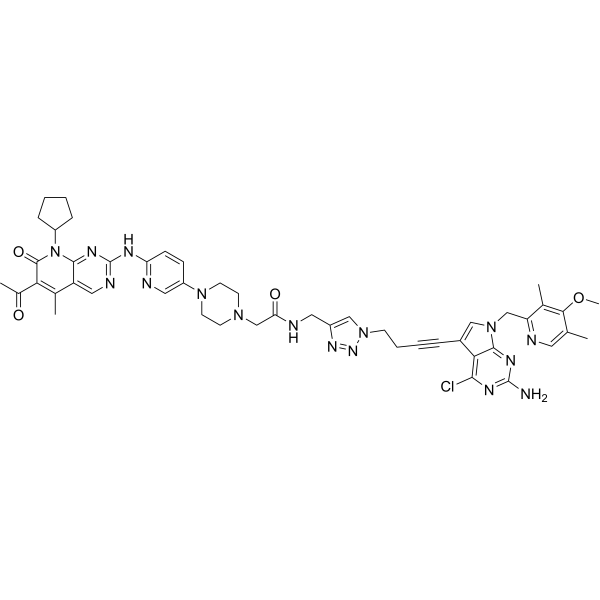 0 ImagesHEMTAC CDK4/6 degrader 1 is a PROTAC connected by ligands for HSP90 and CDK4/6 with a Kd value of 35.7 μM. HEMTAC CDK4/6 degrader 1 induces CDK4/6 degradation in B16F10 melanoma cells. HEMTAC CDK4/6 degrader 1 arrests cell cycle at G0/G1 phase and induces apoptosis. HEMTAC CDK4/6 degrader 1 can be used in research of cancer. HEMTAC CDK4/6 degrader 1 is a click chemistry reagent, it contains an Alkyne group and can undergo copper-catalyzed azide-alkyne cycloaddition (CuAAc) with molecules containing Azide groups.
-
HEMTAC WEE1 degrader-1
 0 ImagesHEMTAC WEE1 degrader-1 is a HSP90-mediated targeting chimera (HEMTAC) degrader of WEE1 (HSP90 enzyme inhibitory activity is IC50: 16.76 nM). HEMTAC WEE1 degrader-1 promotes the ubiquitination and degradation of WEE1. HEMTAC WEE1 degrader-1 blocks the G2/M cell cycle. HEMTAC WEE1 degrader-1 has anticancer activity in acute myeloid leukemia (AML) patient-derived xenograft (PDX) models. HEMTAC WEE1 degrader-1 can be used in AML research. (Pink: HSP90 binder; Blue: WEE1 ligand; Black: linker).
-
DDO3602
 0 ImagesCat. No.: HY-178496DDO3602 is a PARP1 HSPTAC (HSP90-mediated proteolysis-targeting chimera) degrader, with a DC50 of 490.3 nM against PARP1; its Kd values for PARP1 and HSP90 are 66.5 nM and 1.64 nM, respectively. DDO3602 induces the formation of an unnatural PARP1-HSP90 ternary complex, recruits E3 ubiquitin ligase, and promotes PARP1 degradation via the ubiquitin-proteasome pathway. DDO3602 induces G2/M cell cycle arrest, DNA damage, inhibits cell migration, and exhibits antiproliferative activity in breast cancer cells. DDO3602 can be used in breast cancer-related research.



