



iGluR
Ionotropic glutamate receptors
iGluR (ionotropic glutamate receptor) is a ligand-gated ion channel that is activated by the neurotransmitter glutamate. iGluR are integral membrane proteins compose of four large subunits that form a central ion channel pore. Sequence similarity among all known glutamate receptor subunits, including the AMPA, kainate, NMDA, and δ receptors.
AMPA receptors are the main charge carriers during basal transmission, permitting influx of sodium ions to depolarise the postsynaptic membrane. NMDA receptors are blocked by magnesium ions and therefore only permit ion flux following prior depolarisation. This enables them to act as coincidence detectors for synaptic plasticity. Calcium influx through NMDA receptors leads to persistent modifications in the strength of synaptic transmission.
iGluR Isoform Specific Products
All Product Categories
-
iGluR Inhibitors
(130)
View all products
-
iGluR Agonists
(130)
View all products
-
iGluR Antagonists
(347)
View all products
-
iGluR Activators
(34)
View all products
-
iGluR Modulators
(89)
View all products
-
iGluR MDM2 Inhibitor
(1)
View all products
-
iGluR Controls
(5)
View all products
-
iGluR Ligand
(1)
View all products
-
iGluR Related Products (819)
Related Products (819)

-
Antibodies (11)
-
iGluR Isoform Comparison
-
LY339434
 0 ImagesCat. No.: HY-114550CAS No.: 219566-62-8LY339434 is a potent and selective agonist for the hydrochloride receptor GluR5. LY339434 affects the rapid death of neurons through n-methyl-D-aspartate (NMDA) receptors.
-
Nelonemdaz (Standard)
 0 ImagesCat. No.: HY-106408RCAS No.: 640290-67-1Synonyms: Salfaprodil free base (Standard); Neu2000 (Standard)Nelonemdaz (Standard) is the analytical standard of Nelonemdaz (HY-106408). This product is intended for research and analytical applications. Nelonemdaz (Salfaprodil free base) is an NR2B-selective and uncompetitive antagonist of N-methyl-D-aspartate (NMDA). Nelonemdaz is also a free radical scavenger. Nelonemdaz has excellent neuroprotection against NMDA- and free radical-induced cell death.
-
Quinolinic acid-13C7
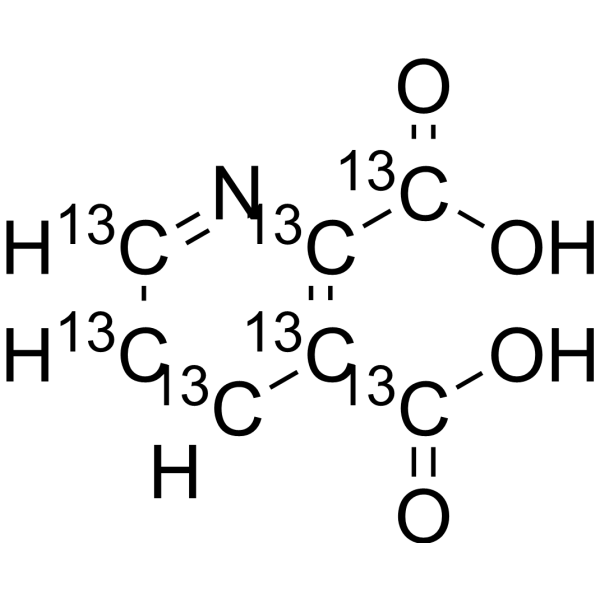 0 ImagesCat. No.: HY-100807S1CAS No.: 1346642-91-8Quinolinic acid-13C7 is the 13C labeled Quinolinic acid (HY-100807). Quinolinic acid, an endogenous metabolite of tryptophan, is a N-methyl-D-aspartate receptor (NMDA receptor) agonist. Quinolinic acid increases glutamate efflux, induces the generation of ROS, activates nitric oxide synthase, produces excessive NO, leading to calcium ion influx and neuronal apoptosis.
-
WMS-1410
 0 ImagesCat. No.: HY-183871CAS No.: 1253197-38-4WMS-1410 is a selective GluN2B-containing NMDA receptor inhibitor with an IC50 of 18.4 nM. WMS-1410 regulates intracellular calcium levels and protects cells from Apoptosis. WMS-1410 inhibits glutamate-induced excitotoxicity. WMS-1410 reverses NMDA/glycine-induced reduction in glucose-stimulated insulin secretion without altering physiological insulin secretion or baseline redox status, but fails to counteract insulin content loss induced by glucolipotoxicity. WMS-1410 exhibits analgesic activity against advanced neuropathic pain. WMS-1410 can be used in studies related to stroke, brain injury, Alzheimer's disease, Parkinson's disease, type 2 diabetes, and neuropathic pain.
-
N,N'-Bis(2-aminoethyl)-1,4-butanediamine
 0 ImagesCat. No.: HY-184804CAS No.: 35513-90-7N,N'-Bis (2-aminoethyl)-1,4-butanediamine is a GluR6 (Q) kainate subtype glutamate receptor channel blocker, with a Kd (0) of 41.1 μM for the GluR6 (Q) receptor.
-
GYKI 52466 dihydrochloride (Standard)
 0 ImagesGYKI 52466 (dihydrochloride) (Standard) is the analytical standard of GYKI 52466 (dihydrochloride). This product is intended for research and analytical applications. GYKI 52466 dihydrochloride is an orally active, highly selective and noncompetitive AMPA/kainate receptor antagonist with the IC50 values of 7.5 and 11μM, respectively. GYKI 52466 dihydrochloride has good blood brain barrier permeability and anticonvulsant effect. GYKI 52466 dihydrochloride can be used in Parkinson's disease research.
-
Caroverine hydrochloride (Standard)
 0 ImagesCat. No.: HY-106467BRCAS No.: 55750-05-5Caroverine (hydrochloride) (Standard) is the analytical standard of Caroverine (hydrochloride). This product is intended for research and analytical applications. Caroverine hydrochloride is a potent, competitive and reversible antagonist of NMDA and AMPA glutamate receptor. Caroverine hydrochloride is also an antioxidant and calcium-blocking agent that exhibits vasorelaxant action. Caroverine hydrochloride can be used for the research of inner ear tinnitus.
-
Sunifiram (Standard)
 0 ImagesSynonyms: DM-235 (Standard)Sunifiram (Standard) is the analytical standard of Sunifiram. This product is intended for research and analytical applications. Sunifiram (DM-235) is an ampakine-like compound and an agonist of AMPA receptor with oral activity. Sunifiram can increase the release of acetylcholine in the rat cerebral cortex and exhibits potent cognitive enhancement effects with better nootropic activity compared to piracetam (HY-B0585). Sunifiram is promising for research in neurodegenerative diseases such as mild cognitive impairment (MCI) and Alzheimer's disease (AD).
-
Co 101244 hydrochloride (Standard)
 0 ImagesCat. No.: HY-107706RCAS No.: 193356-17-1Synonyms: PD 174494 hydrochloride (Standard)Co 101244 hydrochloride (Standard) is the analytical standard of Co 101244 (hydrochloride) (HY-107706). This product is intended for research and analytical applications. Co 101244 (PD 174494) hydrochloride is a NR2B-containing NMDA receptor antagonist.
-
UBP310 (Standard)
 0 ImagesCat. No.: HY-107602RCAS No.: 902464-46-4
-
5,7-Dichlorokynurenic acid (Standard)
 0 ImagesSynonyms: 5,7-DCKA (Standard)5,7-Dichlorokynurenic acid (Standard) is the analytical standard of 5,7-Dichlorokynurenic acid (HY-100834). This product is intended for research and analytical applications. 5,7-Dichlorokynurenic acid (5,7-DCKA) is a selective and competitive antagonist of the glycine site on NMDA receptor with a KB of 65 nM. 5,7-Dichlorokynurenic acid reduces NMDA-induced neuron injury. 5,7-Dichlorokynurenic acid increases social interaction time, increases open arm exploration time, disinhibits suppressed conflict responding in rodent models. 5,7-Dichlorokynurenic acid exhibits anxiolytic-like activity in rodent models and supports exploration of glycine’s role in NMDA receptor-mediated synaptic transmission.
-
Tianeptine sodium salt (Standard)
 0 ImagesTianeptine sodium salt (Standard) is the analytical standard of Tianeptine sodium salt (HY-90003A). This product is intended for research and analytical applications. Tianeptine sodium salt is an atypical antidepressant. Tianeptine sodium salt is a moderate-intensity agonist of the μ-opioid receptor (MOR), and to a lesser extent, is an agonist of the δ-opioid receptor (DOR). Tianeptine sodium salt is a glutamate modulator that can enhance AMPA receptor and antagonize NMDA receptor. Tianeptine sodium salt increases sensitivity of the α1 adrenergic receptor, which only manifests in chronic treatment. Tianeptine sodium salt exerts neuroprotective effects under stress/inflammation-induced conditions, exhibiting anti-inflammatory and antioxidant properties. Tianeptine sodium salt inhibits MMP-9 by suppressing the PI3K/Akt-mediated NF-κB pathway. Tianeptine sodium salt can be used to alleviate symptoms of depression and anxiety, but does not cause sedative effects.
-
IDRA 21 (Standard)
 0 ImagesIDRA 21 (Standard) is the analytical standard of IDRA 21 (HY-101528). This product is intended for research and analytical applications. IDRA 21 is a positive and orally active modulator of the AMPA receptor. IDRA 21 facilitates excitatory neurotransmission via GluR1/2 receptors. IDRA 21 has the potential for the research of cognitive/memory disorders, including those associated with aging.
-
Dimiracetam (Standard)
 0 ImagesCat. No.: HY-106856RCAS No.: 126100-97-8Synonyms: NT-11624 (Standard)Dimiracetam (Standard) (NT-11624 (Standard)) is the analytical standard of Dimiracetam (HY-106856). This product is intended for research and analytical applications. Dimiracetam is an orally active compound, with anti-neuropathic activity. Dimiracetam inhibits hypersensitivity and neurological alterations, and inhibits Sorafenib (HY-10201)-induced neuropathy in cold stimulation rat models.
-
Indicaxanthin
 0 ImagesCat. No.: HY-W747992CAS No.: 2181-75-1Indicaxanthin is an orally available, blood-brain barrier-permeable bioavailable betalain pigment (Betalain Pigment) found in the fruits of Opuntia ficus-indica. Indicaxanthin exhibits antioxidant, anti-inflammatory, antiproliferative and neuromodulatory activities. Indicaxanthin modulates glutamatergic neurotransmission and inhibits PGE2, TNF-α, IL-1β, iNOS, COX-2 and NF-κB-related inflammatory responses. Indicaxanthin can be used in studies of melanoma, colorectal cancer, acute inflammation, obesity-associated insulin resistance and glutamatergic neuromodulation.
-
Budipine hydrochloride
 0 ImagesCat. No.: HY-W001601ACAS No.: 63661-61-0Budipine hydrochloride is an anti-parkinson agent. Budipine hydrochloride also is a substrate of P-glycoprotein (P-gp), is mediated the uptake into the brain by P-gp. Budipine hydrochloride also is N-methyl-d-aspartate (NMDA) antagonist, and has indirect dopaminergic effects through an improved dopamine release, the inhibition of monoamine oxidase type B (MAO-B). Budipine hydrochloride can be used for the research of CNS disorders include Parkinson disease.
-
Aptiganel hydrochloride (Standard)
 0 ImagesCat. No.: HY-110097RCAS No.: 137160-11-3Synonyms: CNS 1102 (Standard)Aptiganel (hydrochloride) (Standard) is the analytical standard of Aptiganel (hydrochloride). This product is intended for research and analytical applications. Aptiganel hydrochloride (Cerestat) is a non-competitive NMDA receptor antagonist with neuroprotective effect.
-
(R)-(+)-HA-966 (Standard)
 0 ImagesSynonyms: (+)-HA-966 (Standard)(R)-(+)-HA-966 (Standard) is the analytical standard of (R)-(+)-HA-966 (HY-100822). This product is intended for research and analytical applications. (R)-(+)-HA-966 ((+)-HA-966) is a partial agonist/antagonist of glycine site of the N-methyl-D-aspartate (NMDA) receptor complex. (R)-(+)-HA-966 selectively blocks the activation of the mesolimbic dopamine system by amphetamine. (R)-(+)-HA-966 can cross the blood-brain barrier and has the potential for neuropathic and acute pain.
-
Etoxadrol
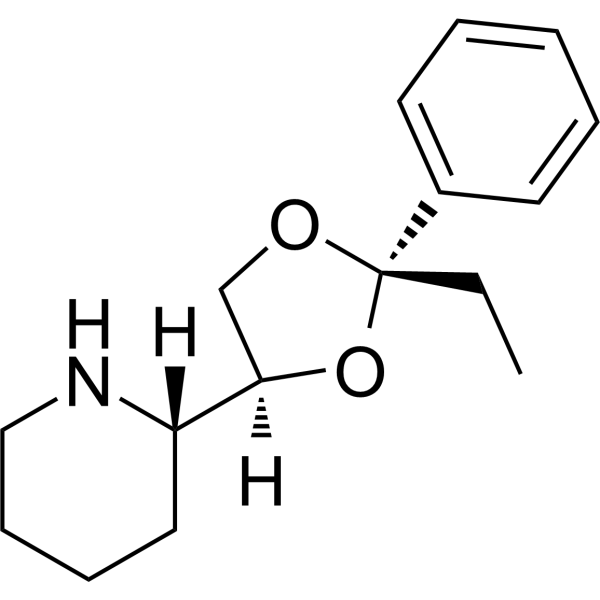 0 ImagesCat. No.: HY-107040CAS No.: 28189-85-7Synonyms: NSC 288020; CL-1848CEtoxadrol (CL-1848C) is a potent, high-affinity N-methyl-D-aspartic acid (NMDA) antagonist. Etoxadrol is used in the anaesthetic and anaesthesia research community to suppress or relieve pain.
-
HA-966 hydrochloride
 0 ImagesCat. No.: HY-W424730CAS No.: 42585-88-6HA-966 hydrochloride is a glycine site antagonist of the NMDA receptor, exhibiting non-competitive antagonism on NMDA responses. HA-966 hydrochloride effectively blocks the enhancement of NMDA responses by glycine in a competitive manner. HA-966 hydrochloride plays a significant role in mediating the antagonist action at the glycine modulatory site of the NMDA receptor.




