



Liposome
Liposomes (NPs typically 100–500 nm in diameter) are fabricated from the self-assembly of phospholipids, which consist of a polar phosphate head group and hydrophobic lipid tails. In aqueous environments, the hydrophobic tails self-orient, resulting in a spherical structure comprised of an aqueous core surrounded by a lipophilic bilayer membrane. Liposomes are both biocompatible and biodegradable (e.g., at certain pH and temperature), which can be controlled by modifying the lipid composition. Furthermore, liposomes are amenable to various modifications that improve their efficacy as drug delivery carriers.
All Product Categories
-
Liposome Related Products (1265)
Related Products (1265)

-
OH-Chol
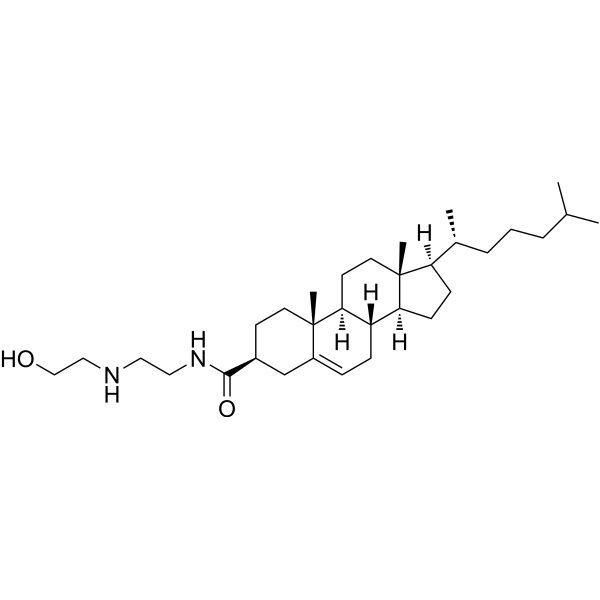 0 ImagesCat. No.: HY-145523CAS No.: 191173-82-7OH-Chol is a cationic cholesterol derivative. OH-Chol can be used for siRNA delivery and gene silencing.
-
DSPE-PEG2000-DHLASLWWGTEL
 0 ImagesCat. No.: HY-182099ADSPE-PEG2000-DHLASLWWGTEL is a PEG compound which composed of DSPE and a GPC3 targeting peptide DHLASLWWGTEL. The DHLASLWWGTEL peptide partially and specifically binds to GPC3-positive cells, achieving precise targeting. DSPE-PEG2000-DHLASLWWGTEL can be used for drug delivery.
-
DSPE-PEG2000-LyP-1
 0 ImagesCat. No.: HY-172271A
-
DPPE-PEG2000-SH
 0 ImagesCat. No.: HY-182882ASynonyms: DPPE-PEG2000-ThiolDPPE-PEG2000-SH (DPPE-PEG2000-Thiol) is a conjugate composed of DPPE, a PEG chain, and a terminal thiol group (-SH). The thiol group in DPPE-PEG2000-SH exhibits strong chemical reactivity and can participate in various bioconjugation reactions for targeted modification of liposomes/nanoparticles.
-
DMG-PEG10000-Alkyne
 0 ImagesCat. No.: HY-183191DDMG-PEG10000-Alkyne is a conjugate composed of dimyristic glycerol (DMG), a PEG chain, and a terminal alkyne group. DMG-PEG10000-Alkyne combines the membrane compatibility of phospholipids with the high reactivity of the alkyne group in click chemistry, making it suitable for research in biomaterial construction and drug delivery.
-
2N12B
 0 ImagesCat. No.: HY-172334CAS No.: 3067164-96-62N12B is a bioreducible ionizable lipid containing disulfide bonds. 2N12B can be used to prepare lipid nanoparticles (LNPs) for the delivery of mRNA in vitro and in vivo. Lipid nanoparticles containing 2N12B can deliver siRNA to inhibit retinal neovascularization.
-
DOPE-mPEG5000
 0 ImagesCat. No.: HY-W440989DOPE-mPEG5000 is a phospholipid. Phospholipids have good biocompatibility and significant amphiphilic characteristics, making them the main and suitable dosage form or excipient in drug formulations, thereby achieving better therapeutic effects. DOPE-mPEG5000can be used in drug delivery research.
-
DSPE-PEG3400-octreotide
 0 ImagesCat. No.: HY-172280CDSPE-PEG3400-Octreotide is a PEG compound which composed of DSPE and a Octreotide (HY-P0036). Octreotide is a somatostatin receptor agonist. Octreotide has antitumor activity, mediates apoptosis and may also be used in disease studies in acromegaly. DSPE-PEG3400-Octreotide can be used for drug delivery.
-
DSPE-PEG5000-CCK8
 0 ImagesCat. No.: HY-172281BDSPE-PEG5000-CCK8 is a PEG compound which composed of DSPE and a Cholecystokinin-8 (CCK8). Cholecystokinin-8 has the activity of peptide regulating gallbladder contraction and digestive system function. DSPE-PEG5000-CCK8 can be used for drug delivery.
-
DMG-PEG5000-DBCO
 0 ImagesCat. No.: HY-183195CDMG-PEG5000-DBCO is a conjugate composed of dimyristic glycerol (DMG), a PEG chain, and a terminal dibenzocyclooctylene (DBCO). DMG-PEG5000-DBCO combines the membrane compatibility of phospholipids with the high reactivity of the DBCO group in copper-free click chemistry, making it suitable for research in biomaterial construction and drug delivery.
-
DSPE-Pyrene
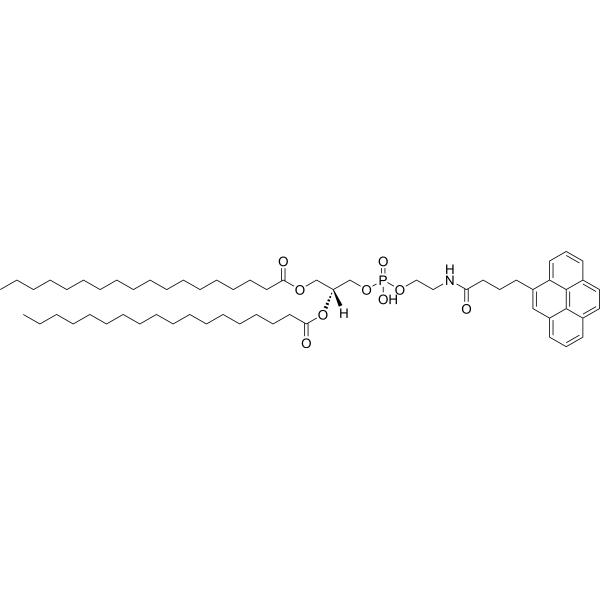 0 ImagesCat. No.: HY-W441021CAS No.: 2933318-11-5DSPE-Pyrene is a phospholipid molecule with polycyclic aromatic hydrocarbon, and can be used for drug encapsulation, such as drug loaded liposomes or nanoparticles. Pyrene is a fluorescent probe whose spectrum is sensitive to the polarity of its environment.
-
Lipid C2
 0 ImagesCat. No.: HY-169480CAS No.: 3003022-09-8Lipid C2 is an ionizable cationic lipid that has been used in the formation of lipid nanoparticles (LNP) for mRNA delivery in vivo. LNPs containing Lipid C2 and encapsulating an mRNA reporter selectively accumulate in the liver and spleen but not the heart, lungs, or kidneys in mice. LNP containing Lipid C2 and encapsulating mRNA encoding the Epstein-Barr virus (EBV) protein latent membrane protein 2 (LMP-2), in combination with an anti-programmed cell death protein 1 (PD-1) antibody, decrease tumor volume and reverse T cell exhaustion, as well as increase the percentage of CD3+CD8+ central and CD3+CD8+ effector memory T cells and decrease the percentage of CD3+ T cells expressing Pd-1, in the spleen in a CT26 murine EBV-infected colon cancer model.
-
Oleyl Mesylate
 0 ImagesCat. No.: HY-142985CAS No.: 35709-09-2Oleyl Mesylate is a derivative of Oleyl Alcohol. Oleyl Alcohol has been incorporated into various formulations for drug delivery.
-
PPPDA-O16B
 0 ImagesCat. No.: HY-159711CAS No.: 3097638-12-2PPPDA-O16B is a lipid containing disulfide bonds used for DNA delivery. PPPDA-O16B can encapsulate DNA plasmid, releasing DNA selectively via lipid degradation catalyzed by GSH.
-
DSPE-PEG3400-R8
 0 ImagesCat. No.: HY-172276CDSPE-PEG3400-R8 is a PEG compound which composed of DSPE and a cell-penetrating peptide (R8). pDSPE-PEG3400-R8 can be used for drug delivery.
-
VL-422 derivative
 0 ImagesCat. No.: HY-186305CAS No.: 3078747-38-0VL-422 derivative is an ionizable lipid component of targeted lipid nanoparticles. VL-422 derivative formulated with a helper lipid, cholesterol, and a PEGylated lipid forms lipid nanoparticles (LNPs). VL-422 derivative can be used for in vivo or ex vivo delivery of agents to immune cells.
-
DSPE-PEG2000-A7R
 0 ImagesCat. No.: HY-172272ADSPE-PEG2000-A7R is a PEG compound which composed of DSPE and a tumor vascular targeting peptide (A7R). A7R exhibits high affinity and specificity for VEGFR-2, which is overexpressed in various tumors.
-
DSG-PEG5000-Biotin
 0 ImagesCat. No.: HY-183170CDSG-PEG5000-Biotin is a conjugate composed of DSG, PEG chains, and biotin. DSG-PEG5000-Biotin combines the membrane compatibility of phospholipids with the high affinity of biotin for avidin/streptavidin, enabling applications such as targeted drug delivery systems and nanoparticle modification.
-
PtdIns-(3)-P1(1,2-dioctanoyl) sodium
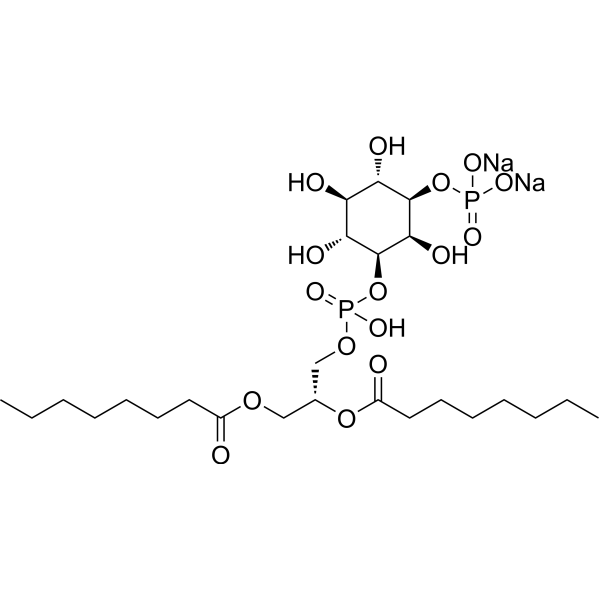 0 ImagesCat. No.: HY-131482CAS No.: 299216-98-1PtdIns-(3)-P1(1,2-dioctanoyl) sodium (compound 1b) is a glycogen phosphate that plays a key role in eukaryotic membrane trafficking and agonist-activated intracellular signaling.
-
DSPC-d13
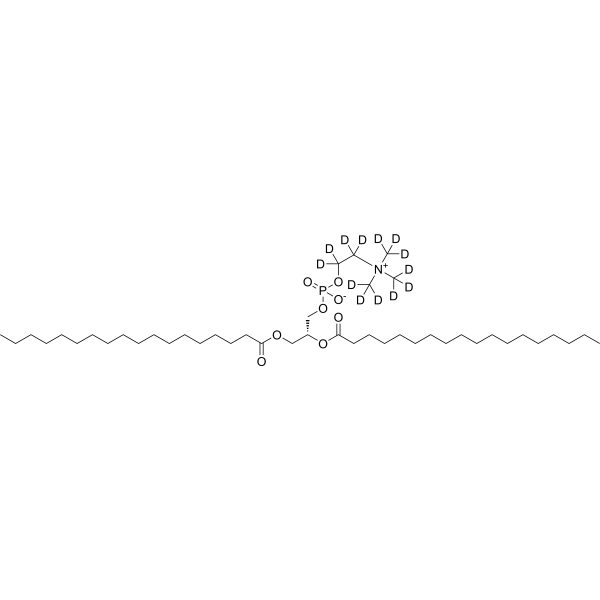 0 ImagesSynonyms: 1,2-Distearoyl-sn-glycero-3-PC-d13; 1,2-Distearoyl-sn-glycero-3-phosphorylcholine-d13DSPC-d13 (1,2-Distearoyl-sn-glycero-3-phosphorylcholine-d13) is the deuterium labeled DSPC (HY-W040193). DSPC is a cylindrical-shaped lipid. 1,2-Distearoyl-sn-glycero-3-phosphorylcholine is used to synthesize liposomes, and is the lipid component in the lipid nanoparticle (LNP) system.



