



Anti-Mouse VEGF Antibody (G6-31)
Anti-Mouse VEGF Antibody (G6-31) is a anti-mouse VEGF antibody. Anti-Mouse VEGF Antibody (G6-31) blocks VEGF-A-mediated angiogenesis and shows antitumor activity. Anti-Mouse VEGF Antibody (G6-31) can be used for the research of cancer, such as multiple endocrine neoplasia type 1.
For research use only. We do not sell to patients.
-
Storage:
Please store the product under the recommended conditions in the Certificate of Analysis.


To place orders, for customer services and technical support, please contact: MedChemExpress USA
Tel: 609-228-6898 E-mail: [email protected] [email protected]


-
 Biological Activity
-
Chemical Information
- Purity & Documentation
- References
-
 Help & FAQs


All VEGFR Isoforms
More

Biological Activity
Description
Isotype
Mouse IgG2a kappa
Recommend Isotype Controls
Species Reactivity
Mouse
In Vivo
Anti-Mouse VEGF Antibody (G6-31) (5 mg/kg; i.p.; once weekly; 35 days) produces a 73% reduction in mean subcutaneous pituitary adenoma transplants volume and lowers serum prolactin levels in BALB/c nude mice[1].
MedChemExpress (MCE) has not independently confirmed the accuracy of these methods. They are for reference only.
-
Animal Model:Men1+/-
mice (female, mixed 129-FVB background, 13.5 to 14.5 months of age, spontaneous pituitary adenomas)[1] -
Dosage:5 mg/kg
-
Administration:i.p.; once weekly; 67 days
-
Result:Reduced mean pituitary adenoma volume by 72% at day 67.
Increased tumor doubling-free survival, with 2 of 8 mice showing no tumor doubling by day 67.
Reduced mean serum prolactin level to 5,163.7 ± 1,608.9 ng/mL at study end point, a significant decrease compared to control.
Reduced pituitary tumor vascular density to 46% of control levels.
Significantly elevated mean relative expression of VEGF-A in treated tumors.
Significantly lowered mean expression levels of VEGFR-1, VEGFR-2, CD31, and Tie-2 compared to control.
-
Animal Model:BALB/c nude (female, 6 to 8 weeks old at grafting, treated 4 months post-grafting, subcutaneous grafted Men1+/- pituitary adenomas)[1]
-
Dosage:5 mg/kg
-
Administration:i.p.; once weekly; 35 days
-
Result:Reduced mean subcutaneous tumor volume by 73% at day 35 (P < 0.0001); mean tumor volume remained stable at 556 ± 89 mm3 compared to a quadrupling of volume in controls.
Significantly reduced serum prolactin levels at day 35 compared to control, while levels were comparable between groups at treatment onset.
Target
VEGF
Conjugated
Unconjugated
Reconsititution
The product can be reconstituted/diluted with sterile PBS or saline.
Format
-
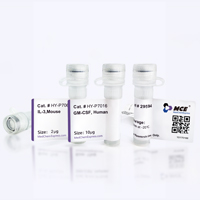
Product Image
Application
ELISA, FACS, Functional assay, Research in vivo


Chemical Information
-
SMILES
[Anti-Mouse VEGF Antibody (G6-31)]
-
Formulation
Please refer to the lot-specific COA for specific buffer information.
-
Storage
Please store the product under the recommended conditions in the Certificate of Analysis.


Purity & Documentation
References

Calculators
Concentration (start) × Volume (start) = Concentration (final) × Volume (final)


Anti-Mouse VEGF Antibody (G6-31) Related Classifications
HY-P992086 Related Classifications
 Powered by Bioz