



ALK-1 Antibody (YA2457)
(Synonyms: ACVRL1; ACVRLK1; ALK1; Serine/threonine-protein kinase receptor R3; SKR3; Activin receptor-like kinase 1; ALK-1; TGF-B superfamily receptor type I; TSR-I)
Based on 1 Customer Validation
ALK-1 Antibody (YA2457) is a Rabbit-derived and non-conjugated IgG monoclonal antibody, targeting to ALK-1.
-
Host:
Rabbit
-
Isotype:
IgG
-
Application:
WB
-
Reactivity :
Human, Mouse, Rat
-
Formulation:
Supplied in 10mM PBS, pH 7.4, 150mM sodium chloride, 0.05% BSA, 0.02% sodium azide and 50% glycerol.
-
Conjugation:
Non-conjugated


To place orders, for customer services and technical support, please contact: MedChemExpress USA
Tel: 609-228-6898 E-mail: [email protected] [email protected]





Applications
| Application |
WB

WB: Western Blot
|
|---|---|
| Dilution Ratio | 1:500-1:1000 |


Product Details
ALK-1 Antibody (YA2457) is a Rabbit-derived and non-conjugated IgG monoclonal antibody, targeting to ALK-1.
-
Host Rabbit

-
Clonality Recombinant,Monoclonal

-
Species ReactivityHuman, Mouse, Rat
-
Observed Molecular WeightObserved band size: 56 kDa
Note: Due to possible protein modifications or aggregation, the molecular weight should be confirmed by actual measurement, and the predicted value is for reference only.

-
Calculated Molecular Weight Predicted band size: 56 kDa

Entrez Gene: 94 Human ; 11482 Mouse ; 25237 Rat
SwissProt: P37023 Human ; Q61288 Mouse ; P80203 Rat
OMIM: 600376 Human
A synthesized peptide derived from human ACVRL1 aa440-503.
Endogenous
Affinity Chromatography
Non-conjugated
Unmodified
IgG


Product Properties
-
Appearance
Solution
-
Formulation
Supplied in 10mM PBS, pH 7.4, 150mM sodium chloride, 0.05% BSA, 0.02% sodium azide and 50% glycerol.
-
Concentration
Batch-dependent, Please check the COA for the concentration of each lot. Check Lot Concentration
-
Storage & Stability
Stored at -20°C for 1 year. Avoid repeated freeze / thaw cycles.
-
Shipping
Shipping with blue ice.


Verification Images
-
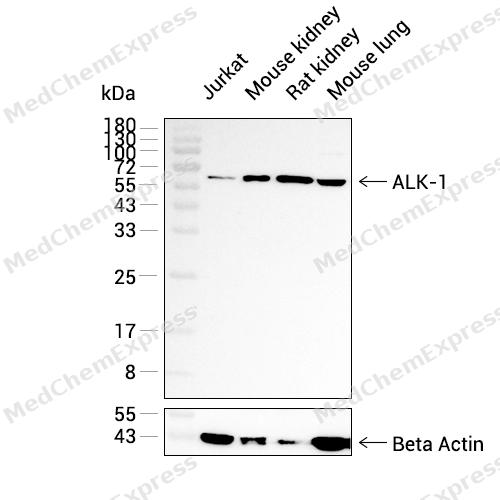 Western blot analysis was performed on extracts from Jurkat (lane 1, 20 μg), Mouse kidney(lane 2, 20 μg),Rat kidney(lane 3, 20 μg), and Mouse lung (lane 4, 20 μg) using ALK-1 Rabbit mAb.Proteins were transferred to a PVDF membrane and blocked with 5% non - fat milk in TBST at 4°C overnight.The primary antibody (1:1000 dilution) and the loading control antibody (beta-Actin, HY-P83730, 1:5000 dilution) were incubated in 5% non-fat milk in TBST for 1 hour at 37°C.Goat Anti - Mouse/Rabbit IgG - HRP Secondary Antibody (1:20000 dilution) was then applied for 40 minutes at 37°C.


Background
-
Function
ALK1 (activin receptor-like kinase 1), encoded by ACVRL1, is an endothelial-enriched transmembrane serine/threonine kinase receptor within the transforming growth factor-β (TGF-β) receptor superfamily that plays a central role in vascular development, endothelial homeostasis, and angiogenic regulation[1][2][3]. Mechanistically, ALK1 functions as a type I receptor that responds primarily to the circulating ligands BMP9 and BMP10, activating downstream SMAD1/5/8-dependent transcriptional programs that regulate endothelial behavior and vascular quiescence[4][5][6]. Continuous BMP10-mediated ALK1 signaling is required for vascular maintenance, and disruption of this pathway leads to arteriovenous malformations, highlighting its importance in endothelial integrity[4]. Consistent with this function, loss-of-function mutations in ACVRL1 are a major cause of hereditary hemorrhagic telangiectasia type 2 (HHT2), a vascular disorder characterized by abnormal artery-vein connections and pathological angiogenesis[1][4][7]. ALK1 mutations have also been associated with pulmonary arterial hypertension and altered endothelial transcriptional responses to BMP9 and BMP10 stimulation. Compared with related TGF-β family type I receptors, ALK1 exhibits marked endothelial-cell specificity, particularly in arterial endothelial cells, distinguishing its biological role from more broadly expressed receptor kinases[1][2]. For experimental applications, recombinant BMP9 and BMP10 are widely used to activate ALK1 signaling, whereas ALK1-targeting antagonists and ligand-trap strategies have been investigated to modulate angiogenesis and vascular remodeling in preclinical disease models, including cancer-associated angiogenesis[6][8][9].
-
Subcellular Localization
Cell membrane; Single-pass type I membrane protein
-
Subunit
Interacts with TSC22D1/TSC-22
-
SwissProt ID
-
Synonyms
ACVRL1; ACVRLK1; ALK1; Serine/threonine-protein kinase receptor R3; SKR3; Activin receptor-like kinase 1; ALK-1; TGF-B superfamily receptor type I; TSR-I
-
Research Field
Cardiovascular


Documentation
-
Data Sheet (261 KB)
-
SDS (252 KB)
- English - EN (252 KB)
- Français - FR (252 KB)
- Deutsch - DE (252 KB)
- Norwegian - NO (252 KB)
- Español - ES (252 KB)
- Swedish - SV (252 KB)
- Italian - IT (252 KB)
- Korean - KR (252 KB)
- Portuguese - PT (252 KB)
-
User Guide for Antibodies (1077 KB)
References
[1]. Roman BL, et al. ALK1 signaling in development and disease: new paradigms. Cell Mol Life Sci. 2017 Dec;74(24):4539-4560. [Content Brief]
[2]. ALK1 gene information from NCBI.
[3]. Cunha SI, et al. ALK1 as an emerging target for antiangiogenic therapy of cancer. Blood. 2011 Jun 30;117(26):6999-7006. [Content Brief]
[4]. Capasso TL, et al. BMP10-mediated ALK1 signaling is continuously required for vascular development and maintenance. Angiogenesis. 2020 May;23(2):203-220. [Content Brief]
[5]. Tillet E, et al. Emerging roles of BMP9 and BMP10 in hereditary hemorrhagic telangiectasia. Front Genet. 2015 Jan 8;5:456. [Content Brief]
[7]. National Library of Medicine.
[8]. Claesson-Welsh L. Alk1 (Activin Receptor-Like Kinase 1) and Vascular Hyperpermeability in Diabetic Retinopathy. Arterioscler Thromb Vasc Biol. 2018 Aug;38(8):1673-1675. [Content Brief]
[9]. Ayuso-Íñigo B,et al. The Dual Effect of the BMP9-ALK1 Pathway in Blood Vessels: An Opportunity for Cancer Therapy Improvement? Cancers (Basel). 2021 Oct 28;13(21):5412. [Content Brief]

 Powered by Bioz
