



BRCA1 Antibody
(Synonyms: BRCA1; RNF53; Breast cancer type 1 susceptibility protein; RING finger protein 53)
Based on 1 Customer Validation
BRCA1 Antibody is a Rabbit-derived and non-conjugated IgG polyclonal antibody, targeting to BRCA1.
-
Host:
Rabbit
-
Isotype:
IgG
-
Application:
WB, IHC-F, IHC-P, ICC/IF, ELISA
-
Reactivity :
Human, Rat
-
Formulation:
Supplied in 1*PBS (pH 7.3), 50% glycerol and 0.5% BSA. Preservative: 0.02% sodium azide.
-
Conjugation:
Non-conjugated


To place orders, for customer services and technical support, please contact: MedChemExpress USA
Tel: 609-228-6898 E-mail: [email protected] [email protected]





Applications
| Application |
WB

WB: Western Blot
|
IHC-P
IHC-P: Immunohistochemistry-Paraffin
|
IHC-F
IHC-F: Immunohistochemistry-Frozen
|
ICC/IF
ICC/IF: Immunocytochemistry/
Immunofluorescence |
ELISA
ELISA: Enzyme Linked Immunosorbent Assay
|
|---|---|---|---|---|---|
| Dilution Ratio | 1:500-1:1000 | 1:50-1:100 | 1:50-1:100 | 1:50-1:200 | 1:10000 |


Product Details
BRCA1 Antibody is a Rabbit-derived and non-conjugated IgG polyclonal antibody, targeting to BRCA1.
-
Host Rabbit

-
Clonality Polyclonal

-
Species ReactivityHuman, Rat
-
Observed Molecular WeightObserved band size: 208 kDa
Note: Due to possible protein modifications or aggregation, the molecular weight should be confirmed by actual measurement, and the predicted value is for reference only.

-
Calculated Molecular Weight Predicted band size: 208 kDa

Synthetic peptide corresponding to Human BRCA1.AA range:1391-1440.
Endogenous
affinity purified
Non-conjugated
Unmodified
IgG


Product Properties
-
Appearance
Solution
-
Formulation
Supplied in 1*PBS (pH 7.3), 50% glycerol and 0.5% BSA. Preservative: 0.02% sodium azide.
-
Concentration
Batch-dependent, Please check the COA for the concentration of each lot. Check Lot Concentration
-
Storage & Stability
Stored at -20°C for 1 year. Avoid repeated freeze / thaw cycles.
-
Shipping
Shipping with blue ice.


Verification Images
-
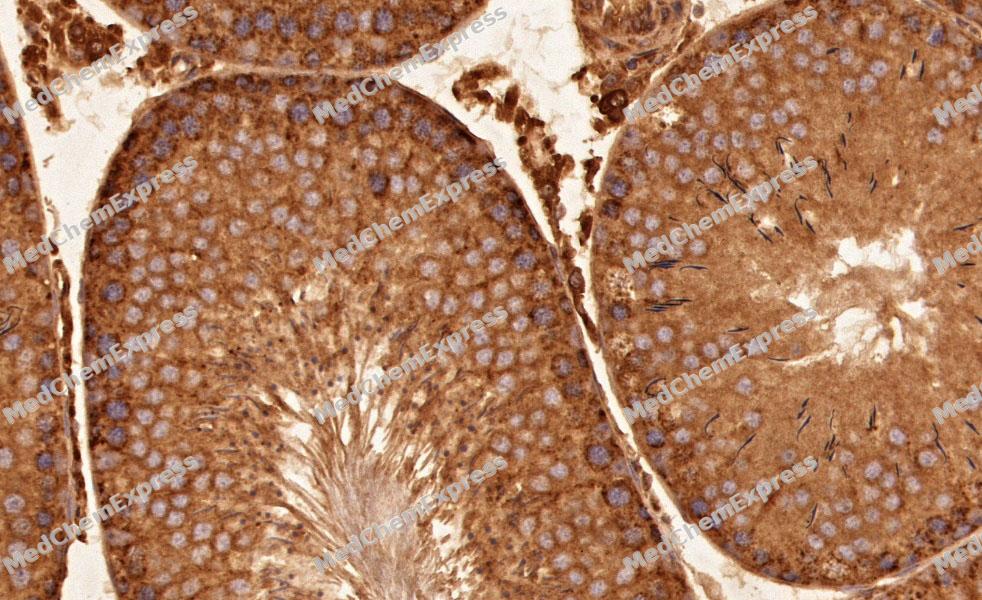 Immunohistochemical analysis of paraffin-embedded rat testis tissue using BRCA1 Antibody. The section was pre-treated using heat mediated antigen retrieval with sodium citrate buffer (pH 6.0) for 8 minutes. The tissues were blocked in QuickBlock for 20 minutes at room temperature, washed with ddH2O and PBS, and then probed with the primary antibody at 1/100 dilution in 4℃ overnight. The detection was performed using an HRP conjugated compact polymer system. DAB was used as the chromogen. Tissues were counterstained with hematoxylin and mounted with DPX.
 -
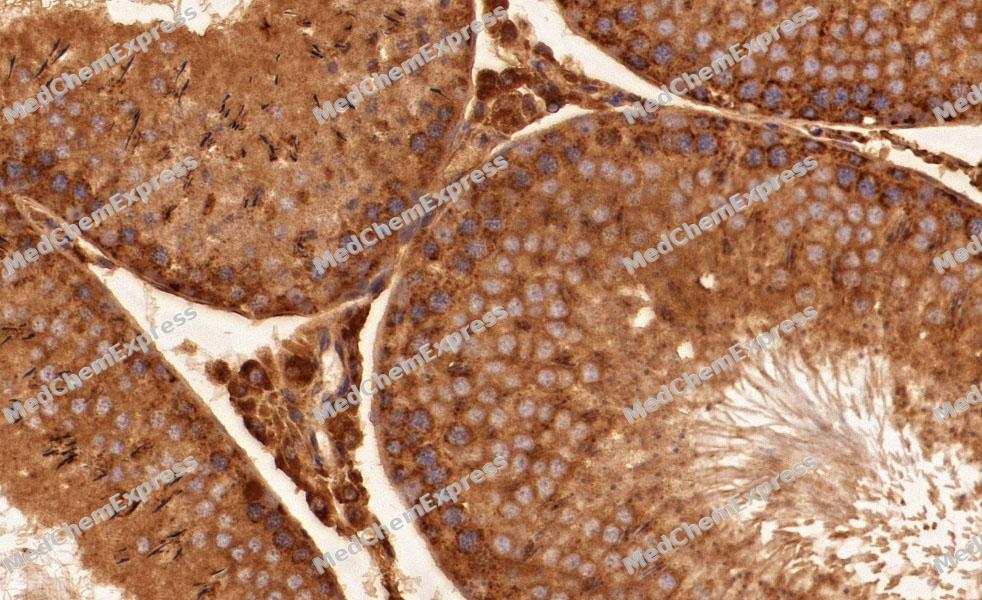 Immunohistochemical analysis of paraffin-embedded rat testis tissue using BRCA1 Antibody. The section was pre-treated using heat mediated antigen retrieval with sodium citrate buffer (pH 6.0) for 8 minutes. The tissues were blocked in QuickBlock for 20 minutes at room temperature, washed with ddH2O and PBS, and then probed with the primary antibody at 1/100 dilution in 4℃ overnight. The detection was performed using an HRP conjugated compact polymer system. DAB was used as the chromogen. Tissues were counterstained with hematoxylin and mounted with DPX.
 -
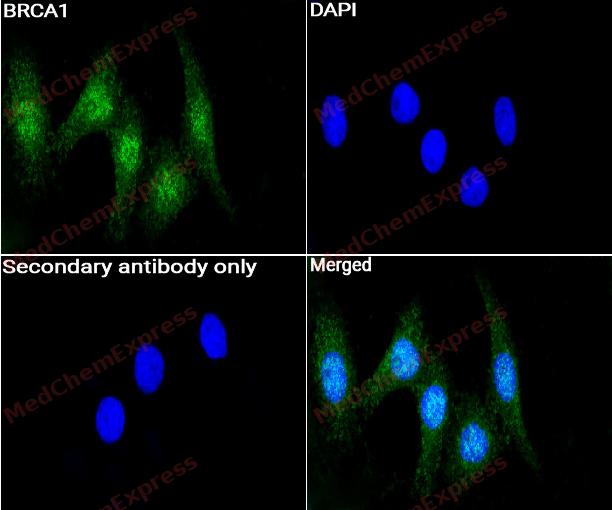 Immunocytochemistry analysis of HeLa cells labeling BRCA1 with BRCA1 Antibody (HY-P80573) at 1/50 dilution. Cells were fixed in 4% paraformaldehyde for 15 minutes at room temperature, permeabilized with 0.1% Triton X-100 for 10 minutes at room temperature, then blocked with BSA for Immunol Staining for 10 min at room temperature. Cells were then incubated with BRCA1 Antibody (HY-P80573) at 1/50 dilution in BSA for Immunol Staining at 4 ℃ overnight. AF488-conjugated AffiniPure Goat Anti-Rabbit IgG H&L(HY-P8002, Green) was used as the secondary antibody at 1/1,000 dilution. PBS instead of the primary antibody was used as the secondary antibody only control. The Nuclear counterstain was DAPI (Blue).
 -
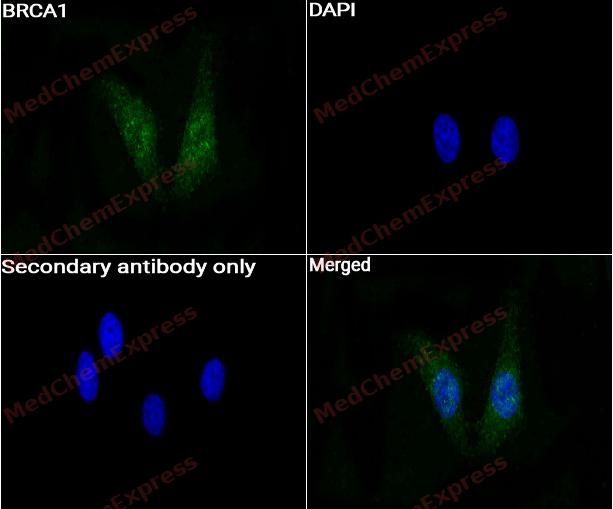 Immunocytochemistry analysis of HeLa cells labeling BRCA1 with BRCA1 Antibody (HY-P80573) at 1/100 dilution. Cells were fixed in 4% paraformaldehyde for 15 minutes at room temperature, permeabilized with 0.1% Triton X-100 for 10 minutes at room temperature, then blocked with BSA for Immunol Staining for 10 min at room temperature. Cells were then incubated with BRCA1 Antibody (HY-P80573) at 1/100 dilution in BSA for Immunol Staining at 4 ℃ overnight. AF488-conjugated AffiniPure Goat Anti-Rabbit IgG H&L(HY-P8002, Green) was used as the secondary antibody at 1/1,000 dilution. PBS instead of the primary antibody was used as the secondary antibody only control. The Nuclear counterstain was DAPI (Blue).


Background
-
Function
BRCA1 is an E3 ubiquitin-protein ligase that specifically mediates the formation of 'Lys-6'-linked polyubiquitin chains and plays a central role in DNA repair by facilitating cellular responses to DNA damage. It is unclear whether it also mediates the formation of other types of polyubiquitin chains. The BRCA1-BARD1 heterodimer coordinates a diverse range of cellular pathways such as DNA damage repair, ubiquitination and transcriptional regulation to maintain genomic stability. Regulates centrosomal microtubule nucleation. Required for appropriate cell cycle arrests after ionizing irradiation in both the S-phase and the G2 phase of the cell cycle. Required for FANCD2 targeting to sites of DNA damage. Inhibits lipid synthesis by binding to inactive phosphorylated ACACA and preventing its dephosphorylation. Contributes to homologous recombination repair (HRR) via its direct interaction with PALB2, fine-tunes recombinational repair partly through its modulatory role in the PALB2-dependent loading of BRCA2-RAD51 repair machinery at DNA breaks. Component of the BRCA1-RBBP8 complex which regulates CHEK1 activation and controls cell cycle G2/M checkpoints on DNA damage via BRCA1-mediated ubiquitination of RBBP8. Acts as a transcriptional activator[1][2][3][4][5][6][7][8][9][10][11][12][13][14][15].
-
Subcellular Localization
Nucleus; Chromosome; Cytoplasm; Cytoplasm; Cytoplasm
-
Expression
Tissue_specificity:Isomer 1 and isomer 3 are widely expressed. Isomer 3 is expressed at reduced or absent levels in several breast cancer and ovarian cancer cell lines. -
Isoforms & Post-Translational Modification
P38398 has 8 isomers: P38398-1: 207721 Da (predicted); P38398-2: 7177 Da (predicted); P38398-3: 85001 Da (predicted); P38398-4: 205838 Da (predicted); P38398-5: 80590 Da (predicted); P38398-6: 78165 Da (predicted); P38398-7: 210266 Da (predicted); P38398-8: 202342 Da (predicted).
Phosphorylated in response to IR, UV, and various stimuli that cause checkpoint activation, probably by ATM or ATR (PubMed:11114888, PubMed:12183412, PubMed:21144835). Phosphorylation at Ser-988 by CHEK2 regulates mitotic spindle assembly (PubMed:10724175, PubMed:20364141). Phosphorylation by AURKA regulates centrosomal microtubule nucleation (PubMed:18056443);Autoubiquitinated, undergoes 'Lys-6'-linked polyubiquitination. 'Lys-6'-linked polyubiquitination does not promote degradation -
Subunit
Heterodimer with BARD1 (PubMed:11573085, PubMed:12890688, PubMed:14976165). Part of the BRCA1-associated genome surveillance complex (BASC), which contains BRCA1, MSH2, MSH6, MLH1, ATM, BLM, PMS2 and the MRE11-RAD50-NBN protein (MRN) complex (PubMed:10783165). This association could be a dynamic process changing throughout the cell cycle and within subnuclear domains (PubMed:10783165). Component of the BRCA1-A complex, at least composed of BRCA1, BARD1, UIMC1/RAP80, ABRAXAS1, BRCC3/BRCC36, BABAM2 and BABAM1/NBA1 (PubMed:19261746, PubMed:19261748, PubMed:19261749, PubMed:20351172). Interacts (via the BRCT domains) with ABRAXAS1 (phosphorylated form); this is important for recruitment to sites of DNA damage (PubMed:17525340, PubMed:17643121, PubMed:17643122, PubMed:23269703, PubMed:24316840, PubMed:26778126). Can form a heterotetramer with two molecules of ABRAXAS1 (phosphorylated form) (PubMed:26778126). Component of the BRCA1-RBBP8 complex (PubMed:16101277). Interacts (via the BRCT domains) with RBBP8 ('Ser-327' phosphorylated form); the interaction ubiquitinates RBBP8, regulates CHEK1 activation, and involves RBBP8 in BRCA1-dependent G2/M checkpoint control on DNA damage (PubMed:16818604, PubMed:9811458). Associates with RNA polymerase II holoenzyme (PubMed:9662397). Interacts with SMC1A, NELFB, DCLRE1C, CLSPN (PubMed:11739404, PubMed:11877377, PubMed:15096610, PubMed:15456891). Interacts with CHEK1, CHEK2, BAP1, BRCC3, UBXN1 and PCLAF (PubMed:10724175, PubMed:11836499, PubMed:14636569, PubMed:20351172, PubMed:21673012). Interacts (via BRCT domains) with BRIP1 (phosphorylated form) (PubMed:11301010, PubMed:15133502, PubMed:21473589). Interacts with FANCD2 (ubiquitinated form) (PubMed:11239454). Interacts with H2AX (phosphorylated on 'Ser-140') (PubMed:12419185). Interacts (via the BRCT domains) with ACACA (phosphorylated form); the interaction prevents dephosphorylation of ACACA (PubMed:12360400, PubMed:16326698, PubMed:16698035, PubMed:18452305). Part of a BRCA complex containing BRCA1, BRCA2 and PALB2 (PubMed:19369211). Interacts directly with PALB2; the interaction is essential for its function in HRR (PubMed:19369211, PubMed:28319063). Interacts directly with BRCA2; the interaction occurs only in the presence of PALB2 which serves as the bridging protein (PubMed:19369211). Interacts (via the BRCT domains) with LMO4; the interaction represses the transcriptional activity of BRCA1 (PubMed:11751867). Interacts (via the BRCT domains) with CCAR2 (via N-terminus); the interaction represses the transcriptional activator activity of BRCA1 (PubMed:20160719). Interacts with EXD2 (PubMed:26807646). Interacts (via C-terminus) with DHX9; this interaction is direct and links BRCA1 to the RNA polymerase II holoenzyme (PubMed:9662397). Interacts with DNA helicase ZGRF1; the interaction is increased following DNA damage induction (PubMed:34552057)
-
SwissProt ID
-
Synonyms
BRCA1; RNF53; Breast cancer type 1 susceptibility protein; RING finger protein 53
-
Research Field
Epigenetics and Nuclear Signaling


Documentation
-
Data Sheet (264 KB)
-
SDS (251 KB)
- English - EN (251 KB)
- Français - FR (251 KB)
- Deutsch - DE (251 KB)
- Norwegian - NO (251 KB)
- Español - ES (251 KB)
- Swedish - SV (251 KB)
- Italian - IT (251 KB)
- Korean - KR (251 KB)
- Portuguese - PT (251 KB)
-
User Guide for Antibodies (1077 KB)
References
[1]. Lorick KL, et al. RING fingers mediate ubiquitin-conjugating enzyme (E2)-dependent ubiquitination. Proc Natl Acad Sci U S A. 1999 Sep 28;96(20):11364-9. [Content Brief]
[2]. Vandenberg CJ, et al. BRCA1-independent ubiquitination of FANCD2. Mol Cell. 2003 Jul;12(1):247-54. [Content Brief]
[3]. Wu-Baer F, et al. The BRCA1/BARD1 heterodimer assembles polyubiquitin chains through an unconventional linkage involving lysine residue K6 of ubiquitin. J Biol Chem. 2003 Sep 12;278(37):34743-6. [Content Brief]
[4]. Morris JR, et al. BRCA1 : BARD1 induces the formation of conjugated ubiquitin structures, dependent on K6 of ubiquitin, in cells during DNA replication and repair. Hum Mol Genet. 2004 Apr 15;13(8):807-17. [Content Brief]
[5]. Yu X, et al. BRCA1 ubiquitinates its phosphorylation-dependent binding partner CtIP. Genes Dev. 2006 Jul 1;20(13):1721-6. [Content Brief]
[6]. Wang B, et al. Abraxas and RAP80 form a BRCA1 protein complex required for the DNA damage response. Science. 2007 May 25;316(5828):1194-8. [Content Brief]
[7]. Feng L, et al. MERIT40 facilitates BRCA1 localization and DNA damage repair. Genes Dev. 2009 Mar 15;23(6):719-28. [Content Brief]
[8]. Wu-Baer F, et al. The UBXN1 protein associates with autoubiquitinated forms of the BRCA1 tumor suppressor and inhibits its enzymatic function. Mol Cell Biol. 2010 Jun;30(11):2787-98. [Content Brief]
[9]. Sankaran S, et al. Aurora-A kinase regulates breast cancer associated gene 1 inhibition of centrosome-dependent microtubule nucleation. Cancer Res. 2007 Dec 1;67(23):11186-94. [Content Brief]
[10]. Lee JS, et al. hCds1-mediated phosphorylation of BRCA1 regulates the DNA damage response. Nature. 2000 Mar 9;404(6774):201-4. [Content Brief]
[11]. Yarden RI, et al. BRCA1 regulates the G2/M checkpoint by activating Chk1 kinase upon DNA damage. Nat Genet. 2002 Mar;30(3):285-9. [Content Brief]
[12]. Xu B, et al. Phosphorylation of serine 1387 in Brca1 is specifically required for the Atm-mediated S-phase checkpoint after ionizing irradiation. Cancer Res. 2002 Aug 15;62(16):4588-91. [Content Brief]
[13]. Moreau K, et al. BRCA1 affects lipid synthesis through its interaction with acetyl-CoA carboxylase. J Biol Chem. 2006 Feb 10;281(6):3172-81. [Content Brief]
[14]. Sy SM, et al. PALB2 is an integral component of the BRCA complex required for homologous recombination repair. Proc Natl Acad Sci U S A. 2009 Apr 28;106(17):7155-60. [Content Brief]
[15]. Hiraike H, et al. Identification of DBC1 as a transcriptional repressor for BRCA1. Br J Cancer. 2010 Mar 16;102(6):1061-7. [Content Brief]

 Powered by Bioz
