



BRD4 Antibody (YA3486)
(Synonyms: Brd4; CAP; HUNK1; MCAP; Bromodomain containing 4; chromosome associated protein)Based on 2 publication(s) in Google Scholar
BRD4 Antibody (YA3486) is a Rabbit-derived and non-conjugated IgG monoclonal antibody, targeting to BRD4.
-
Host:
Rabbit
-
Isotype:
IgG
-
Application:
WB, IHC-P, ICC/IF, IP
-
Reactivity :
Human, Mouse, Rat
-
Formulation:
Supplied in 50mM Tris-Glycine(pH 7.4), 0.15M NaCl, 40%Glycerol, 0.01% sodium azide and 0.05% BSA.
-
Conjugation:
Non-conjugated


To place orders, for customer services and technical support, please contact: MedChemExpress USA
Tel: 609-228-6898 E-mail: [email protected] [email protected]



Publications Citing Use of MedChemExpress (MCE) BRD4 Antibody (YA3486)
More

Applications
| Application |
WB

WB: Western Blot
|
IHC-P
IHC-P: Immunohistochemistry-Paraffin
|
ICC/IF
ICC/IF: Immunocytochemistry/
Immunofluorescence |
IP
IP: Immunoprecipitation
|
|---|---|---|---|---|
| Dilution Ratio | 1:500-1:1000 | 1:50-1:100 | 1:50-1:200 | 1:50 |


Product Details
BRD4 Antibody (YA3486) is a Rabbit-derived and non-conjugated IgG monoclonal antibody, targeting to BRD4.
-
Host Rabbit

-
Clonality Recombinant,Monoclonal

-
Species ReactivityHuman, Mouse, Rat
-
Observed Molecular WeightObserved band size: 152 kDa
Note: Due to possible protein modifications or aggregation, the molecular weight should be confirmed by actual measurement, and the predicted value is for reference only.

-
Calculated Molecular Weight Predicted band size: 152 kDa

Entrez Gene: 23476 Human ; 57261 Mouse ; 362844 Rat
SwissProt: O60885 Human ; Q9ESU6 Mouse ;
OMIM: 620568 Human
A synthesized peptide derived from human Brd4
Endogenous
Protein A affinity purified.
Non-conjugated
Unmodified
IgG


Product Properties
-
Appearance
Solution
-
Formulation
Supplied in 50mM Tris-Glycine(pH 7.4), 0.15M NaCl, 40%Glycerol, 0.01% sodium azide and 0.05% BSA.
-
Concentration
Batch-dependent, Please check the COA for the concentration of each lot. Check Lot Concentration
-
Storage & Stability
Stored at -20°C for 1 year. Avoid repeated freeze / thaw cycles.
-
Shipping
Shipping with blue ice.


Publications (2)
-
Journal Impact Factor
-
Most Recent
-
Proc Natl Acad Sci U S A
YTHDC1 recognizes METTL16-dependent m6A on caRNAs and coordinates cotranscriptional splicing. [Abstract]2026 Apr 21;123(16):e2524579123. PMID: 41980091


Verification Images
-
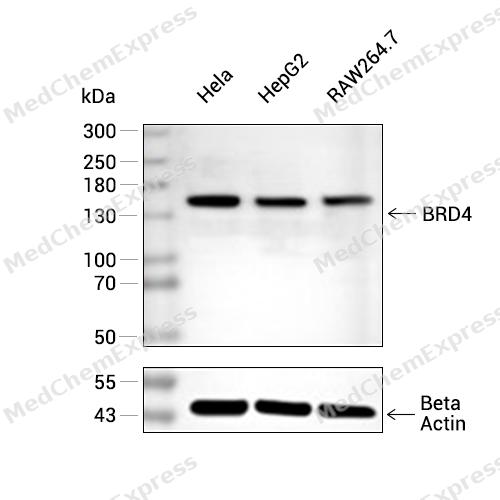 Western blot analysis of extracts from Hela (lane 2(20μg), HepG2 (lane 3(20μg) and RAW264.7(lane 2(20μg) using BRD4 (HY-P80976) Rabbit mAb. Proteins were transferred to a PVDF membrane and blocked with 5% non-fat milk in TBST for 2 hour at room temperature. The primary antibody (1/1000) and Loading control antibody (Beta Actin, HY-P80438, 1/10000) was used in 5% non-fat milk in TBST at 4°C overnight. Goat Anti-Mouse/Rabbit IgG-HRP Secondary Antibody (1/10000) was used for 1 hour at room temperature.
 -
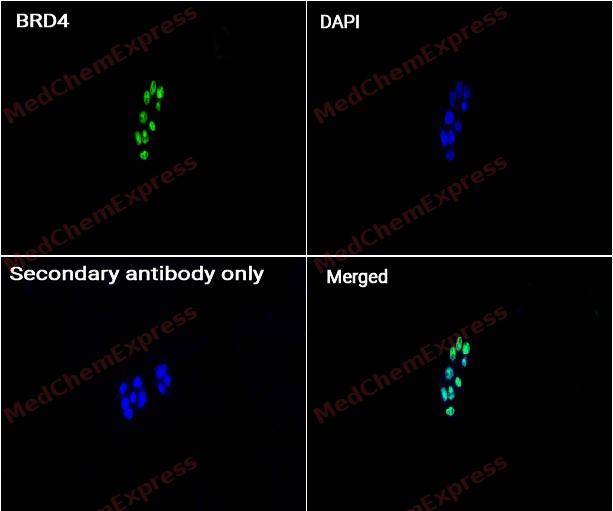 Immunocytochemistry analysis of HepG2 cells labeling BRD4 with BRD4 antibody (HY-P80976) at 1/50 dilution. Cells were fixed in 4% paraformaldehyde for 15 minutes at room temperature, permeabilized with 0.1% Triton X-100 for 10 minutes at room temperature, then blocked with QuickBlock™ Blocking Buffer for Immunol Staining for 10 min at room temperature. Cells were then incubated with BRD4 antibody (HY-P80976) at 1/50 dilution in QuickBlock™ Blocking Buffer for Immunol Staining at 4 ℃. Alexa Fluor® 488-conjugated AffiniPure Goat Anti-Rabbit IgG H&L(HY-P8002, Green) was used as the secondary antibody at 1/1,000 dilution. PBS instead of the primary antibody was used as the secondary antibody only control. The Nuclear counterstain was DAPI (Blue).
 -
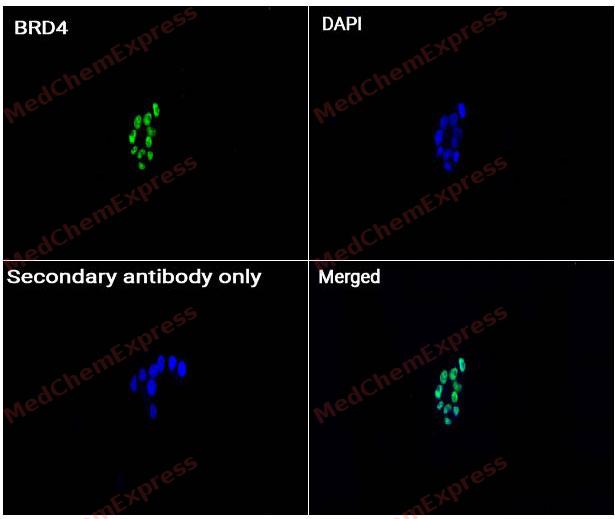 Immunocytochemistry analysis of HepG2 cells labeling BRD4 with BRD4 antibody (HY-P80976) at 1/200 dilution. Cells were fixed in 4% paraformaldehyde for 15 minutes at room temperature, permeabilized with 0.1% Triton X-100 for 10 minutes at room temperature, then blocked with QuickBlock™ Blocking Buffer for Immunol Staining for 10 min at room temperature. Cells were then incubated with BRD4 antibody (HY-P80976) at 1/200 dilution in QuickBlock™ Blocking Buffer for Immunol Staining at 4 ℃. Alexa Fluor® 488-conjugated AffiniPure Goat Anti-Rabbit IgG H&L(HY-P8002, Green) was used as the secondary antibody at 1/1,000 dilution. PBS instead of the primary antibody was used as the secondary antibody only control. The Nuclear counterstain was DAPI (Blue).
 -
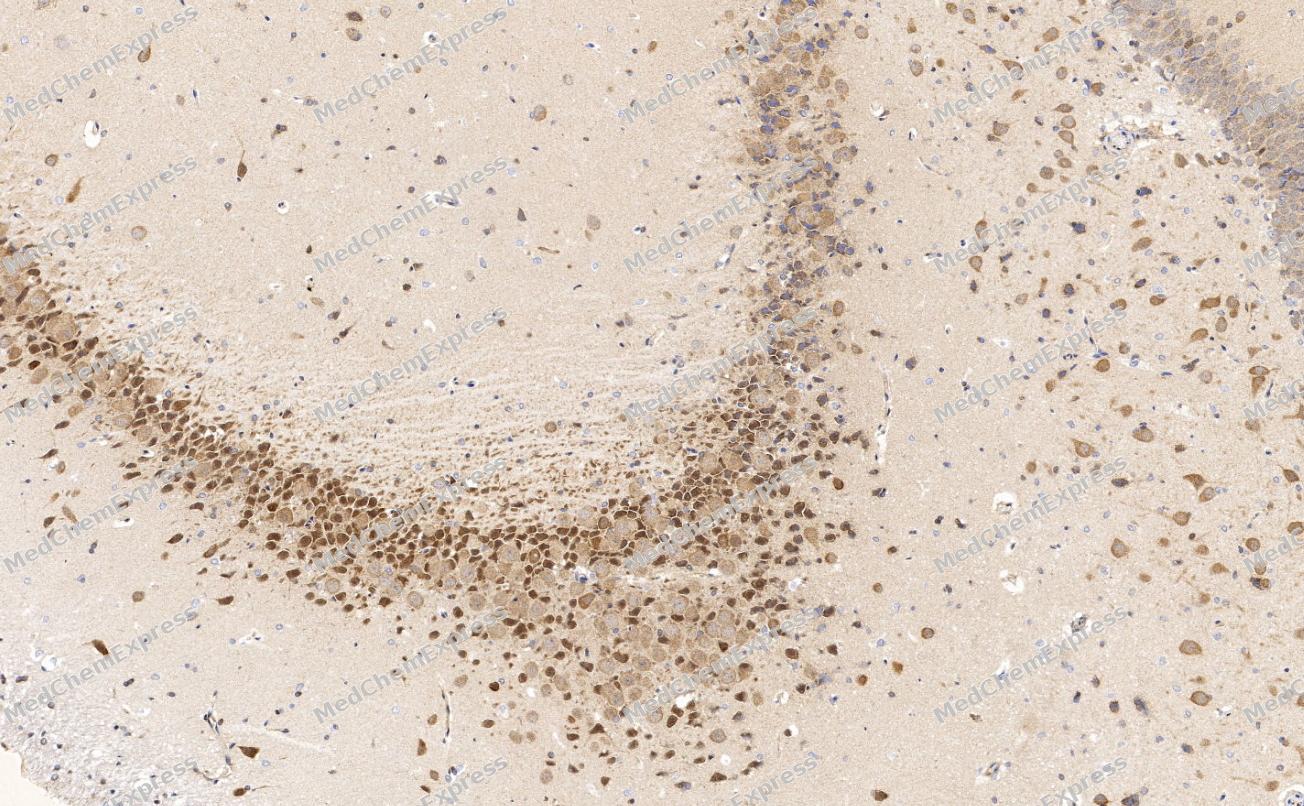 Immunohistochemical analysis of paraffin-embedded Rat brain tissue using BRD4 Antibody. The section was pre-treated using heat mediated antigen retrieval with sodium citrate buffer (pH 6.0) for 8 minutes. The tissues were blocked in QuickBlock for 20 minutes at room temperature, washed with ddH2O and PBS, and then probed with the primary antibody (HY-P80976, 1/100) in 4℃ overnight. The detection was performed using an HRP conjugated compact polymer system. DAB was used as the chromogen. Tissues were counterstained with hematoxylin and mounted with DPX.
 -
Immunohistochemical analysis of paraffin-embedded Rat brain tissue using BRD4 Antibody. The section was pre-treated using heat mediated antigen retrieval with sodium citrate buffer (pH 6.0) for 8 minutes. The tissues were blocked in QuickBlock for 20 minutes at room temperature, washed with ddH2O and PBS, and then probed with the primary antibody (HY-P80976, 1/100) in 4℃ overnight. The detection was performed using an HRP conjugated compact polymer system. DAB was used as the chromogen. Tissues were counterstained with hematoxylin and mounted with DPX.


Background
-
Function
BRD4 (Bromodomain Containing Protein 4) is a member of the BET (bromodomain and extra-terminal) protein family that recognizes acetylated histones and functions as a central regulator of chromatin-associated transcriptional programs[1][2]. Mechanistically, BRD4 promotes RNA polymerase II transcriptional elongation through functional interaction with positive transcription elongation factor b (P-TEFb), thereby facilitating productive gene expression and transcriptional pause release[3][4][5]. Beyond transcriptional control, BRD4 contributes to chromatin organization, DNA replication, and DNA damage response pathways, linking epigenetic regulation to genome stability[1][6]. BRD4 also supports efficient transcription elongation that limits R-loop accumulation and transcription-replication conflicts, processes that are important for maintaining cellular viability[6]. In disease contexts, aberrant BRD4 activity has been associated with cancer, inflammatory disorders, viral infection, and neurological disease, reflecting its broad influence on gene regulatory networks[1][2]. In multiple tumor models, BRD4 regulates transcriptional programs linked to oncogenic drivers and tumor cell survival, supporting its relevance as a therapeutic target[7][8]. Compared with related BET family members BRD2, BRD3, and the testis-restricted BRDT, BRD4 possesses a characteristic C-terminal domain that mediates interaction with P-TEFb and plays a distinct role in transcriptional elongation control[3][9]. For experimental applications, small-molecule BET inhibitors such as JQ1 and I-BET disrupt bromodomain-dependent chromatin interactions and have become widely used tools for investigating BRD4-dependent transcriptional mechanisms and target validation in disease models[1][7][8].
-
Subcellular Localization
Nucleus; Chromosome; Chromosome
-
Expression
Tissue_specificity:Ubiquitously expressed -
Isoforms & Post-Translational Modification
O60885 has 3 isomers: O60885-1: 152219 Da (predicted); O60885-2: 80463 Da (predicted); O60885-3: 88289 Da (predicted).
Phosphorylation by CK2 disrupt the intramolecular binding between the bromo domain 2 and the NPS region and promotes binding between the NPS and the BID regions, leading to activate the protein and promote binding to acetylated histones. In absence of phosphorylation, BRD4 does not localize to p53/TP53 target gene promoters, phosphorylation promoting recruitment to p53/TP53 target promoters -
Subunit
Interacts with p53/TP53; the interaction is direct (PubMed:23317504). Interacts (via CTD region) with CDK9 and CCNT1, acting as an associated component of P-TEFb complex (PubMed:16109376, PubMed:16109377, PubMed:23317504, PubMed:24360279).
-
SwissProt ID
-
Synonyms
Brd4; CAP; HUNK1; MCAP; Bromodomain containing 4; chromosome associated protein
-
Research Field
Epigenetics and Nuclear Signaling
Documentation
-
Data Sheet (263 KB)
-
SDS (251 KB)
- English - EN (251 KB)
- Français - FR (251 KB)
- Deutsch - DE (251 KB)
- Norwegian - NO (251 KB)
- Español - ES (251 KB)
- Swedish - SV (251 KB)
- Italian - IT (251 KB)
- Korean - KR (251 KB)
- Portuguese - PT (251 KB)
-
User Guide for Antibodies (1077 KB)
References
[1]. Cheung KL, et al. The Functions of BET Proteins in Gene Transcription of Biology and Diseases. Front Mol Biosci. 2021 Sep 3;8:728777. [Content Brief]
[2]. Liang Y, et al. BRD4 in physiology and pathology: ''BET'' on its partners. Bioessays. 2021 Dec;43(12):e2100180. [Content Brief]
[3]. Zheng B, et al. Distinct layers of BRD4-PTEFb reveal bromodomain-independent function in transcriptional regulation. Mol Cell. 2023 Aug 17;83(16):2896-2910.e4. [Content Brief]
[4]. Altendorfer E, et al. BRD4: a general regulator of transcription elongation. Transcription. 2022 Feb-Jun;13(1-3):70-81. [Content Brief]
[5]. Kanno T, et al. BRD4 assists elongation of both coding and enhancer RNAs by interacting with acetylated histones. Nat Struct Mol Biol. 2014 Dec;21(12):1047-57. [Content Brief]
[6]. Edwards DS, et al. BRD4 Prevents R-Loop Formation and Transcription-Replication Conflicts by Ensuring Efficient Transcription Elongation. Cell Rep. 2020 Sep 22;32(12):108166. [Content Brief]
[7]. Jung M, et al. Targeting BET bromodomains for cancer treatment. Epigenomics. 2015;7(3):487-501. [Content Brief]
[8]. Lucas X, et al. 4-Acyl pyrroles: mimicking acetylated lysines in histone code reading. Angew Chem Int Ed Engl. 2013 Dec 23;52(52):14055-9. [Content Brief]
[9]. Kargbo RB. PROTAC Degradation of Bromodomain for the Treatment of Hyperplasia and Cancer. ACS Med Chem Lett. 2019 Sep 30;10(10):1372-1373. doi: 10.1021/acsmedchemlett.9b00424. PMID: 31620218; PMCID: PMC6792170. et al. PROTAC Degradation of Bromodomain for the Treatment of Hyperplasia and Cancer. ACS Med Chem Lett. 2019 Sep 30;10(10):1372-1373. [Content Brief]

 Powered by Bioz
