



CD163 Antibody
(Synonyms: Scavenger receptor cysteine-rich type 1 protein M130; CD 163; CD163 antigen; CD163 molecule; Hemoglobin Scavenger Receptor; M130; M130 antigen precursor; Macrophage associated antigen; MM130; C163A_HUMAN.)Based on 2 publication(s) in Google Scholar
CD163 Antibody is a Rabbit-derived and non-conjugated IgG polyclonal antibody, targeting to CD163.
-
Host:
Rabbit
-
Isotype:
IgG
-
Application:
WB, IHC-P, IHC-F, ICC/IF
-
Reactivity :
Human, Mouse
-
Formulation:
Supplied in 0.01M TBS(pH7.4) with 1% BSA, 0.02% or 0.03% Proclin300 and 50% Glycerol.
-
Conjugation:
Non-conjugated


To place orders, for customer services and technical support, please contact: MedChemExpress USA
Tel: 609-228-6898 E-mail: [email protected] [email protected]



Publications Citing Use of MedChemExpress (MCE) CD163 Antibody
More

Applications
| Application |
WB

WB: Western Blot
|
IHC-P
IHC-P: Immunohistochemistry-Paraffin
|
IHC-F
IHC-F: Immunohistochemistry-Frozen
|
ICC/IF
ICC/IF: Immunocytochemistry/
Immunofluorescence |
|---|---|---|---|---|
| Dilution Ratio | 1:500-2000 | 1:100-500 | 1:100-500 | 1:100-500 |


Product Details
CD163 Antibody is a Rabbit-derived and non-conjugated IgG polyclonal antibody, targeting to CD163.
-
Host Rabbit

-
Clonality Polyclonal

-
Species ReactivityHuman, Mouse Predicted Reactivity: Rat,Dog,Pig,Horse
Note: The predicted reactivity is for reference only and should not be considered a guarantee of product performance.
-
Observed Molecular WeightObserved band size: 150 kDa
Note: Due to possible protein modifications or aggregation, the molecular weight should be confirmed by actual measurement, and the predicted value is for reference only.

-
Calculated Molecular Weight Predicted band size: 125 kDa

KLH conjugated synthetic peptide derived from human CD163: 1001-1121/1156
Endogenous
affinity purified
Non-conjugated
Unmodified
IgG


Product Properties
-
Appearance
Solution
-
Formulation
Supplied in 0.01M TBS(pH7.4) with 1% BSA, 0.02% or 0.03% Proclin300 and 50% Glycerol.
-
Concentration
Batch-dependent, Please check the COA for the concentration of each lot. Check Lot Concentration
-
Storage & Stability
Stored at -20°C for 1 year. Avoid repeated freeze / thaw cycles.
-
Shipping
Shipping with blue ice.


Publications (2)
-
Journal Impact Factor
-
Most Recent
-
Int Immunopharmacol
Deficiency of the innate immune protein IFITM3 impairs phagocytosis and promotes autism-like behaviors in mice. [Abstract]2025 Dec 10:167:115599. PMID: 41101227


Verification Images
-
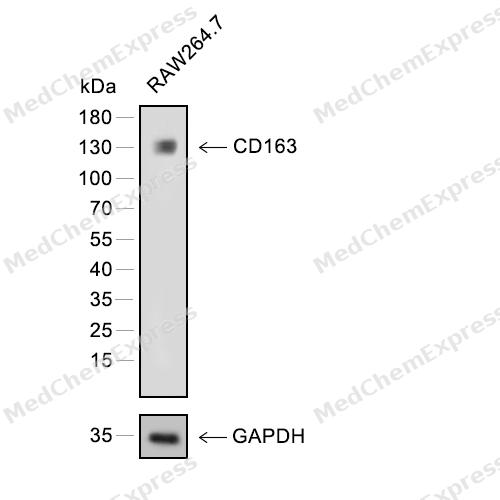 Western blot analysis of extracts from RAW264.7 using CD163 antibody. Proteins were transferred to a PVDF membrane and blocked with 5% nonfat powdered milk in PBST for 2 hour at room temperature. The primary antibody (1/1000) and Loading control antibody (GAPDH, 1/3000) was diluted with 5% nonfat powdered milk in PBST at 4°C overnight. Goat Anti-Rabbit IgG-HRP Secondary Antibody (1/8,000) was incubated for 45min at room temperature.


Background
-
Function
CD163 is a hemoglobin scavenger receptor primarily expressed on the surface of monocytes and macrophages; it functions by mediating the clearance of Hb-Hp complexes and inducing anti-inflammatory pathways. In immunological research, CD163 serves as a key marker for M2-like macrophages, tumor-associated macrophages (TAMs), and tissue-repair macrophages.
-
Subcellular Localization
Secreted; Cell membrane; Single-pass type I membrane protein
-
Expression
Tissue_specificity:This protein is expressed in monocytes and mature macrophages, such as Kupffer cells in the liver, red pulp macrophages in the spleen, cortical macrophages in the thymus, resident macrophages in the bone marrow, and meningeal macrophages in the central nervous system. It is also expressed in the blood. Isotype 1 is present in the lowest concentration in the blood. Isotype 2 is present in the lowest concentrations in the liver and spleen. Isotype 3 is the predominant isotype detected in the blood.
Induction:Induced by anti-inflammatory mediators such as glucocorticoids, interleukin-6/IL6 and interleukin-10/IL10; suppressed by pro-inflammatory mediators like bacterial lipopolysaccharides (LPS) , IFNG/IFN-gamma and TNF -
Isoforms & Post-Translational Modification
CD163 has 4 isomers: Q86VB7-1: 125451 Da (predicted); Q86VB7-2: 125982 Da (predicted); Q86VB7-3: 121609 Da (predicted); Q86VB7-4: 124958 Da (predicted).
A soluble form (sCD163) is produced by proteolytic shedding which can be induced by lipopolysaccharide, phorbol ester and Fc region of immunoglobulin gamma. This cleavage is dependent on protein kinase C and tyrosine kinases and can be blocked by protease inhibitors. The shedding is inhibited by the tissue inhibitor of metalloproteinase TIMP3, and thus probably induced by membrane-bound metalloproteinases ADAMs;Phosphorylated -
Subunit
Interacts with CSNK2B
-
SwissProt ID
-
Synonyms
Scavenger receptor cysteine-rich type 1 protein M130; CD 163; CD163 antigen; CD163 molecule; Hemoglobin Scavenger Receptor; M130; M130 antigen precursor; Macrophage associated antigen; MM130; C163A_HUMAN.
Documentation
-
Data Sheet (234 KB)
-
SDS (252 KB)
- English - EN (252 KB)
- Français - FR (252 KB)
- Deutsch - DE (252 KB)
- Norwegian - NO (252 KB)
- Español - ES (252 KB)
- Swedish - SV (252 KB)
- Italian - IT (252 KB)
- Korean - KR (252 KB)
- Portuguese - PT (252 KB)
-
User Guide for Antibodies (1077 KB)

 Powered by Bioz
