



CD86 Antibody
(Synonyms: CD86; CD28LG2; T-lymphocyte activation antigen CD86; Activation B7-2 antigen; B70; BU63; CTLA-4 counter-receptor B7.2; FUN-1; CD antigen CD86)Based on 4 publication(s) in Google Scholar
CD86 Antibody is a Rabbit-derived and non-conjugated IgG polyclonal antibody, targeting to CD86.
-
Host:
Rabbit
-
Isotype:
IgG
-
Application:
WB, IHC-P, ICC/IF, IP, FC
-
Reactivity :
Human, Rat
-
Formulation:
Supplied in 50mM Tris-Glycine(pH 7.4), 0.15M NaCl, 40%Glycerol, 0.01% sodium azide and 0.05% BSA.
-
Conjugation:
Non-conjugated


To place orders, for customer services and technical support, please contact: MedChemExpress USA
Tel: 609-228-6898 E-mail: [email protected] [email protected]



-

HY-P80725
iNOS Antibody -
HY-18739
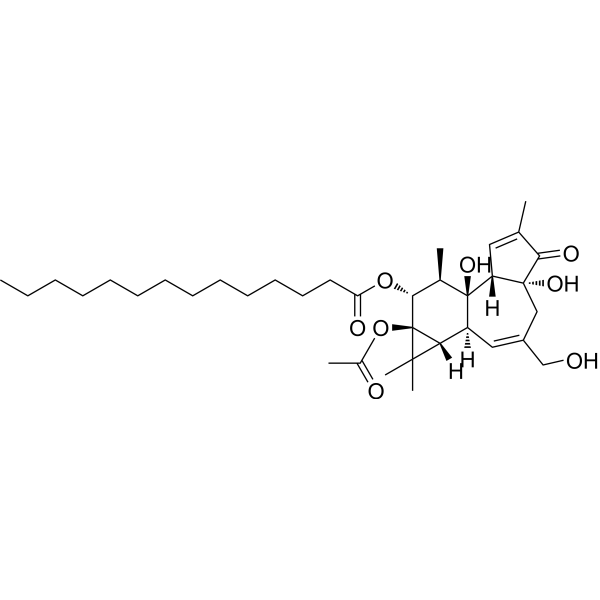
Phorbol 12-myristate 13-acetatePKC Activator -
HY-P80605
CD68 Antibody (YA799) -
HY-P86350
Macrophage mannose receptor 1 Antibody (YA6042) -
HY-P8002
AF488-conjugated Goat Anti-Rabbit IgG H&L -
HY-P81177
CD163 Antibody -
HY-P80950
FITC-conjugated Goat Anti-Mouse IgG H&L -
HY-P80019
Arginase-1 Antibody (YA613) -
HY-P81214
Macrophage mannose receptor 1 Antibody (YA3531)
Publications Citing Use of MedChemExpress (MCE) CD86 Antibody
More
 4 Publications Citing Use of MCE CD86 Antibody (1)
-
IHC


Applications
| Application |
WB

WB: Western Blot
|
IHC-P
IHC-P: Immunohistochemistry-Paraffin
|
ICC/IF
ICC/IF: Immunocytochemistry/
Immunofluorescence |
IP
IP: Immunoprecipitation
|
FC
FC: Flow Cytometry
|
|---|---|---|---|---|---|
| Dilution Ratio | 1:500-1:1000 | 1:50-1:100 | 1:50-1:200 | 1:20 | 1:50-1:100 |


Product Details
CD86 Antibody is a Rabbit-derived and non-conjugated IgG polyclonal antibody, targeting to CD86.
-
Host Rabbit

-
Clonality Polyclonal

-
Species ReactivityHuman, Rat
-
Observed Molecular WeightObserved band size: 70 kDa
Note: Due to possible protein modifications or aggregation, the molecular weight should be confirmed by actual measurement, and the predicted value is for reference only.

-
Calculated Molecular Weight Predicted band size: 38 kDa

Synthetic peptide corresponding to Human CD86 aa25-40。
Endogenous
affinity purified
Non-conjugated
Unmodified
IgG


Product Properties
-
Appearance
Liquid
-
Formulation
Supplied in 50mM Tris-Glycine(pH 7.4), 0.15M NaCl, 40%Glycerol, 0.01% sodium azide and 0.05% BSA.
-
Concentration
Batch-dependent, Please check the COA for the concentration of each lot. Check Lot Concentration
-
Storage & Stability
Stored at -20°C for 1 year. Avoid repeated freeze / thaw cycles.
-
Shipping
Shipping with blue ice.


Publications (4)
-
Journal Impact Factor
-
Most Recent
-
Br J Pharmacol
Antidiabetic DPP4 inhibitor Attenuates Intervertebral Disc Degeneration via Macrophage-Nucleus Pulposus Cell Crosstalk. [Abstract]2026 Jan 15. PMID: 41540645 -
Cell Signal
PDPK1 governs macrophage M2 polarization via hypoxia-driven CD47/AKT-glycolytic Axis in endometriosis. [Abstract]2025 Oct:134:111922. PMID: 40480430
CD86 Antibody purchased from MedChemExpress. Usage Cited in: Cell Signal. 2025 Oct:134:111922. [Abstract]
Representative IHC staining of CD86(HY-P80609, 1:50, MedChemExpress) (M1 macrophage marker) and CD206 (M2 macrophage marker) in endometrial tissues. Scale bars = 100 μm and 25 μm.
-
Ren Fail
Interplay of HIF-1α, SMAD2, and VEGF signaling in hypoxic renal environments: impact on macrophage polarization and renoprotection. [Abstract]2025 Dec;47(1):2561784. PMID: 40993080 -
Biochem Biophys Res Commun
Non-fused ring A-D-A-type dyes for near-infrared II fluorescence imaging guided phototherapy and immune activation of tumour. [Abstract]2026 Jun 16:829:154158. PMID: 42361740


Verification Images
-
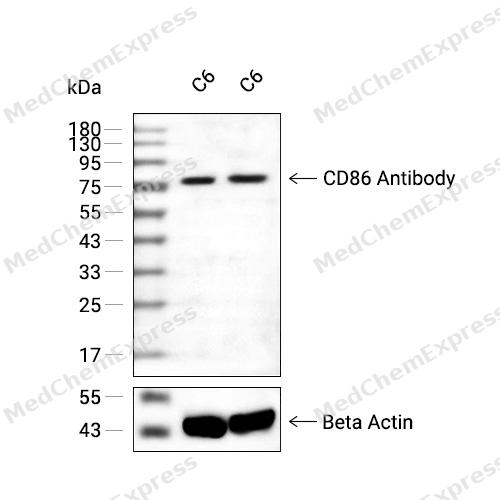 Western blot analysis of extracts from C6(lane 2(20μg) and C6(lane 3(40μg) using CD86 Antibody (HY-P80609) Rabbit mAb. Proteins were transferred to a PVDF membrane and blocked with 5% non-fat milk in TBST for 2 hour at room temperature. The primary antibody (1/1000) and Loading control antibody (Beta Actin, HY-P80438, 1/10000) was used in 5% non-fat milk in TBST at 4°C overnight. Goat Anti-Mouse/Rabbit IgG-HRP Secondary Antibody (1/10000) was used for 1 hour at room temperature.
 -
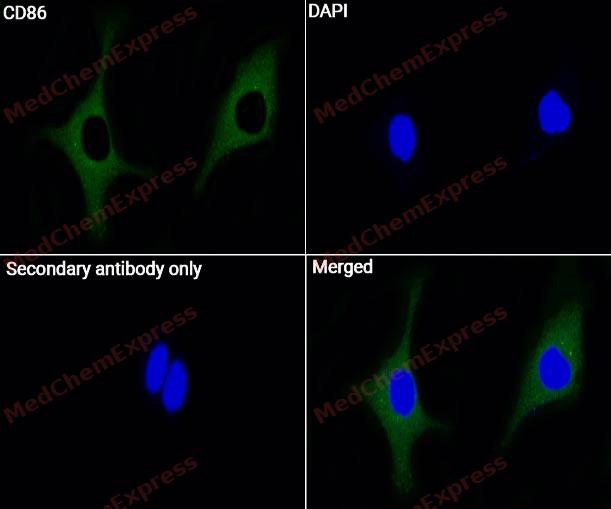 Immunocytochemistry analysis of A549 cells labeling CD86 with beta CD86 Antibody (HY-P80609) at 1/50 dilution. Cells were fixed in 4% paraformaldehyde for 15 minutes at room temperature, then blocked with QuickBlock™ Blocking Buffer for Immunol Staining for 10 min at room temperature. Cells were then incubated with CD86 Antibody (HY-P80609) at 1/50 dilution in QuickBlock™ Blocking Buffer for Immunol Staining at 4 ℃. Alexa Fluor® 488-conjugated AffiniPure Goat Anti-Rabbit IgG H&L(HY-P8002, Green) was used as the secondary antibody at 1/1,000 dilution. PBS instead of the primary antibody was used as the secondary antibody only control. The Nuclear counterstain was DAPI (Blue).
 -
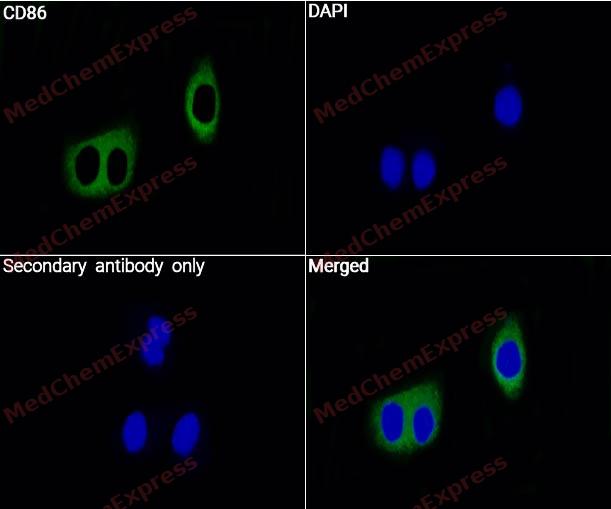 Immunocytochemistry analysis of A549 cells labeling CD86 with beta CD86 Antibody (HY-P80609) at 1/100dilution. Cells were fixed in 4% paraformaldehyde for 15 minutes at room temperature, then blocked with QuickBlock™ Blocking Buffer for Immunol Staining for 10 min at room temperature. Cells were then incubated with CD86 Antibody (HY-P80609) at 1/100 dilution in QuickBlock™ Blocking Buffer for Immunol Staining at 4 ℃. Alexa Fluor® 488-conjugated AffiniPure Goat Anti-Rabbit IgG H&L(HY-P8002, Green) was used as the secondary antibody at 1/1,000 dilution. PBS instead of the primary antibody was used as the secondary antibody only control. The Nuclear counterstain was DAPI (Blue).
 -
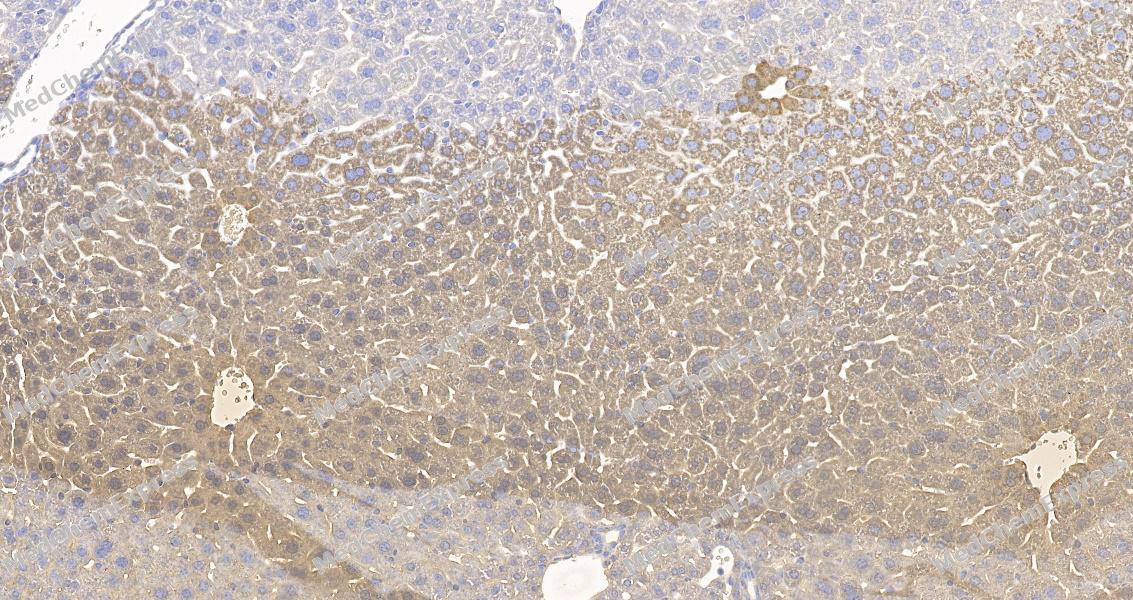 Immunohistochemical analysis of paraffin-embedded mouse liver tissue using CD86 Antibody. The section was pre-treated using heat mediated antigen retrieval with sodium citrate buffer (pH 6.0) for 8 minutes. The tissues were blocked in QuickBlock for 20 minutes at room temperature, washed with ddH2O and PBS, and then probed with the primary antibody at 1/100 dilution in 4℃ overnight. The detection was performed using an HRP conjugated compact polymer system. DAB was used as the chromogen. Tissues were counterstained with hematoxylin and mounted with DPX.
 -
Immunohistochemical analysis of paraffin-embedded mouse liver tissue using CD86 Antibody. The section was pre-treated using heat mediated antigen retrieval with sodium citrate buffer (pH 6.0) for 8 minutes. The tissues were blocked in QuickBlock for 20 minutes at room temperature, washed with ddH2O and PBS, and then probed with the primary antibody at 1/100 dilution in 4℃ overnight. The detection was performed using an HRP conjugated compact polymer system. DAB was used as the chromogen. Tissues were counterstained with hematoxylin and mounted with DPX.
-
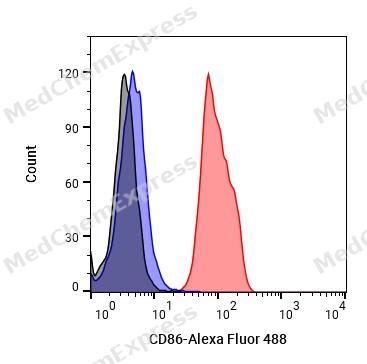 Flow cytometric analysis of 1X10^6 Raji cells labeling CD86 Antibody (HY-P80609, red). Cells were stained with the primary antibody at 1/100 dilution for an hour at 4℃. Alexa Fluor® 488-conjugated AffiniPure Goat Anti-Rabbit IgG H&L (HY-P8002) was used as the secondary antibody at 1/1,000 dilution for 30 minutes at 4℃. Rabbit IgG Isotype Control (HY-P80879, blue) was used as the isotype control, cells without incubation with primary antibody were used as the unlabeled control (black).


Background
-
Function
CD86 (B7-2) is an immune co-stimulatory molecule expressed on the surface of antigen-presenting cells that regulates T-cell activation through binding to CD28 or CTLA-4 on T cells; it serves as a classic marker in research concerning dendritic cell maturation, macrophage polarization, tumor immunity, autoimmunity, infection, and transplant immunology.
-
Subcellular Localization
Cell membrane; Single-pass type I membrane protein
-
Expression
Tissue_specificity:Expressed on activated B-cells -
Isoforms & Post-Translational Modification
CD86 has 2 isomers: P42082-1: 34666 Da (predicted); P42082-2: 33962 Da (predicted).
Polyubiquitinated; which is promoted by MARCH8 and results in endocytosis and lysosomal degradation -
Subunit
Homodimer. Interacts (via cytoplasmic domain) with PHB1 and PHB2; the interactions increases after priming with CD40.
-
SwissProt ID
-
Synonyms
CD86; CD28LG2; T-lymphocyte activation antigen CD86; Activation B7-2 antigen; B70; BU63; CTLA-4 counter-receptor B7.2; FUN-1; CD antigen CD86
-
Research Field
Immunology
Documentation
-
Data Sheet (234 KB)
-
SDS (252 KB)
- English - EN (252 KB)
- Français - FR (252 KB)
- Deutsch - DE (252 KB)
- Norwegian - NO (252 KB)
- Español - ES (252 KB)
- Swedish - SV (252 KB)
- Italian - IT (252 KB)
- Korean - KR (252 KB)
- Portuguese - PT (252 KB)
-
User Guide for Antibodies (1077 KB)

 Powered by Bioz
