



Cullin 2 Antibody (YA2202)
(Synonyms: Cul2; CUL 2; CUL2; cullin 2)
Based on 1 Customer Validation
Cullin 2 Antibody (YA2202) is a Rabbit-derived and non-conjugated IgG monoclonal antibody, targeting to Cullin 2.
-
Host:
Rabbit
-
Isotype:
IgG
-
Application:
WB, ICC/IF, IP, FC
-
Reactivity :
Human, Mouse, Rat
-
Formulation:
Supplied in 50mM Tris-Glycine(pH 7.4), 0.15M NaCl, 40%Glycerol, 0.01% sodium azide and 0.05% BSA.
-
Conjugation:
Non-conjugated


To place orders, for customer services and technical support, please contact: MedChemExpress USA
Tel: 609-228-6898 E-mail: [email protected] [email protected]





Applications
| Application |
WB

WB: Western Blot
|
ICC/IF
ICC/IF: Immunocytochemistry/
Immunofluorescence |
IP
IP: Immunoprecipitation
|
FC
FC: Flow Cytometry
|
|---|---|---|---|---|
| Dilution Ratio | 1:500-1:1000 | 1:50-1:200 | 1:50 | 1:50-1:100 |


Product Details
Cullin 2 Antibody (YA2202) is a Rabbit-derived and non-conjugated IgG monoclonal antibody, targeting to Cullin 2.
-
Host Rabbit

-
Clonality Recombinant, Monoclonal

-
Species ReactivityHuman, Mouse, Rat
-
Observed Molecular WeightObserved band size: 87 kDa
Note: Due to possible protein modifications or aggregation, the molecular weight should be confirmed by actual measurement, and the predicted value is for reference only.

-
Calculated Molecular Weight Predicted band size: 87 kDa

Entrez Gene: 8453 Human ; 71745 Mouse ; 361258 Rat
SwissProt: Q13617 Human ; Q9D4H8 Mouse ;
OMIM: 603135 Human
A synthesized peptide derived from human Cullin 2 aa20-52.
Endogenous
Affinity Chromatography
Non-conjugated
Unmodified
IgG


Product Properties
-
Appearance
Liquid
-
Formulation
Supplied in 50mM Tris-Glycine(pH 7.4), 0.15M NaCl, 40%Glycerol, 0.01% sodium azide and 0.05% BSA.
-
Concentration
Batch-dependent, Please check the COA for the concentration of each lot. Check Lot Concentration
-
Storage & Stability
Stored at -20°C for 1 year. Avoid repeated freeze / thaw cycles.
-
Shipping
Shipping with blue ice.


Verification Images
-
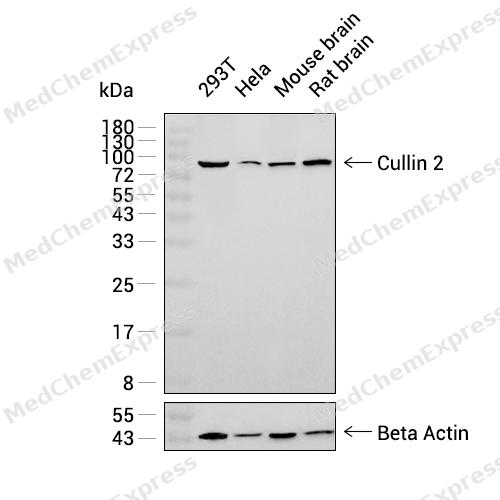 Western blot analysis was performed on extracts from 293T (lane 1, 15 μg), HeLa (lane 2, 15 μg), Mouse brain (lane 3, 15 μg), and Rat brain (lane 4, 15 μg) using Cullin 2 Rabbit mAb.Proteins were transferred to a PVDF membrane and blocked with 5% non - fat milk in TBST at 4°C overnight.The primary antibody (1:2000 dilution) and the loading control antibody (beta-Actin, HY-P83730, 1:20000 dilution) were incubated in 5% non-fat milk in TBST for 1 hour at 37°C.Goat Anti - Rabbit IgG - HRP Secondary Antibody (1:20000 dilution) was then applied for 40 minutes at 37°C.
 -
 Immunocytochemistry analysis of Hela cells labeling Cullin 2 with Cullin 2 Antibody (HY-P82457) at 1/100 dilution. Cells were fixed in 4% paraformaldehyde for 15 minutes at room temperature, permeabilized with 0.1% Triton X-100 in PBS for 15 minutes at room temperature, then blocked with quick block buffer for 10 minutes at room temperature. Cells were then incubated with Cullin 2 Antibody (HY-P82457) at 1/100 dilution in quick block buffer overnight at 4 ℃. AF488-conjugated Goat Anti-Rabbit IgG H&L (HY-P8002, Green) was used as the secondary antibody at 1/1,000 dilution. PBS instead of the primary antibody was used as the secondary antibody only control. The Nuclear counterstain was DAPI (Blue).
 -
 Immunocytochemistry analysis of Hela cells labeling Cullin 2 with Cullin 2 Antibody (HY-P82457) at 1/200 dilution. Cells were fixed in 4% paraformaldehyde for 15 minutes at room temperature, permeabilized with 0.1% Triton X-100 in PBS for 15 minutes at room temperature, then blocked with quick block buffer for 10 minutes at room temperature. Cells were then incubated with Cullin 2 Antibody (HY-P82457) at 1/200 dilution in quick block buffer overnight at 4 ℃. AF488-conjugated Goat Anti-Rabbit IgG H&L (HY-P8002, Green) was used as the secondary antibody at 1/1,000 dilution. PBS instead of the primary antibody was used as the secondary antibody only control. The Nuclear counterstain was DAPI (Blue).
 -
 Flow cytometric analysis of 1X10⁶ Raji cells labeling Cullin 2 Antibody (HY-P82457, red). Cells were fixed with 4% paraformaldehyde and permeabilised with 90% methanol. Then stained with the primary antibody at 1/100 dilution for an hour at 4℃. AF488-conjugated Goat Anti-Rabbit IgG H&L (HY-P8002) was used as the secondary antibody at 1/1,000 dilution for 30 minutes at 4℃. Rabbit IgG Isotype Control (HY-P80879, blue) was used as the isotype control, cells without incubation with primary antibody were used as the unlabeled control (black).


Background
-
Function
Cullin 2 core component of multiple cullin-RING-based ECS (ElonginB/C-CUL2/5-SOCS-box protein) E3 ubiquitin-protein ligase complexes, which mediate the ubiquitination of target proteins. CUL2 serves as a rigid scaffold in the complex and may contribute to catalysis through positioning of the substrate and the E2 ubiquitin-conjugating enzyme. The E3 ubiquitin-protein ligase activity of the complex is dependent on the neddylation of the cullin subunit and is inhibited by the association of the deneddylated cullin subunit with TIP120A/CAND1. The functional specificity of the ECS complex depends on the substrate recognition component. ECS(VHL) mediates the ubiquitination of hypoxia-inducible factor (HIF). A number of ECS complexes (containing either KLHDC2, KLHDC3, KLHDC10, APPBP2, FEM1A, FEM1B or FEM1C as substrate-recognition component) are part of the DesCEND (destruction via C-end degrons) pathway, which recognizes a C-degron located at the extreme C terminus of target proteins, leading to their ubiquitination and degradation. ECS complexes and ARIH1 collaborate in tandem to mediate ubiquitination of target proteins. ECS(LRR1) ubiquitinates MCM7 and promotes CMG replisome disassembly by VCP and chromatin extraction during S-phase[1][2][3][4][5][6][7][8][9][10].
-
Subcellular Localization
Nucleus
-
Isoforms & Post-Translational Modification
Q13617 has 2 isomers: Q13617-1: 86983 Da (predicted); Q13617-2: 89492 Da (predicted).
Neddylated; which enhances the ubiquitination activity of ECS (Elongin BC-CUL2/5-SOCS-box protein) E3 ubiquitin-protein ligase complexes (PubMed:24076655, PubMed:27565346, PubMed:38326650). Neddylation leads to structural rearrangment in the complex that allows interaction between the E2 ubiquitin-conjugating enzyme and the acceptor ubiquitin (PubMed:38326650). CBC(VHL) complex formation seems to promote neddylation. Deneddylated via its interaction with the COP9 signalosome (CSN) complex (By similarity) -
Subunit
Component of multiple Cul2-RING (CRL2) E3 ubiquitin-protein ligase complexes consisting of CUL2, Elongin BC (ELOB and ELOC), RBX1 and a variable substrate-specific adapter; this complex is also known as ECS (Elongin BC-CUL2/5-SOCS-box protein) complex and may consist of CUL2 or CUL5 (PubMed:10973499, PubMed:11384984, PubMed:26138980, PubMed:29775578, PubMed:29779948, PubMed:9122164, PubMed:38326650). Component of a ECS(VHL) or CBC(VHL) complex containing CUL2, RBX1, ELOB, ELOC and VHL (PubMed:10973499, PubMed:11384984, PubMed:9122164, PubMed:38326650). Component of the ECS(MED8) complex with the probable substrate recognition component MED8 (PubMed:12149480). Component of multiple ECS complexes part of the DesCEND (destruction via C-end degrons) pathway, which contain either KLHDC2, KLHDC3, KLHDC10, APPBP2, FEM1A, FEM1B or FEM1C as substrate-recognition component (PubMed:23102700, PubMed:26138980, PubMed:29775578, PubMed:29779948). Component of the ECS(LRR1) complex with the probable substrate recognition component LRR1 (PubMed:15601820, PubMed:34700328). Component of a CRL2(FEM1B) complex containing CUL2, RBX1, ELOB, ELOC and FEM1B (PubMed:15601820). Component of a CRL2(FEM1C) complex containing CUL2, RBX1, ELOB, ELOC and FEM1C (PubMed:38326650). Part of an E3 ubiquitin-protein ligase complex including ZYG11B, CUL2 and Elongin BC (PubMed:17304241). Part of an E3 ubiquitin-protein ligase complex including ZER1, CUL2 and Elongin BC (PubMed:17304241). Interacts with RBX1, RNF7, FEM1B and TIP120A/CAND1 (PubMed:10230407, PubMed:12609982). Found in a complex composed of LIMD1, VHL, EGLN1/PHD2, ELOB and CUL2 (PubMed:22286099). Interacts (when neddylated) with ARIH1; leading to activate the E3 ligase activity of ARIH1 (PubMed:24076655, PubMed:27565346). Interacts (unneddylated form) with DCUN1D1, DCUN1D2, DCUN1D3, DCUN1D4 and DCUN1D5; these interactions promote the cullin neddylation (PubMed:23201271, PubMed:23401859, PubMed:24192928, PubMed:26906416). Component of VCB (elongins BC/CUL2/VHL) complex that contains at least DCUN1D1, CUL2 and VHL; this complex triggers CUL2 neddylation and consequently cullin ring ligase (CRL) substrates polyubiquitylation (PubMed:23401859)
-
SwissProt ID
-
Synonyms
Cul2; CUL 2; CUL2; cullin 2
-
Research Field
Cell Biology


Documentation
-
Data Sheet (259 KB)
-
SDS (251 KB)
- English - EN (251 KB)
- Français - FR (251 KB)
- Deutsch - DE (251 KB)
- Norwegian - NO (251 KB)
- Español - ES (251 KB)
- Swedish - SV (251 KB)
- Italian - IT (251 KB)
- Korean - KR (251 KB)
- Portuguese - PT (251 KB)
-
User Guide for Antibodies (1077 KB)

 Powered by Bioz
