



DDX4 Antibody (YA4813)
(Synonyms: DDX4; VASA; Probable ATP-dependent RNA helicase DDX4; DEAD box protein 4; Vasa homolog)
Based on 1 Customer Validation
DDX4 Antibody (YA4813) is a Mouse-derived and non-conjugated monoclonal antibody, targeting to DDX4.
-
Host:
Mouse
-
Isotype:
IgG1
-
Application:
WB, IHC-P, ICC/IF, FC, ELISA
-
Reactivity :
Human
-
Formulation:
Supplied in PBS containing 50% glycerol, 0.5% BSA and 0.02% sodium azide.
-
Conjugation:
Non-conjugated


To place orders, for customer services and technical support, please contact: MedChemExpress USA
Tel: 609-228-6898 E-mail: [email protected] [email protected]





Applications
| Application |
WB

WB: Western Blot
|
IHC-P
IHC-P: Immunohistochemistry-Paraffin
|
ICC/IF
ICC/IF: Immunocytochemistry/
Immunofluorescence |
FC
FC: Flow Cytometry
|
ELISA
ELISA: Enzyme Linked Immunosorbent Assay
|
|---|---|---|---|---|---|
| Dilution Ratio | 1:500-1:2000 | 1:200-1:1000 | 1:200-1:1000 | 1:200-1:400 | 1:10000 |


Product Details
DDX4 Antibody (YA4813) is a Mouse-derived and non-conjugated monoclonal antibody, targeting to DDX4.
-
Host Mouse

-
Clonality Monoclonal

-
Species ReactivityHuman
-
Calculated Molecular Weight Predicted band size: 79 kDa

Purified recombinant fragment of human DDX4 expressed in E. Coli
affinity purified.
Non-conjugated
Unmodified
IgG1


Product Properties
-
Appearance
Liquid
-
Formulation
Supplied in PBS containing 50% glycerol, 0.5% BSA and 0.02% sodium azide.
-
Concentration
Batch-dependent, Please check the COA for the concentration of each lot. Check Lot Concentration
-
Storage & Stability
Stored at -20°C for 1 year. Avoid repeated freeze / thaw cycles.
-
Shipping
Shipping with blue ice.


Verification Images
-
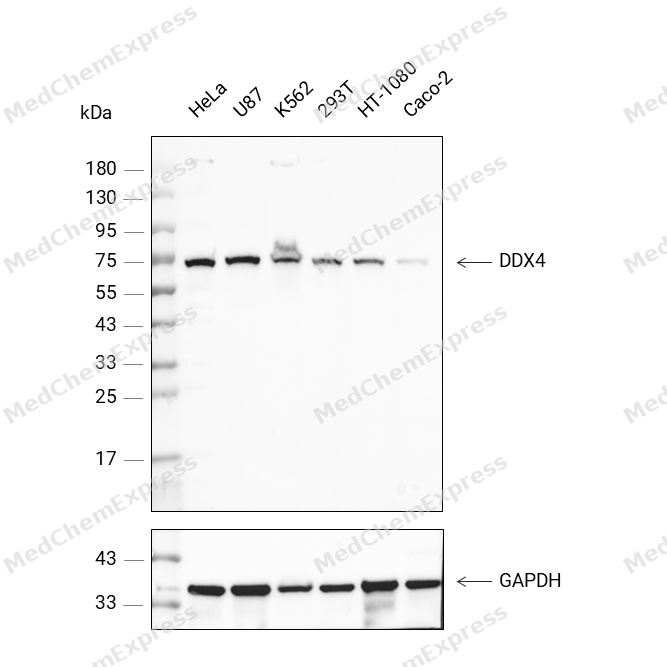 Western blot analysis was performed on protein extracts (30 μg) from HeLa (lane 2), U87 (lane 3), K562 (lane 4), 293T (lane 5), HT-1080 (lane 6), and Caco-2 (lane 7) using DDX4 antibody. Proteins were transferred onto a 0.45 μm PVDF membrane using the Trans-Blot® Turbo™ system for 13 min. The membrane was then blocked with 5% nonfat milk in TBST (HY-K1025) for 1 h at room temperature. Thhe primary antibody (1:1000) and loading control antibody GAPDH Antibody (HRP) (HY-P80954A) (1:2500) were diluted in 5% nonfat milk in TBST and incubated with the membrane overnight at 4°C. After washing, the membrane of primary antibody was incubated with HRP-conjugated goat anti-rabbit/mouse IgG secondary antibody (HY-P8001/HY-P8004) (1:5000) diluted in 5% nonfat milk in TBST for 1 h at room temperature. Protein bands were visualized using an Ultra High Sensitivity ECL detection kit (HY-K1005).


Background
-
Function
DDX4 is an ATP-dependent RNA helicase required during spermatogenesis. Required to repress transposable elements and preventing their mobilization, which is essential for the germline integrity. Acts via the piRNA metabolic process, which mediates the repression of transposable elements during meiosis by forming complexes composed of piRNAs and Piwi proteins and governs the methylation and subsequent repression of transposons. Involved in the secondary piRNAs metabolic process, the production of piRNAs in fetal male germ cells through a ping-pong amplification cycle. Required for PIWIL2 slicing-triggered piRNA biogenesis: helicase activity enables utilization of one of the slice cleavage fragments generated by PIWIL2 and processing these pre-piRNAs into piRNAs[1][2].
-
Subcellular Localization
Cytoplasm; Cytoplasm, perinuclear region
-
Expression
Tissue_specificity:It is expressed only in the ovaries and testes. It is also expressed in migratory primordial germ cells in the gonadal crest region of both sexes. -
Isoforms & Post-Translational Modification
Q9NQI0 has 4 isomers: Q9NQI0-1: 79308 Da (predicted); Q9NQI0-2: 75821 Da (predicted); Q9NQI0-3: 63211 Da (predicted); Q9NQI0-4: 77056 Da (predicted).
-
Subunit
Interacts with RANBP9 (PubMed:27622290). Interacts with RANBP10. Interacts with PIWIL2 and MAEL.
-
SwissProt ID
-
Synonyms
DDX4; VASA; Probable ATP-dependent RNA helicase DDX4; DEAD box protein 4; Vasa homolog


Documentation
-
Data Sheet (234 KB)
-
SDS (252 KB)
- English - EN (252 KB)
- Français - FR (252 KB)
- Deutsch - DE (252 KB)
- Norwegian - NO (252 KB)
- Español - ES (252 KB)
- Swedish - SV (252 KB)
- Italian - IT (252 KB)
- Korean - KR (252 KB)
- Portuguese - PT (252 KB)
-
User Guide for Antibodies (1077 KB)

 Powered by Bioz
