



EPCR Antibody (YA6555)
(Synonyms: Activated protein C receptor antibody; APC receptor antibody; APCR antibody; bA42O4.2 antibody; CCCA antibody; CCD41 antibody; CD201 antibody; CD201 antigen antibody; cell cycle, centrosome-associated protein antibody; Cell cycle, centrosome-associated protein antibody; Activated protein C receptor antibody; APC receptor antibody; APCR antibody; bA42O4.2 antibody; CCCA antibody; CCD41 antibody; CD201 antibody; CD201 antigen antibody; cell cycle, centrosome-associated protein antibody; Cell cycle, centrosome-associated protein antibody; centrocyclin antibody; Endothelial cell protein C receptor antibody; Endothelial protein C receptor antibody; EPCR antibody; EPCR_HUMAN antibody; MGC23024 antibody; PROCR antibody; Protein C receptor, endothelial antibody; )
Based on 1 Customer Validation
EPCR Antibody (YA6555) is a Rabbit-derived and non-conjugated IgG monoclonal antibody, targeting to EPCR.
-
Host:
Rabbit
-
Isotype:
IgG
-
Application:
WB, ICC/IF, FC
-
Reactivity :
Human
-
Formulation:
Supplied in PBS (pH7.4), 0.1% BSA, 40% Glycerol. Preservative: 0.05% Sodium Azide.
-
Conjugation:
Non-conjugated


To place orders, for customer services and technical support, please contact: MedChemExpress USA
Tel: 609-228-6898 E-mail: [email protected] [email protected]





Applications
| Application |
WB

WB: Western Blot
|
ICC/IF
ICC/IF: Immunocytochemistry/
Immunofluorescence |
FC
FC: Flow Cytometry
|
|---|---|---|---|
| Dilution Ratio | 1:1000 | 1:100 | 1:1000 |


Product Details
EPCR Antibody (YA6555) is a Rabbit-derived and non-conjugated IgG monoclonal antibody, targeting to EPCR.
-
Host Rabbit

-
Clonality Recombinant,Monoclonal

-
Species ReactivityHuman
-
Observed Molecular WeightObserved band size: 45 kDa
Note: Due to possible protein modifications or aggregation, the molecular weight should be confirmed by actual measurement, and the predicted value is for reference only.

-
Calculated Molecular Weight Predicted band size: 27 kDa

Recombinant protein within human EPCR aa 1-238 / 238.
affinity purified.
Non-conjugated
Unmodified
IgG


Product Properties
-
Appearance
Liquid
-
Formulation
Supplied in PBS (pH7.4), 0.1% BSA, 40% Glycerol. Preservative: 0.05% Sodium Azide.
-
Concentration
Batch-dependent, Please check the COA for the concentration of each lot. Check Lot Concentration
-
Storage & Stability
Stored at -20°C for 1 year. Avoid repeated freeze / thaw cycles.
-
Shipping
Shipping with blue ice.


Verification Images
-
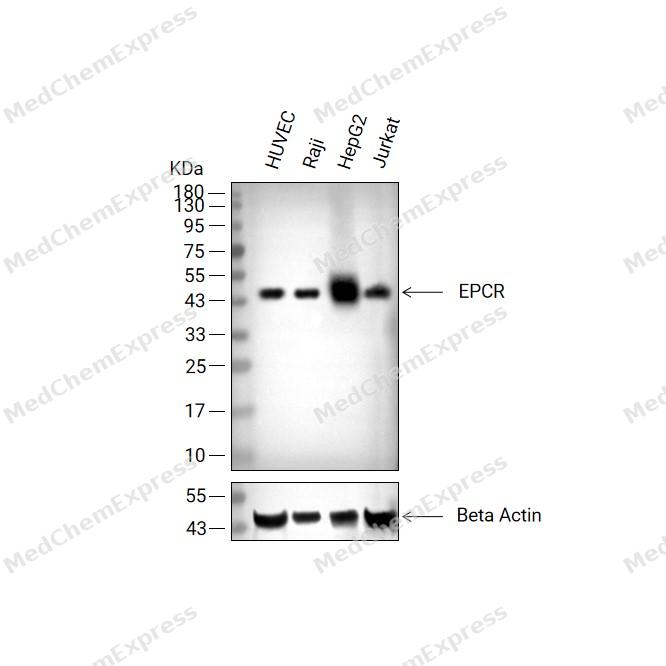 Western blot analysis of extracts from HUVEC (lane2(20μg), Raji (lane3(20μg), HepG2 (lane4(20μg) and Jurkat (lane5(20μg) using EPCR Antibody (HY-P86862). Proteins were transferred to a PVDF membrane and blocked with 5% non-fat milk in TBST at 4°C overnight. The primary antibody (1/1000) and Loading control antibody (Beta Actin, HY-P80993, 1/10,000) was used in 5% non-fat milk in TBST for 2 hour at room temperature. Goat Anti-Rabbit IgG-HRP Secondary Antibody (HY-P8001, 1/10,000) was used for 1 hour at room temperature.
 -
 Immunocytochemistry analysis of Hela cells labeling EPCR with EPCR Antibody (HY-P86862) at 1/100 dilution. Cells were fixed in 4% paraformaldehyde for 15 minutes at room temperature, permeabilized with 0.1% Triton X-100 in PBS for 15 minutes at room temperature, then blocked with quick block buffer for 10 minutes at room temperature. Cells were then incubated with EPCR Antibody (HY-P86862) at 1/100 dilution in quick block buffer overnight at 4 ℃. AF488-conjugated Goat Anti-Rabbit IgG H&L(HY-P8002, Green) was used as the secondary antibody at 1/1,000 dilution. PBS instead of the primary antibody was used as the secondary antibody only control. The Nuclear counterstain was DAPI (Blue).
 -
 Immunocytochemistry analysis of PC-3 cells labeling EPCR with EPCR Antibody (HY-P86862) at 1/100 dilution. Cells were fixed in 4% paraformaldehyde for 15 minutes at room temperature, permeabilized with 0.1% Triton X-100 in PBS for 15 minutes at room temperature, then blocked with quick block buffer for 10 minutes at room temperature. Cells were then incubated with EPCR Antibody (HY-P86862) at 1/100 dilution in quick block buffer overnight at 4 ℃. AF488-conjugated Goat Anti-Rabbit IgG H&L(HY-P8002, Green) was used as the secondary antibody at 1/1,000 dilution. PBS instead of the primary antibody was used as the secondary antibody only control. The Nuclear counterstain was DAPI (Blue).


Background
-
Function
EPCR binds activated protein C. Enhances protein C activation by the thrombin-thrombomodulin complex; plays a role in the protein C pathway controlling blood coagulation
-
Subcellular Localization
Membrane
-
Expression
Tissue_Specificity: Expressed strongly in the endothelial cells of arteries and veins in heart and lung, less intensely in capillaries in the lung and skin, and not at all in the endothelium of small vessels of the liver and kidney -
Isoforms & Post-Translational Modification
Q9UNN8: 238 amino acids, molecular weight 26671 Da.
Autophosphorylated at Ser-1292; autophosphorylation is stimulated by RAB29 (PubMed:28202711, PubMed:28720718, PubMed:29127255, PubMed:29212815, PubMed:30635421, PubMed:38127736)丨Ubiquitinated by TRIM1; undergoes 'Lys-48'-linked polyubiquitination leading to proteasomal degradation -
SwissProt ID
-
Synonyms
Activated protein C receptor antibody; APC receptor antibody; APCR antibody; bA42O4.2 antibody; CCCA antibody; CCD41 antibody; CD201 antibody; CD201 antigen antibody; cell cycle, centrosome-associated protein antibody; Cell cycle, centrosome-associated protein antibody; Activated protein C receptor antibody; APC receptor antibody; APCR antibody; bA42O4.2 antibody; CCCA antibody; CCD41 antibody; CD201 antibody; CD201 antigen antibody; cell cycle, centrosome-associated protein antibody; Cell cycle, centrosome-associated protein antibody; centrocyclin antibody; Endothelial cell protein C receptor antibody; Endothelial protein C receptor antibody; EPCR antibody; EPCR_HUMAN antibody; MGC23024 antibody; PROCR antibody; Protein C receptor, endothelial antibody;


Documentation
-
Data Sheet (231 KB)
-
SDS (254 KB)
- English - EN (254 KB)
- Français - FR (254 KB)
- Deutsch - DE (254 KB)
- Norwegian - NO (254 KB)
- Español - ES (254 KB)
- Swedish - SV (254 KB)
- Italian - IT (254 KB)
- Korean - KR (254 KB)
- Portuguese - PT (254 KB)
-
User Guide for Antibodies (1077 KB)

 Powered by Bioz
