



Exportin 5 Antibody (YA2100)
(Synonyms: Exp5; Exportin 5; Ranbp21; xpo5)
Based on 1 Customer Validation
Exportin 5 Antibody (YA2100) is a Rabbit-derived and non-conjugated IgG monoclonal antibody, targeting to Exportin 5.
-
Host:
Rabbit
-
Isotype:
IgG
-
Application:
WB, IHC-P, ICC/IF, FC
-
Reactivity :
Human, Mouse, Rat
-
Formulation:
Supplied in 10mM PBS, pH 7.4, 150mM sodium chloride, 0.05% BSA, 0.02% sodium azide and 50% glycerol.
-
Conjugation:
Non-conjugated


To place orders, for customer services and technical support, please contact: MedChemExpress USA
Tel: 609-228-6898 E-mail: [email protected] [email protected]





Applications
| Application |
WB

WB: Western Blot
|
IHC-P
IHC-P: Immunohistochemistry-Paraffin
|
ICC/IF
ICC/IF: Immunocytochemistry/
Immunofluorescence |
FC
FC: Flow Cytometry
|
|---|---|---|---|---|
| Dilution Ratio | 1:500-1:1000 | 1:50-1:100 | 1:50-1:200 | 1:50-1:100 |


Product Details
Exportin 5 Antibody (YA2100) is a Rabbit-derived and non-conjugated IgG monoclonal antibody, targeting to Exportin 5.
-
Host Rabbit

-
Clonality Recombinant,Monoclonal

-
Species ReactivityHuman, Mouse, Rat
-
Observed Molecular WeightObserved band size: 136 kDa
Note: Due to possible protein modifications or aggregation, the molecular weight should be confirmed by actual measurement, and the predicted value is for reference only.

-
Calculated Molecular Weight Predicted band size: 136 kDa

Entrez Gene: 57510 Human ; 72322 Mouse ; 363194 Rat
SwissProt: Q9HAV4 Human ; Q924C1 Mouse ;
OMIM: 607845 Human
A synthesized peptide derived from human Exportin 5 aa100-150/1204.
Endogenous
Affinity Chromatography
Non-conjugated
Unmodified
IgG


Product Properties
-
Appearance
Liquid
-
Formulation
Supplied in 10mM PBS, pH 7.4, 150mM sodium chloride, 0.05% BSA, 0.02% sodium azide and 50% glycerol.
-
Concentration
Batch-dependent, Please check the COA for the concentration of each lot. Check Lot Concentration
-
Storage & Stability
Stored at -20°C for 1 year. Avoid repeated freeze / thaw cycles.
-
Shipping
Shipping with blue ice.


Verification Images
-
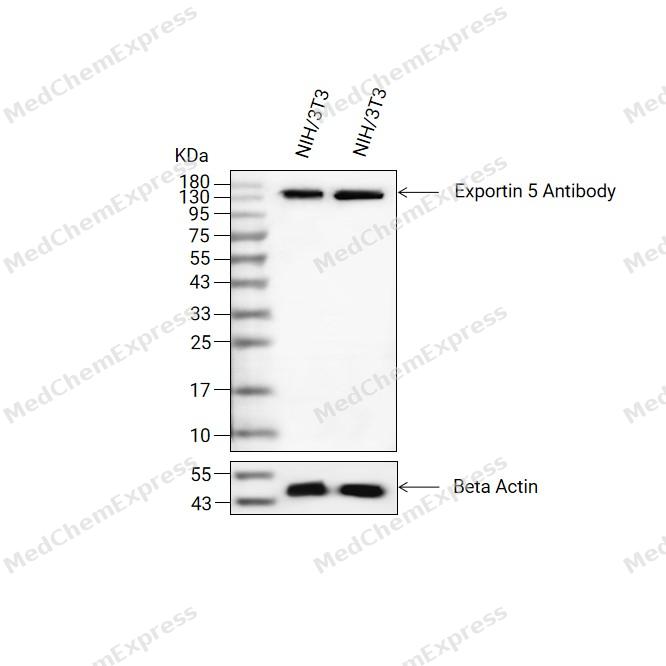 Western blot analysis of extracts from NIH/3T3(lane 2(20ug) and NIH/3T3(lane 3(40ug) using Exportin 5 Antibody (HY-P82355) Rabbit mAb. Proteins were transferred to a PVDF membrane and blocked with 5% non-fat milk in TBST for 2 hour at room temperature. The primary antibody (1/1000) and Loading control antibody (Beta Actin, HY-P83730, 1/10000) was used in 5% non-fat milk in TBST at 4°C overnight. Goat Anti-Mouse/Rabbit IgG-HRP Secondary Antibody (1/10000) was used for 1 hour at room temperature.
 -
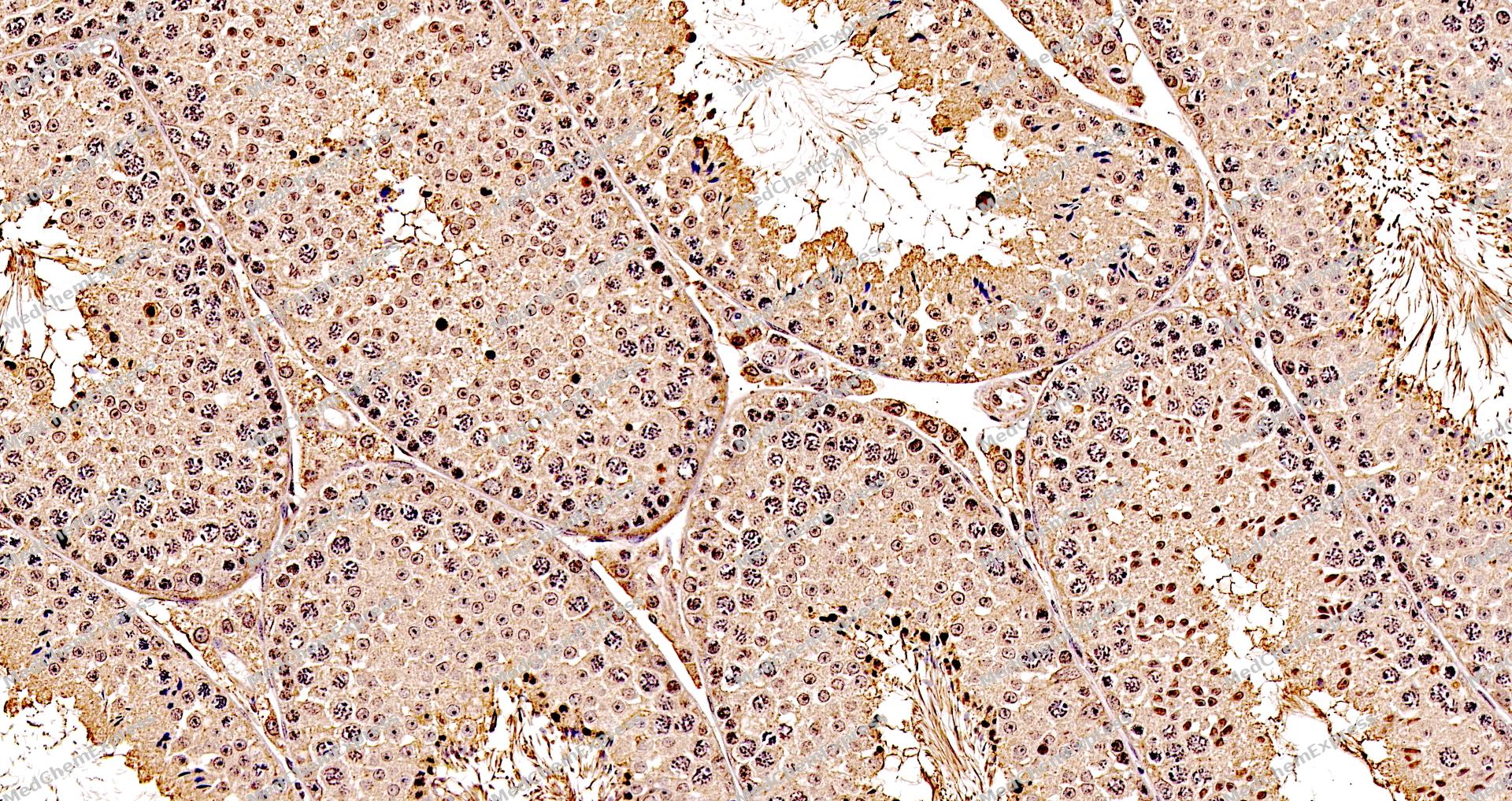 Immunohistochemical analysis of paraffin-embedded Mouse testis tissue using Exportin 5 Antibody (YA2100). The section was pre-treated using heat mediated antigen retrieval with Tris-EDTA buffer (pH 9.0) for 8 minutes. The tissues were blocked in QuickBlock for 20 minutes at room temperature, washed with ddH2O and PBS, and then probed with the primary antibody (HY-P82355, 1/100) in 4℃ overnight. The detection was performed using an HRP conjugated compact polymer system. DAB was used as the chromogen. Tissues were counterstained with hematoxylin and mounted with DPX.
 -
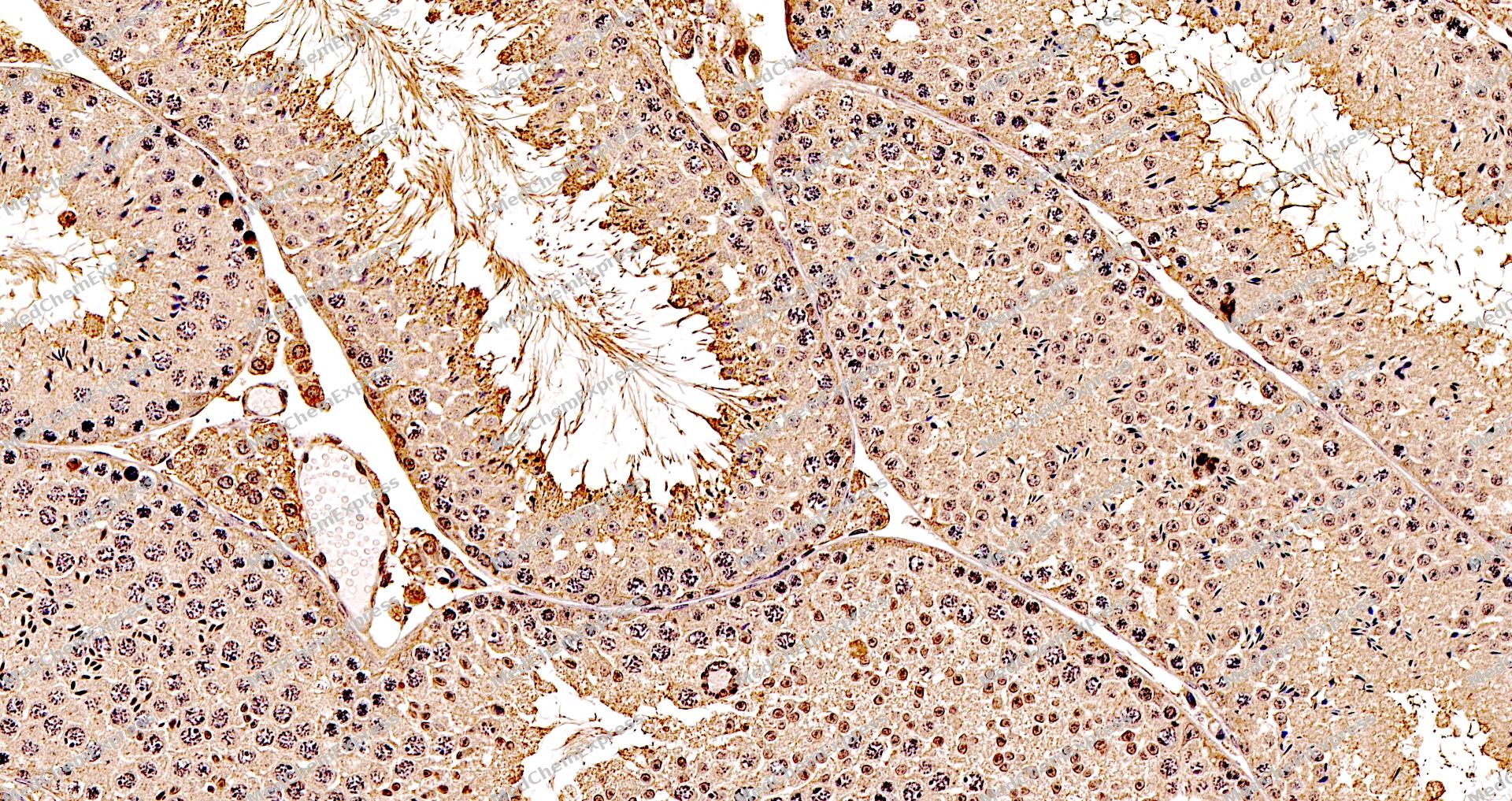 Immunohistochemical analysis of paraffin-embedded Mouse testis tissue using Exportin 5 Antibody (YA2100). The section was pre-treated using heat mediated antigen retrieval with Tris-EDTA buffer (pH 9.0) for 8 minutes. The tissues were blocked in QuickBlock for 20 minutes at room temperature, washed with ddH2O and PBS, and then probed with the primary antibody (HY-P82355, 1/100) in 4℃ overnight. The detection was performed using an HRP conjugated compact polymer system. DAB was used as the chromogen. Tissues were counterstained with hematoxylin and mounted with DPX.
 -
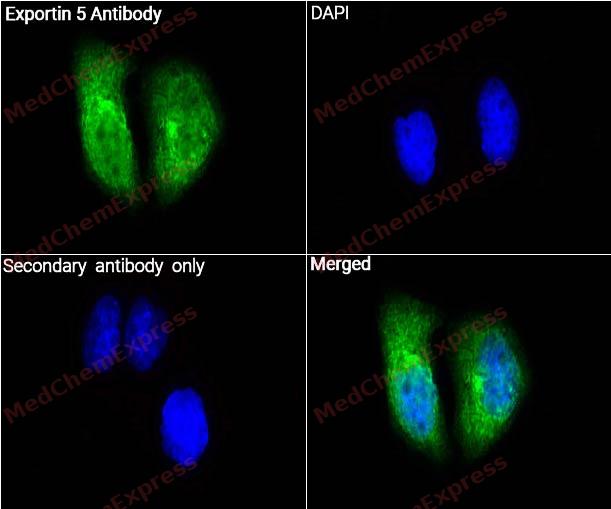 Immunocytochemistry analysis of A431 cells labeling Exportin 5 with Exportin 5 Antibody (HY-P82355) at 1/50 dilution. Cells were fixed in 4% paraformaldehyde for 15 minutes at room temperature, permeabilized with 0.1% Triton X-100 for 10 minutes at room temperature, then blocked with BSA for Immunol Staining for 10 min at room temperature. Cells were then incubated with Exportin 5 Antibody ((HY-P82355) at 1/50 dilution in BSA for Immunol Staining at 4 ℃,stay overnight. AF488-conjugated AffiniPure Goat Anti-Rabbit IgG H&L(HY-P8002, Green) was used as the secondary antibody at 1/1,000 dilution. PBS instead of the primary antibody was used as the secondary antibody only control. The Nuclear counterstain was DAPI (Blue).
 -
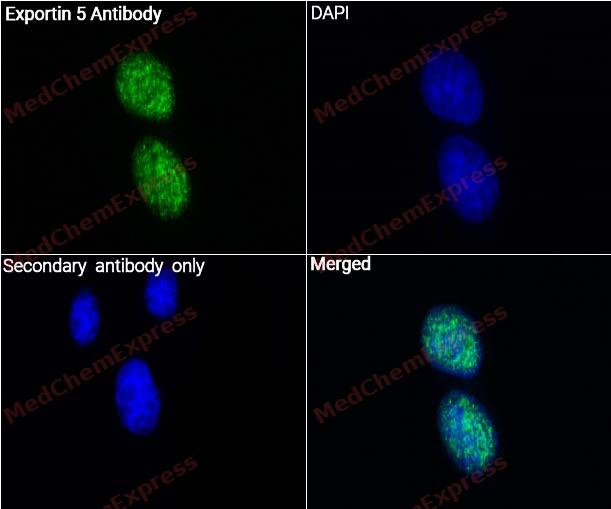 Immunocytochemistry analysis of HeLa cells labeling Exportin 5 with Exportin 5 Antibody (HY-P82355) at 1/50 dilution. Cells were fixed in 4% paraformaldehyde for 15 minutes at room temperature, permeabilized with 0.1% Triton X-100 for 10 minutes at room temperature, then blocked with BSA for Immunol Staining for 10 min at room temperature. Cells were then incubated with Exportin 5 Antibody ((HY-P82355) at 1/50 dilution in BSA for Immunol Staining at 4 ℃,stay overnight. AF488-conjugated AffiniPure Goat Anti-Rabbit IgG H&L(HY-P8002, Green) was used as the secondary antibody at 1/1,000 dilution. PBS instead of the primary antibody was used as the secondary antibody only control. The Nuclear counterstain was DAPI (Blue).


Background
-
Function
Exportin 5 mediates the nuclear export of proteins bearing a double-stranded RNA binding domain (dsRBD) and double-stranded RNAs (cargos). XPO5 in the nucleus binds cooperatively to the RNA and to the GTPase Ran in its active GTP-bound form. Proteins containing dsRBDs can associate with this trimeric complex through the RNA. Docking of this complex to the nuclear pore complex (NPC) is mediated through binding to nucleoporins. Upon transit of a nuclear export complex into the cytoplasm, hydrolysis of Ran-GTP to Ran-GDP (induced by RANBP1 and RANGAP1, respectively) cause disassembly of the complex and release of the cargo from the export receptor. XPO5 then returns to the nuclear compartment by diffusion through the nuclear pore complex, to mediate another round of transport. The directionality of nuclear export is thought to be conferred by an asymmetric distribution of the GTP- and GDP-bound forms of Ran between the cytoplasm and nucleus. Overexpression may in some circumstances enhance RNA-mediated gene silencing (RNAi). Mediates nuclear export of isoform 5 of ADAR/ADAR1 in a RanGTP-dependent manner; Mediates the nuclear export of micro-RNA precursors, which form short hairpins. Also mediates the nuclear export of synthetic short hairpin RNAs used for RNA interference. In some circumstances can also mediate the nuclear export of deacylated and aminoacylated tRNAs. Specifically recognizes dsRNAs that lack a 5'-overhang in a sequence-independent manner, have only a short 3'-overhang, and that have a double-stranded length of at least 15 base-pairs. Binding is dependent on Ran-GTP; (Microbial infection) Mediates the nuclear export of adenovirus VA1 dsRNA[1][2][3][4].
-
Subcellular Localization
Nucleus; Cytoplasm
-
Expression
Tissue_specificity:Expressed in heart, brain, placenta, lung, skeletal muscle, kidney and pancreas -
Subunit
Component of a nuclear export receptor complex composed of XPO5, RAN, dsRNA-binding proteins and dsRNA. Found in a nuclear export complex with XPO5, RAN, EEF1A1, and aminoacylated tRNA. Found in a nuclear export complex with XPO5, RAN, ILF3 and dsRNA. Found in a nuclear export complex with XPO5, RAN and pre-miRNA (PubMed:19965479). Found in a nuclear export complex with XPO5, RAN, ILF3 and minihelix VA1 dsRNA. Found in a nuclear export complex with XPO5, RAN, ILF3, ZNF346 and dsRNA. Interacts with EEF1A1, ILF3, NUP153, NUP214 and ZNF346. Interacts with RAN and cargo proteins in a GTP-dependent manner. Interacts with isoform 5 of ADAR/ADAR1 (via DRBM domains). Interacts with SMAD4; mediates nuclear export of SMAD4 (PubMed:26878725). Interacts with RAN (GTP-bound form) (PubMed:19965479)
-
SwissProt ID
-
Synonyms
Exp5; Exportin 5; Ranbp21; xpo5
-
Research Field
Epigenetics and Nuclear Signaling


Documentation
-
Data Sheet (258 KB)
-
SDS (251 KB)
- English - EN (251 KB)
- Français - FR (251 KB)
- Deutsch - DE (251 KB)
- Norwegian - NO (251 KB)
- Español - ES (251 KB)
- Swedish - SV (251 KB)
- Italian - IT (251 KB)
- Korean - KR (251 KB)
- Portuguese - PT (251 KB)
-
User Guide for Antibodies (1077 KB)

 Powered by Bioz
