



FOXO4 Antibody (YA426)
(Synonyms: AFX, AFX1, MLLT7, FOXO4, Forkhead box protein O4, Fork head domain transcription factor AFX1)Based on 1 Customer Validation
FOXO4 Antibody (YA426) is a Rabbit-derived and non-conjugated IgG monoclonal antibody, targeting to FOXO4.
-
Host:
Rabbit
-
Isotype:
IgG
-
Application:
WB, ICC/IF, IHC-P, FC, IP
-
Reactivity :
Human
-
Formulation:
Supplied in 1*TBS (pH7.4), 0.05% BSA and 40% Glycerol. Preservative: 0.05% Sodium Azide.
-
Conjugation:
Non-conjugated


To place orders, for customer services and technical support, please contact: MedChemExpress USA
Tel: 609-228-6898 E-mail: [email protected] [email protected]





Applications
| Application |
WB

WB: Western Blot
|
ICC/IF
ICC/IF: Immunocytochemistry/
Immunofluorescence |
IHC-P
IHC-P: Immunohistochemistry-Paraffin
|
FC
FC: Flow Cytometry
|
IP
IP: Immunoprecipitation
|
|---|---|---|---|---|---|
| Dilution Ratio | 1:500 | 1:50-1:200 | 1:50-1:200 | 1:50-1:100 | Use at an assay dependent concentration. |


Product Details
FOXO4 Antibody (YA426) is a Rabbit-derived and non-conjugated IgG monoclonal antibody, targeting to FOXO4.
-
Host Rabbit

-
Clonality Recombinant,Monoclonal

-
Species ReactivityHuman
-
Observed Molecular WeightObserved band size: 74 kDa
Note: Due to possible protein modifications or aggregation, the molecular weight should be confirmed by actual measurement, and the predicted value is for reference only.

-
Calculated Molecular Weight Predicted band size: 54 kDa

Synthetic peptide corresponding to Human FOXO4.AA range:456-505.
Endogenous
Protein A affinity purified.
Non-conjugated
Unmodified
IgG


Product Properties
-
Appearance
Solution
-
Formulation
Supplied in 1*TBS (pH7.4), 0.05% BSA and 40% Glycerol. Preservative: 0.05% Sodium Azide.
-
Concentration
Batch-dependent, Please check the COA for the concentration of each lot. Check Lot Concentration
-
Storage & Stability
Stored at -20°C for 1 year. Avoid repeated freeze / thaw cycles.
-
Shipping
Shipping with blue ice.


Verification Images
-
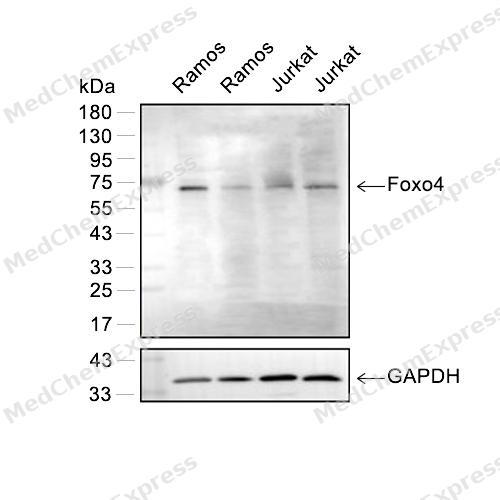 Western blot analysis of extracts from Ramos(lane 2(10μg) and Ramos(lane 3(5μg), Jurkat(lane 4(5μg) ) and Jurkat(lane 5(10μg) ) using FOXO4(HY-P80134) Rabbit mAb. Proteins were transferred to a PVDF membrane and blocked with 5% BSA in TBST for 2 hour at room temperature. The primary antibody (HY-P80134, 1/1000) and Loading control antibody (GAPDH, HY-P80954, 1/3000) was used in 5% BSA in TBST at 4°C overnight. Goat Anti-Mouse/Rabbit IgG-HRP Secondary Antibody (HY-P8004/HY-P8001, 1/10,000) was used for 1 hour at room temperature.
 -
 Immunohistochemical analysis of paraffin-embedded human heart using FOXO4 antibody. The section was pre-treated using heat mediated antigen retrieval with EDTA (pH 9.0) for 14 minutes. The tissues were blocked in 5% BSA for 30 minutes at room temperature, washed with TBST, and then probed with the primary antibody (HY-P80134, 1/200) for 1 hour at room temperature. The detection was performed using Polymer HRP-conjugated Goat Anti-Mouse/Rabbit lgG(H&L) secondary antibody (HY-P83652). DAB was used as the chromogen. Tissues were counterstained with hematoxylin and mounted with DPX.
 -
 Immunohistochemical analysis of paraffin-embedded human placenta using FOXO4 antibody. The section was pre-treated using heat mediated antigen retrieval with EDTA (pH 9.0) for 14 minutes. The tissues were blocked in 5% BSA for 30 minutes at room temperature, washed with TBST, and then probed with the primary antibody (HY-P80134, 1/200) for 1 hour at room temperature. The detection was performed using Polymer HRP-conjugated Goat Anti-Mouse/Rabbit lgG(H&L) secondary antibody (HY-P83652). DAB was used as the chromogen. Tissues were counterstained with hematoxylin and mounted with DPX.
 -
 Flow cytometric analysis of 1X10⁶ HeLa cells labeling FOXO4 Antibody (HY-P80134, red). Cells were fixed with 4% paraformaldehyde and permeabilised with 90% methanol. Then stained with the primary antibody at 1/100 dilution for an hour at 4℃. AF488-conjugated Goat Anti-Rabbit IgG H&L (HY-P8002) was used as the secondary antibody at 1/1,000 dilution for 30 minutes at 4℃. Rabbit IgG Isotype Control (HY-P80879, blue) was used as the isotype control, cells without incubation with primary antibody were used as the unlabeled control (black).


Background
-
Function
FOXO4 is a FOXO-family transcription factor that regulates genes involved in metabolism, cell cycle, apoptosis, and cellular homeostasis[1]. Mechanistically, FOXO proteins act as context-dependent transcriptional regulators across cellular homeostasis, stem-cell maintenance, apoptosis, metabolism, immunity, and cancer biology[2]. In senescent cells, FOXO4 functions as a pivot for cell viability by interacting with p53, and FOXO4-DRI perturbs this interaction to drive p53 nuclear exclusion and cell-intrinsic apoptosis[3]. In disease and aging models, FOXO4-DRI reduced senescent-cell viability, neutralized doxorubicin-induced chemotoxicity, and restored fitness, fur density, and renal function in fast-aging and naturally aged mice[3]. In aged testicular models, FOXO4 maintained senescent Leydig-cell viability, whereas FOXO4-DRI induced apoptosis and alleviated age-related testosterone secretion insufficiency[4]. In keloid fibroblasts, FOXO4-DRI promoted apoptosis by nuclear exclusion of upregulated p53-serine 15 phosphorylation[5]. Compared with related isoforms, mammalian FOXO proteins comprise FOXO1, FOXO3, FOXO4, and FOXO6, and isoform-specific targeting remains important because these proteins show shared and distinct biological functions[2]. For experimental applications, FOXO4-DRI provides a senolytic tool for interrogating the FOXO4-p53 axis, while structural studies define the p53 transactivation domain as a target of FOXO4 and FOXO4-DRI[6].
-
Subcellular Localization
Cytoplasm; Nucleus
-
Expression
Tissue_specificity:Heart, brain, placenta, lung, liver, skeletal muscle, kidney and pancreas. Isoform zeta is most abundant in the liver, kidney, and pancreas -
Isoforms & Post-Translational Modification
P98177 has 2 isomers: P98177-1: 53684 Da (predicted); P98177-2: 47941 Da (predicted).
Acetylation by CREBBP/CBP, which is induced by peroxidase stress, inhibits transcriptional activity. Deacetylation by SIRT1 is NAD-dependent and stimulates transcriptional activity;Phosphorylation by PKB/AKT1 inhibits transcriptional activity and is responsible for cytoplasmic localization. May be phosphorylated at multiple sites by NLK;Monoubiquitinated; monoubiquitination is induced by oxidative stress and reduced by deacetylase inhibitors; results in its relocalization to the nucleus and its increased transcriptional activity. Deubiquitinated by USP7; deubiquitination is induced by oxidative stress; enhances its interaction with USP7 and consequently, deubiquitination; increases its translocation to the cytoplasm and inhibits its transcriptional activity. Hydrogene-peroxide-induced ubiquitination and USP7-mediated deubiquitination have no major effect on its protein stability -
Subunit
Interacts with CREBBP/CBP, CTNNB1, MYOCD, SIRT1, SRF and YWHAZ. Acetylated by CREBBP/CBP and deacetylated by SIRT1.
-
SwissProt ID
-
Synonyms
AFX, AFX1, MLLT7, FOXO4, Forkhead box protein O4, Fork head domain transcription factor AFX1
-
Research Field
Epigenetics and Nuclear Signaling


Documentation
-
Data Sheet (262 KB)
-
SDS (251 KB)
- English - EN (251 KB)
- Français - FR (251 KB)
- Deutsch - DE (251 KB)
- Norwegian - NO (251 KB)
- Español - ES (251 KB)
- Swedish - SV (251 KB)
- Italian - IT (251 KB)
- Korean - KR (251 KB)
- Portuguese - PT (251 KB)
-
User Guide for Antibodies (1077 KB)
References
[1]. Liu W, et al. Current perspective on the regulation of FOXO4 and its role in disease progression. Cell Mol Life Sci. 2020 Feb;77(4):651-663. [Content Brief]
[2]. Santos BF, et al. FOXO family isoforms. Cell Death Dis. 2023 Oct 27;14(10):702. [Content Brief]
[3]. Baar MP, et al. Targeted Apoptosis of Senescent Cells Restores Tissue Homeostasis in Response to Chemotoxicity and Aging. Cell. 2017 Mar 23;169(1):132-147.e16. [Content Brief]
[4]. Zhang C, et al. FOXO4-DRI alleviates age-related testosterone secretion insufficiency by targeting senescent Leydig cells in aged mice. Aging (Albany NY). 2020 Jan 20;12(2):1272-1284. [Content Brief]
[5]. Kong YX, et al. FOXO4-DRI induces keloid senescent fibroblast apoptosis by promoting nuclear exclusion of upregulated p53-serine 15 phosphorylation. Commun Biol. 2025 Feb 24;8(1):299. [Content Brief]
[6]. Bourgeois B, et al. The disordered p53 transactivation domain is the target of FOXO4 and the senolytic compound FOXO4-DRI. Nat Commun. 2025 Jul 1;16(1):5672. [Content Brief]

 Powered by Bioz
