



Integrin beta 3 Antibody (YA336)
(Synonyms: CD61, GP3A, ITGB3, Integrin beta-3, Platelet membrane glycoprotein IIIa, GPIIIa)
Based on 1 Customer Validation
Integrin beta 3 Antibody (YA336) is a Rabbit-derived and non-conjugated IgG monoclonal antibody, targeting to Integrin beta 3.
-
Host:
Rabbit
-
Isotype:
IgG
-
Application:
WB, IHC-P, ICC/IF
-
Reactivity :
Human, Mouse
-
Formulation:
Supplied in 1*TBS (pH7.4), 0.05% BSA and 40% Glycerol. Preservative: 0.05% Sodium Azide.
-
Conjugation:
Non-conjugated


To place orders, for customer services and technical support, please contact: MedChemExpress USA
Tel: 609-228-6898 E-mail: [email protected] [email protected]





Applications
| Application |
WB

WB: Western Blot
|
ICC/IF
ICC/IF: Immunocytochemistry/
Immunofluorescence |
IHC-P
IHC-P: Immunohistochemistry-Paraffin
|
|---|---|---|---|
| Dilution Ratio | 1:1000 | 1:50-1:200 | 1:50-1:400 |


Product Details
Integrin beta 3 Antibody (YA336) is a Rabbit-derived and non-conjugated IgG monoclonal antibody, targeting to Integrin beta 3.
-
Host Rabbit

-
Clonality Recombinant,Monoclonal

-
Species ReactivityHuman, Mouse
-
Observed Molecular WeightObserved band size: 100 kDa
Note: Due to possible protein modifications or aggregation, the molecular weight should be confirmed by actual measurement, and the predicted value is for reference only.

-
Calculated Molecular Weight Predicted band size: 87 kDa

Synthetic peptide corresponding to Human Integrin beta 3.AA range:729-788.
Endogenous
Protein A affinity purified.
Non-conjugated
Unmodified
IgG


Product Properties
-
Appearance
Solution
-
Formulation
Supplied in 1*TBS (pH7.4), 0.05% BSA and 40% Glycerol. Preservative: 0.05% Sodium Azide.
-
Concentration
Batch-dependent, Please check the COA for the concentration of each lot. Check Lot Concentration
-
Storage & Stability
Stored at -20°C for 1 year. Avoid repeated freeze / thaw cycles.
-
Shipping
Shipping with blue ice.


Verification Images
-
 Western blot analysis was performed on protein extracts (25 μg) from U87 (lane 2), Raji (lane 3) and Mouse lung (lane 4) using Integrin beta 3 antibody. Proteins were transferred onto a 0.45 μm PVDF membrane using the Trans-Blot® Turbo™ system for 13 min. The membrane was then blocked with 5% nonfat milk in TBST (HY-K1025) for 1 h at room temperature. The primary antibody (1:1000) and loading control antibody GAPDH Antibody (HRP) (HY-P80954A) (1:5000) were diluted in 5% nonfat milk in TBST and incubated with the membrane overnight at 4°C. After washing, the membrane of primary antibody was incubated with HRP-conjugated goat anti-rabbit/mouse IgG secondary antibody (HY-P8001/HY-P8004) (1:5000) diluted in 5% nonfat milk in TBST for 1 h at room temperature. Protein bands were visualized using an Ultra High Sensitivity ECL detection kit (HY-K1005).
 -
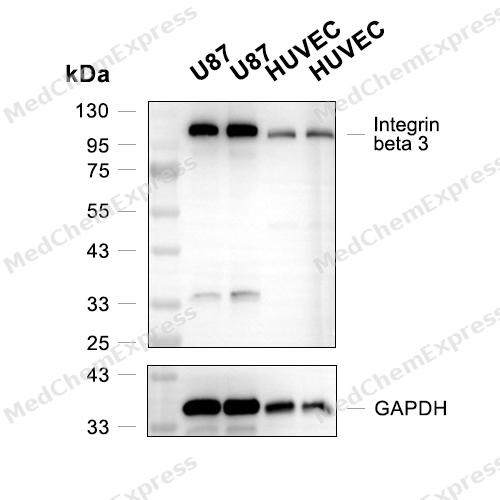 Western blot analysis of extracts from U87(lane 2(20μg) or lane 3(40μg)) and HUVEC(lane 4(20μg) or lane 5(40μg)), using Integrin beta 3 (HY-P80419) Rabbit mAb. Proteins were transferred to a PVDF membrane and blocked with 5% BSA in TBST for 2 hour at room temperature. The primary antibody (HY-P80419, 1/1000) and Loading control antibody (GAPDH, HY-P80954, 1/3000) was used in 5% BSA in TBST at 4°C overnight. Goat Anti-Mouse/Rabbit IgG-HRP Secondary Antibody (HY-P8004/HY-P8001, 1/10,000) was used for 1 hour at room temperature.


Background
-
Function
Integrin beta 3 is an Integrin alpha-V/beta-3 (ITGAV:ITGB3) is a receptor for cytotactin, fibronectin, laminin, matrix metalloproteinase-2, osteopontin, osteomodulin, prothrombin, thrombospondin, vitronectin and von Willebrand factor. Integrin alpha-IIb/beta-3 (ITGA2B:ITGB3) is a receptor for fibronectin, fibrinogen, plasminogen, prothrombin, thrombospondin and vitronectin. Integrins alpha-IIb/beta-3 and alpha-V/beta-3 recognize the sequence R-G-D in a wide array of ligands. Integrin alpha-IIb/beta-3 recognizes the sequence H-H-L-G-G-G-A-K-Q-A-G-D-V in fibrinogen gamma chain. Following activation integrin alpha-IIb/beta-3 brings about platelet/platelet interaction through binding of soluble fibrinogen. This step leads to rapid platelet aggregation which physically plugs ruptured endothelial surface. Fibrinogen binding enhances SELP expression in activated platelets. ITGAV:ITGB3 binds to fractalkine (CX3CL1) and acts as its coreceptor in CX3CR1-dependent fractalkine signaling. ITGAV:ITGB3 binds to NRG1 (via EGF domain) and this binding is essential for NRG1-ERBB signaling. ITGAV:ITGB3 binds to FGF1 and this binding is essential for FGF1 signaling. ITGAV:ITGB3 binds to FGF2 and this binding is essential for FGF2 signaling. ITGAV:ITGB3 binds to IGF1 and this binding is essential for IGF1 signaling. ITGAV:ITGB3 binds to IGF2 and this binding is essential for IGF2 signaling. ITGAV:ITGB3 binds to IL1B and this binding is essential for IL1B signaling. ITGAV:ITGB3 binds to PLA2G2A via a site (site 2) which is distinct from the classical ligand-binding site (site 1) and this induces integrin conformational changes and enhanced ligand binding to site 1. ITGAV:ITGB3 acts as a receptor for fibrillin-1 (FBN1) and mediates R-G-D-dependent cell adhesion to FBN1. In brain, plays a role in synaptic transmission and plasticity. Involved in the regulation of the serotonin neurotransmission, is required to localize to specific compartments within the synapse the serotonin receptor SLC6A4 and for an appropriate reuptake of serotonin. Controls excitatory synaptic strength by regulating GRIA2-containing AMPAR endocytosis, which affects AMPAR abundance and composition. ITGAV:ITGB3 act as a receptor for CD40LG. ITGAV:ITGB3 acts as a receptor for IBSP and promotes cell adhesion and migration to IBSP; (Microbial infection) Integrin ITGAV:ITGB3 acts as a receptor for Herpes virus 8/HHV-8; (Microbial infection) Integrin ITGAV:ITGB3 acts as a receptor for Coxsackievirus A9; (Microbial infection) Acts as a receptor for Hantaan virus; (Microbial infection) Integrin ITGAV:ITGB3 acts as a receptor for Cytomegalovirus/HHV-5; (Microbial infection) Integrin ITGA5:ITGB3 acts as a receptor for Human metapneumovirus; (Microbial infection) Integrin ITGAV:ITGB3 acts aP05556s a receptor for Human parechovirus 1; (Microbial infection) Integrin ITGAV:ITGB3 acts as a receptor for West nile virus; (Microbial infection) In case of HIV-1 infection, the interaction with extracellular viral Tat protein seems to enhance angiogenesis in Kaposi's sarcoma lesions[1][2][3][4][5][6][7][8][9][10][11][12][13][14].
-
Subcellular Localization
Cell membrane; Single-pass type I membrane protein; Cell projection, lamellipodium membrane; Cell junction, focal adhesion; Postsynaptic cell membrane; Single-pass type I membrane protein; Synapse
-
Expression
Tissue_specificity:Both β-3A and β-3C isoforms are widely expressed. β-3A isoform is specifically expressed in osteoblasts; β-3C isoform is specifically expressed in the prostate and testes. -
Subunit
Heterodimer of an alpha and a beta subunit. Beta-3 (ITGB3) associates with either alpha-IIb (ITGA2B) or alpha-V (ITGAV). Isoform Beta-3C interacts with FLNB. Interacts with COMP. Interacts with PDIA6 following platelet stimulation. Interacts with SYK; upon activation by ITGB3 promotes platelet adhesion. Interacts with MYO10. Interacts with DAB2. Interacts with FERMT2. Interacts with EMP2; regulates the levels of the heterodimer ITGA5:ITGB3 integrin expression on the plasma membrane (PubMed:16216233). Integrin ITGAV:ITGB3 interacts with FBLN5 (via N-terminus) (By similarity). ITGAV:ITGB3 interacts with CCN3 (PubMed:12695522). ITGAV:ITGB3 and ITGA2B:ITGB3 interact with SELP (via C-type lectin domain); the interaction mediates cell-cell interaction and adhesion (PubMed:37184585). ITGAV:ITGB3 is found in a ternary complex with CX3CR1 and CX3CL1 (PubMed:23125415). ITGAV:ITGB3 is found in a ternary complex with NRG1 and ERBB3 (PubMed:20682778). ITGAV:ITGB3 is found in a ternary complex with FGF1 and FGFR1 (PubMed:18441324). ITGAV:ITGB3 interacts with FGF2; it is likely that FGF2 can simultaneously bind ITGAV:ITGB3 and FGF receptors (PubMed:28302677). ITGAV:ITGB3 binds to IL1B (PubMed:29030430). ITGAV:ITGB3 is found in a ternary complex with IGF1 and IGF1R (PubMed:19578119). ITGAV:ITGB3 interacts with IGF2 (PubMed:28873464). ITGAV:ITGB3 interacts with FBN1 (PubMed:12807887). ITGAV:ITGB3 interacts with CD9, CD81 and CD151 (via second extracellular domain) (PubMed:27993971). Interacts (via the allosteric site (site 2)) with CXCL12 in a CXCR4-independent manner (PubMed:29301984). Interacts with MXRA8/DICAM; the interaction inhibits ITGAV:ITGB3 heterodimer formation (PubMed:22492581). ITGAV:ITGB3 interacts with PTN (PubMed:19141530). Forms a complex with PTPRZ1 and PTN that stimulates endothelial cell migration through ITGB3 Tyr-773 phosphorylation (PubMed:19141530). ITGAV:ITGB3 interacts with SLC6A4. Interacts with SLC6A4 (via C-terminus); this interaction regulates SLC6A4 trafficking (By similarity). ITGA2B:ITGB3 interacts with PPIA/CYPA; the interaction is ROS and PPIase activity-dependent and is increased in the presence of thrombin (By similarity). Interacts with tensin TNS3; TNS3 also interacts with PEAK1, thus acting as an adapter molecule to bridge the association of PEAK1 with ITGB3 (PubMed:35687021). Interacts with TM4SF19 (PubMed:38016540)
-
SwissProt ID
-
Synonyms
CD61, GP3A, ITGB3, Integrin beta-3, Platelet membrane glycoprotein IIIa, GPIIIa
-
Research Field
Tags & Cell Markers


Documentation
-
Data Sheet (265 KB)
-
SDS (252 KB)
- English - EN (252 KB)
- Français - FR (252 KB)
- Deutsch - DE (252 KB)
- Norwegian - NO (252 KB)
- Español - ES (252 KB)
- Swedish - SV (252 KB)
- Italian - IT (252 KB)
- Korean - KR (252 KB)
- Portuguese - PT (252 KB)
-
User Guide for Antibodies (1077 KB)
References
[1]. Si-Tahar M, et al. Human neutrophil elastase proteolytically activates the platelet integrin alphaIIbbeta3 through cleavage of the carboxyl terminus of the alphaIIb subunit heavy chain. Involvement in the potentiation of platelet aggregation. J Biol Chem. 1997 Apr 25;272(17):11636-47. [Content Brief]
[2]. Fujita M, et al. Integrins αvβ3 and α4β1 act as coreceptors for fractalkine, and the integrin-binding defective mutant of fractalkine is an antagonist of CX3CR1. J Immunol. 2012 Dec 15;189(12):5809-19. [Content Brief]
[3]. Fujita M, et al. The chemokine fractalkine can activate integrins without CX3CR1 through direct binding to a ligand-binding site distinct from the classical RGD-binding site. PLoS One. 2014;9(5):e96372. [Content Brief]
[4]. Ieguchi K, et al. Direct binding of the EGF-like domain of neuregulin-1 to integrins ({alpha}v{beta}3 and {alpha}6{beta}4) is involved in neuregulin-1/ErbB signaling. J Biol Chem. 2010 Oct 8;285(41):31388-98. [Content Brief]
[5]. Mori S, et al. Direct binding of integrin alphavbeta3 to FGF1 plays a role in FGF1 signaling. J Biol Chem. 2008 Jun 27;283(26):18066-75. [Content Brief]
[6]. Mori S, et al. The integrin-binding defective FGF2 mutants potently suppress FGF2 signalling and angiogenesis. Biosci Rep. 2017 Apr 28;37(2):. [Content Brief]
[7]. Saegusa J, et al. The direct binding of insulin-like growth factor-1 (IGF-1) to integrin alphavbeta3 is involved in IGF-1 signaling. J Biol Chem. 2009 Sep 4;284(36):24106-14. [Content Brief]
[8]. Cedano Prieto DM, et al. Direct integrin binding to insulin-like growth factor-2 through the C-domain is required for insulin-like growth factor receptor type 1 (IGF1R) signaling. PLoS One. 2017;12(9):e0184285. [Content Brief]
[9]. Takada YK, et al. Direct binding to integrins and loss of disulfide linkage in interleukin-1β (IL-1β) are involved in the agonistic action of IL-1β. J Biol Chem. 2017 Dec 8;292(49):20067-20075. [Content Brief]
[10]. Saegusa J, et al. Pro-inflammatory secretory phospholipase A2 type IIA binds to integrins alphavbeta3 and alpha4beta1 and induces proliferation of monocytic cells in an integrin-dependent manner. J Biol Chem. 2008 Sep 19;283(38):26107-15. [Content Brief]
[11]. Fujita M, et al. Proinflammatory secreted phospholipase A2 type IIA (sPLA-IIA) induces integrin activation through direct binding to a newly identified binding site (site 2) in integrins αvβ3, α4β1, and α5β1. J Biol Chem. 2015 Jan 2;290(1):259-71. [Content Brief]
[12]. Bax DV, et al. Cell adhesion to fibrillin-1 molecules and microfibrils is mediated by alpha 5 beta 1 and alpha v beta 3 integrins. J Biol Chem. 2003 Sep 5;278(36):34605-16. [Content Brief]
[13]. Takada YK, et al. Integrin Binding to the Trimeric Interface of CD40L Plays a Critical Role in CD40/CD40L Signaling. J Immunol. 2019 Sep 1;203(5):1383-1391. [Content Brief]
[14]. Byzova TV, et al. Activation of integrin alpha(V)beta(3) regulates cell adhesion and migration to bone sialoprotein. Exp Cell Res. 2000 Feb 1;254(2):299-308. [Content Brief]

 Powered by Bioz
