



IRAK4 Antibody (YA3115)
(Synonyms: IL-1 receptor-associated kinase 4; Interleukin 1 receptor associated kinase 4 mutant form 1; IPD1; IRAK4; LOC 51135; NY REN 64; REN64)Based on 1 Customer Validation
IRAK4 Antibody (YA3115) is a Rabbit-derived and non-conjugated IgG monoclonal antibody, targeting to IRAK4.
-
Host:
Rabbit
-
Isotype:
IgG
-
Application:
WB, IHC-F, IHC-P, ICC/IF
-
Reactivity :
Human
-
Formulation:
Supplied in 50mM Tris-Glycine(pH 7.4), 0.15M NaCl, 40% Glycerol, 0.01% Sodium azide and 0.05% BSA
-
Conjugation:
Non-conjugated


To place orders, for customer services and technical support, please contact: MedChemExpress USA
Tel: 609-228-6898 E-mail: [email protected] [email protected]





Applications
| Application |
WB

WB: Western Blot
|
IHC-P
IHC-P: Immunohistochemistry-Paraffin
|
IHC-F
IHC-F: Immunohistochemistry-Frozen
|
ICC/IF
ICC/IF: Immunocytochemistry/
Immunofluorescence |
|---|---|---|---|---|
| Dilution Ratio | 1:500-1:1000 | 1:50-1:100 | 1:50-1:100 | 1:50-1:200 |


Product Details
IRAK4 Antibody (YA3115) is a Rabbit-derived and non-conjugated IgG monoclonal antibody, targeting to IRAK4.
-
Host Rabbit

-
Clonality Recombinant,Monoclonal

-
Species ReactivityHuman
-
Observed Molecular WeightObserved band size:55 kD
Note: Due to possible protein modifications or aggregation, the molecular weight should be confirmed by actual measurement, and the predicted value is for reference only.

A synthetic peptide of human IRAK4
Endogenous
Affinity Purified
Non-conjugated
Unmodified
IgG


Product Properties
-
Appearance
Solution
-
Formulation
Supplied in 50mM Tris-Glycine(pH 7.4), 0.15M NaCl, 40% Glycerol, 0.01% Sodium azide and 0.05% BSA
-
Concentration
Batch-dependent, Please check the COA for the concentration of each lot. Check Lot Concentration
-
Storage & Stability
Stored at -20°C for 1 year. Avoid repeated freeze / thaw cycles.
-
Shipping
Shipping with blue ice.


Verification Images
-
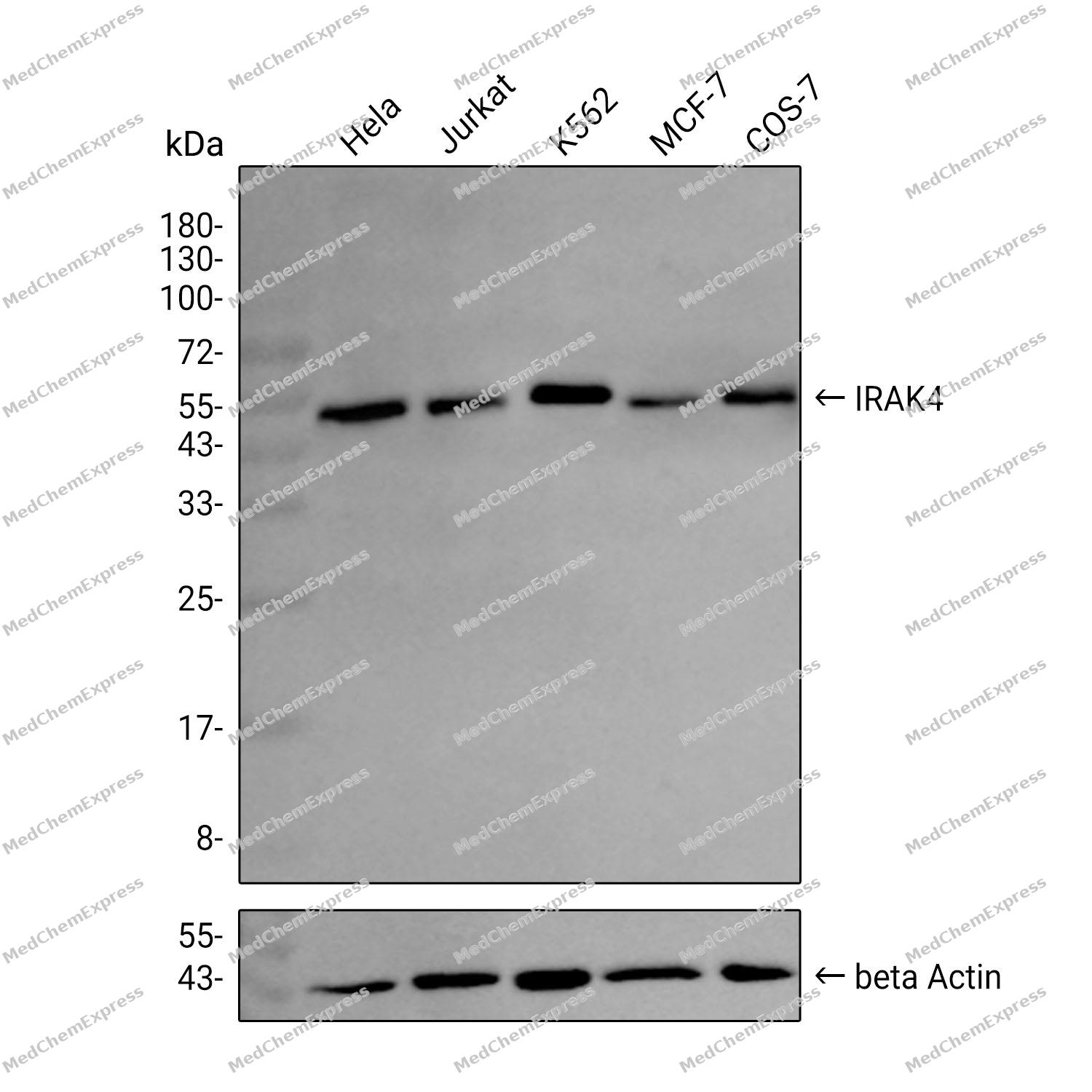 Western blot analysis was performed on extracts from Hela (lane 1, 15 μg), Jurkat (lane 2, 15 μg), K562 (lane 3, 15 μg), MCF-7 (lane 4, 15 μg), and COS-7 (lane 5, 15 μg) using IRAK4 Rabbit mAb.Proteins were transferred to a PVDF membrane and blocked with 5% non-fat milk in TBST at 4°C overnight.The primary antibody (1:1000 dilution) and the loading control antibody (beta-Actin, HY-P80438, 1:5000 dilution) was incubated in 5% non-fat milk in TBST for 1 hour at 37°C.Goat Anti-Rabbit IgG-HRP Secondary Antibody (1:20000 dilution) was then applied for 40 minutes at 37°C.
 -
 Western blot analysis was performed on protein extracts (25 μg) from HeLa (lane 1), 293T (lane 2), THP-1 (lane 3), Ramos (lane 4), and SH-SY5Y (lane 5) using IRAK4 antibody. Proteins were transferred onto a 0.45 μm PVDF membrane using the Trans-Blot® Turbo™ system for 13 min. The membrane was then blocked with 5% nonfat milk in TBST (HY-K1025) for 1 h at room temperature. The primary antibody (1:1000) and loading control antibody GAPDH Antibody (HRP) (HY-P80954A) (1:5000) were diluted in 5% nonfat milk in TBST and incubated with the membrane overnight at 4°C. After washing, the membrane of primary antibody was incubated with HRP-conjugated goat anti-rabbit/mouse IgG secondary antibody (HY-P8001/HY-P8004) (1:5000) diluted in 5% nonfat milk in TBST for 1 h at room temperature. Protein bands were visualized using an Ultra High Sensitivity ECL detection kit (HY-K1005).
 -
 Immunohistochemical analysis of paraffin-embedded human Prostate Cancer tissue using IRAK4 antibody was performed. The section was pretreated using high-temperature and high-pressure mediated EDTA antigen retrieval buffer (pH 9.0), for 5 minutes. The tissues were incubated with primary antibody (HY-P83370, 1:300 dilution) at room temperature for 60 minutes. Detection was performed using an HRP conjugated compact polymer system. DAB was used as the chromogen. The tissues were counterstained with hematoxylin and mounted with neutral balsam mounting medium.
 -
 Immunohistochemical analysis of paraffin-embedded human cholangiocarcinoma tissue using IRAK4 antibody was performed. The section was pretreated using high-temperature and high-pressure mediated EDTA antigen retrieval buffer (pH 9.0), for 5 minutes. The tissues were incubated with primary antibody (HY-P83370, 1:300 dilution) at room temperature for 60 minutes. Detection was performed using an HRP conjugated compact polymer system. DAB was used as the chromogen. The tissues were counterstained with hematoxylin and mounted with neutral balsam mounting medium.
 -
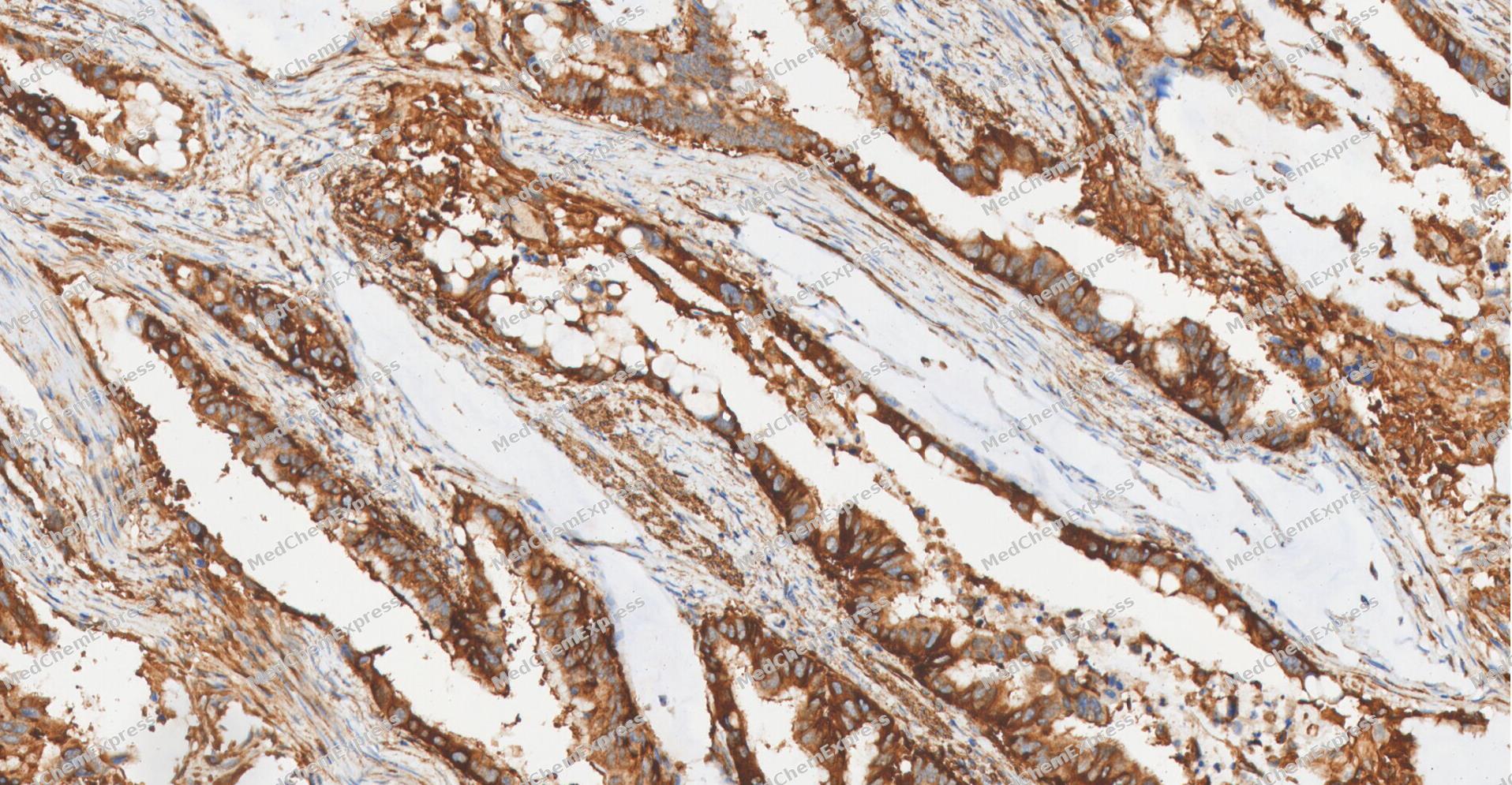 Immunohistochemical analysis of paraffin-embedded human Gastric Cancer tissue using IRAK4 antibody was performed. The section was pretreated using high-temperature and high-pressure mediated EDTA antigen retrieval buffer (pH 9.0), for 5 minutes. The tissues were incubated with primary antibody (HY-P83370, 1:300 dilution) at room temperature for 60 minutes. Detection was performed using an HRP conjugated compact polymer system. DAB was used as the chromogen. The tissues were counterstained with hematoxylin and mounted with neutral balsam mounting medium.
 -
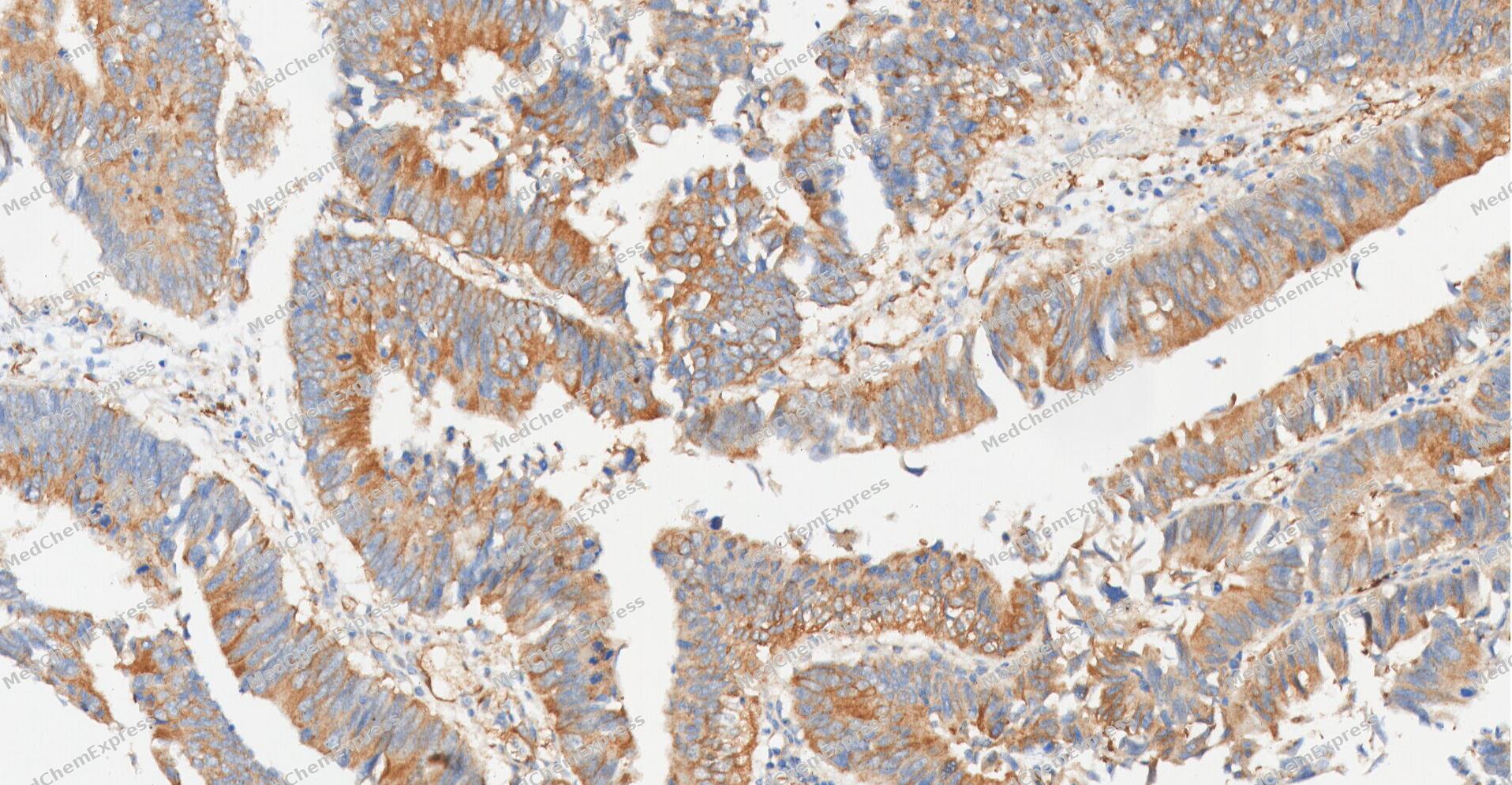 Immunohistochemical analysis of paraffin-embedded human Colon cancer tissue using IRAK4 antibody was performed. The section was pretreated using high-temperature and high-pressure mediated EDTA antigen retrieval buffer (pH 9.0), for 5 minutes. The tissues were incubated with primary antibody (HY-P83370, 1:300 dilution) at room temperature for 60 minutes. Detection was performed using an HRP conjugated compact polymer system. DAB was used as the chromogen. The tissues were counterstained with hematoxylin and mounted with neutral balsam mounting medium.
 -
 Immunohistochemical analysis of paraffin-embedded human Colon cancer tissue using IRAK4 antibody was performed. The section was pretreated using high-temperature and high-pressure mediated EDTA antigen retrieval buffer (pH 9.0), for 5 minutes. The tissues were incubated with primary antibody (HY-P83370, 1:300 dilution) at room temperature for 60 minutes. Detection was performed using an HRP conjugated compact polymer system. DAB was used as the chromogen. The tissues were counterstained with hematoxylin and mounted with neutral balsam mounting medium.
 -
 Immunohistochemical analysis of paraffin-embedded human Lung Adenocarcinom tissue using IRAK4 antibody was performed. The section was pretreated using high-temperature and high-pressure mediated EDTA antigen retrieval buffer (pH 9.0), for 5 minutes. The tissues were incubated with primary antibody (HY-P83370, 1:300 dilution) at room temperature for 60 minutes. Detection was performed using an HRP conjugated compact polymer system. DAB was used as the chromogen. The tissues were counterstained with hematoxylin and mounted with neutral balsam mounting medium.
 -
 Tyramide signaling amplification based immunofluorescence was performed on paraffin-embedded human Colon cancer tissue using IRAK4 antibody. Antigen retrieval was performed in EDTA buffer pH 9.0 (95 °C, 20 min) followed by cooling to RT. Then incubated with primary antibody (HY-P83370, 1:200 dilution) at room temperature for 60 minutes and HRP conjugated secondary antibody for 10 minutes. Fluorescence was then developed with Vari Fluor 532 TSA (200×)(HY-D1832). The tissues were counterstained with DAPI and mounted with Anti-fade mounting medium.
 -
 Tyramide signaling amplification based immunofluorescence was performed on paraffin-embedded human Colon cancer tissue using IRAK4 antibody. Antigen retrieval was performed in EDTA buffer pH 9.0 (95 °C, 20 min) followed by cooling to RT. Then incubated with primary antibody (HY-P83370, 1:200 dilution) at room temperature for 60 minutes and HRP conjugated secondary antibody for 10 minutes. Fluorescence was then developed with Vari Fluor 532 TSA (200×)(HY-D1832). The tissues were counterstained with DAPI and mounted with Anti-fade mounting medium.
 -
 Tyramide signaling amplification based immunofluorescence was performed on paraffin-embedded human Colon cancer tissue using IRAK4 antibody. Antigen retrieval was performed in EDTA buffer pH 9.0 (95 °C, 20 min) followed by cooling to RT. Then incubated with primary antibody (HY-P83370, 1:200 dilution) at room temperature for 60 minutes and HRP conjugated secondary antibody for 10 minutes. Fluorescence was then developed with Vari Fluor 532 TSA (200×)(HY-D1832). The tissues were counterstained with DAPI and mounted with Anti-fade mounting medium.
 -
 Tyramide signaling amplification based immunofluorescence was performed on paraffin-embedded human Prostate Cancer tissue using IRAK4 antibody. Antigen retrieval was performed in EDTA buffer pH 9.0 (95 °C, 20 min) followed by cooling to RT. Then incubated with primary antibody (HY-P83370, 1:200 dilution) at room temperature for 60 minutes and HRP conjugated secondary antibody for 10 minutes. Fluorescence was then developed with Vari Fluor 532 TSA (200×)(HY-D1832). The tissues were counterstained with DAPI and mounted with Anti-fade mounting medium.
 -
 Tyramide signaling amplification based immunofluorescence was performed on paraffin-embedded human Prostate Cancer tissue using IRAK4 antibody. Antigen retrieval was performed in EDTA buffer pH 9.0 (95 °C, 20 min) followed by cooling to RT. Then incubated with primary antibody (HY-P83370, 1:200 dilution) at room temperature for 60 minutes and HRP conjugated secondary antibody for 10 minutes. Fluorescence was then developed with Vari Fluor 532 TSA (200×)(HY-D1832). The tissues were counterstained with DAPI and mounted with Anti-fade mounting medium.
 -
 Tyramide signaling amplification based immunofluorescence was performed on paraffin-embedded human Prostate Cancer tissue using IRAK4 antibody. Antigen retrieval was performed in EDTA buffer pH 9.0 (95 °C, 20 min) followed by cooling to RT. Then incubated with primary antibody (HY-P83370, 1:200 dilution) at room temperature for 60 minutes and HRP conjugated secondary antibody for 10 minutes. Fluorescence was then developed with Vari Fluor 532 TSA (200×)(HY-D1832). The tissues were counterstained with DAPI and mounted with Anti-fade mounting medium.


Background
-
Function
Interleukin-1 receptor-associated kinase 4 (IRAK4) is a serine/threonine kinase that functions as a key mediator in Toll-like receptor (TLR) and interleukin-1 receptor (IL-1R) signaling pathways[1][2]. Mechanistically, IRAK4 initiates myddosome formation by recruiting and activating IRAK1, facilitating downstream NF-κB and MAPK signaling[2][3]. Compared with other IRAK family members, IRAK4 possesses both kinase activity and scaffolding functions, with its scaffold role being essential for myddosome assembly independent of catalytic activity[2][3]. Dysregulation or overexpression of IRAK4 contributes to inflammatory, autoimmune, and oncogenic processes, including rheumatoid arthritis, myelodysplastic syndromes (MDS), and acute myeloid leukemia (AML) [1][4][5]. In MDS and AML, long isoforms of IRAK4 (IRAK4-L) produced by spliceosome mutations such as SF3B1 or U2AF1 retain maximal functional domains, driving constitutive NF-κB activation and sustaining leukemic stem cell function[5][6][7]. Selective IRAK4 inhibitors, including DW18134, CA-4948, PF-06650833, and KME-0584, have demonstrated efficacy in preclinical models by reducing proinflammatory cytokines and suppressing leukemic progenitor proliferation[8][9][10]. Dual inhibition of IRAK4 and IRAK1 enhances therapeutic outcomes, as IRAK1 compensatory activation can limit the efficacy of IRAK4-selective agents[9]. Mechanistic studies also highlight that IRAK4 degraders, which eliminate both scaffolding and kinase functions, achieve broader suppression of TLR/IL-1R-induced NF-κB and p38 signaling compared with kinase inhibition alone[3].
-
Subcellular Localization
Cytoplasm
-
Isoforms & Post-Translational Modification
Q9NWZ3 has 2 isomers: Q9NWZ3-1: 51530 Da (predicted); Q9NWZ3-2: 37674 Da (predicted).
Phosphorylated -
Subunit
Associates with MYD88 and IRAK2 to form a ternary complex called the Myddosome (PubMed:16951688, PubMed:24316379). Once phosphorylated, IRAK4 dissociates from the receptor complex and then associates with the TNF receptor-associated factor 6 (TRAF6), IRAK1, and PELI1; this intermediate complex is required for subsequent NF-kappa-B activation (PubMed:11960013, PubMed:12496252, PubMed:16951688). Direct binding of SMAD6 to PELI1 prevents complex formation and hence negatively regulates IL1R-TLR signaling and eventually NF-kappa-B-mediated gene expression (PubMed:16951688). Interacts with IL1RL1 (PubMed:16286016). Interacts (when phosphorylated) with IRAK1 (PubMed:33238146). May interact (when phosphorylated) with IRAK3 (PubMed:33238146)
-
SwissProt ID
-
Synonyms
IL-1 receptor-associated kinase 4; Interleukin 1 receptor associated kinase 4 mutant form 1; IPD1; IRAK4; LOC 51135; NY REN 64; REN64
-
Research Field
Immunology


Documentation
-
Data Sheet (262 KB)
-
SDS (252 KB)
- English - EN (252 KB)
- Français - FR (252 KB)
- Deutsch - DE (252 KB)
- Norwegian - NO (252 KB)
- Español - ES (252 KB)
- Swedish - SV (252 KB)
- Italian - IT (252 KB)
- Korean - KR (252 KB)
- Portuguese - PT (252 KB)
-
User Guide for Antibodies (1077 KB)
References
[1]. Singer JW, et al. Inhibition of interleukin-1 receptor-associated kinase 1 (IRAK1) as a therapeutic strategy. Oncotarget. 2018 Sep 7;9(70):33416-33439. [Content Brief]
[2]. Feng Y, et al. Emerging interleukin-1 receptor-associated kinase 4 (IRAK4) inhibitors or degraders as therapeutic agents for autoimmune diseases and cancer. Acta Pharm Sin B. 2024 Dec;14(12):5091-5105. [Content Brief]
[3]. De Nardo D, et al. Interleukin-1 receptor-associated kinase 4 (IRAK4) plays a dual role in myddosome formation and Toll-like receptor signaling. J Biol Chem. 2018 Sep 28;293(39):15195-15207. [Content Brief]
[4]. Huang Y, et al. A Novel IRAK4 Inhibitor DW18134 Ameliorates Peritonitis and Inflammatory Bowel Disease. Molecules. 2024 Apr 16;29(8):1803. [Content Brief]
[5]. Yoon SB, et al. A novel IRAK4/PIM1 inhibitor ameliorates rheumatoid arthritis and lymphoid malignancy by blocking the TLR/MYD88-mediated NF-κB pathway. Acta Pharm Sin B. 2023 Mar;13(3):1093-1109. [Content Brief]
[8]. Choudhary SA, et al. A small molecule potent IRAK4 inhibitor abrogates lipopolysaccharide-induced macrophage inflammation in-vitro and in-vivo. Eur J Pharmacol. 2023 Apr 5;944:175593. [Content Brief]
[9]. Hao X, et al. Electromagnetic Functional Properties of Flexible Picosecond Laser-Induced Graphene Films Modified with Silver Nanoparticles. ACS Appl Mater Interfaces. 2026 May 27;18(20):28957-28968. [Content Brief]

 Powered by Bioz
