



Junctional Adhesion Molecule 1 Antibody (YA3025)
(Synonyms: F11R; JAM1; JCAM; Junctional adhesion molecule A; JAM-A; Junctional adhesion molecule 1; JAM-1; Platelet F11 receptor; Platelet adhesion molecule 1; PAM-1; CD321)
Based on 1 Customer Validation
Junctional Adhesion Molecule 1 Antibody (YA3025) is a Rabbit-derived and non-conjugated IgG monoclonal antibody, targeting to Junctional Adhesion Molecule 1.
-
Host:
Rabbit
-
Isotype:
IgG
-
Application:
WB, ICC/IF, IP, FC
-
Reactivity :
Human
-
Formulation:
Supplied in 50mM Tris-Glycine(pH 7.4), 0.15M NaCl, 40% Glycerol, 0.01% Sodium azide and 0.05% BSA
-
Conjugation:
Non-conjugated


To place orders, for customer services and technical support, please contact: MedChemExpress USA
Tel: 609-228-6898 E-mail: [email protected] [email protected]





Applications
| Application |
WB

WB: Western Blot
|
ICC/IF
ICC/IF: Immunocytochemistry/
Immunofluorescence |
FC
FC: Flow Cytometry
|
IP
IP: Immunoprecipitation
|
|---|---|---|---|---|
| Dilution Ratio | 1:500-1:1000 | 1:20-1:50 | 1:200-1:500 | 1:20-1:50 |


Product Details
Junctional Adhesion Molecule 1 Antibody (YA3025) is a Rabbit-derived and non-conjugated IgG monoclonal antibody, targeting to Junctional Adhesion Molecule 1.
-
Host Rabbit

-
Clonality Recombinant,Monoclonal

-
Species ReactivityHuman
-
Observed Molecular WeightObserved band size: 37 kD
Note: Due to possible protein modifications or aggregation, the molecular weight should be confirmed by actual measurement, and the predicted value is for reference only.

Recombinant protein (aa28-238) of human Junctional Adhesion Molecule 1/JAM-A.
Endogenous
Affinity Purified
Non-conjugated
Unmodified
IgG


Product Properties
-
Appearance
Solution
-
Formulation
Supplied in 50mM Tris-Glycine(pH 7.4), 0.15M NaCl, 40% Glycerol, 0.01% Sodium azide and 0.05% BSA
-
Concentration
Batch-dependent, Please check the COA for the concentration of each lot. Check Lot Concentration
-
Storage & Stability
Stored at -20°C for 1 year. Avoid repeated freeze / thaw cycles.
-
Shipping
Shipping with blue ice.


Verification Images
-
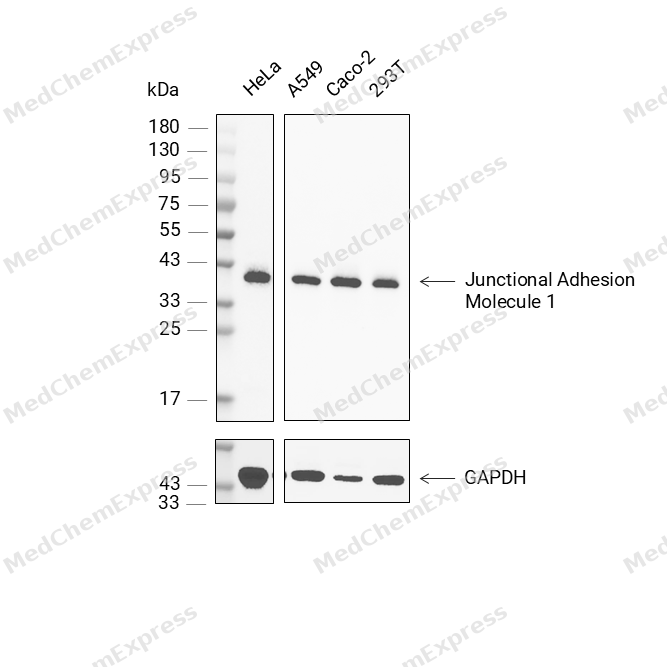 Western blot analysis was performed on protein extracts (25 μg) from HeLa (lane 2), A549 (lane 3), Caco-2 (lane 4), and 293T (lane 5) using Junctional Adhesion Molecule 1 antibody. Proteins were transferred onto a 0.45 μm PVDF membrane using the Trans-Blot® Turbo™ system for 13 min. The membrane was then blocked with 5% nonfat milk in TBST (HY-K1025) for 1 h at room temperature. The primary antibody (1:1000) and loading control antibody GAPDH Antibody (HRP) (HY-P80954A) (1:5000) were diluted in 5% nonfat milk in TBST and incubated with the membrane overnight at 4°C. After washing, the membrane of primary antibody was incubated with HRP-conjugated goat anti-rabbit/mouse IgG secondary antibody (HY-P8001/HY-P8004) (1:5000) diluted in 5% nonfat milk in TBST for 1 h at room temperature. Protein bands were visualized using an Ultra High Sensitivity ECL detection kit (HY-K1005).


Background
-
Function
Junctional Adhesion Molecule 1 is a Seems to play a role in epithelial tight junction formation. Appears early in primordial forms of cell junctions and recruits PARD3. The association of the PARD6-PARD3 complex may prevent the interaction of PARD3 with JAM1, thereby preventing tight junction assembly. Plays a role in regulating monocyte transmigration involved in integrity of epithelial barrier. Ligand for integrin alpha-L/beta-2 involved in memory T-cell and neutrophil transmigration. Involved in platelet activation; (Microbial infection) Acts as a receptor for Mammalian reovirus sigma-1; (Microbial infection) Acts as a receptor for Human Rotavirus strain Wa[1][2][3].
-
Subcellular Localization
Cell junction, tight junction; Cell membrane; Single-pass type I membrane protein
-
Expression
Tissue_specificity:It is expressed (at the protein level) in endothelial cells, epithelial cells, and leukocytes. -
Isoforms & Post-Translational Modification
Q9Y624 has 2 isomers: Q9Y624-1: 32583 Da (predicted); Q9Y624-2: 27208 Da (predicted).
N-glycosylated;(Microbial infection) Cleaved by H.pylori virulence factor PqqE. Cleavage leads to altered tight junction functions -
Subunit
Interacts with the ninth PDZ domain of MPDZ (PubMed:11489913). Interacts with the first PDZ domain of PARD3 (PubMed:11489913). The association between PARD3 and PARD6B probably disrupts this interaction (By similarity). Interacts with ITGAL (via I-domain) (PubMed:15528364). Interacts with CD151 (PubMed:35067832)
-
SwissProt ID
-
Synonyms
F11R; JAM1; JCAM; Junctional adhesion molecule A; JAM-A; Junctional adhesion molecule 1; JAM-1; Platelet F11 receptor; Platelet adhesion molecule 1; PAM-1; CD321
-
Research Field
Cardiovascular


Documentation

 Powered by Bioz
