



Ku80 Antibody (YA714)
(Synonyms: XRCC5; G22P2; X-ray repair cross-complementing protein 5; 86 kDa subunit of Ku antigen; ATP-dependent DNA helicase 2 subunit 2; ATP-dependent DNA helicase II 80 kDa subunit; CTC box-binding factor 85 kDa subunit; CTC85; CTCBF; DNA repair pr)
Based on 1 Customer Validation
Ku80 Antibody (YA714) is a Mouse-derived and non-conjugated IgG1 monoclonal antibody, targeting to Ku80.
-
Host:
Mouse
-
Isotype:
IgG
-
Application:
WB, ICC/IF, IP, ChIP
-
Reactivity :
Human, Monkey
-
Formulation:
Supplied in 1*PBS (pH 7.3), 50% glycerol and 0.5% BSA. Preservative: 0.02% sodium azide.
-
Conjugation:
Non-conjugated


To place orders, for customer services and technical support, please contact: MedChemExpress USA
Tel: 609-228-6898 E-mail: [email protected] [email protected]





Applications
| Application |
WB

WB: Western Blot
|
ICC/IF
ICC/IF: Immunocytochemistry/
Immunofluorescence |
IP
IP: Immunoprecipitation
|
ChIP
ChIP: Chromatin Immunoprecipitation
|
|---|---|---|---|---|
| Dilution Ratio | 1:500-1:1000 | 1:50-1:200 | 1:20 | 1:20 |


Product Details
Ku80 Antibody (YA714) is a Mouse-derived and non-conjugated IgG1 monoclonal antibody, targeting to Ku80.
-
Host Mouse

-
Clonality Monoclonal

-
Species ReactivityHuman, Monkey
-
Observed Molecular WeightObserved band size: 86 kDa
Note: Due to possible protein modifications or aggregation, the molecular weight should be confirmed by actual measurement, and the predicted value is for reference only.

-
Calculated Molecular Weight Predicted band size: 83 kDa

Synthetic peptide corresponding to Human Ku80.The exact sequence is proprietary to MCE.
Endogenous
affinity purified
Non-conjugated
Unmodified
IgG


Product Properties
-
Appearance
Solution
-
Formulation
Supplied in 1*PBS (pH 7.3), 50% glycerol and 0.5% BSA. Preservative: 0.02% sodium azide.
-
Concentration
Batch-dependent, Please check the COA for the concentration of each lot. Check Lot Concentration
-
Storage & Stability
Stored at -20°C for 1 year. Avoid repeated freeze / thaw cycles.
-
Shipping
Shipping with blue ice.


Verification Images
-
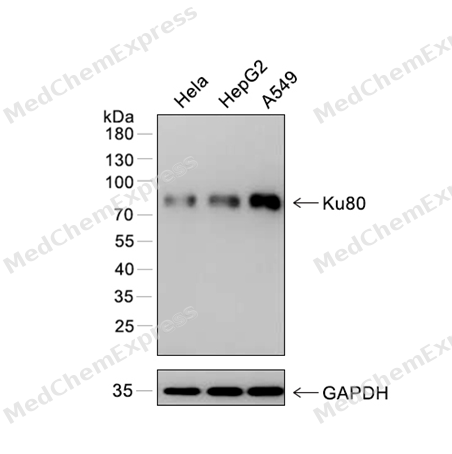 Western blot analysis of extracts from Hela (lane 1) and HepG2 (lane 2) and A549 (lane 3) using Ku80 antibody. Proteins were transferred to a PVDF membrane and blocked with 5% nonfat powdered milk in PBST for 2 hour at room temperature. The primary antibody (1/1000) and loading control antibody (GAPDH, 1/3000) was diluted with 5% nonfat powdered milk in PBST at 4°C overnight. Goat Anti-Rabbit IgG-HRP Secondary Antibody (1/8,000) was incubated for 45min at room temperature.
 -
 Immunocytochemistry analysis of Hela cells labeling Ku80 with Ku80 Antibody (HY-P80737) at 1/100 dilution. Cells were fixed in 4% paraformaldehyde for 15 minutes at room temperature, permeabilized with 0.1% Triton X-100 in PBS for 15 minutes at room temperature, then blocked with quick block buffer for 10 minutes at room temperature. Cells were then incubated with Ku80 Antibody (HY-P80737) at 1/100 dilution in quick block buffer overnight at 4 ℃.AF488-conjugated Goat Anti-Mouse IgG H&L (HY-P8005, Green) was used as the secondary antibody at 1/1,000 dilution. PBS instead of the primary antibody was used as the secondary antibody only control. The Nuclear counterstain was DAPI (Blue).
 -
 Immunocytochemistry analysis of PC-3 cells labeling Ku80 with Ku80 Antibody (HY-P80737) at 1/100 dilution. Cells were fixed in 4% paraformaldehyde for 15 minutes at room temperature, permeabilized with 0.1% Triton X-100 in PBS for 15 minutes at room temperature, then blocked with quick block buffer for 10 minutes at room temperature. Cells were then incubated with Ku80 Antibody (HY-P80737) at 1/100 dilution in quick block buffer overnight at 4 ℃.AF488-conjugated Goat Anti-Mouse IgG H&L (HY-P8005, Green) was used as the secondary antibody at 1/1,000 dilution. PBS instead of the primary antibody was used as the secondary antibody only control. The Nuclear counterstain was DAPI (Blue).


Background
-
Function
Ku80 is a Single-stranded DNA-dependent ATP-dependent helicase that plays a key role in DNA non-homologous end joining (NHEJ) by recruiting DNA-PK to DNA. Required for double-strand break repair and V(D)J recombination. Also has a role in chromosome translocation. The DNA helicase II complex binds preferentially to fork-like ends of double-stranded DNA in a cell cycle-dependent manner. It works in the 3'-5' direction. During NHEJ, the XRCC5-XRRC6 dimer performs the recognition step: it recognizes and binds to the broken ends of the DNA and protects them from further resection. Binding to DNA may be mediated by XRCC6. The XRCC5-XRRC6 dimer acts as a regulatory subunit of the DNA-dependent protein kinase complex DNA-PK by increasing the affinity of the catalytic subunit PRKDC to DNA by 100-fold. The XRCC5-XRRC6 dimer is probably involved in stabilizing broken DNA ends and bringing them together. The assembly of the DNA-PK complex to DNA ends is required for the NHEJ ligation step. The XRCC5-XRRC6 dimer probably also acts as a 5'-deoxyribose-5-phosphate lyase (5'-dRP lyase), by catalyzing the beta-elimination of the 5' deoxyribose-5-phosphate at an abasic site near double-strand breaks. XRCC5 probably acts as the catalytic subunit of 5'-dRP activity, and allows to 'clean' the termini of abasic sites, a class of nucleotide damage commonly associated with strand breaks, before such broken ends can be joined. The XRCC5-XRRC6 dimer together with APEX1 acts as a negative regulator of transcription. In association with NAA15, the XRCC5-XRRC6 dimer binds to the osteocalcin promoter and activates osteocalcin expression. As part of the DNA-PK complex, involved in the early steps of ribosome assembly by promoting the processing of precursor rRNA into mature 18S rRNA in the small-subunit processome. Binding to U3 small nucleolar RNA, recruits PRKDC and XRCC5/Ku86 to the small-subunit processome. Plays a role in the regulation of DNA virus-mediated innate immune response by assembling into the HDP-RNP complex, a complex that serves as a platform for IRF3 phosphorylation and subsequent innate immune response activation through the cGAS-STING pathway[1][2][3][4][5][6][7].
-
Subcellular Localization
Nucleus; Nucleus, nucleolus; Chromosome
-
Expression
Induction:In osteoblasts, by FGF2 -
Subunit
Heterodimer composed of XRCC5/Ku80 and XRCC6/Ku70; heterodimerization stabilizes XRCC5 protein (PubMed:11493912, PubMed:22442688, PubMed:25670504, PubMed:25941166, PubMed:35545041). Component of the core long-range non-homologous end joining (NHEJ) complex (also named DNA-PK complex) composed of PRKDC, LIG4, XRCC4, XRCC6/Ku70, XRCC5/Ku86 and NHEJ1/XLF (PubMed:11493912, PubMed:22442688, PubMed:25670504, PubMed:25941166, PubMed:33854234, PubMed:34352203). Additional component of the NHEJ complex includes PAXX (PubMed:25574025, PubMed:25670504, PubMed:25941166, PubMed:27601299). Following autophosphorylation, PRKDC dissociates from DNA, leading to formation of the short-range NHEJ complex, composed of LIG4, XRCC4, XRCC6/Ku70, XRCC5/Ku86 and NHEJ1/XLF (PubMed:33854234). The XRCC5-XRCC6 dimer also associates with NAA15, and this complex displays DNA binding activity towards the osteocalcin FGF response element (OCFRE) (PubMed:12145306). In addition, XRCC5 binds to the osteoblast-specific transcription factors MSX2 and RUNX2 (PubMed:12145306). Interacts with ELF3 (PubMed:15075319). Interacts with APLF (via KBM motif) (PubMed:17353262, PubMed:17396150, PubMed:23689425, PubMed:27063109, PubMed:31733588). The XRCC5/XRCC6 dimer associates in a DNA-dependent manner with APEX1 (PubMed:8621488). Identified in a complex with DEAF1 and XRCC6. Interacts with NR4A3; the DNA-dependent protein kinase complex DNA-PK phosphorylates and activates NR4A3 and prevents NR4A3 ubiquitinylation and degradation (PubMed:25852083). Interacts with RNF138 (PubMed:26502055). Interacts with CYREN isoform 1 (CYREN-1) and isoform 4 (CYREN-2) (via KBM motif) (PubMed:24610814, PubMed:27063109, PubMed:28959974). Interacts with WRN (via KBM motif) (PubMed:27063109). Interacts (via N-terminus) with HSF1 (via N-terminus); this interaction is direct and prevents XRCC5/XRCC6 heterodimeric binding and non-homologous end joining (NHEJ) repair activities induced by ionizing radiation (IR) (PubMed:26359349). Interacts with DHX9; this interaction occurs in a RNA-dependent manner (PubMed:14704337). Part of the HDP-RNP complex composed of at least HEXIM1, PRKDC, XRCC5, XRCC6, paraspeckle proteins (SFPQ, NONO, PSPC1, RBM14, and MATR3) and NEAT1 RNA (PubMed:28712728). Interacts with ERCC6 (PubMed:26030138). The XRCC5-XRCC6 dimer associates with ALKBH2. Interacts with TPRN; TPRN interacts with a number of DNA damage response proteins, is recruited to sites of DNA damage and may play a role in DNA damage repair (PubMed:23213405). Interacts with ERCC6L2 (By similarity)
-
SwissProt ID
-
Synonyms
XRCC5; G22P2; X-ray repair cross-complementing protein 5; 86 kDa subunit of Ku antigen; ATP-dependent DNA helicase 2 subunit 2; ATP-dependent DNA helicase II 80 kDa subunit; CTC box-binding factor 85 kDa subunit; CTC85; CTCBF; DNA repair pr
-
Research Field
Epigenetics and Nuclear Signaling


Documentation
-
Data Sheet (235 KB)
-
SDS (252 KB)
- English - EN (252 KB)
- Français - FR (252 KB)
- Deutsch - DE (252 KB)
- Norwegian - NO (252 KB)
- Español - ES (252 KB)
- Swedish - SV (252 KB)
- Italian - IT (252 KB)
- Korean - KR (252 KB)
- Portuguese - PT (252 KB)
-
User Guide for Antibodies (1077 KB)

 Powered by Bioz
