



RPA70 Antibody (YA678)
(Synonyms: RPA1; HSSB; MST075; REPA1; RF-A; RP-A; RPA70)Based on 2 publication(s) in Google Scholar
RPA70 Antibody (YA678) is a Mouse-derived and non-conjugated IgG2a monoclonal antibody, targeting to RPA70.
-
Host:
Mouse
-
Isotype:
IgG
-
Application:
WB, ICC/IF, IP
-
Reactivity :
Human, Monkey, Mouse, Rat
-
Formulation:
Supplied in 1*PBS (pH 7.3), 50% glycerol and 0.5% BSA. Preservative: 0.02% sodium azide.
-
Conjugation:
Non-conjugated


To place orders, for customer services and technical support, please contact: MedChemExpress USA
Tel: 609-228-6898 E-mail: [email protected] [email protected]



Publications Citing Use of MedChemExpress (MCE) RPA70 Antibody (YA678)
More

Applications
| Application |
WB

WB: Western Blot
|
ICC/IF
ICC/IF: Immunocytochemistry/
Immunofluorescence |
IP
IP: Immunoprecipitation
|
|---|---|---|---|
| Dilution Ratio | 1:500-1:1000 | 1:50-1:200 | 1:20 |


Product Details
RPA70 Antibody (YA678) is a Mouse-derived and non-conjugated IgG2a monoclonal antibody, targeting to RPA70.
-
Host Mouse

-
Clonality Monoclonal

-
Species ReactivityHuman, Monkey, Mouse, Rat
-
Observed Molecular WeightObserved band size: 68 kDa
Note: Due to possible protein modifications or aggregation, the molecular weight should be confirmed by actual measurement, and the predicted value is for reference only.

-
Calculated Molecular Weight Predicted band size: 68 kDa

Entrez Gene: 6117 Human ; 68275 Mouse ; 287524 Rat
SwissProt: P27694 Human ; Q8VEE4 Mouse ;
OMIM: 619767 Human
Synthetic peptide corresponding to Human RPA70.The exact sequence is proprietary to MCE.
Endogenous
affinity purified
Non-conjugated
Unmodified
IgG


Product Properties
-
Appearance
Solution
-
Formulation
Supplied in 1*PBS (pH 7.3), 50% glycerol and 0.5% BSA. Preservative: 0.02% sodium azide.
-
Concentration
Batch-dependent, Please check the COA for the concentration of each lot. Check Lot Concentration
-
Storage & Stability
Stored at -20°C for 1 year. Avoid repeated freeze / thaw cycles.
-
Shipping
Shipping with blue ice.


Publications (2)
-
Journal Impact Factor
-
Most Recent
-
Sci Bull
Dynamic R-loops at centromeres ensure chromosome alignment during oocyte meiotic divisions in mice. [Abstract]2025 Apr 30;70(8):1311-1327. PMID: 39984387 -
Nucleic Acids Res
RPA-ssDNA co-phase separation facilitates RAD51 enrichment during homologous recombination. [Abstract]2026 Jun 8;54(11):gkag586. PMID: 42273915


Verification Images
-
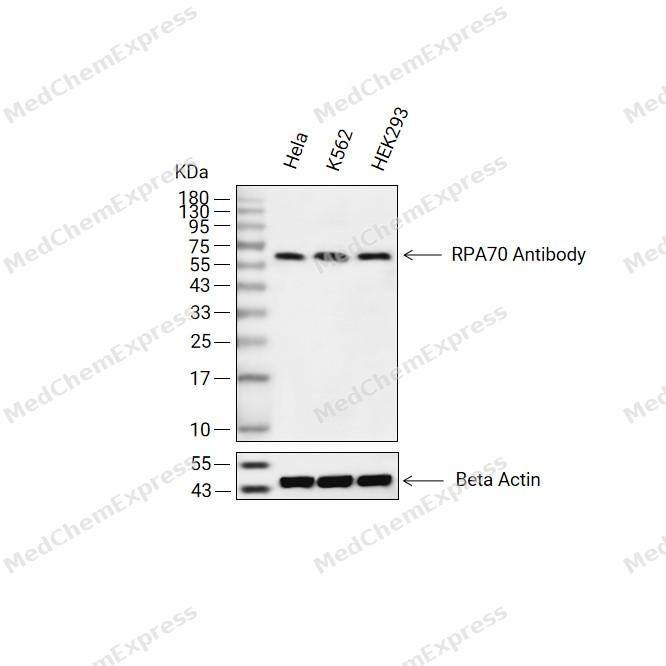 Western blot analysis of extracts from Hela(lane 2(20ug) ,K562(lane 3(20ug) and HEK293(lane 4(20ug) using RPA70 Antibody (HY-P80884) Rabbit mAb. Proteins were transferred to a PVDF membrane and blocked with 5% non-fat milk in TBST for 2 hour at room temperature. The primary antibody (1/1000) and Loading control antibody (Beta Actin, HY-P83730, 1/10000) was used in 5% non-fat milk in TBST at 4°C overnight. Goat Anti-Mouse/Rabbit IgG-HRP Secondary Antibody (1/10000) was used for 1 hour at room temperature.
 -
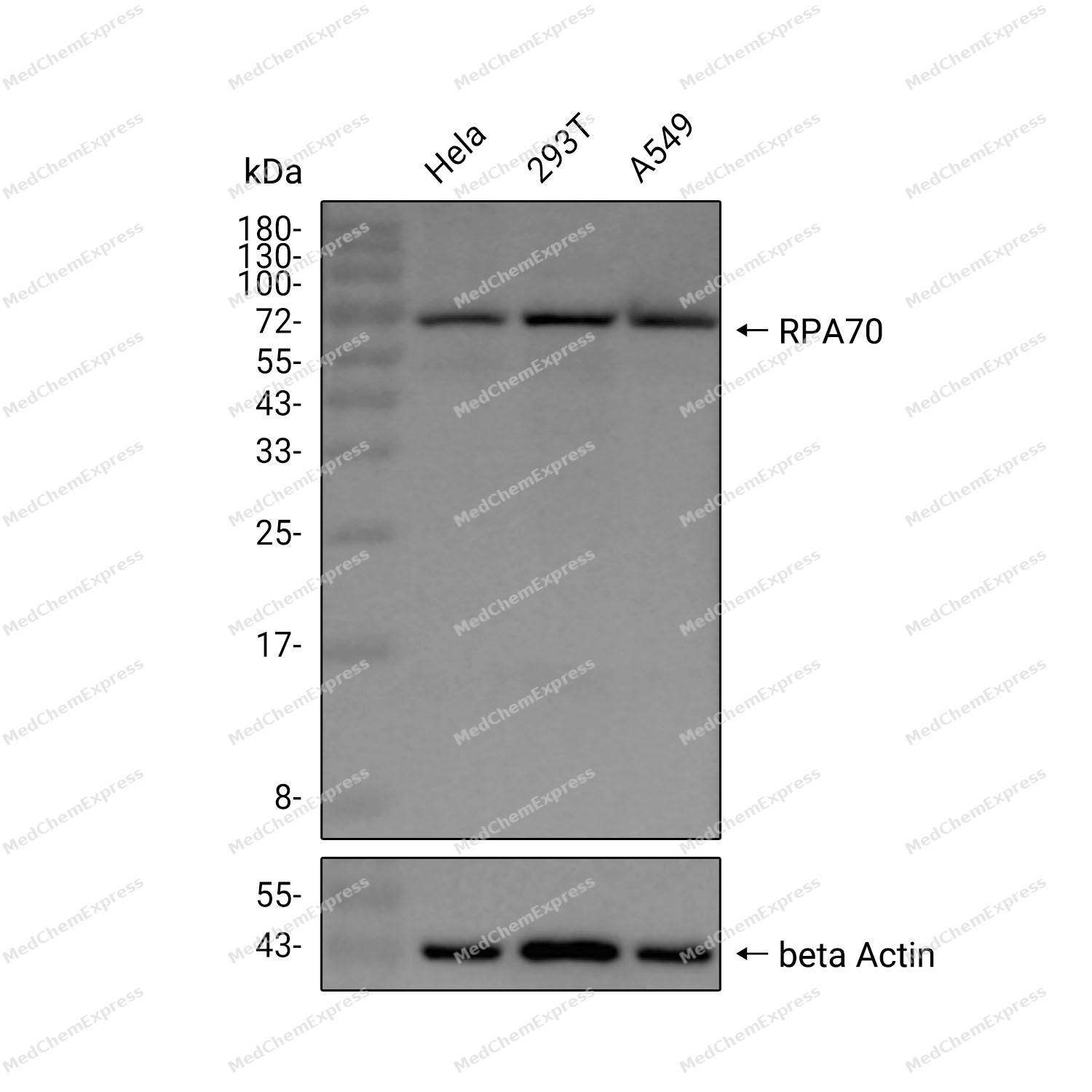 Western blot analysis was performed on extracts from Hela (lane 1, 15 μg), 293T (lane 2, 15 μg), and A549 (lane 3, 15 μg) using RPA70 Mouse mAb.Proteins were transferred to a PVDF membrane and blocked with 5% non-fat milk in TBST at 4°C overnight.The primary antibody (1:1000 dilution) and the loading control antibody (beta-Actin, HY-P80438, 1:20000 dilution) were incubated in 5% non-fat milk in TBST for 1 hour at 37°C.Goat Anti-Mouse/Rabbit IgG-HRP Secondary Antibody (1:20000 dilution) was then applied for 40 minutes at 37°C.
 -
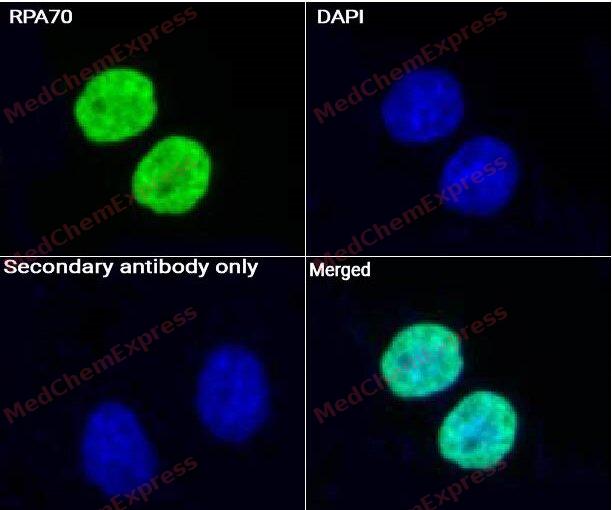 Immunocytochemistry analysis of Hela cells labeling RPA70 Antibody (HY-P80884) at 1/50 dilution. Cells were fixed in 4% paraformaldehyde for 15 minutes at room temperature, permeabilized with 0.1% Triton X-100 for 10 minutes at room temperature, then blocked with QuickBlock™ Blocking Buffer for Immunol Staining for 10 min at room temperature. Cells were then incubated with RPA70 Antibody (HY-P80884) at 1/50 dilution in QuickBlock™ Blocking Buffer for Immunol Staining at 4 ℃. Alexa Fluor® 488-conjugated AffiniPure Goat Anti-Rabbit IgG H&L(HY-P8002, Green) was used as the secondary antibody at 1/1,000 dilution. PBS instead of the primary antibody was used as the secondary antibody only control. The Nuclear counterstain was DAPI (Blue).
 -
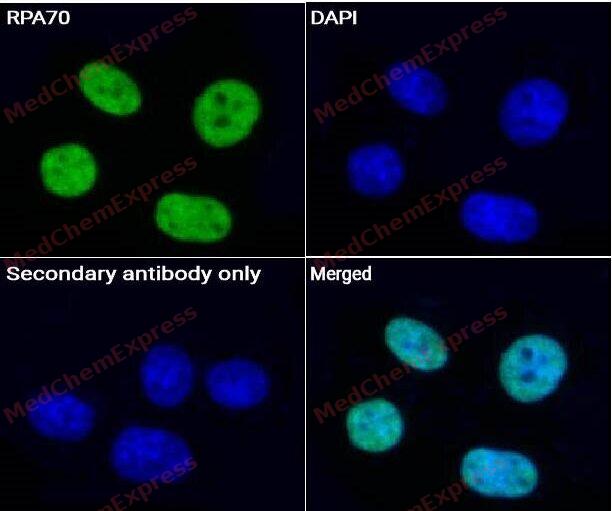 Immunocytochemistry analysis of Hela cells labeling RPA70 Antibody (HY-P80884) at 1/150 dilution. Cells were fixed in 4% paraformaldehyde for 15 minutes at room temperature, permeabilized with 0.1% Triton X-100 for 10 minutes at room temperature, then blocked with QuickBlock™ Blocking Buffer for Immunol Staining for 10 min at room temperature. Cells were then incubated with RPA70 Antibody (HY-P80884) at 1/150 dilution in QuickBlock™ Blocking Buffer for Immunol Staining at 4 ℃. Alexa Fluor® 488-conjugated AffiniPure Goat Anti-Rabbit IgG H&L(HY-P8002, Green) was used as the secondary antibody at 1/1,000 dilution. PBS instead of the primary antibody was used as the secondary antibody only control. The Nuclear counterstain was DAPI (Blue).


Background
-
Function
RPA70 is an As part of the heterotrimeric replication protein A complex (RPA/RP-A), binds and stabilizes single-stranded DNA intermediates that form during DNA replication or upon DNA stress. It prevents their reannealing and in parallel, recruits and activates different proteins and complexes involved in DNA metabolism. Thereby, it plays an essential role both in DNA replication and the cellular response to DNA damage. In the cellular response to DNA damage, the RPA complex controls DNA repair and DNA damage checkpoint activation. Through recruitment of ATRIP activates the ATR kinase a master regulator of the DNA damage response. It is required for the recruitment of the DNA double-strand break repair factors RAD51 and RAD52 to chromatin in response to DNA damage. Also recruits to sites of DNA damage proteins like XPA and XPG that are involved in nucleotide excision repair and is required for this mechanism of DNA repair. Also plays a role in base excision repair (BER) probably through interaction with UNG. Also recruits SMARCAL1/HARP, which is involved in replication fork restart, to sites of DNA damage. Plays a role in telomere maintenance. As part of the alternative replication protein A complex, aRPA, binds single-stranded DNA and probably plays a role in DNA repair. Compared to the RPA2-containing, canonical RPA complex, may not support chromosomal DNA replication and cell cycle progression through S-phase. The aRPA may not promote efficient priming by DNA polymerase alpha but could support DNA synthesis by polymerase delta in presence of PCNA and replication factor C (RFC), the dual incision/excision reaction of nucleotide excision repair and RAD51-dependent strand exchange. RPA stimulates 5'-3' helicase activity of the BRIP1/FANCJ[1][2][3][4][5][6][7][8][9][10][11].
-
Subcellular Localization
Nucleus; Nucleus, PML body
-
Subunit
Component of the canonical replication protein A complex (RPA), a heterotrimer composed of RPA1, RPA2 and RPA3 (PubMed:27723717, PubMed:27723720, PubMed:34767620). Also a component of the aRPA, the alternative replication protein A complex, a trimeric complex similar to the replication protein A complex/RPA but where RPA1 and RPA3 are associated with RPA4 instead of RPA2 (PubMed:19116208, PubMed:7760808). The DNA-binding activity may reside exclusively on the RPA1 subunit. Interacts with PRPF19; the PRP19-CDC5L complex is recruited to the sites of DNA repair where it ubiquitinates the replication protein A complex (RPA) (PubMed:24332808). Interacts with RIPK1 (PubMed:16135809). Interacts with the polymerase alpha subunit POLA1/p180; this interaction stabilizes the replicative complex and reduces the misincorporation rate of DNA polymerase alpha by acting as a fidelity clamp (PubMed:9214288). Interacts with RAD51 and SENP6 to regulate DNA repair (PubMed:20705237). Interacts with HELB; this interaction promotes HELB recruitment to chromatin following DNA damage (PubMed:22194613, PubMed:26774285). Interacts with PRIMPOL; leading to recruit PRIMPOL on chromatin and stimulate its DNA primase activity (PubMed:24126761, PubMed:25550423, PubMed:28534480). Interacts with XPA; the interaction is direct and associates XPA with the RPA complex (PubMed:10563794, PubMed:7700386, PubMed:9699634). Interacts with ETAA1; the interaction is direct and promotes ETAA1 recruitment at stalled replication forks (PubMed:27601467, PubMed:27723717, PubMed:27723720). Interacts with RPA1; this interaction associates HROB with the RPA complex (By similarity). Interacts (when poly-ADP-ribosylated) with HTATSF1 (PubMed:35597237). Interacts with BRIP1/FANCJ via this RPA1 subunit; following DNA damage they colocalize in foci in the nucleus (PubMed:17596542)
-
SwissProt ID
-
Synonyms
RPA1; HSSB; MST075; REPA1; RF-A; RP-A; RPA70
-
Research Field
Epigenetics and Nuclear Signaling
Documentation
-
Data Sheet (263 KB)
-
SDS (251 KB)
- English - EN (251 KB)
- Français - FR (251 KB)
- Deutsch - DE (251 KB)
- Norwegian - NO (251 KB)
- Español - ES (251 KB)
- Swedish - SV (251 KB)
- Italian - IT (251 KB)
- Korean - KR (251 KB)
- Portuguese - PT (251 KB)
-
User Guide for Antibodies (1077 KB)
References
[1]. Gupta R, et al. FANCJ (BACH1) helicase forms DNA damage inducible foci with replication protein A and interacts physically and functionally with the single-stranded DNA-binding protein. Blood. 2007 Oct 1;110(7):2390-8. [Content Brief]
[2]. Haahr P, et al. Activation of the ATR kinase by the RPA-binding protein ETAA1. Nat Cell Biol. 2016 Nov;18(11):1196-1207. [Content Brief]
[3]. Bass TE, et al. ETAA1 acts at stalled replication forks to maintain genome integrity. Nat Cell Biol. 2016 Nov;18(11):1185-1195. [Content Brief]
[4]. Lin YL, et al. The evolutionarily conserved zinc finger motif in the largest subunit of human replication protein A is required for DNA replication and mismatch repair but not for nucleotide excision repair. J Biol Chem. 1998 Jan 16;273(3):1453-61. [Content Brief]
[5]. Maréchal A, et al. PRP19 transforms into a sensor of RPA-ssDNA after DNA damage and drives ATR activation via a ubiquitin-mediated circuitry. Mol Cell. 2014 Jan 23;53(2):235-246. [Content Brief]
[6]. Sleeth KM, et al. RPA mediates recombination repair during replication stress and is displaced from DNA by checkpoint signalling in human cells. J Mol Biol. 2007 Oct 12;373(1):38-47. [Content Brief]
[7]. Aboussekhra A, et al. Mammalian DNA nucleotide excision repair reconstituted with purified protein components. Cell. 1995 Mar 24;80(6):859-68. [Content Brief]
[8]. DeMott MS, et al. Replication protein A stimulates long patch DNA base excision repair. J Biol Chem. 1998 Oct 16;273(42):27492-8. [Content Brief]
[9]. Grudic A, et al. Replication protein A prevents accumulation of single-stranded telomeric DNA in cells that use alternative lengthening of telomeres. Nucleic Acids Res. 2007;35(21):7267-78. [Content Brief]
[10]. Sharma R, et al. Gain-of-function mutations in RPA1 cause a syndrome with short telomeres and somatic genetic rescue. Blood. 2022 Feb 17;139(7):1039-1051. [Content Brief]
[11]. Kemp MG, et al. An alternative form of replication protein a expressed in normal human tissues supports DNA repair. J Biol Chem. 2010 Feb 12;285(7):4788-97. [Content Brief]

 Powered by Bioz
