



NEK6 Antibody (YA2396)
(Synonyms: NEK6; NimA related protein kinase 6; SID61512)
Based on 1 Customer Validation
NEK6 Antibody (YA2396) is a Rabbit-derived and non-conjugated IgG monoclonal antibody, targeting to NEK6.
-
Host:
Rabbit
-
Isotype:
IgG
-
Application:
WB, IP
-
Reactivity :
Human, Mouse, Rat
-
Formulation:
Supplied in rabbit IgG in 50 mM Tris-Glycine, pH 7.4, 0.15 M NaCl, 40% glycerol, 0.01% sodium azide and 0.05% BSA.
-
Conjugation:
Non-conjugated


To place orders, for customer services and technical support, please contact: MedChemExpress USA
Tel: 609-228-6898 E-mail: [email protected] [email protected]





Applications
| Application |
WB

WB: Western Blot
|
IP
IP: Immunoprecipitation
|
|---|---|---|
| Dilution Ratio | 1:1000-1:2000 | 1:50 |


Product Details
NEK6 Antibody (YA2396) is a Rabbit-derived and non-conjugated IgG monoclonal antibody, targeting to NEK6.
-
Host Rabbit

-
Clonality Recombinant,Monoclonal

-
Species ReactivityHuman, Mouse, Rat
-
Observed Molecular WeightObserved band size: 36-39 kDa
Note: Due to possible protein modifications or aggregation, the molecular weight should be confirmed by actual measurement, and the predicted value is for reference only.

-
Calculated Molecular Weight Predicted band size: 36-39 kDa

Entrez Gene: 10783 Human ; 59126 Mouse ; 360161 Rat
SwissProt: Q9HC98 Human ; Q9ES70 Mouse ; P59895 Rat ;
OMIM: 604884 Human
A synthesized peptide derived from human NEK6 aa250-313.
Endogenous
Affinity Purified
Non-conjugated
Unmodified
IgG


Product Properties
-
Appearance
Solution
-
Formulation
Supplied in rabbit IgG in 50 mM Tris-Glycine, pH 7.4, 0.15 M NaCl, 40% glycerol, 0.01% sodium azide and 0.05% BSA.
-
Concentration
Batch-dependent, Please check the COA for the concentration of each lot. Check Lot Concentration
-
Storage & Stability
Stored at -20°C for 1 year. Avoid repeated freeze / thaw cycles.
-
Shipping
Shipping with blue ice.


Verification Images
-
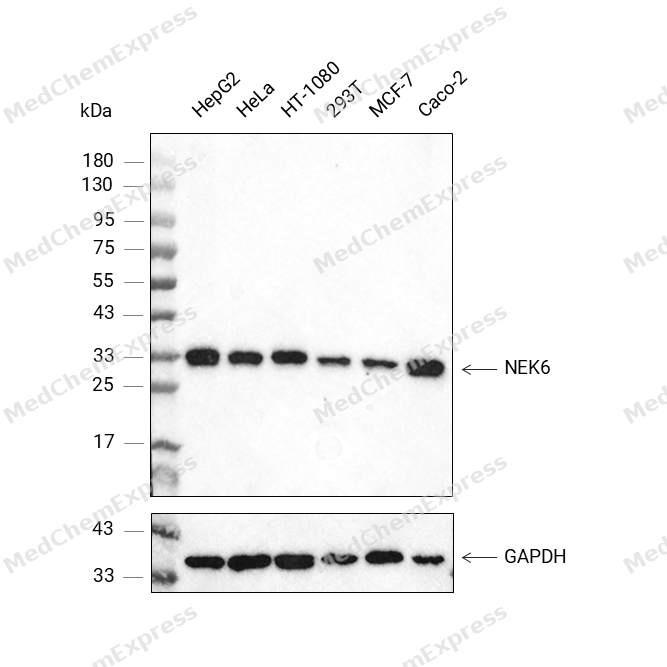 Western blot analysis was performed on protein extracts (25 μg) from HepG2 (lane 2), HeLa (lane 3), HT-1080 (lane 4), 293T (lane 5), MCF-7 (lane 6), and Caco-2 (lane 7) using NEK6 antibody. Proteins were transferred onto a 0.45 μm PVDF membrane using the Trans-Blot® Turbo™ system for 13 min. The membrane was then blocked with 5% nonfat milk in TBST (HY-K1025) for 1 h at room temperature. Thhe primary antibody (1:1000) and loading control antibody GAPDH Antibody (HRP) (HY-P80954A) (1:2500) were diluted in 5% nonfat milk in TBST and incubated with the membrane overnight at 4°C. After washing, the membrane of primary antibody was incubated with HRP-conjugated goat anti-rabbit IgG (H&L) secondary antibody (HY-P8001) (1:5000) diluted in 5% nonfat milk in TBST for 1 h at room temperature. Protein bands were visualized using an Ultra High Sensitivity ECL detection kit (HY-K1005).
 -
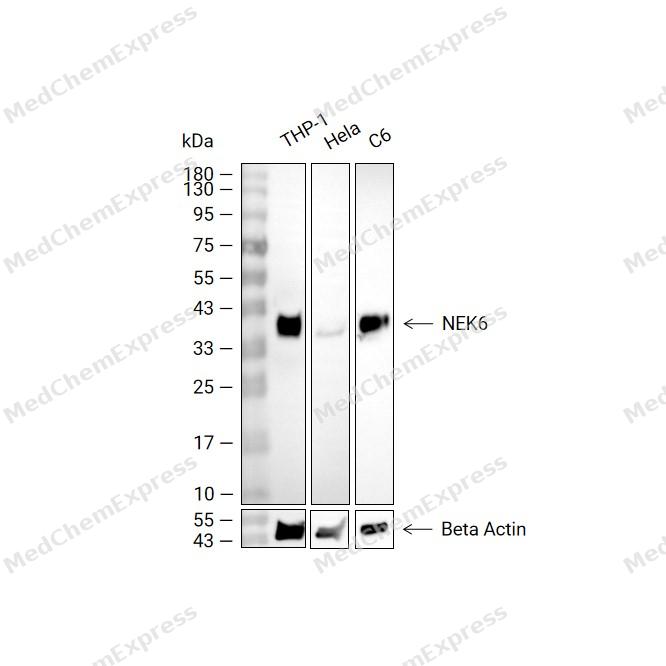 Western blot analysis of extracts from THP-1 (lane 2, 20ug), Hela (lane 3, 20ug) and C6 (lane 4, 20ug) using NEK6 Antibody (HY-P82651). Proteins were transferred to a PVDF membrane and blocked with 5% non-fat milk in TBST at 4°C overnight. The primary antibody (1/1000) and Loading control antibody (Beta Actin, HY-P80993, 1/10,000) was used in 5% non-fat milk in TBST for 2 hour at room temperature. Goat Anti-Rabbit IgG-HRP Secondary Antibody (HY-P8001, 1/10,000) was used for 1 hour at room temperature.


Background
-
Function
NIMA-related kinase 6 (NEK6) is a serine/threonine kinase that regulates cell cycle progression, mitotic spindle assembly, and microtubule dynamics[1][2]. Mechanistically, NEK6 interacts with Smad4 to inhibit TGFβ/Smad-mediated transcription, blocking nuclear translocation and counteracting growth arrest in tumor models[3]. NEK6 also contributes to endocytic trafficking by regulating early and recycling endosome morphology and cargo sorting, a function distinct from NEK7 which shares partial overlapping roles[2]. In disease contexts, NEK6 mediates castration-resistant prostate cancer by maintaining androgen-independent proliferation and activating transcription factors such as FOXJ2[4]. In neurodegenerative models, NEK6 modulates poly (PR) -induced p53-related DNA damage in C9orf72-associated frontotemporal dementia and ALS, indicating its broader relevance beyond oncology[5]. Compared with related isoforms, NEK6 exhibits unique substrate specificity, particularly for Y-box binding protein-1 (YBX1) and Smad4, and forms protein complexes that localize at centrosomes and cytoplasmic networks[1][2][4]. Preclinical studies suggest that inhibition of NEK6, alone or combined with CDK4/6 inhibitors, effectively suppresses tumor growth and rescues cellular toxicity in neuronal models, highlighting its potential as a targetable kinase[5][6]. Therefore, NEK6 serves as a multifunctional regulator of mitotic control, intracellular trafficking, and stress responses, with implications for cancer therapy and neurodegenerative disease research[1][2][3][4][5][6].
-
Subcellular Localization
Cytoplasm; Nucleus; Nucleus speckle; Cytoplasm, cytoskeleton, microtubule organizing center, centrosome; Cytoplasm, cytoskeleton, spindle pole
-
Expression
Tissue_specificity:Ubiquitous, with highest expression in heart and skeletal muscle
Induction:Up-regulated during the M phase of cell cycle progression. Down-regulated in both replicative and premature senescence of cancer cells -
Isoforms & Post-Translational Modification
Q9HC98 has 4 isomers: Q9HC98-1: 35714 Da (predicted); Q9HC98-2: 39844 Da (predicted); Q9HC98-3: 37823 Da (predicted); Q9HC98-4: 38460 Da (predicted).
Autophosphorylated. Phosphorylation at Ser-206 is required for its activation. Phosphorylated upon IR or UV-induced DNA damage. Phosphorylated by CHEK1 and CHEK2. Interaction with APBB1 down-regulates phosphorylation at Thr-210 -
Subunit
Interacts with STAT3 and RPS6KB1 (By similarity). Interacts with NEK9, predominantly in mitosis. Interacts with KIF11 (via C-terminus). Interacts with APBB1 (via WW domain). Interacts with ANKRA2, ATF4, ARHGAP33, CDC42, CIR1, PRAM1, PTN, PRDX3, PIN1, RAD26L, RBBP6, RPS7 and TRIP4
-
SwissProt ID
-
Synonyms
NEK6; NimA related protein kinase 6; SID61512
-
Research Field
Cell Biology


Documentation
-
Data Sheet (261 KB)
-
SDS (251 KB)
- English - EN (251 KB)
- Français - FR (251 KB)
- Deutsch - DE (251 KB)
- Norwegian - NO (251 KB)
- Español - ES (251 KB)
- Swedish - SV (251 KB)
- Italian - IT (251 KB)
- Korean - KR (251 KB)
- Portuguese - PT (251 KB)
-
User Guide for Antibodies (1077 KB)
References
[1]. Vaz Meirelles G, et al. Characterization of hNek6 interactome reveals an important role for its short N-terminal domain and colocalization with proteins at the centrosome. J Proteome Res. 2010 Dec 3;9(12):6298-316. [Content Brief]
[2]. Joseph BB, et al. Conserved NIMA kinases regulate multiple steps of endocytic trafficking. PLoS Genet. 2023 Apr 26;19(4):e1010741. [Content Brief]
[3]. Zuo J, et al. An inhibitory role of NEK6 in TGFβ/Smad signaling pathway. BMB Rep. 2015 Aug;48(8):473-8. [Content Brief]
[4]. Choudhury AD, et al. Castration Resistance in Prostate Cancer Is Mediated by the Kinase NEK6. Cancer Res. 2017 Feb 1;77(3):753-765. [Content Brief]
[5]. Guo W, et al. CRISPR/Cas9 screen in human iPSC-derived cortical neurons identifies NEK6 as a novel disease modifier of C9orf72 poly(PR) toxicity. Alzheimers Dement. 2023 Apr;19(4):1245-1259. [Content Brief]
[6]. Jian F, et al. Genome-wide CRISPR screen identified NEK6 as a determinant of sensitivity to CDK4/6 inhibitor in endometrial cancer. Front Pharmacol. 2026 Jan 5;16:1725886. [Content Brief]

 Powered by Bioz
