



NGF Antibody (YA3533)
(Synonyms: Beta nerve growth factor antibody; Beta NGF antibody; Beta-nerve growth factor antibody; Beta-NGF antibody; HSAN5 antibody; MGC161426 antibody; MGC161428 antibody; Nerve growth factor (beta polypeptide) antibody; Nerve growth factor antibody; Nerve growth factor beta antibody; Nerve growth factor beta polypeptide antibody; Nerve growth factor beta subunit antibody; NGF antibody; NGF_HUMAN antibody; NGFB antibody; NID67 antibody; )
Based on 1 Customer Validation
NGF Antibody (YA3533) is a Rabbit-derived and non-conjugated IgG monoclonal antibody, targeting to NGF.
-
Host:
Rabbit
-
Isotype:
IgG
-
Application:
WB, IHC-P, IHC-F, ICC/IF, IF-Tissue
-
Reactivity :
Human, Mouse, Rat, Zebrafish
-
Formulation:
Supplied in 1*TBS (pH7.4), 0.05% BSA, 40% Glycerol. Preservative: 0.05% Sodium Azide.
-
Conjugation:
Non-conjugated


To place orders, for customer services and technical support, please contact: MedChemExpress USA
Tel: 609-228-6898 E-mail: [email protected] [email protected]





Applications
| Application |
WB

WB: Western Blot
|
ICC/IF
ICC/IF: Immunocytochemistry/
Immunofluorescence |
IF-Tissue
IF-Tissue: Immunofluorescence-Tissue
|
IHC-P
IHC-P: Immunohistochemistry-Paraffin
|
IHC-F
IHC-F: Immunohistochemistry-Frozen
|
|---|---|---|---|---|---|
| Dilution Ratio | 1:2000 | 1:50-1:200 | 1:50-1:200 | 1:50-1:100 | 1:100 |


Product Details
NGF Antibody (YA3533) is a Rabbit-derived and non-conjugated IgG monoclonal antibody, targeting to NGF.
-
Host Rabbit

-
Clonality Monoclonal,Recombinant

-
Species ReactivityHuman, Mouse, Rat, Zebrafish
-
Observed Molecular WeightObserved band size: 35 kDa
Note: Due to possible protein modifications or aggregation, the molecular weight should be confirmed by actual measurement, and the predicted value is for reference only.

-
Calculated Molecular Weight Predicted band size: 27 kDa

Entrez Gene: 4803 Human ; 18049 Mouse ; 310738 Rat
SwissProt: P01138 Human ; P01139 Mouse ; P25427 Rat
OMIM: 608654 Human
Synthetic peptide within Human NGF aa 192-241 / 241.
Endogenous
affinity purified
Non-conjugated
Unmodified
IgG


Product Properties
-
Appearance
Liquid
-
Formulation
Supplied in 1*TBS (pH7.4), 0.05% BSA, 40% Glycerol. Preservative: 0.05% Sodium Azide.
-
Concentration
Batch-dependent, Please check the COA for the concentration of each lot. Check Lot Concentration
-
Storage & Stability
Stored at -20°C for 1 year. Avoid repeated freeze / thaw cycles.
-
Shipping
Shipping with blue ice.


Verification Images
-
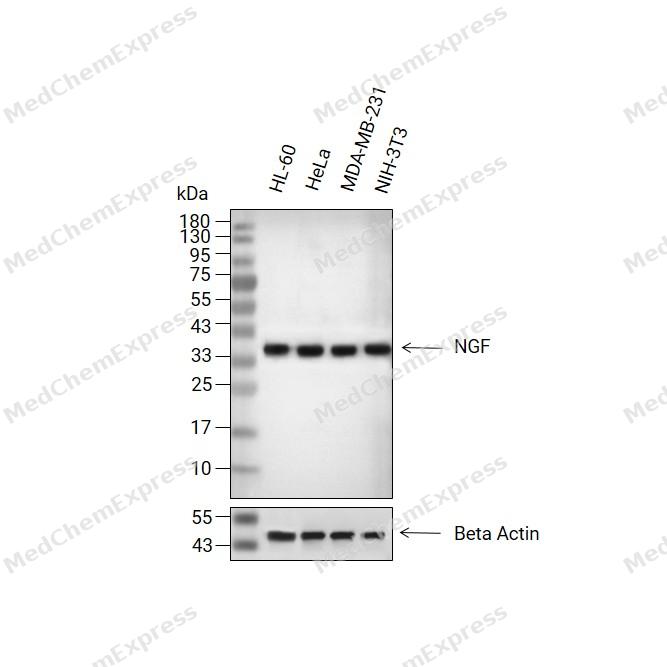 Western blot analysis of extracts from HL-60(lane 2, 20μg), HeLa(lane 3, 20μg), MDA-MB-231(lane 4, 20μg) and NIH-3T3(lane 5, 20μg) using NGF Antibody (HY-P81121). Proteins were transferred to a PVDF membrane and blocked with 5% non-fat milk in TBST for 2 hours at room temperature. The primary antibody (1/2000) and Loading control antibody (Beta Actin, HY-P80993, 1/10000) was used in 5% non-fat milk in TBST at 4°C overnight. Goat Anti-Rabbit IgG-HRP Secondary Antibody (HY-P8001, 1/10000) was used for 1 hour at room temperature.
 -
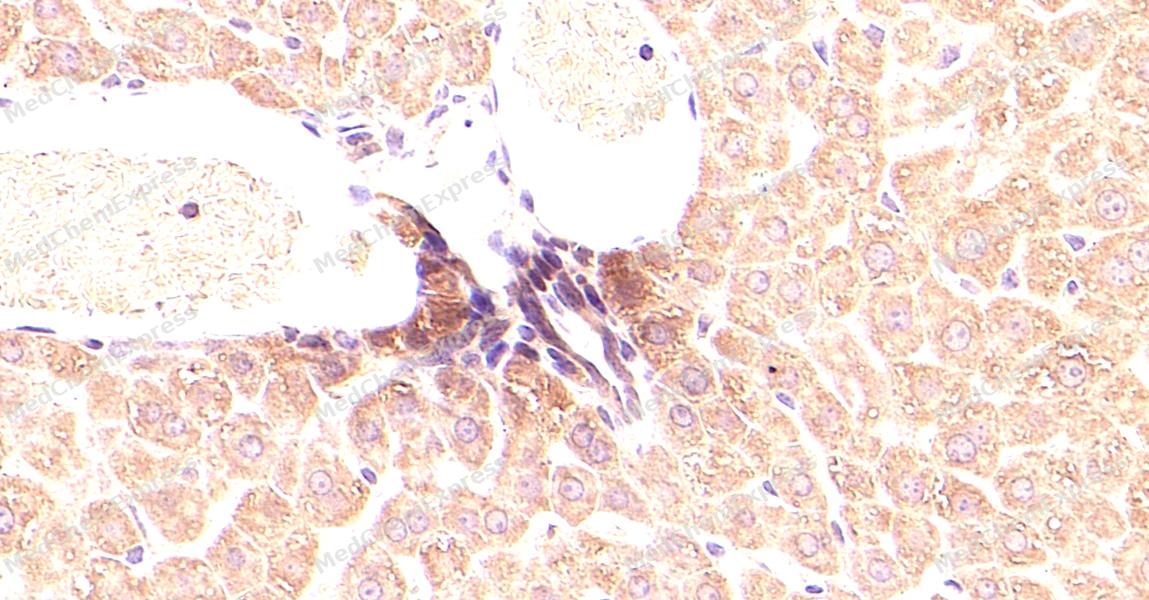 Immunohistochemical analysis of paraffin-embedded Mouse brain tissue using NGF Antibody. The section was pre-treated using heat mediated antigen retrieval with Tris-EDTA buffer (pH 8.0) for 8 minutes. The tissues were blocked in QuickBlock for 20 minutes at room temperature, washed with ddH2O and PBS, and then probed with the primary antibody (HY-P81121, 1:100) in 4℃ overnight. The detection was performed using an HRP conjugated compact polymer system. DAB was used as the chromogen. Tissues were counterstained with hematoxylin and mounted with DPX.
 -
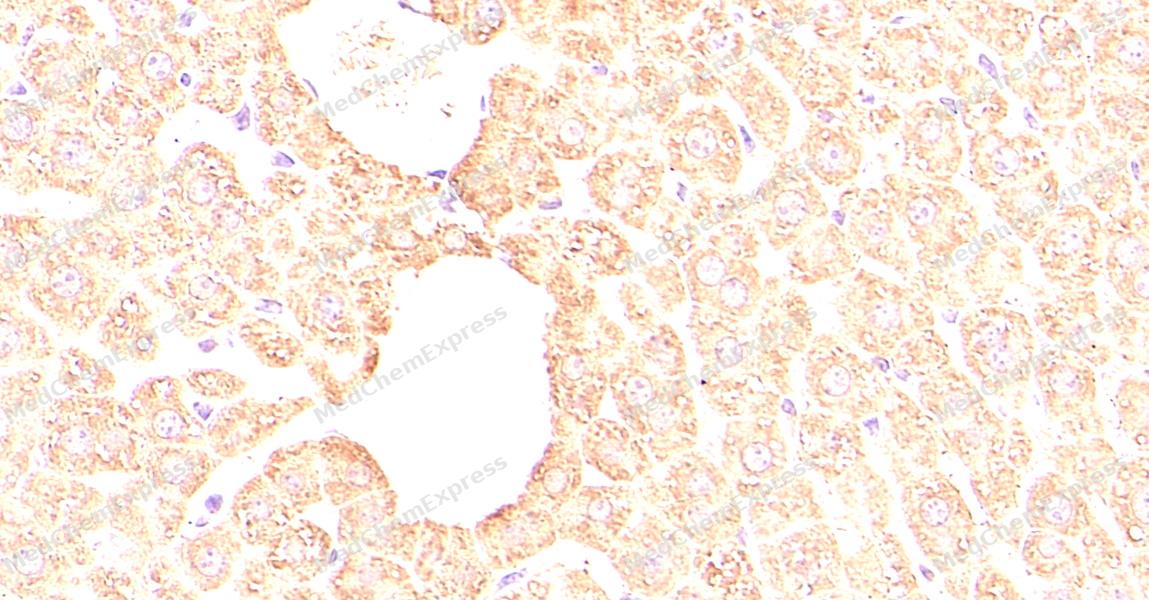 Immunohistochemical analysis of paraffin-embedded Mouse brain tissue using NGF Antibody. The section was pre-treated using heat mediated antigen retrieval with Tris-EDTA buffer (pH 8.0) for 8 minutes. The tissues were blocked in QuickBlock for 20 minutes at room temperature, washed with ddH2O and PBS, and then probed with the primary antibody (HY-P81121, 1:100) in 4℃ overnight. The detection was performed using an HRP conjugated compact polymer system. DAB was used as the chromogen. Tissues were counterstained with hematoxylin and mounted with DPX.
 -
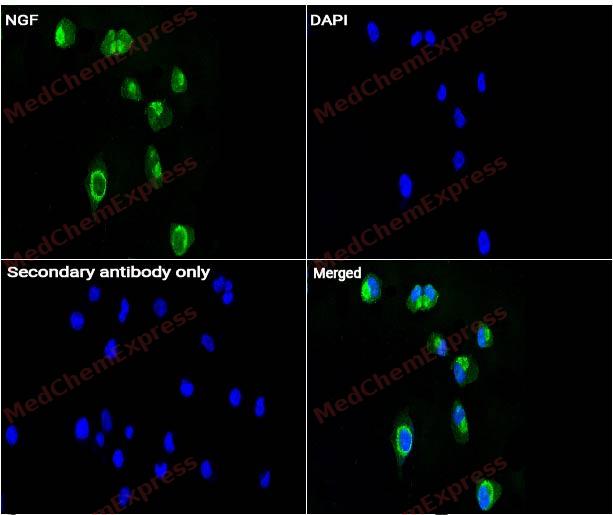 Immunocytochemistry analysis of SH-SY-5Y cells labeling NGF with NGF antibody (HY-P81121) at 1/50 dilution. Cells were fixed in 4% paraformaldehyde for 15 minutes at room temperature, permeabilized with 0.1% Triton X-100 for 10 minutes at room temperature, then blocked with QuickBlock™ Blocking Buffer for Immunol Staining for 10 min at room temperature. Cells were then incubated with NGF antibody (HY-P81121) at 1/50 dilution in QuickBlock™ Blocking Buffer for Immunol Staining at 4 ℃. Alexa Fluor® 488-conjugated AffiniPure Goat Anti-Rabbit IgG H&L(HY-P8002, Green) was used as the secondary antibody at 1/1,000 dilution. PBS instead of the primary antibody was used as the secondary antibody only control. The Nuclear counterstain was DAPI (Blue).
 -
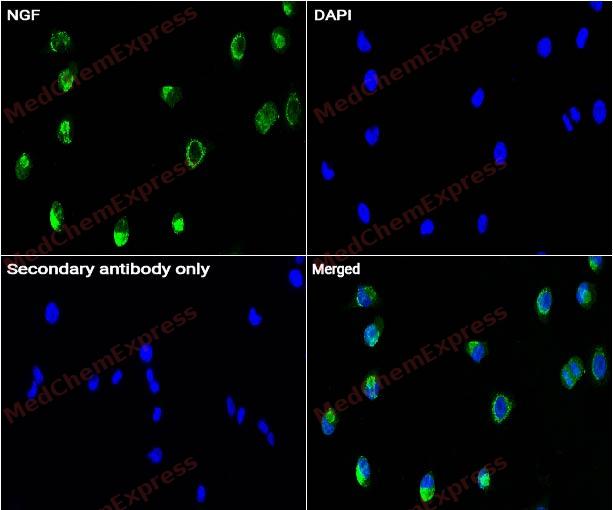 Immunocytochemistry analysis of SH-SY-5Y cells labeling NGF with NGF antibody (HY-P81121) at 1/200 dilution. Cells were fixed in 4% paraformaldehyde for 15 minutes at room temperature, permeabilized with 0.1% Triton X-100 for 10 minutes at room temperature, then blocked with QuickBlock™ Blocking Buffer for Immunol Staining for 10 min at room temperature. Cells were then incubated with NGF antibody (HY-P81121) at 1/200 dilution in QuickBlock™ Blocking Buffer for Immunol Staining at 4 ℃. Alexa Fluor® 488-conjugated AffiniPure Goat Anti-Rabbit IgG H&L(HY-P8002, Green) was used as the secondary antibody at 1/1,000 dilution. PBS instead of the primary antibody was used as the secondary antibody only control. The Nuclear counterstain was DAPI (Blue).


Background
-
Function
NGF is a Nerve growth factor is important for the development and maintenance of the sympathetic and sensory nervous systems. Extracellular ligand for the NTRK1 and NGFR receptors, activates cellular signaling cascades to regulate neuronal proliferation, differentiation and survival (Probable). The immature NGF precursor (proNGF) functions as a ligand for the heterodimeric receptor formed by SORCS2 and NGFR, and activates cellular signaling cascades that lead to inactivation of RAC1 and/or RAC2, reorganization of the actin cytoskeleton and neuronal growth cone collapse. In contrast to mature NGF, the precursor form (proNGF) promotes neuronal apoptosis (in vitro). Inhibits metalloproteinase-dependent proteolysis of platelet glycoprotein VI. Binds lysophosphatidylinositol and lysophosphatidylserine between the two chains of the homodimer. The lipid-bound form promotes histamine relase from mast cells, contrary to the lipid-free form[1][2][3].
-
Subcellular Localization
Secreted; Endosome lumen
-
Subunit
Homodimer (PubMed:10490030, PubMed:15131306, PubMed:17196528). The homodimer interacts with a single NTRK1 chain (PubMed:10490030, PubMed:17196528). The homodimer interacts with a single NGFR chain (PubMed:15131306). The NGF dimer interacts with a single SORCS2 chain (via extracellular domain) (By similarity). The NGF precursor (proNGF) binds to a receptor complex formed by SORT1 and NGFR, which leads to NGF endocytosis. Both mature NGF and the immature NGF precursor (proNGF) interact with SORCS2 and with the heterodimer formed by SORCS2 and NGFR (via extracellular domains) (By similarity). The NGF precursor (proNGF) has much higher affinity for SORCS2 than mature NGF. The NGF precursor (proNGF) has much higher affinity for SORT1 than mature NGF (By similarity). Interacts with ADAM10 in a divalent cation-dependent manner (PubMed:20164177). Interaction with SORCS3 (PubMed:15710408)
-
SwissProt ID
-
Synonyms
Beta nerve growth factor antibody; Beta NGF antibody; Beta-nerve growth factor antibody; Beta-NGF antibody; HSAN5 antibody; MGC161426 antibody; MGC161428 antibody; Nerve growth factor (beta polypeptide) antibody; Nerve growth factor antibody; Nerve growth factor beta antibody; Nerve growth factor beta polypeptide antibody; Nerve growth factor beta subunit antibody; NGF antibody; NGF_HUMAN antibody; NGFB antibody; NID67 antibody;


Documentation
-
Data Sheet (234 KB)
-
SDS (254 KB)
- English - EN (254 KB)
- Français - FR (254 KB)
- Deutsch - DE (254 KB)
- Norwegian - NO (254 KB)
- Español - ES (254 KB)
- Swedish - SV (254 KB)
- Italian - IT (254 KB)
- Korean - KR (254 KB)
- Portuguese - PT (254 KB)
-
User Guide for Antibodies (1077 KB)

 Powered by Bioz
