



beta III Tubulin Antibody (YA586)
(Synonyms: TUBB3; TUBB4; Tubulin beta-3 chain; Tubulin beta-4 chain; Tubulin beta-III; tuj 1; tuj1)Based on 2 publication(s) in Google Scholar
beta III Tubulin Antibody is a non-conjugated and Rabbit origined IgG monoclonal antibody, targeting to beta III Tubulin. It can be used as a loading control antibody.
-
Host:
Rabbit
-
Isotype:
IgG
-
Application:
WB, IHC-F, IHC-P, ICC/IF, IP
-
Reactivity :
Human, Mouse, Rat
-
Formulation:
Supplied in 50 mM Tris-Glycine (pH 7.4), 0.15 M NaCl, 40% Glycerol and 0.05% BSA. Preservative: 0.01% Sodium azide
-
Conjugation:
Non-conjugated


To place orders, for customer services and technical support, please contact: MedChemExpress USA
Tel: 609-228-6898 E-mail: [email protected] [email protected]



-

HY-P80139
GFAP Antibody (YA755) -
HY-13753
Streptozotocin -
HY-P81053
MAP2 Antibody -
HY-P8003
AF594-conjugated Goat Anti-Rabbit IgG H&L -

HY-D1056
Lipopolysaccharides, from E. coli O55:B5 -
HY-P8001
HRP-conjugated Goat Anti-Rabbit IgG H&L -
HY-P8002
AF488-conjugated Goat Anti-Rabbit IgG H&L -
HY-P8006
AF594-conjugated Goat Anti-Mouse IgG H&L -
HY-P81121
NGF Antibody (YA3533) -
HY-P80891
S100B Antibody -
HY-P86812
CGRP Antibody (YA6505) -
HY-P8005
AF488-conjugated Goat Anti-Mouse IgG H&L
Publications Citing Use of MedChemExpress (MCE) beta III Tubulin Antibody (YA586)
More
 2 Publications Citing Use of MCE beta III Tubulin Antibody (YA586) (1)
-
WB


Applications
| Application |
WB

WB: Western Blot
|
IHC-P
IHC-P: Immunohistochemistry-Paraffin
|
IHC-F
IHC-F: Immunohistochemistry-Frozen
|
ICC/IF
ICC/IF: Immunocytochemistry/
Immunofluorescence |
IP
IP: Immunoprecipitation
|
|---|---|---|---|---|---|
| Dilution Ratio | 1:500-1:1000 | 1:50-1:100 | 1:50-1:100 | 1:50-1:200 | 1:20 |


Product Details
beta III Tubulin Antibody is a non-conjugated and Rabbit origined IgG monoclonal antibody, targeting to beta III Tubulin. It can be used as a loading control antibody.
-
Host Rabbit

-
Clonality Recombinant,Monoclonal

-
Species ReactivityHuman, Mouse, Rat
-
Observed Molecular WeightObserved band size: 50 kDa
Note: Due to possible protein modifications or aggregation, the molecular weight should be confirmed by actual measurement, and the predicted value is for reference only.

-
Calculated Molecular Weight Predicted band size: 50 kDa

Entrez Gene: 10381 Human ; 22152 Mouse ; 246118 Rat
SwissProt: Q13509 Human ; Q9ERD7 Mouse ; Q4QRB4 Rat
OMIM: 600638 Human
Synthetic peptide corresponding to Human beta III Tubulin.The exact sequence is proprietary to MCE.
Endogenous
affinity purified
Non-conjugated
Unmodified
IgG


Product Properties
-
Appearance
Solution
-
Formulation
Supplied in 50 mM Tris-Glycine (pH 7.4), 0.15 M NaCl, 40% Glycerol and 0.05% BSA. Preservative: 0.01% Sodium azide
-
Concentration
Batch-dependent, Please check the COA for the concentration of each lot. Check Lot Concentration
-
Storage & Stability
Stored at -20°C for 1 year. Avoid repeated freeze / thaw cycles.
-
Shipping
Shipping with blue ice.


Publications (2)
-
Journal Impact Factor
-
Most Recent
-
Neuroscience
Decursin ameliorates neurotoxicity induced by glutamate through restraining ferroptosis by up-regulating FTH1 in SH-SY5Y neuroblastoma cells. [Abstract]2024 Nov 1:559:139-149. PMID: 39197742
beta III Tubulin Antibody (YA586) purchased from MedChemExpress. Usage Cited in: Neuroscience. 2024 Nov 1:559:139-149. [Abstract]
Decursin simulated the translocation of Nrf2 from the cytoplasm into the nucleus in glutamate-induced SH-SY5Y cells.


Verification Images
-
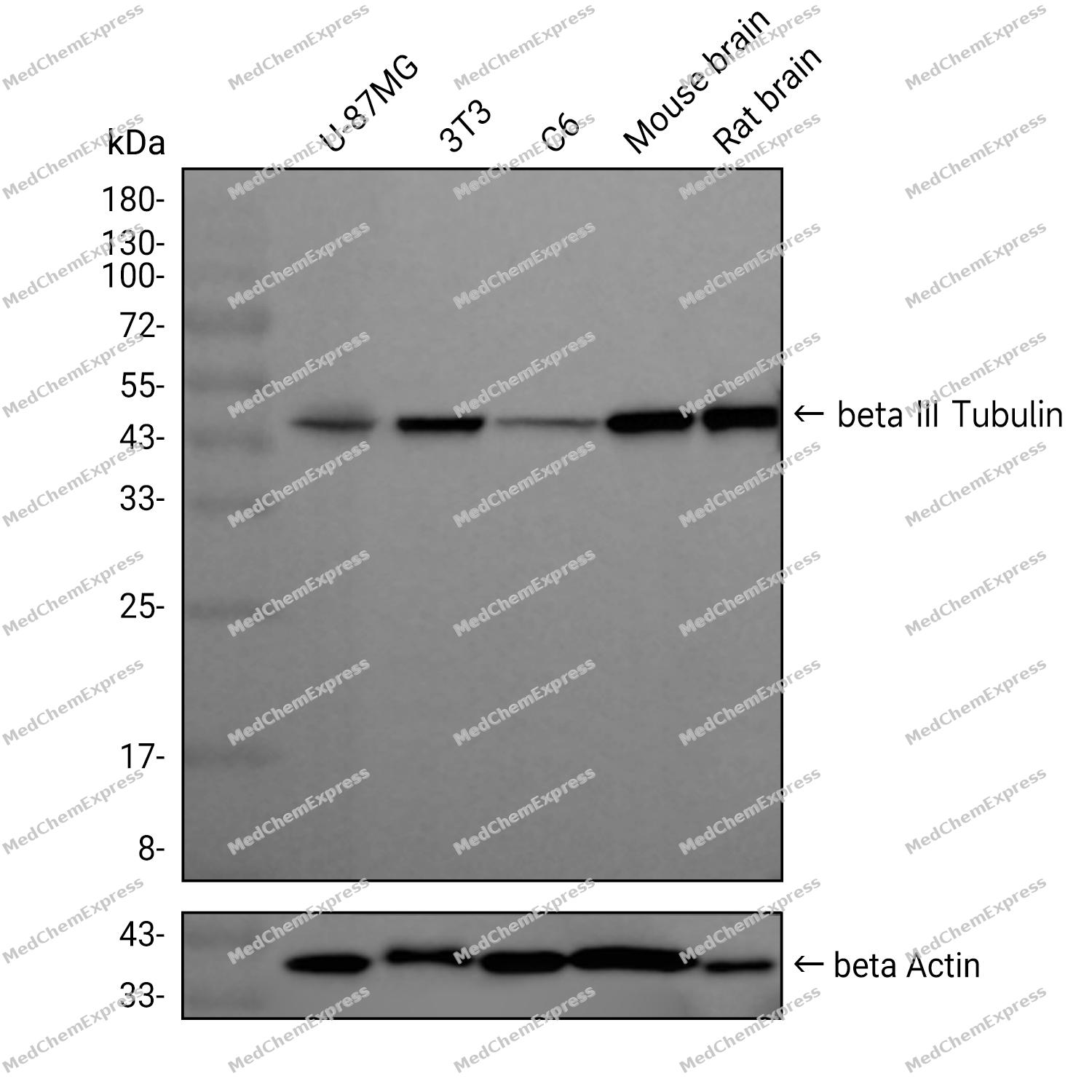 Western blot analysis was performed on extracts from U-87MG (lane 1, 15 μg), 3T3 (lane 2, 15 μg), C6 (lane 3, 15 μg), Mouse brain (lane 4, 15 μg), and Rat brain (lane 5, 15 μg) using beta III Tubulin Rabbit mAb.Proteins were transferred to a PVDF membrane and blocked with 5% non-fat milk in TBST at 4°C overnight.The primary antibody (1:5000 dilution) and the loading control antibody (GAPDH, HY-P80137, 1:20000 dilution) were incubated in 5% non-fat milk in TBST for 1 hour at 37°C.Goat Anti-Rabbit IgG-HRP Secondary Antibody (1:20000 dilution) was then applied for 40 minutes at 37°C.
 -
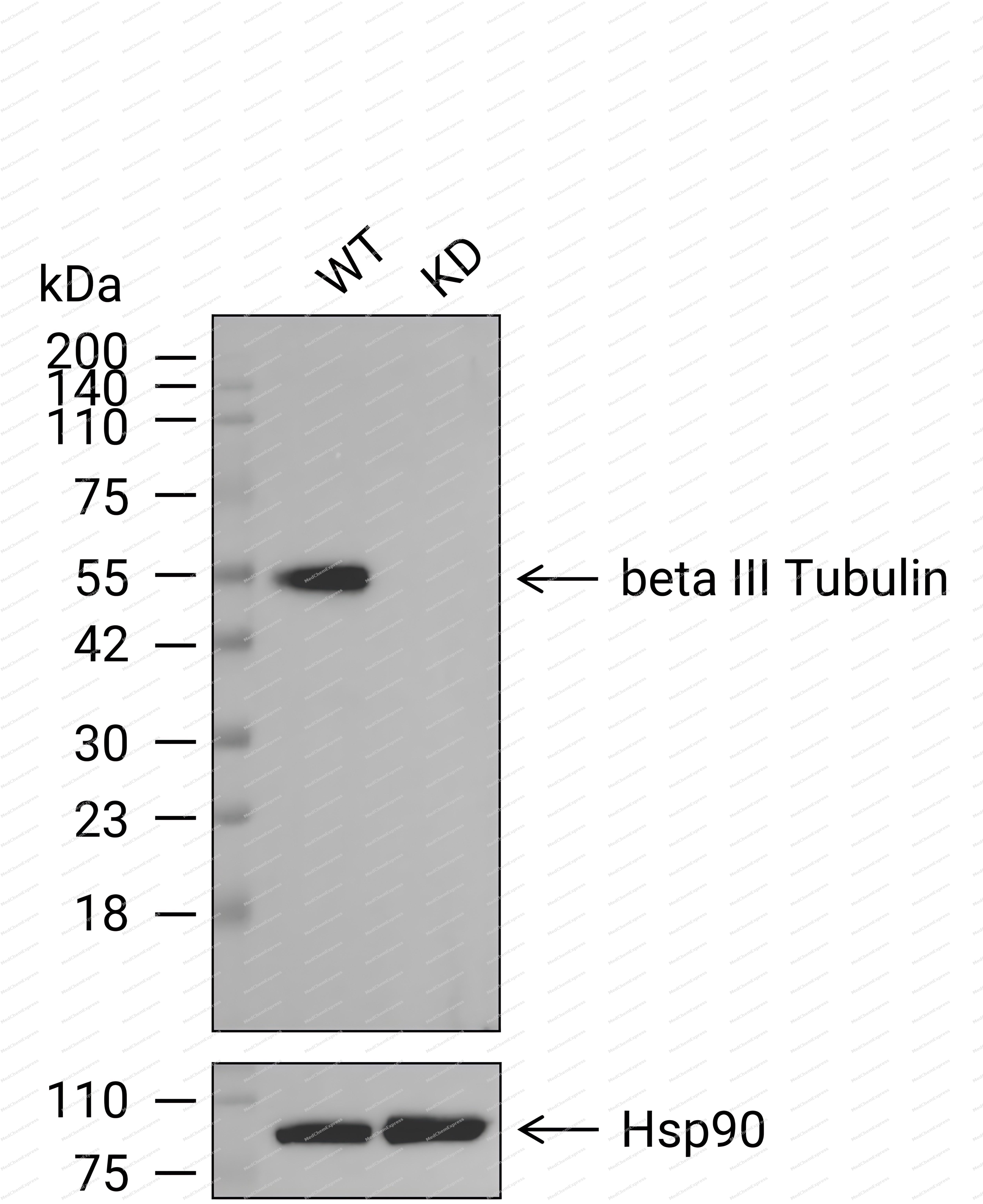 Western blot analysis of extracts from WT Hela cells (lane 1(20μg)) and KD Hela cells (lane 2(20μg)) using beta III Tubulin Antibody (HY-P80570) . Proteins were transferred to a PVDF membrane and blocked with 5% BSA in TBST for 1.5 hour at room temperature. The primary antibody (1/1000) and Loading control antibody (Hsp90, 1/10000) was used in 5% nonfat dry milk in TBST at 4℃ overnight. Goat Anti-Rabbit IgG-HRP Secondary Antibody (1/10,000) was used for 1 hour at room temperature.
 -
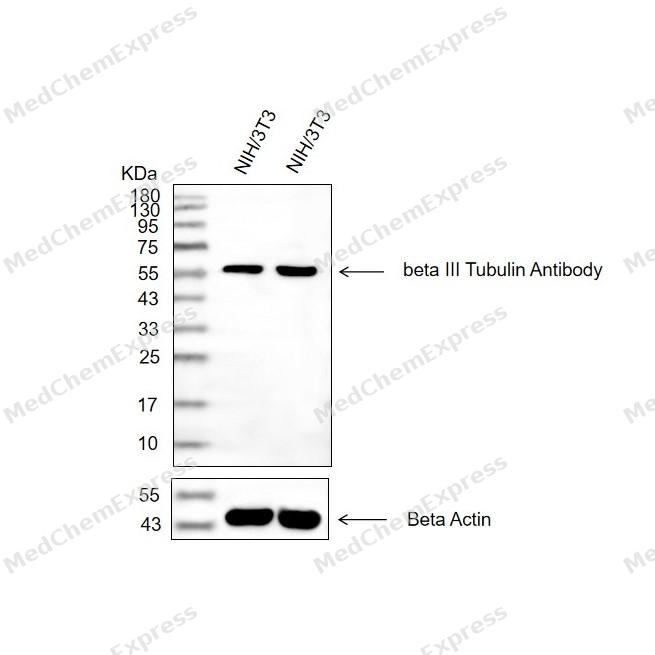 Western blot analysis of extracts from NIH/3T3(lane 2(20μg) and NIH/3T3(lane 3(40ug)using beta III Tubulin Antibody (HY-P80570) Rabbit mAb. Proteins were transferred to a PVDF membrane and blocked with 5% non-fat milk in TBST for 2 hour at room temperature. The primary antibody (1/1000) and Loading control antibody (Beta Actin, HY-P80438, 1/10000) was used in 5% non-fat milk in TBST at 4°C overnight. Goat Anti-Mouse/Rabbit IgG-HRP Secondary Antibody (1/10000) was used for 1 hour at room temperature.
 -
 Immunohistochemical analysis of paraffin-embedded Mouse brain tissue using beta III Tubulin Antibody. The section was pre-treated using heat mediated antigen retrieval with sodium citrate buffer (pH 6.0) for 8 minutes. The tissues were blocked in QuickBlock for 20 minutes at room temperature, washed with ddH2O and PBS, and then probed with the primary antibody (HY-P80570, 1/100) in 4℃ overnight. The detection was performed using an HRP conjugated compact polymer system. DAB was used as the chromogen. Tissues were counterstained with hematoxylin and mounted with DPX.
 -
 Immunohistochemical analysis of paraffin-embedded Mouse brain tissue using beta III Tubulin Antibody. The section was pre-treated using heat mediated antigen retrieval with sodium citrate buffer (pH 6.0) for 8 minutes. The tissues were blocked in QuickBlock for 20 minutes at room temperature, washed with ddH2O and PBS, and then probed with the primary antibody (HY-P80570, 1/100) in 4℃ overnight. The detection was performed using an HRP conjugated compact polymer system. DAB was used as the chromogen. Tissues were counterstained with hematoxylin and mounted with DPX.
 -
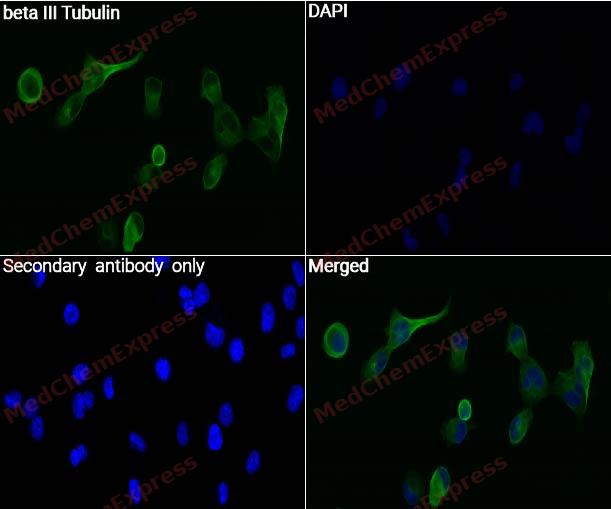 Immunocytochemistry analysis of SH-SY5Y cells labeling beta III Tubulin with beta III Tubulin Antibody (HY-P80570) at 1/50 dilution. Cells were fixed in 4% paraformaldehyde for 15 minutes at room temperature, permeabilized with 0.1% Triton X-100 for 10 minutes at room temperature, then blocked with QuickBlock™ Blocking Buffer for Immunol Staining for 10 min at room temperature. Cells were then incubated with beta III Tubulin Antibody (HY-P80570) at 1/50 dilution in QuickBlock™ Blocking Buffer for Immunol Staining at 4 ℃. Alexa Fluor® 488-conjugated AffiniPure Goat Anti-Rabbit IgG H&L(HY-P8002, Green) was used as the secondary antibody at 1/1,000 dilution. PBS instead of the primary antibody was used as the secondary antibody only control. The Nuclear counterstain was DAPI (Blue).
 -
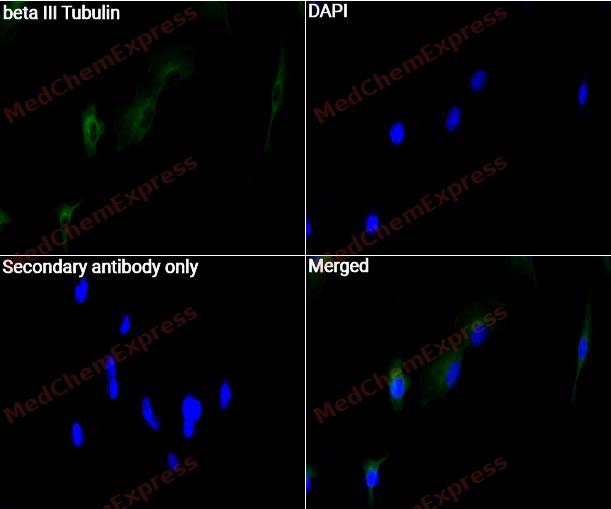 Immunocytochemistry analysis of U87 cells labeling beta III Tubulin with beta III Tubulin Antibody (HY-P80570) at 1/50 dilution. Cells were fixed in 4% paraformaldehyde for 15 minutes at room temperature, permeabilized with 0.1% Triton X-100 for 10 minutes at room temperature, then blocked with QuickBlock™ Blocking Buffer for Immunol Staining for 10 min at room temperature. Cells were then incubated with beta III Tubulin Antibody (HY-P80570) at 1/50 dilution in QuickBlock™ Blocking Buffer for Immunol Staining at 4 ℃. Alexa Fluor® 488-conjugated AffiniPure Goat Anti-Rabbit IgG H&L(HY-P8002, Green) was used as the secondary antibody at 1/1,000 dilution. PBS instead of the primary antibody was used as the secondary antibody only control. The Nuclear counterstain was DAPI (Blue).


Background
-
Function
beta III Tubulin is a Tubulin is the major constituent of microtubules, protein filaments consisting of alpha- and beta-tubulin heterodimers. Microtubules grow by the addition of GTP-tubulin dimers to the microtubule end, where a stabilizing cap forms. Below the cap, alpha-beta tubulin heterodimers are in GDP-bound state, owing to GTPase activity of alpha-tubulin. TUBB3 plays a critical role in proper axon guidance and maintenance. Binding of NTN1/Netrin-1 to its receptor UNC5C might cause dissociation of UNC5C from polymerized TUBB3 in microtubules and thereby lead to increased microtubule dynamics and axon repulsion. Plays a role in dorsal root ganglion axon projection towards the spinal cord[1][2][3][4][5].
-
Subcellular Localization
Cytoplasm, cytoskeleton; Cell projection, growth cone; Cell projection, lamellipodium; Cell projection, filopodium
-
Expression
Tissue_specificity:This gene is primarily expressed in the central and peripheral nervous systems, and its expression is significantly enhanced in most cancerous tissues. -
Isoforms & Post-Translational Modification
Q13509 has 2 isomers: Q13509-1: 50433 Da (predicted); Q13509-2: 42433 Da (predicted).
Some glutamate residues at the C-terminus are polyglutamylated, resulting in polyglutamate chains on the gamma-carboxyl group (PubMed:26875866). Polyglutamylation plays a key role in microtubule severing by spastin (SPAST). SPAST preferentially recognizes and acts on microtubules decorated with short polyglutamate tails: severing activity by SPAST increases as the number of glutamates per tubulin rises from one to eight, but decreases beyond this glutamylation threshold (PubMed:26875866). Glutamylation is also involved in cilia motility (By similarity);Some glutamate residues at the C-terminus are monoglycylated but not polyglycylated due to the absence of functional TTLL10 in human. Monoglycylation is mainly limited to tubulin incorporated into cilia and flagella axonemes, which is required for their stability and maintenance. Flagella glycylation controls sperm motility. Both polyglutamylation and monoglycylation can coexist on the same protein on adjacent residues, and lowering glycylation levels increases polyglutamylation, and reciprocally;Phosphorylated on Ser-172 by CDK1 during the cell cycle, from metaphase to telophase, but not in interphase. This phosphorylation inhibits tubulin incorporation into microtubules -
Subunit
Heterodimer of alpha- and beta-tubulin (PubMed:34996871, PubMed:35482892, PubMed:38305685, PubMed:38609661).
-
SwissProt ID
-
Synonyms
TUBB3; TUBB4; Tubulin beta-3 chain; Tubulin beta-4 chain; Tubulin beta-III; tuj 1; tuj1
-
Research Field
Signal Transduction
Documentation
-
Data Sheet (261 KB)
-
SDS (251 KB)
- English - EN (251 KB)
- Français - FR (251 KB)
- Deutsch - DE (251 KB)
- Norwegian - NO (251 KB)
- Español - ES (251 KB)
- Swedish - SV (251 KB)
- Italian - IT (251 KB)
- Korean - KR (251 KB)
- Portuguese - PT (251 KB)
-
User Guide for Antibodies (1077 KB)
References
[1]. LaFrance BJ, et al. Structural transitions in the GTP cap visualized by cryo-electron microscopy of catalytically inactive microtubules. Proc Natl Acad Sci U S A. 2022 Jan 11;119(2):. [Content Brief]
[2]. Brito C, et al. Transition of human γ-tubulin ring complex into a closed conformation during microtubule nucleation. Science. 2024 Feb 23;383(6685):870-876. [Content Brief]
[3]. Aher A, et al. Structure of the γ-tubulin ring complex-capped microtubule. Nat Struct Mol Biol. 2024 Jul;31(7):1124-1133. [Content Brief]
[4]. Tischfield MA, et al. Human TUBB3 mutations perturb microtubule dynamics, kinesin interactions, and axon guidance. Cell. 2010 Jan 8;140(1):74-87. [Content Brief]
[5]. Shao Q, et al. Uncoupling of UNC5C with Polymerized TUBB3 in Microtubules Mediates Netrin-1 Repulsion. J Neurosci. 2017 Jun 7;37(23):5620-5633. [Content Brief]

 Powered by Bioz
