



NADPH Oxidase 4 Antibody (YA4513)
(Synonyms: KOX; KOX-1; RENOX)
Based on 1 Customer Validation
NADPH Oxidase 4 Antibody (YA4513) is a Mouse-derived and non-conjugated IgG1 monoclonal antibody, targeting to NADPH Oxidase 4.
-
Host:
Mouse
-
Isotype:
IgG1
-
Application:
IHC-P, ICC/IF, FC, ELISA
-
Reactivity :
Human
-
Formulation:
Supplied in PBS with 0.05% sodium azide
-
Conjugation:
Non-conjugated


To place orders, for customer services and technical support, please contact: MedChemExpress USA
Tel: 609-228-6898 E-mail: [email protected] [email protected]





Applications
| Application |
IHC-P

IHC-P: Immunohistochemistry-Paraffin
|
ICC/IF
ICC/IF: Immunocytochemistry/
Immunofluorescence |
FC
FC: Flow Cytometry
|
ELISA
ELISA: Enzyme Linked Immunosorbent Assay
|
|---|---|---|---|---|
| Dilution Ratio | 1:200-1:1000 | 1:200-1:1000 | 1:200-1:400 | 1:10000 |


Product Details
NADPH Oxidase 4 Antibody (YA4513) is a Mouse-derived and non-conjugated IgG1 monoclonal antibody, targeting to NADPH Oxidase 4.
-
Host Mouse

-
Clonality Monoclonal

-
Species ReactivityHuman
-
Observed Molecular WeightObserved band size: 67 kDa
Note: Due to possible protein modifications or aggregation, the molecular weight should be confirmed by actual measurement, and the predicted value is for reference only.

-
Calculated Molecular Weight Predicted band size: 67 kDa

Purified recombinant fragment of human NOX4 (AA: 210-310) expressed in E. Coli.
affinity purified.
Non-conjugated
Unmodified
IgG1


Product Properties
-
Appearance
Liquid
-
Formulation
Supplied in PBS with 0.05% sodium azide
-
Concentration
Batch-dependent, Please check the COA for the concentration of each lot. Check Lot Concentration
-
Storage & Stability
Stored at -20°C for 1 year. Avoid repeated freeze / thaw cycles.
-
Shipping
Shipping with blue ice.


Verification Images
-
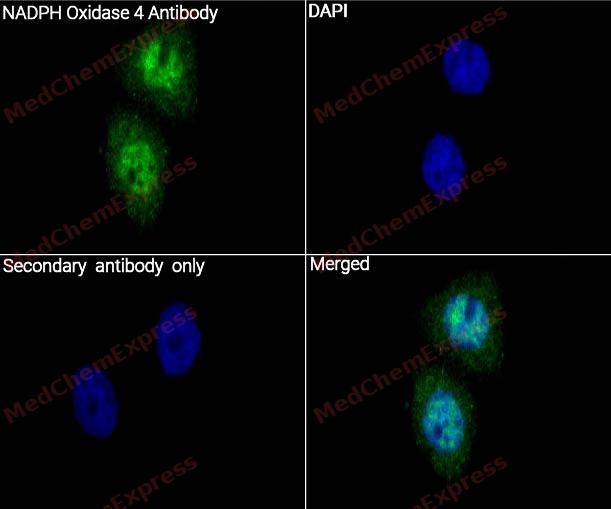 Immunocytochemistry analysis of HeLa cells labeling NADPH Oxidase 4 with NADPH Oxidase 4 Antibody (HY-P84816) at 1/500 dilution. Cells were fixed in 4% paraformaldehyde for 15 minutes at room temperature, permeabilized with 0.1% Triton X-100 in PBS for 15 minutes at room temperature, then blocked with quick block buffer for 10 minutes at room temperature. Cells were then incubated with NADPH Oxidase 4 Antibody (HY-P84816) at 1/500 dilution in quick block buffer overnight at 4 ℃. AF488-conjugated Goat Anti-Mouse IgG H&L(HY-P8005, Green) was used as the secondary antibody at 1/1,000 dilution. PBS instead of the primary antibody was used as the secondary antibody only control. The Nuclear counterstain was DAPI (Blue).
 -
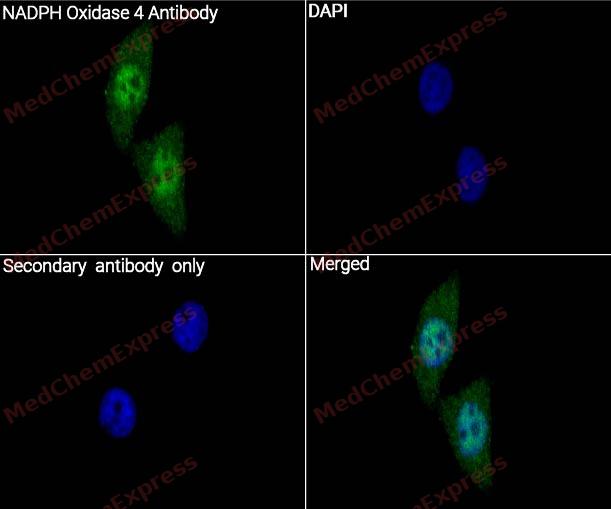 Immunocytochemistry analysis of HePG2 cells labeling NADPH Oxidase 4 with NADPH Oxidase 4 Antibody (HY-P84816) at 1/500 dilution. Cells were fixed in 4% paraformaldehyde for 15 minutes at room temperature, permeabilized with 0.1% Triton X-100 in PBS for 15 minutes at room temperature, then blocked with quick block buffer for 10 minutes at room temperature. Cells were then incubated with NADPH Oxidase 4 Antibody (HY-P84816) at 1/500 dilution in quick block buffer overnight at 4 ℃. AF488-conjugated Goat Anti-Mouse IgG H&L(HY-P8005, Green) was used as the secondary antibody at 1/1,000 dilution. PBS instead of the primary antibody was used as the secondary antibody only control. The Nuclear counterstain was DAPI (Blue).


Background
-
Function
NADPH Oxidase 4 is a NADPH oxidase that catalyzes predominantly the reduction of oxygen to H2O2. Can also catalyze to a smaller extent, the reduction of oxygen to superoxide. May function as an oxygen sensor regulating the KCNK3/TASK-1 potassium channel and HIF1A activity. May regulate insulin signaling cascade. May play a role in apoptosis, bone resorption and lipolysaccharide-mediated activation of NFKB. May produce superoxide in the nucleus and play a role in regulating gene expression upon cell stimulation. Promotes ferroptosis, reactive oxygen species production and reduced glutathione (GSH) levels by activating NLRP3 inflammasome activation and cytokine release; NADPH oxidase that catalyzes the generation of superoxide from molecular oxygen utilizing NADPH as an electron donor. Involved in redox signaling in vascular cells. Modulates the nuclear activation of ERK1/2 and the ELK1 transcription factor, and is capable of inducing nuclear DNA damage; Lacks superoxide-generating NADPH oxidase activity[1][2][3][4][5][6][7][8][9][10][11][12][13][14][15][16].
-
Subcellular Localization
Cytoplasm; Endoplasmic reticulum membrane; Multi-pass membrane protein; Cell membrane; Multi-pass membrane protein; Cell junction, focal adhesion; Nucleus; Nucleus; Nucleus, nucleolus; Cytoplasm; Cytoplasm, perinuclear region; Cytoplasm; Cytoplasm, perinuclear region; Cytoplasm; Cytoplasm, perinuclear region; Cytoplasm; Cytoplasm, perinuclear region
-
Expression
Tissue_specificity:This gene is expressed (protein level) in distal renal tubular cells and endothelial cells of the renal cortex. Expression is widespread. It is highly expressed in the kidneys, and expressed at lower levels in the heart, adipocytes, liver cancer cells, endothelial cells, skeletal muscle, brain, various brain tumor cell lines, and airway epithelial cells.
Induction:By 7-ketocholesterol (at protein level) -
Isoforms & Post-Translational Modification
Q9NPH5 has 9 isomers: Q9NPH5-1: 66932 Da (predicted); Q9NPH5-2: 58410 Da (predicted); Q9NPH5-3: 27625 Da (predicted); Q9NPH5-4: 31812 Da (predicted); Q9NPH5-5: 25761 Da (predicted); Q9NPH5-6: 62745 Da (predicted); Q9NPH5-7: 6516 Da (predicted); Q9NPH5-8: 64102 Da (predicted); Q9NPH5-9: 59915 Da (predicted).
Deubiquitinated by USP19;N-glycosylated and glycosylation is required for its proper function;N-glycosylated -
Subunit
Interacts with protein disulfide isomerase (By similarity). Interacts with, relocalizes and stabilizes CYBA/p22phox. Interacts with TLR4. Interacts with PPP1R15A (PubMed:26742780). Interacts with LRRC8A; this interaction prevents the ubiquitin-mediated degradation of LRRC8A (PubMed:39909992)
-
SwissProt ID
-
Synonyms
KOX; KOX-1; RENOX


Documentation
-
Data Sheet (234 KB)
-
SDS (251 KB)
- English - EN (251 KB)
- Français - FR (251 KB)
- Deutsch - DE (251 KB)
- Norwegian - NO (251 KB)
- Español - ES (251 KB)
- Swedish - SV (251 KB)
- Italian - IT (251 KB)
- Korean - KR (251 KB)
- Portuguese - PT (251 KB)
-
User Guide for Antibodies (1077 KB)

 Powered by Bioz
