



PRK2 Antibody (YA2890)
(Synonyms: PKN2; PRK2; PRKCL2; Serine/threonine-protein kinase N2; PKN gamma; Protein kinase C-like 2; Protein-kinase C-related kinase 2)
Based on 1 Customer Validation
PRK2 Antibody (YA2890) is a Rabbit-derived and non-conjugated IgG monoclonal antibody, targeting to PRK2.
-
Host:
Rabbit
-
Isotype:
IgG
-
Application:
WB, IHC-P, ICC/IF, IP, FC
-
Reactivity :
Human, Mouse, Rat
-
Formulation:
Supplied in 10mM PBS, pH 7.4, 150mM sodium chloride, 0.05% BSA, 0.02% sodium azide and 50% glycerol.
-
Conjugation:
Non-conjugated


To place orders, for customer services and technical support, please contact: MedChemExpress USA
Tel: 609-228-6898 E-mail: [email protected] [email protected]





Applications
| Application |
WB

WB: Western Blot
|
IHC-P
IHC-P: Immunohistochemistry-Paraffin
|
ICC/IF
ICC/IF: Immunocytochemistry/
Immunofluorescence |
IP
IP: Immunoprecipitation
|
FC
FC: Flow Cytometry
|
|---|---|---|---|---|---|
| Dilution Ratio | 1:500-1:1000 | 1:50-1:100 | 1:50-1:200 | 1:50 | 1:50-1:100 |


Product Details
PRK2 Antibody (YA2890) is a Rabbit-derived and non-conjugated IgG monoclonal antibody, targeting to PRK2.
-
Host Rabbit

-
Clonality Recombinant,Monoclonal

-
Species ReactivityHuman, Mouse, Rat
-
Observed Molecular WeightObserved band size: 112-130 kDa
Note: Due to possible protein modifications or aggregation, the molecular weight should be confirmed by actual measurement, and the predicted value is for reference only.

-
Calculated Molecular Weight Predicted band size: 112 kDa

Entrez Gene: 5586 Human ; 109333 Mouse ;
SwissProt: Q16513 Human ; Q8BWW9 Mouse ; O08874 Rat
OMIM: 602549 Human
A synthesized peptide derived from human PKN2 aa1-58/984.
Endogenous
Affinity Chromatography
Non-conjugated
Unmodified
IgG


Product Properties
-
Appearance
Liquid
-
Formulation
Supplied in 10mM PBS, pH 7.4, 150mM sodium chloride, 0.05% BSA, 0.02% sodium azide and 50% glycerol.
-
Concentration
Batch-dependent, Please check the COA for the concentration of each lot. Check Lot Concentration
-
Storage & Stability
Stored at -20°C for 1 year. Avoid repeated freeze / thaw cycles.
-
Shipping
Shipping with blue ice.


Verification Images
-
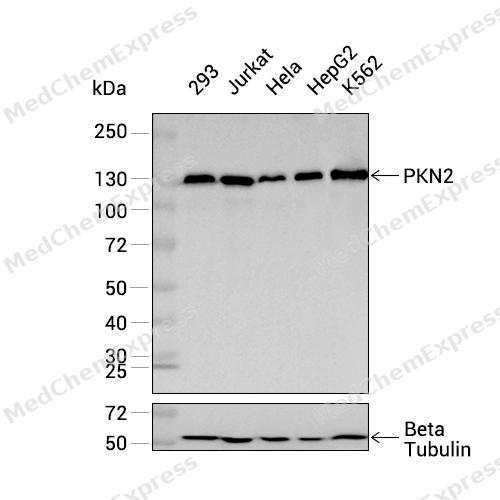
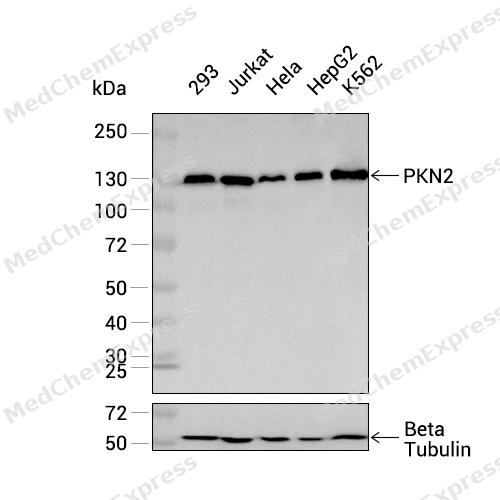 Western blot analysis was performed on extracts from 293 (lane 1, 15 μg), Jurkat (lane 2, 15 μg), Hela (lane 3, 15 μg), HepG2 (lane 4, 15 μg), and K562 (lane 5, 15 μg) using PKN2 Rabbit mAb.Proteins were transferred to a PVDF membrane and blocked with 5% non-fat milk in TBST at 4°C overnight.The primary antibody (1:1000 dilution) and the loading control antibody (beta-Tubulin, HY-P80487, 1:20000 dilution) were incubated in 5% non-fat milk in TBST for 1 hour at 37°C.Goat Anti-Rabbit IgG-HRP Secondary Antibody (1:20000 dilution) was then applied for 40 minutes at 37°C.
 -
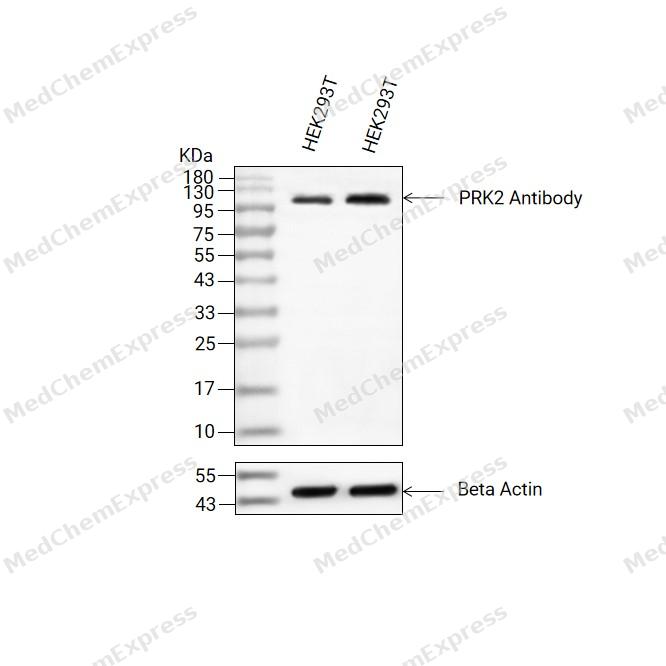 Western blot analysis of extracts from HEK293T(lane 2(20ug) and HEK293T(lane 3(40ug) using PRK2 Antibody (HY-P83145) Rabbit mAb. Proteins were transferred to a PVDF membrane and blocked with 5% non-fat milk in TBST for 2 hour at room temperature. The primary antibody (1/1000) and Loading control antibody (Beta Actin, HY-P83730, 1/10000) was used in 5% non-fat milk in TBST at 4°C overnight. Goat Anti-Mouse/Rabbit IgG-HRP Secondary Antibody (1/10000) was used for 1 hour at room temperature.
 -
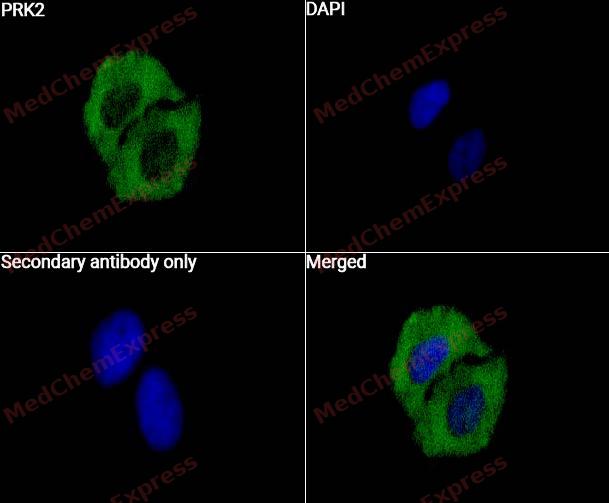 Immunocytochemistry analysis of HeLa cells labeling PRK2 with PRK2 Antibody (HY-P83145) at 1/50 dilution. Cells were fixed in 4% paraformaldehyde for 15 minutes at room temperature, permeabilized with 0.1% Triton X-100 for 10 minutes at room temperature, then blocked with BSA for Immunol Staining for 10 min at room temperature. Cells were then incubated with PRK2 Antibody (HY-P83145) at 1/50 dilution in BSA for Immunol Staining the night at 4 ℃. AF488-conjugated AffiniPure Goat Anti-Rabbit IgG H&L(HY-P8002, Green) was used as the secondary antibody at 1/1,000 dilution. PBS instead of the primary antibody was used as the secondary antibody only control. The Nuclear counterstain was DAPI (Blue).
 -
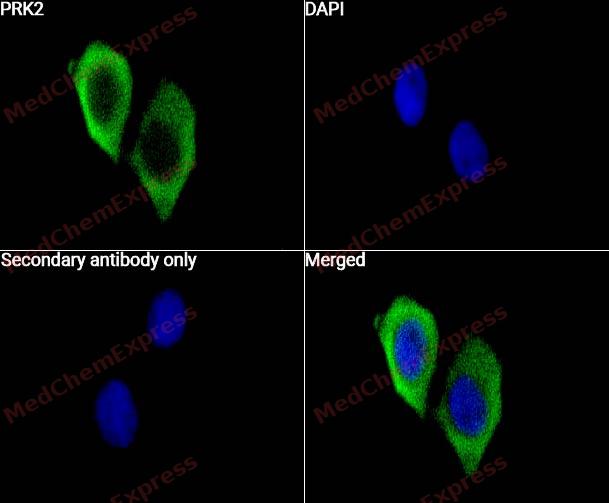 Immunocytochemistry analysis of HepG2 cells labeling PRK2 with PRK2 Antibody (HY-P83145) at 1/50 dilution. Cells were fixed in 4% paraformaldehyde for 15 minutes at room temperature, permeabilized with 0.1% Triton X-100 for 10 minutes at room temperature, then blocked with BSA for Immunol Staining for 10 min at room temperature. Cells were then incubated with PRK2 Antibody (HY-P83145) at 1/50 dilution in BSA for Immunol Staining the night at 4 ℃. AF488-conjugated AffiniPure Goat Anti-Rabbit IgG H&L(HY-P8002, Green) was used as the secondary antibody at 1/1,000 dilution. PBS instead of the primary antibody was used as the secondary antibody only control. The Nuclear counterstain was DAPI (Blue).


Background
-
Function
PRK2 is a PKC-related serine/threonine-protein kinase and Rho/Rac effector protein that participates in specific signal transduction responses in the cell. Plays a role in the regulation of cell cycle progression, actin cytoskeleton assembly, cell migration, cell adhesion, tumor cell invasion and transcription activation signaling processes. Phosphorylates CTTN in hyaluronan-induced astrocytes and hence decreases CTTN ability to associate with filamentous actin. Phosphorylates HDAC5, therefore lead to impair HDAC5 import. Direct RhoA target required for the regulation of the maturation of primordial junctions into apical junction formation in bronchial epithelial cells. Required for G2/M phases of the cell cycle progression and abscission during cytokinesis in a ECT2-dependent manner. Stimulates FYN kinase activity that is required for establishment of skin cell-cell adhesion during keratinocytes differentiation. Regulates epithelial bladder cells speed and direction of movement during cell migration and tumor cell invasion. Inhibits Akt pro-survival-induced kinase activity. Mediates Rho protein-induced transcriptional activation via the c-fos serum response factor (SRF). Involved in the negative regulation of ciliogenesis; (Microbial infection) Phosphorylates HCV NS5B leading to stimulation of HCV RNA replication[1].
-
Subcellular Localization
Cytoplasm; Nucleus; Membrane; Cell projection, lamellipodium; Cytoplasm, cytoskeleton; Cleavage furrow; Midbody; Cell junction
-
Expression
Tissue_specificity:It is ubiquitous. It is expressed in a variety of tumor cell lines, especially bladder tumor cells.
Induction:Up-regulated during keratinocyte differentiation -
Isoforms & Post-Translational Modification
Q16513 has 5 isomers: Q16513-1: 112035 Da (predicted); Q16513-2: 110345 Da (predicted); Q16513-3: 106217 Da (predicted); Q16513-4: 94136 Da (predicted); Q16513-5: 75171 Da (predicted).
Autophosphorylated. Phosphorylated during mitosis. Phosphorylated by CDK10 (PubMed:27104747);Activated by limited proteolysis with trypsin (By similarity). Proteolytically cleaved by caspase-3 during the induction of apoptotic cell death -
Subunit
Interacts (via the REM repeats) with RHOA (GTP-bound form preferentially) and interacts (via the REM repeats) with RAC1 (GTP-bound form preferentially); the interactions induce its autophosphorylation (PubMed:20974804, PubMed:9121475). Interacts with RHOC (PubMed:20974804). Interacts with NCK1 and NCK2 (PubMed:10026169). Interacts with NCK1 (via SH3 domains) (By similarity). Interacts with CD44 (PubMed:15123640). Interacts (via C-terminal kinase domain) with PDPK1; the interaction stimulates PDPK1 kinase activity (PubMed:10226025, PubMed:10792047, PubMed:11781095, PubMed:18835241). Interacts with MAP3K2; the interaction activates PRK2 kinase activity in a MAP3K2-independent kinase activity (PubMed:10818102). Interacts (via C-terminal domain) with AKT1; the interaction occurs with the C-terminal cleavage product of PRK2 in apoptotic cells (PubMed:10926925). Interacts (via C-terminus) with PTPN13 (via PDZ 3 domain) (PubMed:11356191). Interacts with CDK10 (PubMed:27104747)
-
SwissProt ID
-
Synonyms
PKN2; PRK2; PRKCL2; Serine/threonine-protein kinase N2; PKN gamma; Protein kinase C-like 2; Protein-kinase C-related kinase 2
-
Research Field
Cell Biology


Documentation
-
Data Sheet (234 KB)
-
SDS (251 KB)
- English - EN (251 KB)
- Français - FR (251 KB)
- Deutsch - DE (251 KB)
- Norwegian - NO (251 KB)
- Español - ES (251 KB)
- Swedish - SV (251 KB)
- Italian - IT (251 KB)
- Korean - KR (251 KB)
- Portuguese - PT (251 KB)
-
User Guide for Antibodies (1077 KB)

 Powered by Bioz
