



SHIP1 Antibody (YA2832)
(Synonyms: INPP5D; SHIP; SHIP1; Phosphatidylinositol 3; 4; 5-trisphosphate 5-phosphatase 1; Inositol polyphosphate-5-phosphatase of 145 kDa; SIP-145; SH2 domain-containing inositol 5'-phosphatase 1; SH2 domain-containing inositol phosphatase 1; SHIP-1)
Based on 1 Customer Validation
SHIP1 Antibody (YA2832) is a Rabbit-derived and non-conjugated IgG monoclonal antibody, targeting to SHIP1.
-
Host:
Rabbit
-
Isotype:
IgG
-
Application:
WB, IHC-P, IP, FC
-
Reactivity :
Human
-
Formulation:
Supplied in 50mM Tris-Glycine(pH 7.4), 0.15M NaCl, 40%Glycerol, 0.01% sodium azide and 0.05% BSA.
-
Conjugation:
Non-conjugated


To place orders, for customer services and technical support, please contact: MedChemExpress USA
Tel: 609-228-6898 E-mail: [email protected] [email protected]





Applications
| Application |
WB

WB: Western Blot
|
IHC-P
IHC-P: Immunohistochemistry-Paraffin
|
IP
IP: Immunoprecipitation
|
FC
FC: Flow Cytometry
|
|---|---|---|---|---|
| Dilution Ratio | 1:500-1:1000 | 1:50-1:100 | 1:50 | 1:50-1:100 |


Product Details
SHIP1 Antibody (YA2832) is a Rabbit-derived and non-conjugated IgG monoclonal antibody, targeting to SHIP1.
-
Host Rabbit

-
Clonality Recombinant,Monoclonal

-
Species ReactivityHuman
-
Observed Molecular WeightObserved band size: 140 kDa
Note: Due to possible protein modifications or aggregation, the molecular weight should be confirmed by actual measurement, and the predicted value is for reference only.

-
Calculated Molecular Weight Predicted band size: 133 kDa

A synthesized peptide derived from human SHIP aa1100-1155.
Endogenous
Affinity Chromatography
Non-conjugated
Unmodified
IgG


Product Properties
-
Appearance
Solution
-
Formulation
Supplied in 50mM Tris-Glycine(pH 7.4), 0.15M NaCl, 40%Glycerol, 0.01% sodium azide and 0.05% BSA.
-
Concentration
Batch-dependent, Please check the COA for the concentration of each lot. Check Lot Concentration
-
Storage & Stability
Stored at -20°C for 1 year. Avoid repeated freeze / thaw cycles.
-
Shipping
Shipping with blue ice.


Verification Images
-
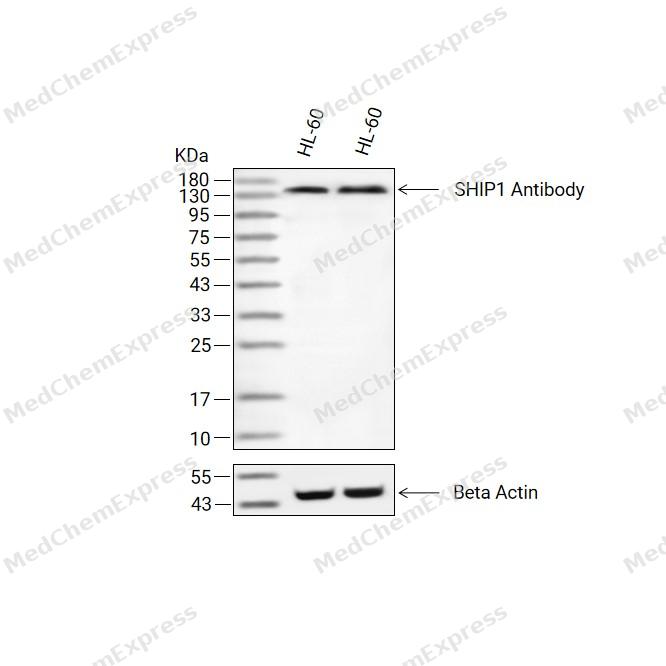 Western blot analysis of extracts from HL-60(lane 2(20ug) and HL-60(lane 3(40ug) using SHIP1 Antibody (HY-P83087) Rabbit mAb. Proteins were transferred to a PVDF membrane and blocked with 5% non-fat milk in TBST for 2 hour at room temperature. The primary antibody (1/1000) and Loading control antibody (Beta Actin, HY-P83730, 1/10000) was used in 5% non-fat milk in TBST at 4°C overnight. Goat Anti-Mouse/Rabbit IgG-HRP Secondary Antibody (1/10000) was used for 1 hour at room temperature.
 -
 Flow cytometric analysis of 1X10⁶ Jurkat cells labeling SHIP1 Antibody (HY-P83087, red). Cells were fixed with 4% paraformaldehyde and permeabilised with 90% methanol. Then stained with the primary antibody at 1/50 dilution for an hour at 4℃. AF488-conjugated Goat Anti-Rabbit IgG H&L (HY-P8002) was used as the secondary antibody at 1/1,000 dilution for 30 minutes at 4℃. Rabbit IgG Isotype Control (HY-P80879, blue) was used as the isotype control, cells without incubation with primary antibody were used as the unlabeled control (black).


Background
-
Function
SHIP1 is a Phosphatidylinositol (PtdIns) phosphatase that specifically hydrolyzes the 5-phosphate of phosphatidylinositol-3,4,5-trisphosphate (PtdIns(3,4,5)P3) to produce PtdIns(3,4)P2, thereby negatively regulating the PI3K (phosphoinositide 3-kinase) pathways. Able also to hydrolyzes the 5-phosphate of phosphatidylinositol-4,5-bisphosphate (PtdIns(4,5)P3) and inositol 1,3,4,5-tetrakisphosphate. Acts as a negative regulator of B-cell antigen receptor signaling. Mediates signaling from the FC-gamma-RIIB receptor (FCGR2B), playing a central role in terminating signal transduction from activating immune/hematopoietic cell receptor systems. Acts as a negative regulator of myeloid cell proliferation/survival and chemotaxis, mast cell degranulation, immune cells homeostasis, integrin alpha-IIb/beta-3 signaling in platelets and JNK signaling in B-cells. Regulates proliferation of osteoclast precursors, macrophage programming, phagocytosis and activation and is required for endotoxin tolerance. Involved in the control of cell-cell junctions, CD32a signaling in neutrophils and modulation of EGF-induced phospholipase C activity. Key regulator of neutrophil migration, by governing the formation of the leading edge and polarization required for chemotaxis. Modulates FCGR3/CD16-mediated cytotoxicity in NK cells. Mediates the activin/TGF-beta-induced apoptosis through its Smad-dependent expression[1][2][3][4][5].
-
Subcellular Localization
Cytoplasm; Cell membrane; Peripheral membrane protein; Membrane raft; Cytoplasm, cytoskeleton; Membrane; Peripheral membrane protein
-
Expression
Tissue_specificity:This protein is specifically expressed on immune cells and hematopoietic cells. It is expressed in both bone marrow and blood cells. Its expression level varies significantly across different cell populations. It is expressed in at least 74% of immature CD34+ cells, while only 10% of more mature CD33+ cells express it. This protein is expressed in most T cells, and in a minority of B cells (protein level) . -
Isoforms & Post-Translational Modification
Q92835 has 3 isomers: Q92835-1: 133292 Da (predicted); Q92835-2: 133193 Da (predicted); Q92835-3: 109294 Da (predicted).
Tyrosine phosphorylated by the members of the SRC family after exposure to a diverse array of extracellular stimuli such as cytokines, growth factors, antibodies, chemokines, integrin ligands and hypertonic and oxidative stress. Phosphorylated upon IgG receptor FCGR2B-binding -
Subunit
Interacts with tyrosine phosphorylated form of SHC1 (PubMed:8874179). Interacts with tyrosine phosphorylated form of DOK1 (PubMed:10822173)
-
SwissProt ID
-
Synonyms
INPP5D; SHIP; SHIP1; Phosphatidylinositol 3; 4; 5-trisphosphate 5-phosphatase 1; Inositol polyphosphate-5-phosphatase of 145 kDa; SIP-145; SH2 domain-containing inositol 5'-phosphatase 1; SH2 domain-containing inositol phosphatase 1; SHIP-1
-
Research Field
Immunology


Documentation
-
Data Sheet (235 KB)
-
SDS (252 KB)
- English - EN (252 KB)
- Français - FR (252 KB)
- Deutsch - DE (252 KB)
- Norwegian - NO (252 KB)
- Español - ES (252 KB)
- Swedish - SV (252 KB)
- Italian - IT (252 KB)
- Korean - KR (252 KB)
- Portuguese - PT (252 KB)
-
User Guide for Antibodies (1077 KB)

 Powered by Bioz
