



SMARCC1 Antibody (YA1047)
(Synonyms: BAF155; CRACC1; Rsc8; SMARCC1; SRG3; SWI3)
Based on 1 Customer Validation
SMARCC1 Antibody (YA1047) is a Rabbit-derived and non-conjugated IgG monoclonal antibody, targeting to SMARCC1.
-
Host:
Rabbit
-
Isotype:
IgG
-
Application:
WB, ICC/IF, IP, FC
-
Reactivity :
Human, Rat
-
Formulation:
Supplied in rabbit IgG in PBS(pH 7.4), 150mM sodium chloride, 0.05% BSA, 0.02% sodium azide and 50% glycerol.
-
Conjugation:
Non-conjugated


To place orders, for customer services and technical support, please contact: MedChemExpress USA
Tel: 609-228-6898 E-mail: [email protected] [email protected]





Applications
| Application |
WB

WB: Western Blot
|
ICC/IF
ICC/IF: Immunocytochemistry/
Immunofluorescence |
IP
IP: Immunoprecipitation
|
FC
FC: Flow Cytometry
|
|---|---|---|---|---|
| Dilution Ratio | 1:1000-1:2000 | 1:50-1:200 | 1:50 | 1:50-1:100 |


Product Details
SMARCC1 Antibody (YA1047) is a Rabbit-derived and non-conjugated IgG monoclonal antibody, targeting to SMARCC1.
-
Host Rabbit

-
Clonality Recombinant,Monoclonal

-
Species ReactivityHuman, Rat
-
Observed Molecular WeightObserved band size: 155 kDa
Note: Due to possible protein modifications or aggregation, the molecular weight should be confirmed by actual measurement, and the predicted value is for reference only.

-
Calculated Molecular Weight Predicted band size: 123 kDa

Entrez Gene: 6599 Human ; 20588 Mouse ; 301020 Rat
SwissProt: Q92922 Human ; P97496 Mouse ;
OMIM: 620241 Human
A synthesized peptide derived from human SMARCC1/BAF155 aa700-750/1105.
Endogenous
Affinity Chromatography
Non-conjugated
Unmodified
IgG


Product Properties
-
Appearance
Solution
-
Formulation
Supplied in rabbit IgG in PBS(pH 7.4), 150mM sodium chloride, 0.05% BSA, 0.02% sodium azide and 50% glycerol.
-
Concentration
Batch-dependent, Please check the COA for the concentration of each lot. Check Lot Concentration
-
Storage & Stability
Stored at -20°C for 1 year. Avoid repeated freeze / thaw cycles.
-
Shipping
Shipping with blue ice.


Verification Images
-
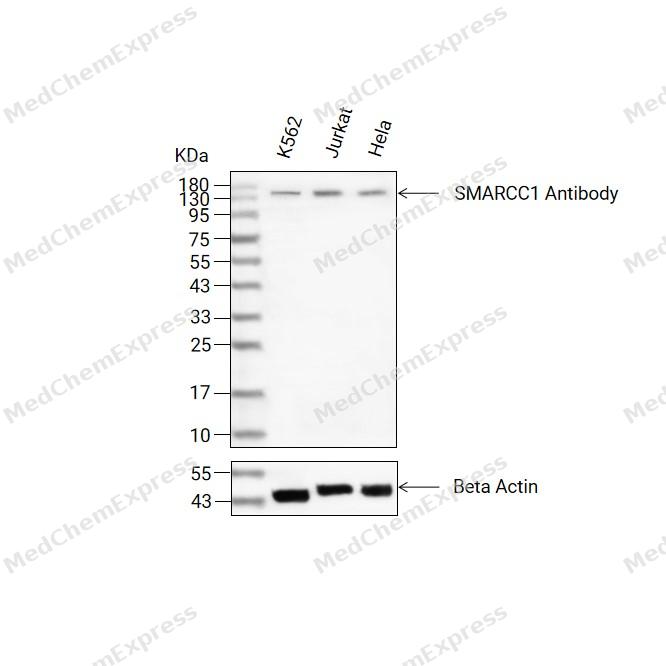 Western blot analysis of extracts from K562(lane 2(20ug) , Jurkat(lane 3(20ug) and Hela(lane 4(20ug) using SMARCC1 Antibody (HY-P81309) Rabbit mAb. Proteins were transferred to a PVDF membrane and blocked with 5% non-fat milk in TBST for 2 hour at room temperature. The primary antibody (1/1000) and Loading control antibody (Beta Actin, HY-P83730, 1/10000) was used in 5% non-fat milk in TBST at 4°C overnight. Goat Anti-Mouse/Rabbit IgG-HRP Secondary Antibody (1/10000) was used for 1 hour at room temperature.


Background
-
Function
SMARCC1, also called BAF155, is a core SWI/SNF/BAF chromatin-remodeling complex subunit that helps ATP-dependent remodeling of nucleosomes and supports transcriptional regulation[1]. Mechanistically, BAF155-containing complexes regulate chromatin accessibility during stem-cell differentiation, embryonic stem-cell self-renewal exit, and hematopoietic lineage chromatin priming[2][3][4]. In developmental models, Baf155 loss disrupts myeloid and erythroid differentiation from erythromyeloid progenitors, while human SMARCC1 variants associate with congenital hydrocephalus, ventriculomegaly, aqueductal stenosis, developmental delay, and structural brain or cardiac defects[3][5][6]. Compared with the related isoform SMARCC2/BAF170, BAF155 predominates in stem cells, whereas BAF170 incorporation increases during differentiation; BAF170 can compete with BAF155 in BAF complexes to regulate cortical progenitor programs and cerebral cortical size[7][8]. For experimental applications, current evidence supports SMARCC1/BAF155 as a chromatin-remodeling, neurodevelopmental, hematopoietic, and cancer-biology research target, while structural work identifies conserved N-terminal pockets that may guide future small-molecule targeting rather than validated SMARCC1-specific agonists or inhibitors[9].
-
Subcellular Localization
Nucleus; Cytoplasm
-
Expression
Tissue_specificity:It is expressed in the brain, heart, muscles, placenta, lungs, liver, muscles, kidneys, and pancreas. -
Subunit
Component of the multiprotein chromatin-remodeling complexes SWI/SNF: SWI/SNF-A (BAF), SWI/SNF-B (PBAF) and related complexes. The canonical complex contains a catalytic subunit (either SMARCA4/BRG1/BAF190A or SMARCA2/BRM/BAF190B) and at least SMARCE1, ACTL6A/BAF53, SMARCC1/BAF155, SMARCC2/BAF170, and SMARCB1/SNF5/BAF47. Other subunits specific to each of the complexes may also be present permitting several possible combinations developmentally and tissue specific (Probable). Component of the BAF complex, which includes at least actin (ACTB), ARID1A/BAF250A, ARID1B/BAF250B, SMARCA2/BRM, SMARCA4/BRG1, ACTL6A/BAF53, ACTL6B/BAF53B, SMARCE1/BAF57, SMARCC1/BAF155, SMARCC2/BAF170, SMARCB1/SNF5/INI1, and one or more SMARCD1/BAF60A, SMARCD2/BAF60B, or SMARCD3/BAF60C. In muscle cells, the BAF complex also contains DPF3 (PubMed:18765789). Component of neural progenitors-specific chromatin remodeling complex (npBAF complex) composed of at least, ARID1A/BAF250A or ARID1B/BAF250B, SMARCD1/BAF60A, SMARCD3/BAF60C, SMARCA2/BRM/BAF190B, SMARCA4/BRG1/BAF190A, SMARCB1/BAF47, SMARCC1/BAF155, SMARCE1/BAF57, SMARCC2/BAF170, PHF10/BAF45A, ACTL6A/BAF53A and actin. Component of neuron-specific chromatin remodeling complex (nBAF complex) composed of at least, ARID1A/BAF250A or ARID1B/BAF250B, SMARCD1/BAF60A, SMARCD3/BAF60C, SMARCA2/BRM/BAF190B, SMARCA4/BRG1/BAF190A, SMARCB1/BAF47, SMARCC1/BAF155, SMARCE1/BAF57, SMARCC2/BAF170, DPF1/BAF45B, DPF3/BAF45C, ACTL6B/BAF53B and actin (By similarity). Component of the SWI/SNF-B (PBAF) chromatin remodeling complex, at least composed of SMARCA4/BRG1, SMARCB1/BAF47/SNF5, ACTL6A/BAF53A or ACTL6B/BAF53B, SMARCE1/BAF57, SMARCD1/BAF60A, SMARCD2/BAF60B, perhaps SMARCD3/BAF60C, SMARCC1/BAF155, SMARCC2/BAF170, PBRM1/BAF180, ARID2/BAF200 and actin (PubMed:22952240, PubMed:26601204). Component of SWI/SNF (GBAF) subcomplex, which includes at least BICRA or BICRAL (mutually exclusive), BRD9, SS18, SMARCA2/BRM, SMARCA4/BRG1/BAF190A, ACTL6A/BAF53, SMARCC1/BAF155, and SMARCD1/BAF60A (PubMed:29374058). May also interact with the SIN3A histone deacetylase transcription repressor complex in conjunction with SMARCA2 and SMARCA4 (PubMed:11238380). The minimal complex composed of SMARCC1 and SMARCA4 seems to be able to associate with cyclin such as CCNE1 or transcription factors such as KLF1 or GATA1 (PubMed:9891079). Interacts with NR3C1 and SMARD1 (PubMed:12917342). Interacts with TRIP12; leading to disrupt interaction between TRIP12 and SMARCE1 and prevent SMARCE1 ubiquitination (PubMed:20111005). Interacts with CEBPB (when not methylated) (PubMed:20829358). Interacts with KDM6B (By similarity). Interacts with MKKS; the interaction takes place predominantly in the cytoplasm and may modulate SMARCC1 location (PubMed:28753627). Interacts with DPF2 (PubMed:28533407). Interacts with PRDM1/BLIMP1 (PubMed:32417234). Interacts with DPF3a (isoform 2 of DPF3/BAF45C) and with HDGFL2 in a DPF3a-dependent manner (PubMed:32459350)
-
SwissProt ID
-
Synonyms
BAF155; CRACC1; Rsc8; SMARCC1; SRG3; SWI3
-
Research Field
Epigenetics and Nuclear Signaling


Documentation
References
[1]. Phelan ML, et al. Reconstitution of a core chromatin remodeling complex from SWI/SNF subunits. Mol Cell. 1999 Feb;3(2):247-53. [Content Brief]
[2]. Schaniel C, et al. Smarcc1/Baf155 couples self-renewal gene repression with changes in chromatin structure in mouse embryonic stem cells. Stem Cells. 2009 Dec;27(12):2979-91. [Content Brief]
[3]. Wu J, et al. Requisite Chromatin Remodeling for Myeloid and Erythroid Lineage Differentiation from Erythromyeloid Progenitors. Cell Rep. 2020 Nov 17;33(7):108395. [Content Brief]
[4]. Wu J, et al. Baf155 controls hematopoietic differentiation and regeneration through chromatin priming. Cell Rep. 2024 Aug 27;43(8):114558. [Content Brief]
[5]. Al Mutairi F, et al. A mendelian form of neural tube defect caused by a de novo variant in SMARCC1 in an identical twin. Ann Neurol. 2018 Feb;83(2):433-436. [Content Brief]
[6]. Singh AK, et al. A novel SMARCC1 BAFopathy implicates neural progenitor epigenetic dysregulation in human hydrocephalus. Brain. 2024 Apr 4;147(4):1553-1570. [Content Brief]
[7]. Tuoc TC, et al. Chromatin regulation by BAF170 controls cerebral cortical size and thickness. Dev Cell. 2013 May 13;25(3):256-69. [Content Brief]
[8]. Allen MD, et al. SWI/SNF subunit BAF155 N-terminus structure informs the impact of cancer-associated mutations and reveals a potential drug binding site. Commun Biol. 2021 May 5;4(1):528. [Content Brief]

 Powered by Bioz
