



STING Antibody (YA048)
(Synonyms: ERIS, MITA, STING, TMEM173, STING1, Stimulator of interferon genes protein, hSTING, Endoplasmic reticulum interferon stimulator, Mediator of IRF3 activation, Transmembrane protein 173, hMITA)
Based on 1 Customer Validation
STING Antibody (YA048) is a Rabbit-derived and non-conjugated IgG monoclonal antibody, targeting to STING.
-
Host:
Rabbit
-
Isotype:
IgG
-
Application:
WB, FC
-
Reactivity :
Human
-
Formulation:
Supplied in 1*TBS (pH7.4), 0.05% BSA and 40% Glycerol. Preservative: 0.05% Sodium Azide.
-
Conjugation:
Non-conjugated


To place orders, for customer services and technical support, please contact: MedChemExpress USA
Tel: 609-228-6898 E-mail: [email protected] [email protected]





Applications
| Application |
WB

WB: Western Blot
|
FC
FC: Flow Cytometry
|
|---|---|---|
| Dilution Ratio | 1:500-1:1000 | 1:50-1:100 |


Product Details
STING Antibody (YA048) is a Rabbit-derived and non-conjugated IgG monoclonal antibody, targeting to STING.
-
Host Rabbit

-
Clonality Recombinant,Monoclonal

-
Species ReactivityHuman
-
Observed Molecular WeightObserved band size: 42 kDa
Note: Due to possible protein modifications or aggregation, the molecular weight should be confirmed by actual measurement, and the predicted value is for reference only.

-
Calculated Molecular Weight Predicted band size: 42 kDa

Synthetic peptide corresponding to Human TMEM173.AA range:220-379.
Endogenous
Protein A affinity purified.
Non-conjugated
Unmodified
IgG


Product Properties
-
Appearance
Solution
-
Formulation
Supplied in 1*TBS (pH7.4), 0.05% BSA and 40% Glycerol. Preservative: 0.05% Sodium Azide.
-
Concentration
Batch-dependent, Please check the COA for the concentration of each lot. Check Lot Concentration
-
Storage & Stability
Stored at -20°C for 1 year. Avoid repeated freeze / thaw cycles.
-
Shipping
Shipping with blue ice.


Verification Images
-
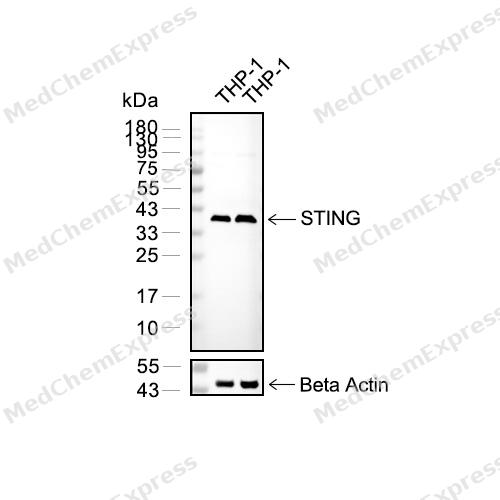 Western blot analysis of extracts from THP-1 (lane 2(20μg) , THP-1 (lane 3(40μg),using STING Antibody (HY-P80350). Proteins were transferred to a PVDF membrane and blocked with 5% BSA in TBST for 2 hour at room temperature. The primary antibody and Loading control antibody (Beta Actin, HY-P80438, 1/3000) was used in 5% BSA in TBST at 4°C overnight. Goat Anti-Mouse/Rabbit IgG-HRP Secondary Antibody (HY-P8004/HY-P8001, 1/10,000) was used for 1 hour at room temperature.
 -
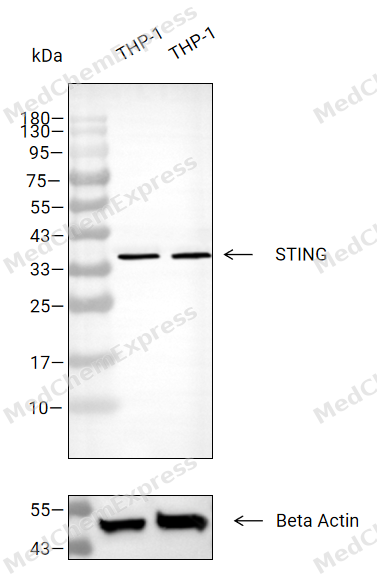 Western blot analysis of extracts from THP-1(lane 2(20μg), THP-1 (lane 3(40μg),using STING Antibody. Proteins were transferred to a PVDF membrane and blocked with 5% BSA in TBST for 2 hour at room temperature. The primary antibody and Loading control antibody (Beta Actin, HY-P80438, 1/3000) was used in 5% BSA in TBST at 4°C overnight. Goat Anti-Mouse/Rabbit IgG-HRP Secondary Antibody (HY-P8004/HY-P8001, 1/10,000) was used for 1 hour at room temperature.
 -
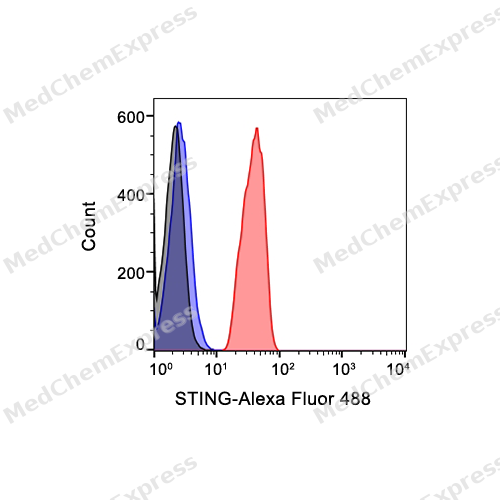 Flow cytometric analysis of 1X10^6 THP-1 cells labeling STING Antibody (HY-P80350, red). Cells were fixed with 4% paraformaldehyde and permeabilised with 90% methanol. Then stained with the primary antibody at 1/1000 dilution for an hour at 4℃. Alexa Fluor® 488-conjugated AffiniPure Goat Anti-Rabbit IgG H&L (HY-P8002) was used as the secondary antibody at 1/1,000 dilution for 30 minutes at 4℃. Rabbit IgG Isotype Control (HY-P80879, blue) was used as the isotype control, cells without incubation with primary antibody were used as the unlabeled control (black).


Background
-
Function
Stimulator of interferon genes (STING) is an integral ER-membrane protein that can be activated by 2'3'-cGAMP synthesized by cyclic guanosine monophosphate-adenosine monophosphate synthase (cGAS) upon binding of double-stranded DNA. It activates interferon (IFN) and inflammatory cytokine responses to defend against infection by microorganisms. STING is a key cytosolic receptor for small nucleotides and plays a key role in anticancer and antiviral immunity. STING signaling pathway is also a critical link between innate and adaptive immunity, and induces anti-tumor immune responses. STING agonists, such as endogenous cyclic dinucleotide (CDN) cyclic GMP-AMP (cGAMP), have been used in diverse research for immunogenic tumor clearance, antiviral treatments and vaccine adjuvants.
-
Subcellular Localization
Endoplasmic reticulum membrane; Multi-pass membrane protein; Cytoplasm, perinuclear region; Endoplasmic reticulum-Golgi intermediate compartment membrane; Multi-pass membrane protein; Golgi apparatus membrane; Multi-pass membrane protein; Cytoplasmic vesicle, autophagosome membrane; Multi-pass membrane protein; Mitochondrion outer membrane; Multi-pass membrane protein; Cell membrane; Multi-pass membrane protein
-
Expression
Tissue_specificity:Widely expressed (PubMed:18724357, PubMed:18818105) . Expressed in skin endothelial cells, type II alveolar cells, bronchial epithelial cells, and alveolar macrophages (PubMed:25029335) . -
Subunit
Homodimer; forms a homodimer in absence of cyclic nucleotide (c-di-GMP or cGAMP); 'Lys-63'-linked ubiquitination at Lys-150 is required for homodimerization (PubMed:19285439, PubMed:22579474, PubMed:22705373, PubMed:22728658, PubMed:22728659, PubMed:22728660, PubMed:30842659). Homotetramer; in presence of cyclic nucleotide (c-di-GMP or cGAMP), forms tetramers and higher-order oligomers through side-by-side packing (PubMed:30842653, PubMed:35388221). Interacts (when phosphorylated) with IRF3; following activation and phosphorylation on the pLxIS motif by TBK1, recruits IRF3 (PubMed:22394562, PubMed:25636800, PubMed:27302953, PubMed:28331227). Interacts with RIGI, MAVS and SSR2 (PubMed:18724357, PubMed:18818105). Interacts with RNF5 and TRIM56 (PubMed:19285439, PubMed:21074459). Interacts with TBK1; when homodimer, leading to subsequent production of IFN-beta (PubMed:19416887). Interacts with IFIT1 and IFIT2 (PubMed:19416887). Interacts with TRIM29; this interaction induces STING1 ubiquitination and subsequent degradation (PubMed:29038422). Associates with the MHC-II complex (By similarity). Interacts with STEEP1; interaction takes place upon cGAMP-activation and STING1 phosphorylation by MAP3K7/TAK1 and promotes STING1 translocation to COPII vesicles (PubMed:32690950, PubMed:37832545). Interacts with SEC24A, SEC24B, and SEC24C; promoting translocation to COPII vesicles (PubMed:30842662, PubMed:32690950). Interacts (when ubiquitinated) with SQSTM1; leading to relocalization to autophagosomes (By similarity). Interacts with SURF4 (PubMed:29251827). Interacts with HNRNPA2B1 (PubMed:31320558). Interacts with ZDHHC1; ZDHHC1 constitutively interacts with STING1 and in presence of DNA viruses activates it by promoting its cGAMP-induced oligomerization and the recruitment of downstream signaling components (PubMed:25299331). Interacts with ZDHHC11; in presence of DNA viruses promotes the recruitment of IRF3 to STING1 (PubMed:28331227). Interacts with TOMM70 (PubMed:20628368). Interacts with isoform IFI16-beta of IFI16 (PubMed:30104205). Interacts with TAB1; promoting recruitment of TAB1 to the endoplasmic reticulum membrane and subsequent activation of MAP3K7/TAK1 (PubMed:37832545). Interacts (via transmembrane domain) with TMEM203 (By similarity). Interacts with DDX41 (PubMed:25704810). Interacts with TMEM120A (via C-terminal domain); regulates the trafficking of STING1 from the ER to the ER-Golgi intermediate compartment to elicit antiviral effects (PubMed:35013224)
-
SwissProt ID
-
Synonyms
ERIS, MITA, STING, TMEM173, STING1, Stimulator of interferon genes protein, hSTING, Endoplasmic reticulum interferon stimulator, Mediator of IRF3 activation, Transmembrane protein 173, hMITA
-
Research Field
Immunology


Documentation
-
Data Sheet (235 KB)
-
SDS (252 KB)
- English - EN (252 KB)
- Français - FR (252 KB)
- Deutsch - DE (252 KB)
- Norwegian - NO (252 KB)
- Español - ES (252 KB)
- Swedish - SV (252 KB)
- Italian - IT (252 KB)
- Korean - KR (252 KB)
- Portuguese - PT (252 KB)
-
User Guide for Antibodies (1077 KB)

 Powered by Bioz
