



TIE2 Antibody (YA6798)
(Synonyms: Angiopoietin 1 receptor antibody; Angiopoietin-1 receptor antibody; CD202b antibody; CD202b antigen antibody; Endothelial tyrosine kinase antibody; Endothelium specific receptor tyrosine kinase 2 antibody; hTIE 2 antibody; hTIE2 antibody; Hyk antibody; p140 TEK antibody; Angiopoietin 1 receptor antibody; Angiopoietin-1 receptor antibody; CD202b antibody; CD202b antigen antibody; Endothelial tyrosine kinase antibody; Endothelium specific receptor tyrosine kinase 2 antibody; hTIE 2 antibody; hTIE2 antibody; Hyk antibody; p140 TEK antibody; Soluble TIE2 variant 1 antibody; Soluble TIE2 variant 2 antibody; Tek antibody; tek tyrosine kinase antibody; TEK tyrosine kinase endothelial antibody; tek tyrosine kinase, endothelial antibody; TIE 2 antibody; TIE2 antibody; TIE2_HUMAN antibody; Tunica interna endothelial cell kinase antibody; Tyrosine kinase with Ig and EGF homology domains 2 antibody; Tyrosine kinase with Ig and EGF homology domains-2 antibody; Tyrosine protein kinase receptor TEK antibody; Tyrosine protein kinase receptor TIE 2 antibody; Tyrosine-protein kinase receptor TEK antibody; Tyrosine-protein kinase receptor TIE-2 antibody; Venous malformations multiple cutaneous and mucosal antibody; VMCM 1 antibody; VMCM antibody; VMCM1 antibody; )Based on 1 Customer Validation
TIE2 Antibody (YA6798) is a Rabbit-derived and non-conjugated IgG monoclonal antibody, targeting to TIE2.
-
Host:
Rabbit
-
Isotype:
IgG
-
Application:
WB, FC
-
Reactivity :
Human
-
Formulation:
Supplied in PBS (pH7.4), 0.1% BSA, 40% Glycerol. Preservative: 0.05% Sodium Azide.
-
Conjugation:
Non-conjugated


To place orders, for customer services and technical support, please contact: MedChemExpress USA
Tel: 609-228-6898 E-mail: [email protected] [email protected]





Applications
| Application |
WB

WB: Western Blot
|
FC
FC: Flow Cytometry
|
|---|---|---|
| Dilution Ratio | 1:1000 | 1:1000 |


Product Details
TIE2 Antibody (YA6798) is a Rabbit-derived and non-conjugated IgG monoclonal antibody, targeting to TIE2.
-
Host Rabbit

-
Clonality Recombinant,Monoclonal

-
Species ReactivityHuman
-
Observed Molecular WeightObserved band size: 150 kDa
Note: Due to possible protein modifications or aggregation, the molecular weight should be confirmed by actual measurement, and the predicted value is for reference only.

-
Calculated Molecular Weight Predicted band size: 126 kDa

Recombinant protein within human TIE2 aa 1-769.
affinity purified.
Non-conjugated
Unmodified
IgG


Product Properties
-
Appearance
Solution
-
Formulation
Supplied in PBS (pH7.4), 0.1% BSA, 40% Glycerol. Preservative: 0.05% Sodium Azide.
-
Concentration
Batch-dependent, Please check the COA for the concentration of each lot. Check Lot Concentration
-
Storage & Stability
Stored at -20°C for 1 year. Avoid repeated freeze / thaw cycles.
-
Shipping
Shipping with blue ice.


Verification Images
-
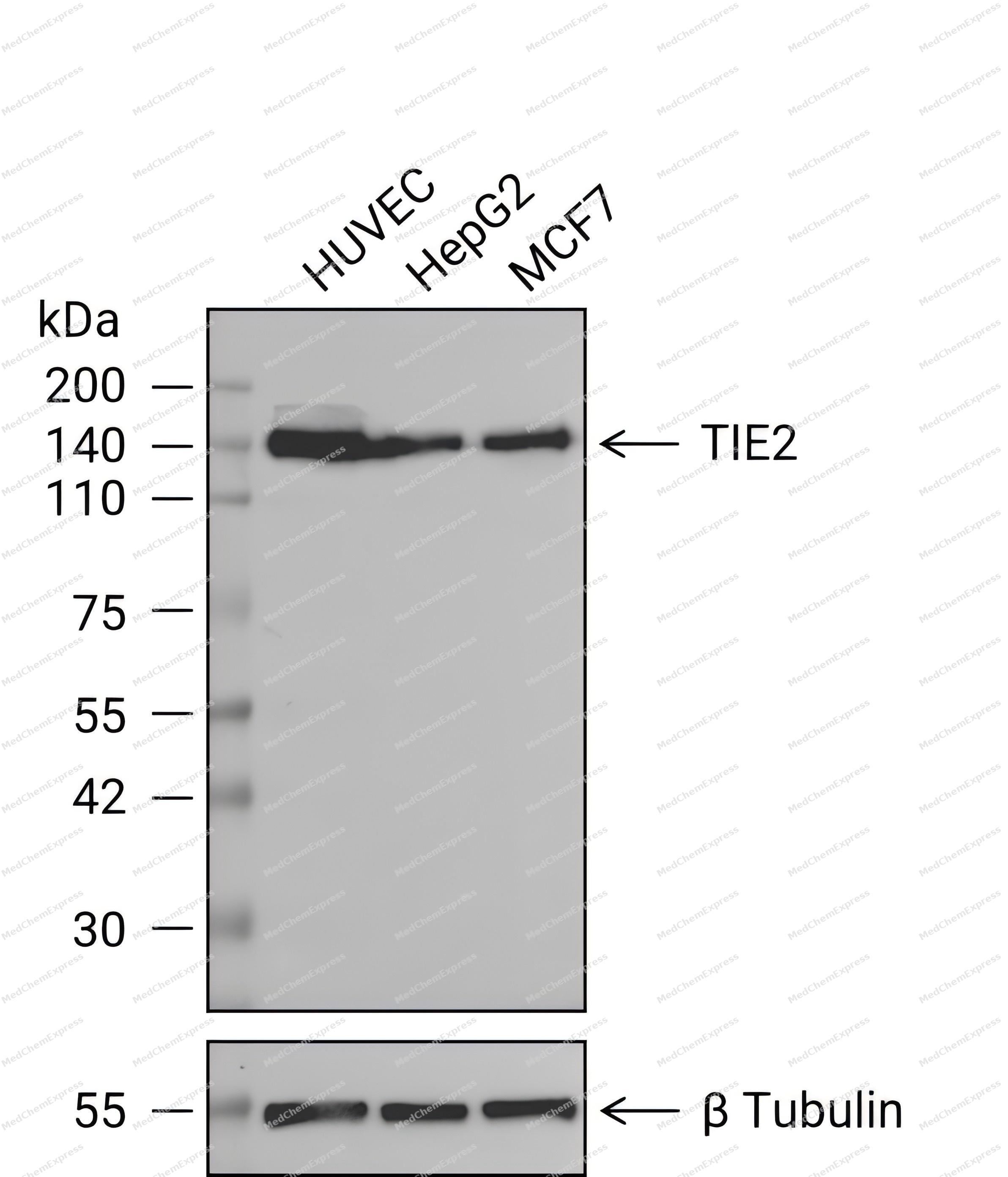 Western blot analysis of extracts from HUVEC (lane 1(20μg)) 、HepG2 (lane 2(20μg)) and MCF7 (lane 3(20μg)) using TIE2 Antibody (HY-P87105) . Proteins were transferred to a PVDF membrane and blocked with 5% nonfat dry milk in TBST for 1.5 hour at room temperature. The primary antibody (1/1000) and Loading control antibody (β Tubulin, 1/10000) was used in 5% nonfat dry milk in TBST at 4℃ overnight. Goat Anti-Rabbit IgG-HRP Secondary Antibody (1/10,000) was used for 1 hour at room temperature.


Background
-
Function
Tie2, encoded by TEK, belongs to the Tie1/Tie2 receptor tyrosine kinase class expressed in developing vascular endothelial cells[1]. Angiopoietin-1 was identified as a secreted ligand for Tie2 and functions as a primary physiological ligand during embryonic angiogenesis[2][3]. Mechanistically, Ang1-Tie2 signaling supports vascular maturation and has angiogenic actions distinct from VEGF[3]. In disease-relevant angiogenesis models, Ang2 acts as a natural antagonist for Tie2, disrupts in vivo angiogenesis, and modulates VEGF-induced postnatal neovascularization with Ang1[4][5]. Compared with Tie1, Tie2 has ligand-defined angiopoietin signaling, whereas Tie1 can negatively regulate Tie2 surface presentation in angiogenic endothelial cells and cooperatively sustain Tie2 signaling in remodeling stalk cells[7]. In adult tissues, Tie2 expression and phosphorylation occur in both angiogenic and quiescent vasculature, supporting roles in vascular growth and maintenance[6]. For experimental applications, VE-PTP inhibition activates Tie2 and stabilizes ocular vessels, making Tie2 activation a practical strategy for vascular leakage and neovascularization models[8].
-
Subcellular Localization
Cell membrane,Cell junction,Cell junction, focal adhesion,Cytoplasm, cytoskeleton,Secreted
-
Expression
Tissue_Specificity: Detected in umbilical vein endothelial cells. Proteolytic processing gives rise to a soluble extracellular domain that is detected in blood plasma (at protein level). Predominantly expressed in endothelial cells and their progenitors, the angioblasts. Has been directly found in placenta and lung, with a lower level in umbilical vein endothelial cells, brain and kidney -
Isoforms & Post-Translational Modification
Q02763 has three isomers: Q02763-1: 125830 Da (predicted); Q02763-2: 121048 Da (predicted); Q02763-3: 109141 Da (predicted).
Proteolytic processing leads to the shedding of the extracellular domain (soluble TIE-2 alias sTIE-2)丨Autophosphorylated on tyrosine residues in response to ligand binding丨Ubiquitinated -
Subunit
Homodimer
-
SwissProt ID
-
Synonyms
Angiopoietin 1 receptor antibody; Angiopoietin-1 receptor antibody; CD202b antibody; CD202b antigen antibody; Endothelial tyrosine kinase antibody; Endothelium specific receptor tyrosine kinase 2 antibody; hTIE 2 antibody; hTIE2 antibody; Hyk antibody; p140 TEK antibody; Angiopoietin 1 receptor antibody; Angiopoietin-1 receptor antibody; CD202b antibody; CD202b antigen antibody; Endothelial tyrosine kinase antibody; Endothelium specific receptor tyrosine kinase 2 antibody; hTIE 2 antibody; hTIE2 antibody; Hyk antibody; p140 TEK antibody; Soluble TIE2 variant 1 antibody; Soluble TIE2 variant 2 antibody; Tek antibody; tek tyrosine kinase antibody; TEK tyrosine kinase endothelial antibody; tek tyrosine kinase, endothelial antibody; TIE 2 antibody; TIE2 antibody; TIE2_HUMAN antibody; Tunica interna endothelial cell kinase antibody; Tyrosine kinase with Ig and EGF homology domains 2 antibody; Tyrosine kinase with Ig and EGF homology domains-2 antibody; Tyrosine protein kinase receptor TEK antibody; Tyrosine protein kinase receptor TIE 2 antibody; Tyrosine-protein kinase receptor TEK antibody; Tyrosine-protein kinase receptor TIE-2 antibody; Venous malformations multiple cutaneous and mucosal antibody; VMCM 1 antibody; VMCM antibody; VMCM1 antibody;


Documentation
-
Data Sheet (260 KB)
-
SDS (254 KB)
- English - EN (254 KB)
- Français - FR (254 KB)
- Deutsch - DE (254 KB)
- Norwegian - NO (254 KB)
- Español - ES (254 KB)
- Swedish - SV (254 KB)
- Italian - IT (254 KB)
- Korean - KR (254 KB)
- Portuguese - PT (254 KB)
-
User Guide for Antibodies (1077 KB)
References
[1]. Sato TN, et al. Distinct roles of the receptor tyrosine kinases Tie-1 and Tie-2 in blood vessel formation. Nature. 1995 Jul 6;376(6535):70-4. [Content Brief]
[2]. Davis S, et al. Isolation of angiopoietin-1, a ligand for the TIE2 receptor, by secretion-trap expression cloning. Cell. 1996 Dec 27;87(7):1161-9. [Content Brief]
[3]. Suri C, et al. Requisite role of angiopoietin-1, a ligand for the TIE2 receptor, during embryonic angiogenesis. Cell. 1996 Dec 27;87(7):1171-80. [Content Brief]
[5]. Asahara T, et al. Tie2 receptor ligands, angiopoietin-1 and angiopoietin-2, modulate VEGF-induced postnatal neovascularization. Circ Res. 1998 Aug 10;83(3):233-40. [Content Brief]
[6]. Wong AL, et al. Tie2 expression and phosphorylation in angiogenic and quiescent adult tissues. Circ Res. 1997 Oct;81(4):567-74. [Content Brief]
[7]. Simões-Costa M, et al. Axud1 Integrates Wnt Signaling and Transcriptional Inputs to Drive Neural Crest Formation. Dev Cell. 2015 Sep 14;34(5):544-54. [Content Brief]
[8]. Shen J, et al. Targeting VE-PTP activates TIE2 and stabilizes the ocular vasculature. J Clin Invest. 2014 Oct;124(10):4564-76. [Content Brief]

 Powered by Bioz
