



TRAF4 Antibody (YA2808)
(Synonyms: TRAF4; CART1; MLN62; RNF83; TNF receptor-associated factor 4; Cysteine-rich domain associated with RING and Traf domains protein 1; Metastatic lymph node gene 62 protein; MLN 62; RING finger protein 83)
Based on 1 Customer Validation
TRAF4 Antibody (YA2808) is a Rabbit-derived and non-conjugated IgG monoclonal antibody, targeting to TRAF4.
-
Host:
Rabbit
-
Isotype:
IgG
-
Application:
WB, ICC/IF, FC
-
Reactivity :
Human, Mouse
-
Formulation:
Liquid in 10 mM PBS, pH 7.4, 150 mM sodium chloride, 0.05% BSA, 0.02% sodium azide and 50% glycerol.
-
Conjugation:
Non-conjugated


To place orders, for customer services and technical support, please contact: MedChemExpress USA
Tel: 609-228-6898 E-mail: [email protected] [email protected]





Applications
| Application |
WB

WB: Western Blot
|
ICC/IF
ICC/IF: Immunocytochemistry/
Immunofluorescence |
FC
FC: Flow Cytometry
|
|---|---|---|---|
| Dilution Ratio | 1:1000-1:2000 | 1:50-1:200 | 1:50-1:100 |


Product Details
TRAF4 Antibody (YA2808) is a Rabbit-derived and non-conjugated IgG monoclonal antibody, targeting to TRAF4.
-
Host Rabbit

-
Clonality Recombinant,Monoclonal

-
Species ReactivityHuman, Mouse
-
Observed Molecular WeightObserved band size: 54 kDa
Note: Due to possible protein modifications or aggregation, the molecular weight should be confirmed by actual measurement, and the predicted value is for reference only.

-
Calculated Molecular Weight Predicted band size: 54 kDa

A synthesized peptide derived from human TRAF4 aa370-450.
Endogenous
Affinity Chromatography
Non-conjugated
Unmodified
IgG


Product Properties
-
Appearance
Liquid
-
Formulation
Liquid in 10 mM PBS, pH 7.4, 150 mM sodium chloride, 0.05% BSA, 0.02% sodium azide and 50% glycerol.
-
Concentration
Batch-dependent, Please check the COA for the concentration of each lot. Check Lot Concentration
-
Storage & Stability
Stored at -20°C for 1 year. Avoid repeated freeze / thaw cycles.
-
Shipping
Shipping with blue ice.


Verification Images
-
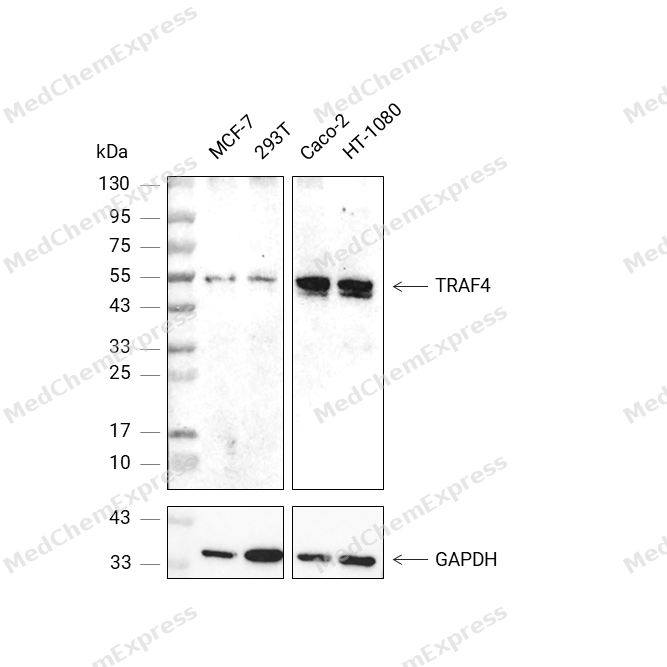 Western blot analysis was performed on protein extracts (25 μg) from MCF-7(lane 2), 293T (lane 3), Caco-2 (lane 4), and HT-1080 (lane 5) using TRAF4 antibody. Proteins were transferred onto a 0.45 μm PVDF membrane using the Trans-Blot® Turbo™ system for 13 min. The membrane was then blocked with 5% nonfat milk in TBST (HY-K1025) for 1 h at room temperature. Thhe primary antibody (1:1000) and loading control antibody GAPDH Antibody (HRP) (HY-P80954A) (1:2500) were diluted in 5% nonfat milk in TBST and incubated with the membrane overnight at 4°C. After washing, the membrane of primary antibody was incubated with HRP-conjugated goat anti-rabbit IgG (H&L) secondary antibody (HY-P8001) (1:5000) diluted in 5% nonfat milk in TBST for 1 h at room temperature. Protein bands were visualized using an Ultra High Sensitivity ECL detection kit (HY-K1005).


Background
-
Function
TRAF4 is an Adapter protein with E3 ligase activity that is involved in many diverse biological processes including cell proliferation, migration, differentiation, DNA repair, platelet activation or apoptosis. Promotes EGFR-mediated signaling by facilitating the dimerization of EGFR and downstream AKT activation thereby promoting cell proliferation. Ubiquitinates SMURF2 through 'Lys-48'-linked ubiquitin chain leading to SMURF2 degradation through the proteasome and subsequently osteogenic differentiation. Promotes 'Lys-63'-mediated ubiquitination of CHK1 which in turn activates cell cycle arrest and activation of DNA repair. In addition, promotes an atypical 'Lys-29'-linked ubiquitination at the C-terminal end of IRS1 which is crucial for insulin-like growth factor (IGF) signal transduction. Regulates activation of NF-kappa-B in response to signaling through Toll-like receptors. Required for normal skeleton development, and for normal development of the respiratory tract. Required for activation of RPS6KB1 in response to TNF signaling. Modulates TRAF6 functions. Inhibits adipogenic differentiation by activating pyruvate kinase PKM activity and subsequently the beta-catenin signaling pathway[1][2][3][4][5].
-
Subcellular Localization
Cytoplasm; Nucleus; Cytoplasm, perinuclear region; Cell junction, tight junction; Cell membrane; Peripheral membrane protein; Cytoplasmic side; Cytoplasm, cytoskeleton
-
Expression
Tissue_specificity:Expressed in epithelial cells of thymus, dendritic cells of lymph node, and in the basal cell layer of epithelia such as epidermis, nasopharynx, respiratory tract, salivary gland, and esophagus
Induction:Up-regulated by bacterial lipopolysaccharides (LPS) and by single-stranded CpG oligodeoxynucleotide -
Isoforms & Post-Translational Modification
Q9BUZ4 has 2 isomers: Q9BUZ4-1: 53543 Da (predicted); Q9BUZ4-2: 22841 Da (predicted).
Polyubiquitinated, leading to its proteasomal degradation (PubMed:19937093). Ubiquitinated at Lys-263 by the SCF(FBXL2) complex, leading to its degradation by the proteasome (By similarity) -
Subunit
Homotrimer (Probable). Interacts with LTBR/TNFRSF3, NGFR/TNFRSF16, RPS6KB1 and TGFB1I1. Interacts with SMURF1. Interacts (via TRAF domain) with MAP3K4 (via kinase domain). Interacts with NCF1, TICAM1, IRAK1 and TRAF6, and is probably part of a complex containing TRAF4, NCF1, TICAM1, IRAK1 and TRAF6. Interacts (via MATH domain) with GP6 and GP1BB (PubMed:20946164, PubMed:29073066). Interacts with EGFR (via C-terminal region); this interaction promotes the formation of EGFR asymmetric dimers (PubMed:30352854). Interacts with PKM; this interaction promotes PKM kinase activity (PubMed:32268273)
-
SwissProt ID
-
Synonyms
TRAF4; CART1; MLN62; RNF83; TNF receptor-associated factor 4; Cysteine-rich domain associated with RING and Traf domains protein 1; Metastatic lymph node gene 62 protein; MLN 62; RING finger protein 83
-
Research Field
Cell Biology


Documentation
-
Data Sheet (235 KB)
-
SDS (252 KB)
- English - EN (252 KB)
- Français - FR (252 KB)
- Deutsch - DE (252 KB)
- Norwegian - NO (252 KB)
- Español - ES (252 KB)
- Swedish - SV (252 KB)
- Italian - IT (252 KB)
- Korean - KR (252 KB)
- Portuguese - PT (252 KB)
-
User Guide for Antibodies (1077 KB)

 Powered by Bioz
