



USP11 Antibody (YA1846)
(Synonyms: UHX1; USP11)
Based on 1 Customer Validation
USP11 Antibody (YA1846) is a Rabbit-derived and non-conjugated IgG monoclonal antibody, targeting to USP11.
-
Host:
Rabbit
-
Isotype:
IgG
-
Application:
WB, IP, FC
-
Reactivity :
Human, Mouse, Rat
-
Formulation:
Liquid in 10 mM PBS, pH 7.4, 150 mM sodium chloride, 0.05% BSA, 0.02% sodium azide and 50% glycerol.
-
Conjugation:
Non-conjugated


To place orders, for customer services and technical support, please contact: MedChemExpress USA
Tel: 609-228-6898 E-mail: [email protected] [email protected]





Applications
| Application |
WB

WB: Western Blot
|
FC
FC: Flow Cytometry
|
IP
IP: Immunoprecipitation
|
|---|---|---|---|
| Dilution Ratio | 1:1000-1:5000 | 1:200-1:1000 | 1:10-1:100 |


Product Details
USP11 Antibody (YA1846) is a Rabbit-derived and non-conjugated IgG monoclonal antibody, targeting to USP11.
-
Host Rabbit

-
Clonality Recombinant,Monoclonal

-
Species ReactivityHuman, Mouse, Rat
-
Observed Molecular WeightObserved band size: 110 kDa
Note: Due to possible protein modifications or aggregation, the molecular weight should be confirmed by actual measurement, and the predicted value is for reference only.

-
Calculated Molecular Weight Predicted band size: 110 kDa

A synthetic peptide of human USP11
Endogenous
Affinity Purified
Non-conjugated
Unmodified
IgG


Product Properties
-
Appearance
Solution
-
Formulation
Liquid in 10 mM PBS, pH 7.4, 150 mM sodium chloride, 0.05% BSA, 0.02% sodium azide and 50% glycerol.
-
Concentration
Batch-dependent, Please check the COA for the concentration of each lot. Check Lot Concentration
-
Storage & Stability
Stored at -20°C for 1 year. Avoid repeated freeze / thaw cycles.
-
Shipping
Shipping with blue ice.


Verification Images
-
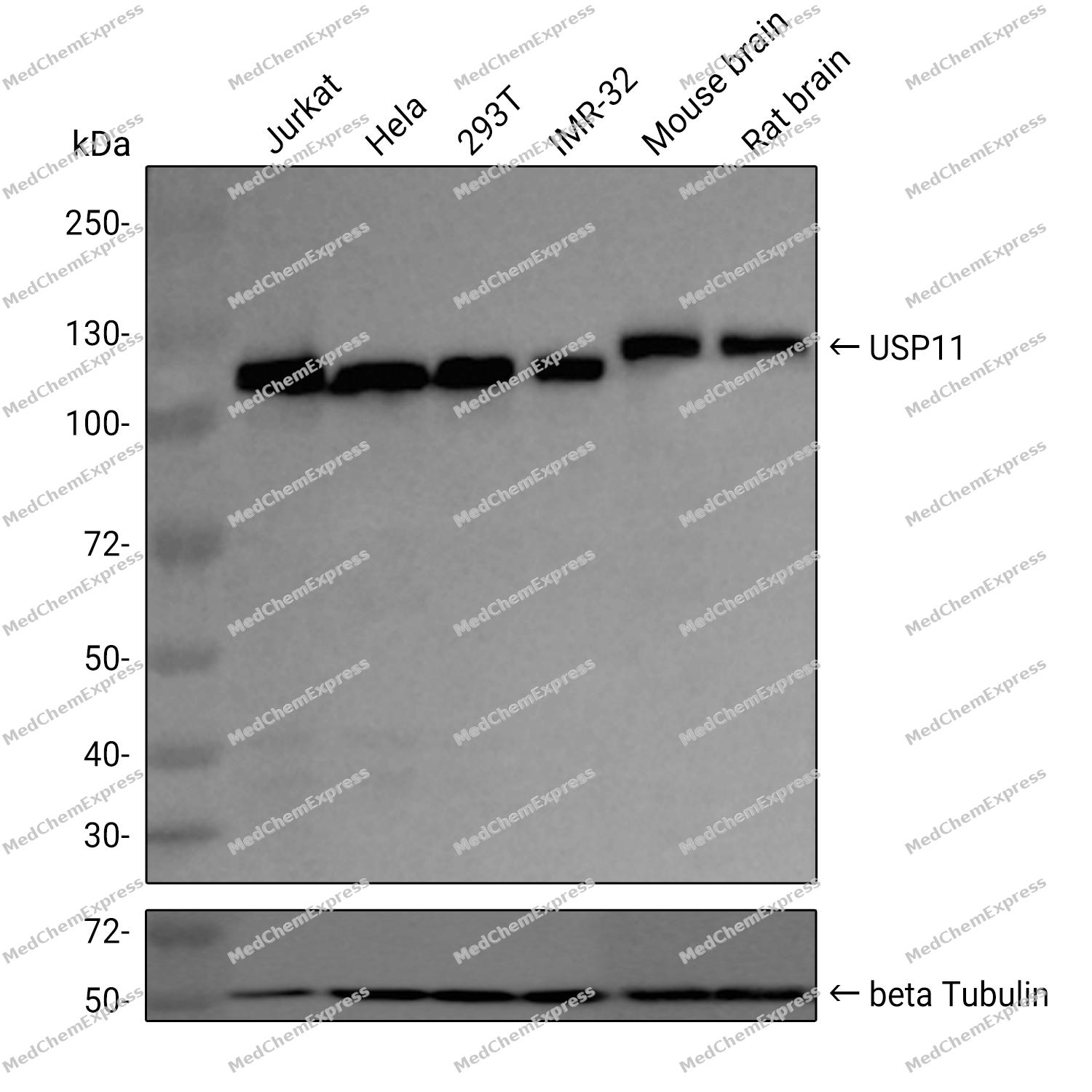 Western blot analysis was performed on extracts from Jurkat (lane 1, 15 μg), Hela (lane 2, 15 μg), 293T (lane 3, 15 μg), IMR-32 (lane 4, 15 μg), Mouse brain (lane 5, 15 μg), and Rat brain (lane 6, 15 μg) using USP11 Rabbit mAb. Proteins were transferred to a PVDF membrane and blocked with 5% non - fat milk in TBST at 4°C overnight. The primary antibody (1:1000 dilution) and the loading control antibody (beta-Tubulin(HRP), HY-P80955A, 1:5000 dilution) was incubated in 5% non-fat milk in TBST for 1 hour at 37°C. Goat Anti - Rabbit IgG - HRP Secondary Antibody (1:20000 dilution) was then applied for 40 minutes at 37°C.
 -
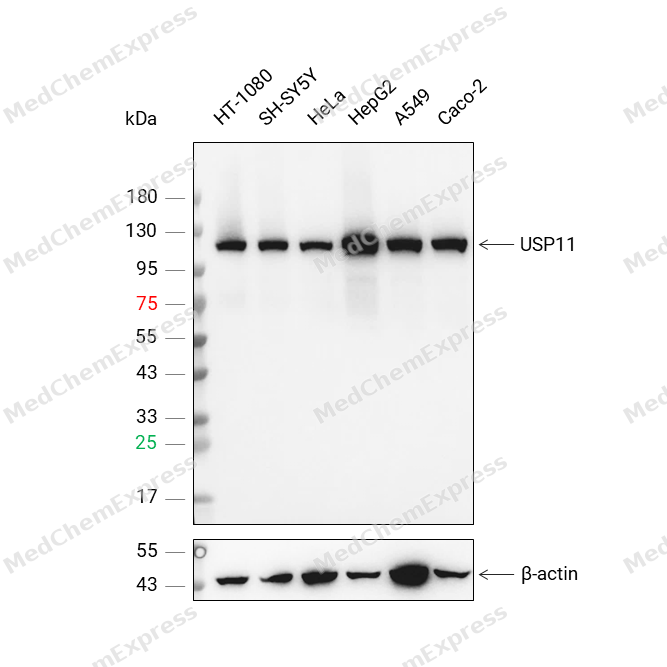 Western blot analysis was performed on protein extracts (30 μg) from HT-1080 (lane 1), SH-SY5Y (lane 2), HeLa (lane 3), HepG2 (lane 4), A549 (lane 5), and Caco-2 (lane 6) using USP11 antibody. Proteins were transferred onto a 0.45 μm NC membrane using the Trans-Blot® Turbo™ system for 13 min. The membrane was then blocked with 5% nonfat milk in TBST (HY-K1025) for 1 h at room temperature. Thhe primary antibody (1:1000) and loading control antibody β-actin Antibody (HRP) (HY-P80993) (1:10000) were diluted in 5% nonfat milk in TBST and incubated with the membrane overnight at 4°C. After washing, the membrane of primary antibody was incubated with HRP-conjugated goat anti-rabbit IgG (H&L) secondary antibody (HY-P8001) (1:5000) diluted in 5% nonfat milk in TBST for 1 h at room temperature. Protein bands were visualized using an Ultra High Sensitivity ECL detection kit (HY-K1005).


Background
-
Function
USP11 (ubiquitin-specific peptidase 11) is an X-linked deubiquitinating enzyme of the ubiquitin-specific protease family that primarily regulates protein stability by removing ubiquitin chains from substrate proteins and thereby modulating protein turnover and signaling networks[1]. Mechanistically, USP11 functions in chromatin regulation and the cellular DNA damage response, where it acts as a histone deubiquitinase that contributes to chromatin reorganization during DNA repair processes[2]. Through these activities, USP11 participates in pathways controlling DNA double-strand break repair, cell-cycle progression, and signal transduction, highlighting its importance in maintaining genome integrity[3]. In disease contexts, dysregulated USP11 activity has been linked to multiple cancer models, where stabilization of specific substrates can influence tumor growth, survival, and therapeutic responses[1][3]. Compared with its closest paralogs, USP4 and USP15, USP11 belongs to the same DUSP-UBL domain-containing subfamily but exhibits distinct regulatory mechanisms and substrate specificity despite overall structural similarity, making isoform-selective investigation particularly important for mechanistic studies[3]. This functional divergence has increased interest in USP11 as a research target for understanding deubiquitinase-dependent signaling pathways and disease biology[1][3]. For experimental applications, peptide ligands that recognize a specific ubiquitin-like domain-binding site of USP11 have been developed, providing tools to interrogate USP11-specific molecular interactions[4]. More recently, selective USP11 inhibitors have been reported, enabling pharmacological disruption of USP11-dependent signaling and supporting target-validation studies in cancer research models[5].
-
Subcellular Localization
Nucleus; Cytoplasm; Chromosome
-
Subunit
Monomer (PubMed:24724799). Associated component of the Polycomb group (PcG) multiprotein PRC1-like complex (PubMed:20601937). Interacts with RANBP9/RANBPM (PubMed:12084015). Interacts with BRCA2 (PubMed:15314155). Interacts with CHUK/IKKA (PubMed:17897950). Interacts with NFKBIA (PubMed:19874889). Interacts with SPRY3, RAE1, MYCBP2/PAM, and KCTD6 (PubMed:29293652)
-
SwissProt ID
-
Synonyms
UHX1; USP11
-
Research Field
Epigenetics and Nuclear Signaling


Documentation
-
Data Sheet (260 KB)
-
SDS (251 KB)
- English - EN (251 KB)
- Français - FR (251 KB)
- Deutsch - DE (251 KB)
- Norwegian - NO (251 KB)
- Español - ES (251 KB)
- Swedish - SV (251 KB)
- Italian - IT (251 KB)
- Korean - KR (251 KB)
- Portuguese - PT (251 KB)
-
User Guide for Antibodies (1077 KB)
References
[1]. Guo T, et al. The Dual Role of USP11 in Cancer. J Oncol. 2022 Mar 22;2022:9963905. [Content Brief]
[2]. Ting X, et al. USP11 acts as a histone deubiquitinase functioning in chromatin reorganization during DNA repair. Nucleic Acids Res. 2019 Oct 10;47(18):9721-9740. [Content Brief]
[3]. Maurer SK, et al. Ubiquitin-specific protease 11 structure in complex with an engineered substrate mimetic reveals a molecular feature for deubiquitination selectivity. J Biol Chem. 2023 Nov;299(11):105300. [Content Brief]
[4]. Spiliotopoulos A, et al. Discovery of peptide ligands targeting a specific ubiquitin-like domain-binding site in the deubiquitinase USP11. J Biol Chem. 2019 Jan 11;294(2):424-436. [Content Brief]
[5]. Kayastha F, et al. Discovery, development, and characterization of potent and selective USP11 inhibitors. Pharmacol Res. 2026 Jan;223:108075. [Content Brief]

 Powered by Bioz
