



Beta Actin Antibody (HRP)(YA4634)
(Synonyms: Beta-actin, ACTB)
Based on 1 Customer Validation
Beta Actin Antibody (HRP)(YA4634) is a rabbit-derived HRP-conjugated IgG monoclonal antibody targeting beta-Actin.
-
Host:
Rabbit
-
Isotype:
IgG
-
Application:
WB
-
Reactivity :
Human, Mouse, Rat
-
Formulation:
Supplied in TBS (pH7.4), 0.05% BSA, 40% Glycerol.
-
Conjugation:
HRP


To place orders, for customer services and technical support, please contact: MedChemExpress USA
Tel: 609-228-6898 E-mail: [email protected] [email protected]





Applications
| Application |
WB

WB: Western Blot
|
|---|---|
| Dilution Ratio | 1:20000-1:50000 |


Product Details
Beta Actin Antibody (HRP)(YA4634) is a rabbit-derived HRP-conjugated IgG monoclonal antibody targeting beta-Actin.
-
Host Rabbit

-
Clonality Monoclonal,Recombinant

-
Species ReactivityHuman, Mouse, Rat
-
Observed Molecular WeightObserved band size: 42 kDa
Note: Due to possible protein modifications or aggregation, the molecular weight should be confirmed by actual measurement, and the predicted value is for reference only.

-
Calculated Molecular Weight Predicted band size: 42 kDa

SwissProt: P60709 Human ; P60710 Mouse ; P60711 Rat
Synthetic peptide within N-terminal residues of β-Actin.
Endogenous
HRP
Unmodified
IgG


Product Properties
-
Appearance
Solution
-
Formulation
Supplied in TBS (pH7.4), 0.05% BSA, 40% Glycerol.
-
Concentration
Batch-dependent, Please check the COA for the concentration of each lot. Check Lot Concentration
-
Storage & Stability
Stored at -20°C for 1 year. Avoid repeated freeze / thaw cycles.
-
Shipping
Shipping with blue ice.


Verification Images
-
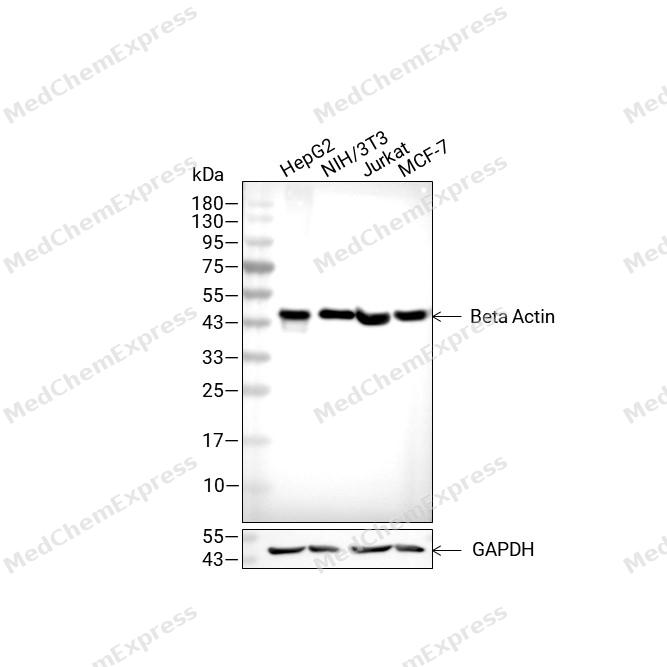 Western blot analysis of extracts from HepG2 (lane2(20μg), NIH/3T3 (lane3(20μg), Jurkat (lane4(20μg) and MCF-7 (lane5(20μg) using Beta Actin Antibody (HY-P80993). Proteins were transferred to a PVDF membrane and blocked with 5% non-fat milk in TBST for 2 hour at room temperature. The primary antibody (1/10000) and Loading control antibody (GAPDH, HY-P80137, 1/10,000) was used in 5% non-fat milk in TBST at 4°C overnight. Goat Anti-Rabbit IgG-HRP Secondary Antibody (HY-P8001 ,1/10,000) was used for 1 hour at room temperature.


Background
-
Function
Beta Actin is an Actin is a highly conserved protein that polymerizes to produce filaments that form cross-linked networks in the cytoplasm of cells. Actin exists in both monomeric (G-actin) and polymeric (F-actin) forms, both forms playing key functions, such as cell motility and contraction. In addition to their role in the cytoplasmic cytoskeleton, G- and F-actin also localize in the nucleus, and regulate gene transcription and motility and repair of damaged DNA. Plays a role in the assembly of the gamma-tubulin ring complex (gTuRC), which regulates the minus-end nucleation of alpha-beta tubulin heterodimers that grow into microtubule protafilaments. Part of the ACTR1A/ACTB filament around which the dynactin complex is built. The dynactin multiprotein complex activates the molecular motor dynein for ultra-processive transport along microtubules[1][2][3][4][5].
-
Subcellular Localization
Cytoplasm, cytoskeleton; Nucleus
-
Subunit
Polymerization of globular actin (G-actin) leads to a structural filament (F-actin) in the form of a two-stranded helix (PubMed:16685646, PubMed:28604741). Each actin can bind to 4 others (PubMed:16685646, PubMed:28604741). Identified in a IGF2BP1-dependent mRNP granule complex containing untranslated mRNAs (PubMed:17289661). Component of the BAF complex, which includes at least actin (ACTB), ARID1A, ARID1B/BAF250, SMARCA2, SMARCA4/BRG1, ACTL6A/BAF53, ACTL6B/BAF53B, SMARCE1/BAF57 SMARCC1/BAF155, SMARCC2/BAF170, SMARCB1/SNF5/INI1, and one or more of SMARCD1/BAF60A, SMARCD2/BAF60B, or SMARCD3/BAF60C (PubMed:18765789). In muscle cells, the BAF complex also contains DPF3 (PubMed:18765789). Found in a complex with XPO6, Ran, ACTB and PFN1 (PubMed:14592989). Interacts with PFN1 (PubMed:10411937, PubMed:25255767). Interacts with XPO6 and EMD (PubMed:15328537). Interacts with ERBB2 (PubMed:21555369). Interacts with GCSAM (PubMed:17823310). Interacts with TBC1D21 (By similarity). Interacts with CPNE1 (via VWFA domain) and CPNE4 (via VWFA domain) (By similarity). Interacts with DHX9 (via C-terminus); this interaction is direct and mediates the attachment to nuclear ribonucleoprotein complexes (PubMed:11687588). Interacts with FAM107A (PubMed:21969592, PubMed:28604741). Associates with the gamma-tubulin ring complex (gTuRC) consisting of TUBGCP2, TUBGCP3, TUBGCP4, TUBGCP5 and TUBGCP6 and gamma-tubulin TUBG1 or TUBG2; within the complex, interacts with TUBGCP3 and TUBGCP6 to form a luminal bridge with MZT1 that stabilizes the initial structure during complex assembly (PubMed:39321809, PubMed:38609661). Part of the ACTR1A/ACTB filament around which the dynactin complex is built (By similarity). The filament contains 8 copies of ACTR1A and 1 ACTB (By similarity). Interacts with TPRN which forms ring-like structures in the stereocilium taper region; the interaction may stabilize stereocilia in inner ear hair cells (By similarity). Interacts with AMOTL2 (via N-terminus), the interaction facilitates binding of cell junction complexes to actin fibers in endothelial cells (By similarity)
-
SwissProt ID
-
Synonyms
Beta-actin, ACTB


Documentation
-
Data Sheet (261 KB)
-
SDS (251 KB)
- English - EN (251 KB)
- Français - FR (251 KB)
- Deutsch - DE (251 KB)
- Norwegian - NO (251 KB)
- Español - ES (251 KB)
- Swedish - SV (251 KB)
- Italian - IT (251 KB)
- Korean - KR (251 KB)
- Portuguese - PT (251 KB)
-
User Guide for Antibodies (1077 KB)
References
[1]. Hundt N, et al. Molecular mechanisms of disease-related human β-actin mutations p.R183W and p.E364K. FEBS J. 2014 Dec;281(23):5279-91. [Content Brief]
[2]. Drazic A, et al. NAA80 is actin's N-terminal acetyltransferase and regulates cytoskeleton assembly and cell motility. Proc Natl Acad Sci U S A. 2018 Apr 24;115(17):4399-4404. [Content Brief]
[3]. Schrank BR, et al. Nuclear ARP2/3 drives DNA break clustering for homology-directed repair. Nature. 2018 Jul;559(7712):61-66. [Content Brief]
[4]. Serna M, et al. CDK5RAP2 activates microtubule nucleator γTuRC by facilitating template formation and actin release. Dev Cell. 2024 Dec 2;59(23):3175-3188.e8. [Content Brief]
[5]. Aher A, et al. Structure of the γ-tubulin ring complex-capped microtubule. Nat Struct Mol Biol. 2024 Jul;31(7):1124-1133. [Content Brief]

 Powered by Bioz
