



AV-153 free base
Based on 2 publication(s) in Google Scholar
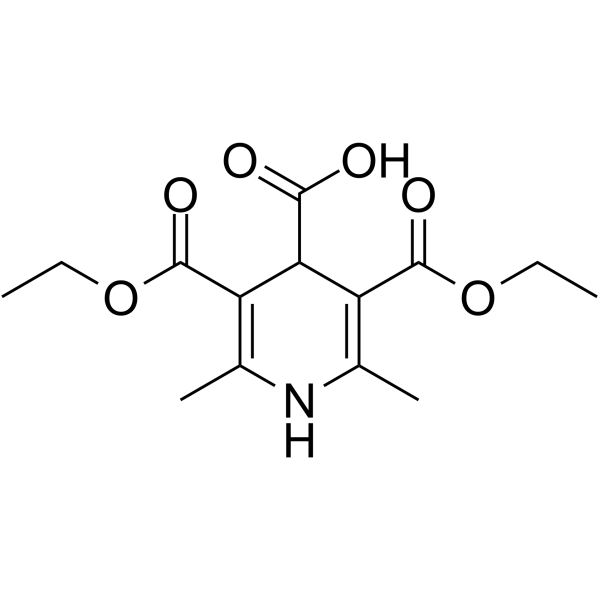
AV-153 free base, a 1,4-dihydropyridine (1,4-DHP) derivative, is an antimutagenic. AV-153 free base intercalates to DNA in a single strand break and reduces DNA damage, stimulates DNA repair in human cells in vitro. AV-153 free base interacts with thymine and cytosine and has an influence on poly(ADP)ribosylation. AV-153 free base has anti-cancer activity.
Nos produits utilisent uniquement pour la recherche. Nous ne vendons pas aux patients.
- Pureté : 99.59%
- CAS No.: 19350-66-4
- Formule: C14H19NO6
- Masse moléculaire:297.30
-
Stockage:Powder -20°C, 3 years , 4°C, 2 years ; In solvent -80°C, 2 years , -20°C, 1 year

To place orders, for customer services and technical support, please contact: MedChemExpress USA
Tel: 609-228-6898 E-mail: [email protected] [email protected]


-
 Activité biologique
-
Chemical Information
-
Solvant et solubilité
- Protocole
- Pureté et documentation
- Références
-
 Help & FAQs



Publications Citing Use of MedChemExpress (MCE) AV-153 free base
MoreVoir tous les produits spécifiques à Isoform DNA/RNA Synthesis
More

Activité biologique
Description
In Vitro
AV-153 free base causes IC50s for Raji and HL-60 cells of 14.9 mM and 10.3 mM, respectively[1].
AV-153 free base (1 nM to 10 μM; 3 hours) reduces the level of spontaneously arising DNA single-strand breaks (SSBs) in peripheral blood lymphocytes or HL-60 cells by 13–67%[1].
MedChemExpress (MCE) has not independently confirmed the accuracy of these methods. They are for reference only. Further protocols information, click here.


Chemical Information
-
CAS No. 19350-66-4
-
Appearance Solid
-
Masse moléculaire 297.30
-
Formule C14H19NO6
-
Color White to light yellow
-
SMILES
O=C(C1=C(C)NC(C)=C(C(OCC)=O)C1C(O)=O)OCC
-
Livraison
Room temperature in continental US; may vary elsewhere.
-
Stockage
Powder -20°C 3 years 4°C 2 years In solvent -80°C 2 years -20°C 1 year


Publications (2)
-
Journal Impact Factor
-
Most Recent
-
Int J Biol Sci
Diallyl disulfide induces DNA damage and growth inhibition in colorectal cancer cells by promoting POU2F1 ubiquitination. [Abstract]2024 Jan 21;20(4):1125-1141. PMID: 38385081 -
J Mol Cell Cardiol
Deletion of SIRT6 in vascular smooth muscle cells facilitates vascular calcification via suppression of DNA damage repair. [Abstract]2022 Dec:173:154-168. PMID: 36367517


Solvant et solubilité
In Vitro:
DMSO : 100 mg/mL (336.36 mM; Need ultrasonic; Hygroscopic DMSO has a significant impact on the solubility of product, please use newly opened DMSO)
Please refer to the solubility information to select the appropriate solvent. Once prepared, please aliquot and store the solution to prevent product inactivation from repeated freeze-thaw cycles.
Storage method and period of stock solution: -80°C, 2 years; -20°C, 1 year. When stored at -80°C, please use it within 2 years. When stored at -20°C, please use it within 1 year.
Please refer to the solubility information to select the appropriate solvent. Once prepared, please aliquot and store the solution to prevent product inactivation from repeated freeze-thaw cycles.
Storage method and period of stock solution: -80°C, 2 years; -20°C, 1 year. When stored at -80°C, please use it within 2 years. When stored at -20°C, please use it within 1 year.
Concentration (start) × Volume (start) = Concentration (final) × Volume (final)
In Vivo:
Select the appropriate dissolution method based on your experimental animal and administration route.
- For the following dissolution methods, please ensure to first prepare a clear stock solution using an In Vitro approach and then sequentially add co-solvents:
- To ensure reliable experimental results, the clarified stock solution can be appropriately stored based on storage conditions. As for the working solution for In Vivo experiments, it is recommended to prepare freshly and use it on the same day.
- The percentages shown for the solvents indicate their volumetric ratio in the final prepared solution. If precipitation or phase separation occurs during preparation, heat and/or sonication can be used to aid dissolution.
Add each solvent one by one: 10% DMSO 40% PEG300 5% Tween-80 45% Saline
Solubility: ≥ 2.08 mg/mL (7.00 mM); Clear solution
This protocol yields a clear solution of ≥ 2.08 mg/mL (saturation unknown).
Taking 1 mL working solution as an example, add 100 μL DMSO stock solution (20.8 mg/mL) to 400 μL PEG300, and mix evenly; then add 50 μL Tween-80 and mix evenly; then add 450 μL Saline to adjust the volume to 1 mL.
Preparation of Saline: Dissolve 0.9 g sodium chloride in ddH₂O and dilute to 100 mL to obtain a clear Saline solution.
In Vivo Dissolution Calculator
Please enter the basic information of animal experiments:
-
-
-
-
Recommended: Prepare an additional quantity of animals to account for potential losses during experiments.
Please enter your animal formula composition:
-
%DMSO +
Recommended: Keep the proportion of DMSO in working solution below 2% if your animal is weak.
-
%+
-
+%Tween-80 + +
-
%Saline +
The co-solvents required include: DMSO, . All of co-solvents are available by MedChemExpress (MCE). , Tween 80. All of co-solvents are available by MedChemExpress (MCE).
Working solution concentration: 0.22 mg/mL
Method for preparing stock solution: mg drug dissolved in μL DMSO. Stock solution concentration: mg/mL.
1. Take μL DMSO stock solution;
2. Add μL .
μL , mix evenly;
3. Then add μL Tween 80, mix evenly;
4. Then add μL
Please ensure that the stock solution in the first step is dissolved to a clear state, and add co-solvents in sequence. You can use ultrasonic heating (ultrasonic cleaner, recommended frequency 20-40 kHz), vortexing, etc. to assist dissolution.

Protocole
-
Genotoxicity/Mutagenicity Study
The bacterial reverse mutation assay detects point mutations that restore amino-acid prototrophy in auxotrophic Salmonella typhimurium or Escherichia coli tester strains; after exposure to a test article, mutagenic activity is read out as an increased number of revertant colonies on minimal agar compared with the vehicle control. The assay uses tester strains with different mutation targets so that base-substitution and frameshift mutagens can be detected, and testing is performed with and without exogenous mammalian metabolic activation because some chemicals require biotransformation to become mutagenic.


Pureté et documentation
-
Fiche technique (273 KB)
-
SDS (396 KB)
- English - EN (396 KB)
- Français - FR (396 KB)
- Deutsch - DE (396 KB)
- Norwegian - NO (396 KB)
- Español - ES (396 KB)
- Swedish - SV (396 KB)
- Italian - IT (396 KB)
- Korean - KR (396 KB)
- Portuguese - PT (396 KB)
-
Instruction de manipulation (2659 KB)
Références
[1]. Nadezhda I Ryabokon, et al. A 1,4-dihydropyridine Derivative Reduces DNA Damage and Stimulates DNA Repair in Human Cells in Vitro. Mutat Res. 2005 Nov 10;587(1-2):52-8. [Content Brief]
[2]. E Buraka, et al. DNA-binding Studies of AV-153, an Antimutagenic and DNA Repair-Stimulating Derivative of 1,4-dihydropiridine. Chem Biol Interact. 2014 Sep 5;220:200-7. [Content Brief]
[3]. Lidija Milkovic, et al. Antioxidative 1,4-Dihydropyridine Derivatives Modulate Oxidative Stress and Growth of Human Osteoblast-Like Cells In Vitro. Antioxidants (Basel). 2018 Sep 19;7(9):123. [Content Brief]


Complete Stock Solution Preparation Table
Please refer to the solubility information to select the appropriate solvent. Once prepared, please aliquot and store the solution to prevent product inactivation from repeated freeze-thaw cycles.
Storage method and period of stock solution: -80°C, 2 years; -20°C, 1 year. When stored at -80°C, please use it within 2 years. When stored at -20°C, please use it within 1 year.
| Optional Solvent | Concentration Solvent Mass | 1 mg | 5 mg | 10 mg | 25 mg |
|---|---|---|---|---|---|
| DMSO | 1 mM | 3.3636 mL | 16.8180 mL | 33.6361 mL | 84.0901 mL |
| 5 mM | 0.6727 mL | 3.3636 mL | 6.7272 mL | 16.8180 mL | |
| 10 mM | 0.3364 mL | 1.6818 mL | 3.3636 mL | 8.4090 mL | |
| 15 mM | 0.2242 mL | 1.1212 mL | 2.2424 mL | 5.6060 mL | |
| 20 mM | 0.1682 mL | 0.8409 mL | 1.6818 mL | 4.2045 mL | |
| 25 mM | 0.1345 mL | 0.6727 mL | 1.3454 mL | 3.3636 mL | |
| 30 mM | 0.1121 mL | 0.5606 mL | 1.1212 mL | 2.8030 mL | |
| 40 mM | 0.0841 mL | 0.4205 mL | 0.8409 mL | 2.1023 mL | |
| 50 mM | 0.0673 mL | 0.3364 mL | 0.6727 mL | 1.6818 mL | |
| 60 mM | 0.0561 mL | 0.2803 mL | 0.5606 mL | 1.4015 mL | |
| 80 mM | 0.0420 mL | 0.2102 mL | 0.4205 mL | 1.0511 mL | |
| 100 mM | 0.0336 mL | 0.1682 mL | 0.3364 mL | 0.8409 mL |


AV-153 free base Related Classifications
HY-135218A Related Classifications
 Powered by Bioz