



AVE 0991
Based on 17 publication(s) in Google Scholar
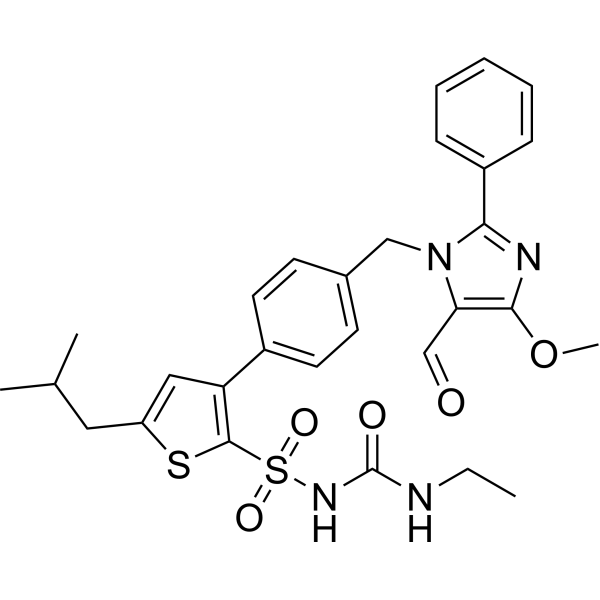
AVE 0991 is a nonpeptide and orally active angiotensin-(1-7) receptor agonist with an IC50 of 21 nM.
Nos produits utilisent uniquement pour la recherche. Nous ne vendons pas aux patients.
- Pureté: 99.91%
- CAS No.: 304462-19-9
- Formule: C29H32N4O5S2
- Masse moléculaire:580.72
-
Stockage:Powder -20°C, 3 years , 4°C, 2 years ; In solvent -80°C, 2 years , -20°C, 1 year

To place orders, for customer services and technical support, please contact: MedChemExpress USA
Tel: 609-228-6898 E-mail: [email protected] [email protected]


-
 Activité biologique
-
Chemical Information
-
Solvant et solubilité
- Protocole
- Pureté et documentation
- Références
-
 Help & FAQs


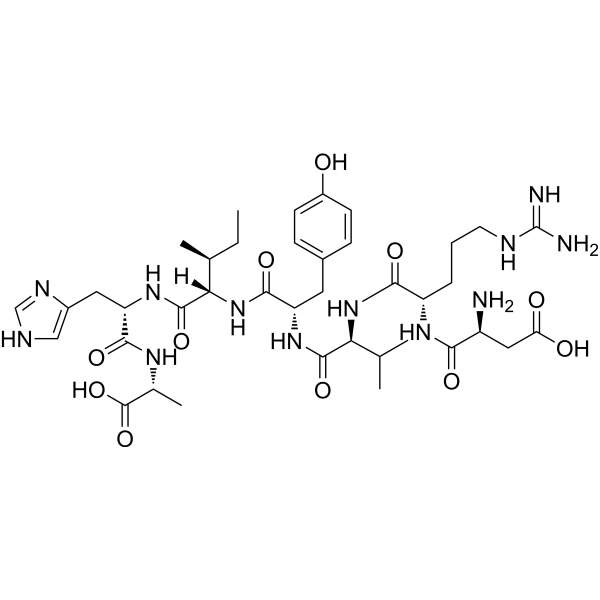
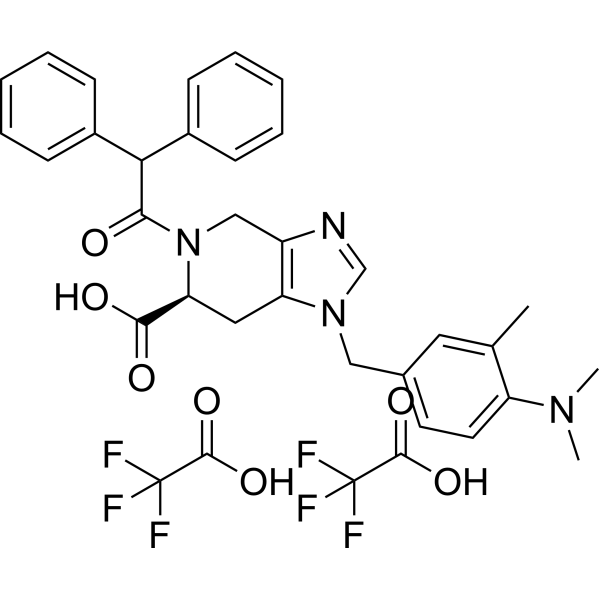
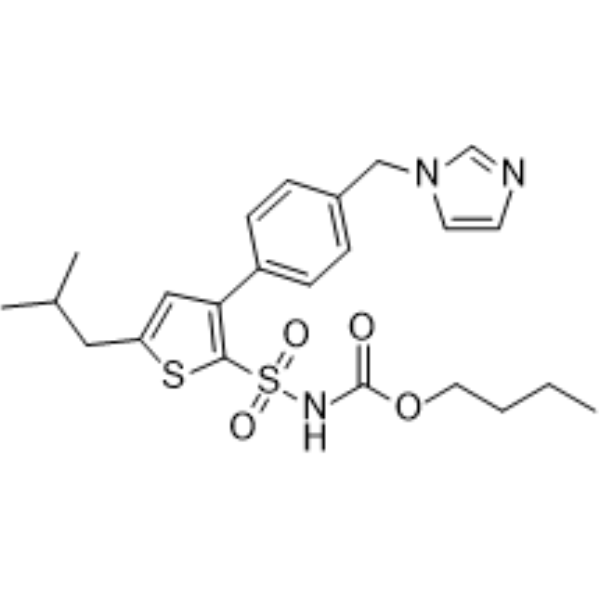
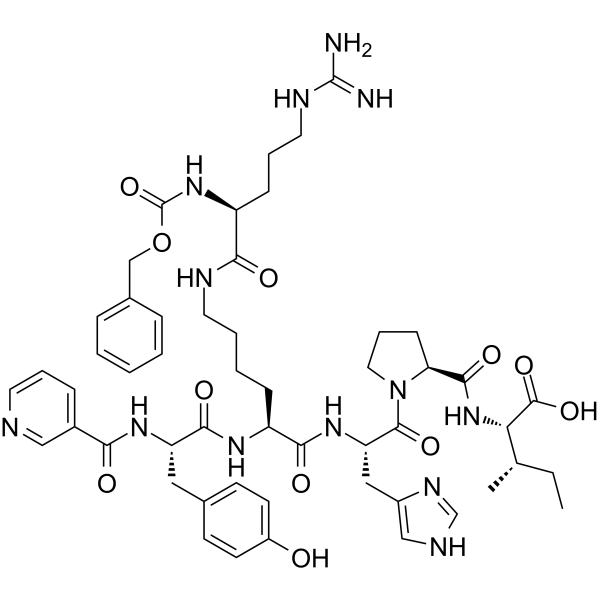
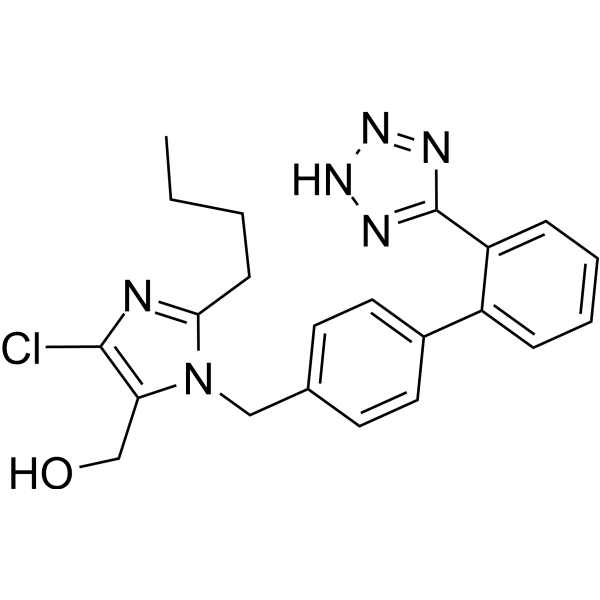
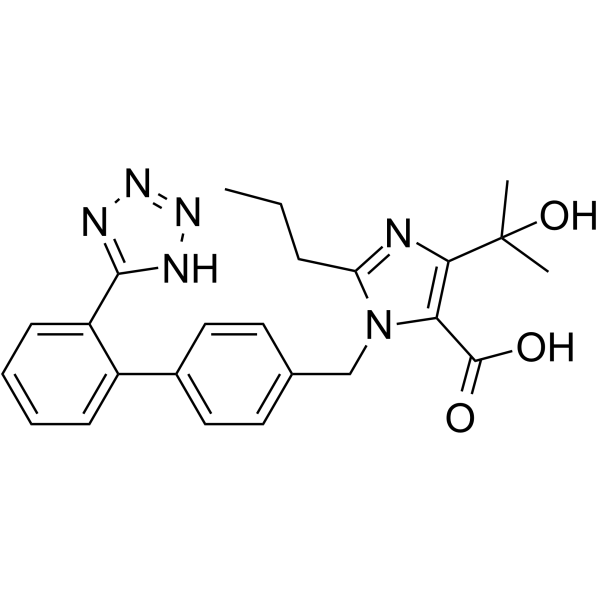
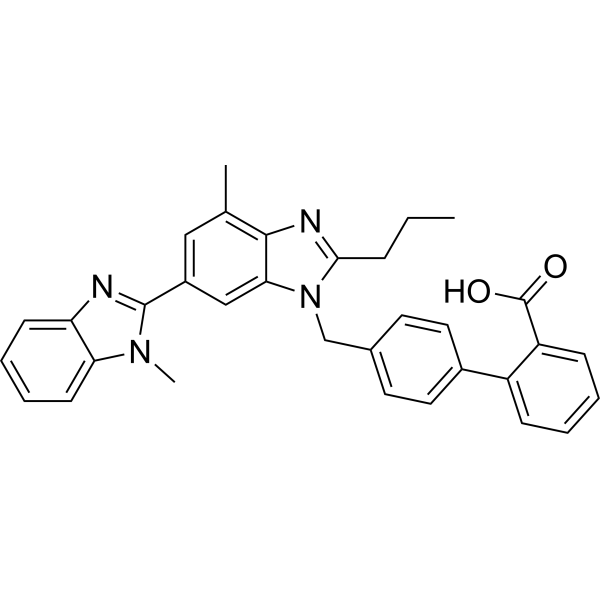
Publications Citing Use of MedChemExpress (MCE) AVE 0991
More- J Hepatol. 2022 Nov 9;S0168-8278(22)03285-8. [Abstract]
- Blood. 2015 Jan 22;125(4):710-9. [Abstract]
- Metabolism. 2025 Aug:169:156275. [Abstract]
- Redox Biol. 2019 Jan:20:75-86. [Abstract]
- Diabetes. 2017 Aug;66(8):2201-2212. [Abstract]
- Biochem Pharmacol. 2024 Jun:224:116261. [Abstract]
- Front Aging Neurosci. 2021 Feb 15:13:624387. [Abstract]
- Sci Rep. 2024 Nov 1;14(1):26346. [Abstract]
- J Inflamm Res. 2021 Dec 18;14:7007-7019. [Abstract]
- J Cell Physiol. 2019 Apr;234(4):4668-4680. [Abstract]
- Psychopharmacology (Berl). 2026 Jul 13.
- PLoS One. 2015 Nov 5;10(11):e0142087. [Abstract]
- Exp Anim. 2022 Nov 10;71(4):519-528. [Abstract]
- SSRN. 2025 Jun 2.
- Res Sq. 2024 Aug 10.
- Research Square Preprint. 2021 Nov.
- Aging (Albany NY). 2018 Apr 17;10(4):645-657. [Abstract]
 Customer Validation & Images

-
WB
-
Cell Proliferation/Viability Assay
Voir tous les produits spécifiques à Isoform Angiotensin Receptor
More

Activité biologique
Description
IC50 & Target
IC50: 21±35 nM (Ang-(1-7) receptor)[1]
In Vitro
AVE 0991 is a nonpeptide compound that evokes effects similar to Ang-(1-7) on the endothelium. AVE 0991 and unlabeled Ang-(1-7) compete for high-affinity binding of [125I]-Ang-(1-7) to bovine aortic endothelial cell membranes with IC50s of 21±35 and 220±280 nM, respectively. Peak concentrations of NO and O2- release by AVE 0991 sodium salt and Ang-(1-7) (both 10 μM) are not significantly different (NO: 295±20 and 270±25 nM; O2-: 18±2 and 20±4 nM). However, the released amount of bioactive NO is ≈5 times higher for AVE 0991 in comparison to Ang-(1-7)[1].
MedChemExpress (MCE) has not independently confirmed the accuracy of these methods. They are for reference only.
In Vivo
MedChemExpress (MCE) has not independently confirmed the accuracy of these methods. They are for reference only.


Chemical Information
-
CAS No. 304462-19-9
-
Appearance Solid
-
Masse moléculaire 580.72
-
Formule C29H32N4O5S2
-
Color White to yellow
-
SMILES
O=S(C1=C(C2=CC=C(CN3C(C=O)=C(OC)N=C3C4=CC=CC=C4)C=C2)C=C(CC(C)C)S1)(NC(NCC)=O)=O
-
Livraison
Room temperature in continental US; may vary elsewhere.
-
Stockage
Powder -20°C 3 years 4°C 2 years In solvent -80°C 2 years -20°C 1 year


Publications (17)
-
Journal Impact Factor
-
Most Recent
-
J Hepatol
Hepatocyte-specific Mas activation enhances lipophagy and fatty acid oxidation to protect against acetaminophen-induced hepatotoxicity in mice. [Abstract]2022 Nov 9;S0168-8278(22)03285-8. PMID: 36368597 -
Blood
Reduced thrombosis in Klkb1-/- mice is mediated by increased Mas receptor, prostacyclin, Sirt1, and KLF4 and decreased tissue factor. [Abstract]2015 Jan 22;125(4):710-9. PMID: 25339356 -
Metabolism
Angiotensinogen inhibition concurrently mitigates alcohol-associated hepatic and muscle injury. [Abstract]2025 Aug:169:156275. PMID: 40311841 -
Redox Biol
AVE 0991 attenuates oxidative stress and neuronal apoptosis via Mas/PKA/CREB/UCP-2 pathway after subarachnoid hemorrhage in rats. [Abstract]2019 Jan:20:75-86. PMID: 30296700
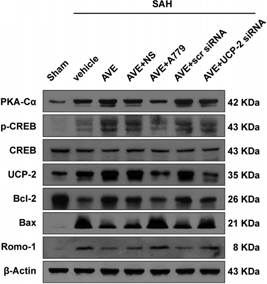
AVE 0991 purchased from MedChemExpress. Usage Cited in: Redox Biol. 2019 Jan:20:75-86. [Abstract]
AVE 0991 (AVE) treatment increases the expression of PKA-Cα, p-CREB, UCP-2, and Bcl-2, but the expression of Bax and Romo-1 are decreased in SAH+AVE group when compared with SAH+vehicle group.
-
Diabetes
Neprilysin Is Required for Angiotensin-(1-7)'s Ability to Enhance Insulin Secretion via Its Proteolytic Activity to Generate Angiotensin-(1-2). [Abstract]2017 Aug;66(8):2201-2212. PMID: 28559246 -
Biochem Pharmacol
A53T α-synuclein mutation increases susceptibility to postoperative delayed neurocognitive recovery via hippocampal Ang-(1-7)/MasR axis. [Abstract]2024 Jun:224:116261. PMID: 38705534 -
Front Aging Neurosci
The Non-peptide Angiotensin-(1-7) Mimic AVE 0991 Attenuates Delayed Neurocognitive Recovery After Laparotomy by Reducing Neuroinflammation and Restoring Blood-Brain Barrier Integrity in Aged Rats. [Abstract]2021 Feb 15:13:624387. PMID: 33658918 -
Sci Rep
AVE0991 ameliorates dopaminergic neuronal damage in Parkinson's disease through HOTAIRM1/miR-223-3p/α-synuclein axis. [Abstract]2024 Nov 1;14(1):26346. PMID: 39487232 -
J Inflamm Res
Angiotensin-(1-7) Analogue AVE0991 Modulates Astrocyte-Mediated Neuroinflammation via lncRNA SNHG14/miR-223-3p/NLRP3 Pathway and Offers Neuroprotection in a Transgenic Mouse Model of Alzheimer's Disease. [Abstract]2021 Dec 18;14:7007-7019. PMID: 34955647 -
J Cell Physiol
Angiotensin (1-7) inhibits arecoline-induced migration and collagen synthesis in human oral myofibroblasts via inhibiting NLRP3 inflammasome activation. [Abstract]2019 Apr;234(4):4668-4680. PMID: 30246378 -
-
PLoS One
2015 Nov 5;10(11):e0142087. PMID: 26540167
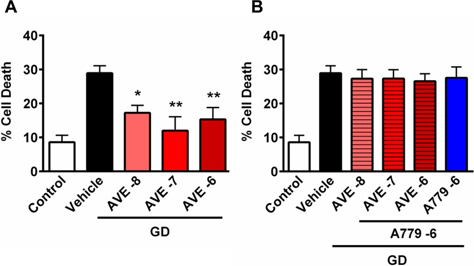
AVE 0991 purchased from MedChemExpress. Usage Cited in: PLoS One. 2015 Nov 5;10(11):e0142087. [Abstract]
The effect of AVE0991 on neuronal cell death following glucose deprivation. Data are shown for cells exposed to normal conditions (control) or glucose deprivation (vehicle) for 24 h or with (A) AVE0991 or (B) AVE0991+A779.
-
Exp Anim
Angiotensin 1-7 and its analogue decrease blood pressure but aggravate renal damage in preeclamptic mice. [Abstract]2022 Nov 10;71(4):519-528. PMID: 35934804 -
-
-
-
Aging (Albany NY)
2018 Apr 17;10(4):645-657. PMID: 29667931


Solvant et solubilité
In Vitro:
DMSO : 41.67 mg/mL (71.76 mM; Need ultrasonic; Hygroscopic DMSO has a significant impact on the solubility of product, please use newly opened DMSO)
Please refer to the solubility information to select the appropriate solvent. Once prepared, please aliquot and store the solution to prevent product inactivation from repeated freeze-thaw cycles.
Storage method and period of stock solution: -80°C, 2 years; -20°C, 1 year. When stored at -80°C, please use it within 2 years. When stored at -20°C, please use it within 1 year.
Please refer to the solubility information to select the appropriate solvent. Once prepared, please aliquot and store the solution to prevent product inactivation from repeated freeze-thaw cycles.
Storage method and period of stock solution: -80°C, 2 years; -20°C, 1 year. When stored at -80°C, please use it within 2 years. When stored at -20°C, please use it within 1 year.
Concentration (start) × Volume (start) = Concentration (final) × Volume (final)
In Vivo:
Select the appropriate dissolution method based on your experimental animal and administration route.
- For the following dissolution methods, please ensure to first prepare a clear stock solution using an In Vitro approach and then sequentially add co-solvents:
- To ensure reliable experimental results, the clarified stock solution can be appropriately stored based on storage conditions. As for the working solution for In Vivo experiments, it is recommended to prepare freshly and use it on the same day.
- The percentages shown for the solvents indicate their volumetric ratio in the final prepared solution. If precipitation or phase separation occurs during preparation, heat and/or sonication can be used to aid dissolution.
Add each solvent one by one: 10% DMSO 40% PEG300 5% Tween-80 45% Saline
Solubility: ≥ 2.5 mg/mL (4.31 mM); Clear solution
This protocol yields a clear solution of ≥ 2.5 mg/mL (saturation unknown).
Taking 1 mL working solution as an example, add 100 μL DMSO stock solution (25.0 mg/mL) to 400 μL PEG300, and mix evenly; then add 50 μL Tween-80 and mix evenly; then add 450 μL Saline to adjust the volume to 1 mL.
Preparation of Saline: Dissolve 0.9 g sodium chloride in ddH₂O and dilute to 100 mL to obtain a clear Saline solution.
Add each solvent one by one: 10% DMSO 90% (20% SBE-β-CD in Saline)
Solubility: 2.5 mg/mL (4.31 mM); Suspended solution; Need ultrasonic
This protocol yields a suspended solution of 2.5 mg/mL. Suspended solution can be used for oral and intraperitoneal injection.
Taking 1 mL working solution as an example, add 100 μL DMSO stock solution (25.0 mg/mL) to 900 μL 20% SBE-β-CD in Saline, and mix evenly.
Preparation of 20% SBE-β-CD in Saline (4°C, storage for one week): 2 g SBE-β-CD powder is dissolved in 10 mL Saline, completely dissolve until clear.
In Vivo Dissolution Calculator
Please enter the basic information of animal experiments:
-
-
-
-
Recommended: Prepare an additional quantity of animals to account for potential losses during experiments.
Please enter your animal formula composition:
-
%DMSO +
Recommended: Keep the proportion of DMSO in working solution below 2% if your animal is weak.
-
%+
-
+%Tween-80 + +
-
%Saline +
The co-solvents required include: DMSO, . All of co-solvents are available by MedChemExpress (MCE). , Tween 80. All of co-solvents are available by MedChemExpress (MCE).
Working solution concentration: 0.22 mg/mL
Method for preparing stock solution: mg drug dissolved in μL DMSO. Stock solution concentration: mg/mL.
1. Take μL DMSO stock solution;
2. Add μL .
μL , mix evenly;
3. Then add μL Tween 80, mix evenly;
4. Then add μL
Please ensure that the stock solution in the first step is dissolved to a clear state, and add co-solvents in sequence. You can use ultrasonic heating (ultrasonic cleaner, recommended frequency 20-40 kHz), vortexing, etc. to assist dissolution.

Protocole
Cell Assay[1]
Monkey kidney (COS) cells and Chinese hamster ovary (CHO) cells are stably transfected with rat Mas cDNA driven by a cytomegalovirus promoter and selected by neomycin. 125I-Ang-(1-7) (0.5×10⁻⁹ mol/L) is incubated in 24-well plates for 60 minutes at 4°C in 0.3 mL of serum-free medium (DMEM) supplemented with 0.2% BSA, 0.005% bacitracin, 0.1 mol/L PMSF, and 0.5 mol/L orthophenanthroline with Mas-transfected COS cells in the presence or absence of AVE 0991 (AVE, 10-10 to -5 mol/L). After 2 ishes with ice-cold serum-free DMEM, cells are disrupted with 0.1% Triton X-100. Bound radioactivity is measured in a gamma counter. Binding of rhodamine-Ang-(1-7) in Mas-transfected CHO cells is performed under similar conditions using 2×10⁻⁹ mol/L rhodamine-labeled-Ang-(1-7) in the presence or absence of AVE (10-6 mol/L), CV11974 (10-6 mol/L), or PD123319 (10-6 mol/L). NSB is determined in the presence of 10-6 mol/L Ang-(1-7)[1].
MedChemExpress (MCE) has not independently confirmed the accuracy of these methods. They are for reference only.
Mice[2]
Swiss male mice, Mas-KO (Mas-/-) male mice on the pure genetic background C57BL/6, and WT C57BL/6 control mice (Mas+/+) are used. Water diuresis is induced by intraperitoneal water injection (0.05 mL/g of body weight [BW]) in conscious mice. Drugs are administered in the same injection with water load at prefixed volumes (0.01 mL/g BW). In the first set of experiments, WT mice (C57BL/6, control group) or Mas-KO mice are treated with: (1) 0.58 nmol/g AVE 0991 (n=9, control; n=11, Mas-KO mice); or (2) vehicle for AVE 0991 (10 μM KOH, 0.01 mL/g; n=9, control; n=9, Mas-KO). In the second set, Swiss mice are treated with: (1) vehicle (n=36); (2) 0.58 nmol/g AVE 0991 (n=16); (3) 46 pmol/g Ang-(1-7) antagonist A-779 (n=4); (4) 2 nmol/g DuP-753 or CGP 48933 (n=5); (5) 2 nmol/g AT2 receptor antagonists PD123319 or PD123177 (n=9); (6) AVE 0991 combined with A-779; (7) AVE 0991 combined with DuP-753 or CGP 48933 (n=4 for each); (8) or AVE 0991combined with PD123319 (n=5) or PD123177 (n=4). The urinary volume is measured for 60 minutes after water loading, and urine samples are obtained to determine the osmolality. The dose of AVE 0991is based in preliminary experiments performed in Swiss mice.
Rats[3]
Male Wistar rats weighting 250-300 g are used. Rats are treated either with AVE-0991 (1 mg/kg, n=9) or vehicle (0.9% NaCl, n=11) administered orally by gavage.
MedChemExpress (MCE) has not independently confirmed the accuracy of these methods. They are for reference only.


Pureté et documentation
-
Fiche technique (287 KB)
-
SDS (393 KB)
- English - EN (393 KB)
- Français - FR (393 KB)
- Deutsch - DE (393 KB)
- Norwegian - NO (393 KB)
- Español - ES (393 KB)
- Swedish - SV (393 KB)
- Italian - IT (393 KB)
- Korean - KR (393 KB)
- Portuguese - PT (393 KB)
-
Instruction de manipulation (2659 KB)
Références
[1]. Wiemer G, et al. AVE 0991, a nonpeptide mimic of the effects of angiotensin-(1-7) on the endothelium. Hypertension. 2002 Dec;40(6):847-52. [Content Brief]
[2]. Pinheiro SV, et al. Nonpeptide AVE 0991 is an angiotensin-(1-7) receptor Mas agonist in the mouse kidney. Hypertension. 2004 Oct;44(4):490-6. [Content Brief]
[3]. Ferreira AJ, et al. The nonpeptide angiotensin-(1-7) receptor Mas agonist AVE-0991 attenuates heart failure induced by myocardial infarction. Am J Physiol Heart Circ Physiol. 2007 Feb;292(2):H1113-9. [Content Brief]
[4]. Mo J, et al. AVE 0991 attenuates oxidative stress and neuronal apoptosis via Mas/PKA/CREB/UCP-2 pathway after subarachnoid hemorrhage in rats. Redox Biol. 2018 Sep 28;20:75-86. [Content Brief]


Complete Stock Solution Preparation Table
Please refer to the solubility information to select the appropriate solvent. Once prepared, please aliquot and store the solution to prevent product inactivation from repeated freeze-thaw cycles.
Storage method and period of stock solution: -80°C, 2 years; -20°C, 1 year. When stored at -80°C, please use it within 2 years. When stored at -20°C, please use it within 1 year.
| Optional Solvent | Concentration Solvent Mass | 1 mg | 5 mg | 10 mg | 25 mg |
|---|---|---|---|---|---|
| DMSO | 1 mM | 1.7220 mL | 8.6100 mL | 17.2200 mL | 43.0500 mL |
| 5 mM | 0.3444 mL | 1.7220 mL | 3.4440 mL | 8.6100 mL | |
| 10 mM | 0.1722 mL | 0.8610 mL | 1.7220 mL | 4.3050 mL | |
| 15 mM | 0.1148 mL | 0.5740 mL | 1.1480 mL | 2.8700 mL | |
| 20 mM | 0.0861 mL | 0.4305 mL | 0.8610 mL | 2.1525 mL | |
| 25 mM | 0.0689 mL | 0.3444 mL | 0.6888 mL | 1.7220 mL | |
| 30 mM | 0.0574 mL | 0.2870 mL | 0.5740 mL | 1.4350 mL | |
| 40 mM | 0.0431 mL | 0.2153 mL | 0.4305 mL | 1.0763 mL | |
| 50 mM | 0.0344 mL | 0.1722 mL | 0.3444 mL | 0.8610 mL | |
| 60 mM | 0.0287 mL | 0.1435 mL | 0.2870 mL | 0.7175 mL |


AVE 0991 Related Classifications
HY-15778 Related Classifications
 Powered by Bioz