



Thioquinapiperifil
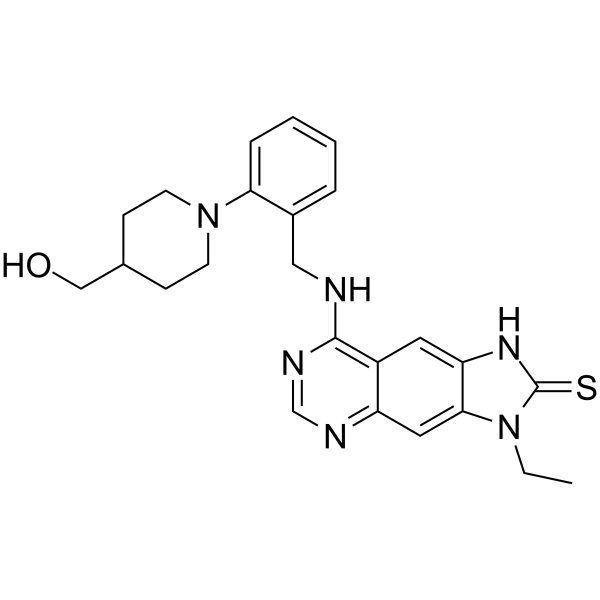
Thioquinapiperifil (KF31327 free base), a potent, selective and non-competitive phosphodiesterase-5 (PDE-5, IC50 of 0.074 nM) inhibitor, is used for sexual enhancement study.
Nur für Forschungszwecke. Wir verkaufen nicht an Patienten.
- CAS. Nr.: 220060-39-9
- Formel: C24H28N6OS
- Molecular Weight:448.58
-
Speicherung:
Please store the product under the recommended conditions in the Certificate of Analysis.

To place orders, for customer services and technical support, please contact: MedChemExpress USA
Tel: 609-228-6898 E-mail: [email protected] [email protected]


-
 Biologische Aktivität
-
Chemical Information
- Reinheit & Dokumentation
- Verweise
-
 Help & FAQs




Biologische Aktivität
Beschreibung
IC50 & Target
[2]|
PDE5 0.074 nM (IC50) |
PDE1 380 nM (IC50) |
PDE2 670 nM (IC50) |
PDE3 38 nM (IC50) |
PDE4 800 nM (IC50) |
In Vitro
Thioquinapiperifil can be found in dietary supplements[1].
Thioquinapiperifil (KF31327 free base) (0.1-10 μM) concentration dependently inhibits platelet aggregation. In the absence of nitroglycerin, higher concentrations 1 and 10 μM of Thioquinapiperifil (KF31327 free base) are required to inhibit platelet aggregation[2].
Thioquinapiperifil (KF31327 free base) and shows significant increase in cyclic GMP at 10 μM. After 5 min incubation, the mean cyclic GMP levels of Thioquinapiperifil (KF31327)-treated cells is 0.95±0.17 pmol/108 cells[2].
MedChemExpress (MCE) has not independently confirmed the accuracy of these methods. They are for reference only.


Chemical Information
-
CAS. Nr. 220060-39-9
-
Molecular Weight 448.58
-
Formel C24H28N6OS
-
SMILES
S=C1NC2=CC3=C(NCC4=CC=CC=C4N5CCC(CO)CC5)N=CN=C3C=C2N1CC
-
Synonyms
KF31327 free base
-
Versand
Room temperature in continental US; may vary elsewhere.
-
Speicherung
Please store the product under the recommended conditions in the Certificate of Analysis.


Reinheit & Dokumentation
Verweise
[1]. Nahoko Uchiyama, et al. Determination of a new type of phosphodiesterase-5 inhibitor, thioquinapiperifil, in a dietary supplement promoted for sexual enhancement. Chem Pharm Bull (Tokyo). 2008 Sep;56(9):1331-4. [Content Brief]
[2]. R Hirose, et al. KF31327, a new potent and selective inhibitor of cyclic nucleotide phosphodiesterase 5. Eur J Pharmacol. 2001 Nov 9;431(1):17-24. [Content Brief]

Calculators
Konzentration (Stammlösung) × Volumen (Stammlösung) = Konzentration (Ziellösung) × Volumen (Ziellösung)


Thioquinapiperifil Related Classifications
HY-119611 Related Classifications
 Powered by Bioz