



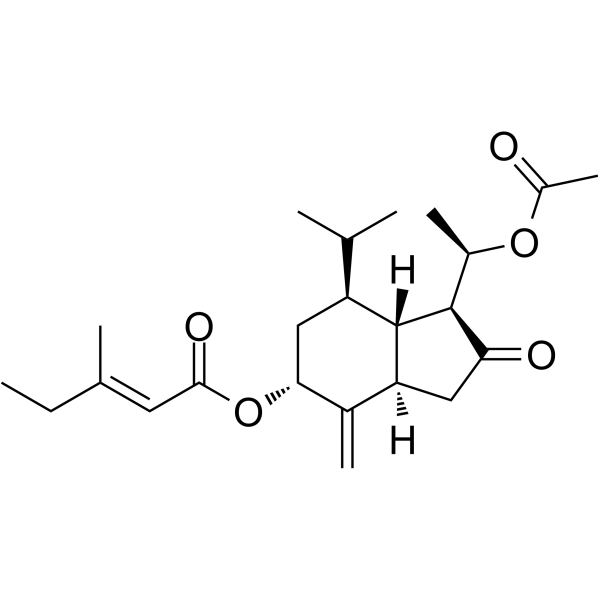
Tussilagone
Based on 3 publication(s) in Google Scholar
Tussilagone, a major active component in Tussilago farfara, has anti-inflammatory effect. Tussilagone ameliorates inflammatory responses in dextran sulphate sodium-induced murine colitis. Tussilagone inhibits the inflammatory response and improves survival in cecal ligation and puncture (CLP)-induced septic mice.
Nur für Forschungszwecke. Wir verkaufen nicht an Patienten.
- Reinheit: 99.52%
- CAS. Nr.: 104012-37-5
- Formel: C23H34O5
- Molecular Weight:390.51
-
Speicherung:
-20°C, protect from light
* In solvent : -80°C, 6 months; -20°C, 1 month (protect from light)

To place orders, for customer services and technical support, please contact: MedChemExpress USA
Tel: 609-228-6898 E-mail: [email protected] [email protected]


-
 Biologische Aktivität
-
Chemical Information
-
Lösungsmittel & Löslichkeit
- Reinheit & Dokumentation
- Verweise
-
 Help & FAQs


Publications Citing Use of MedChemExpress (MCE) Tussilagone
More

Biologische Aktivität
Beschreibung
In Vitro
Tussilagone suppressed the expression of the inflammatory mediators, nitric oxide and prostaglandin E2, and the inflammatory cytokines, tumor necrosis factor-alpha (TNF-α) and high-mobility group box 1 (HMGB1), in lipopolysaccharide-stimulated RAW 264.7 cells and peritoneal macrophages. Tussilagone also reduced the activation of the mitogen-activated protein kinases and nuclear factor kappa-light-chain-enhancer of activated B cells (NF-κB) involved in the activation of various inflammatory mediators in activated macrophages[1].
MedChemExpress (MCE) has not independently confirmed the accuracy of these methods. They are for reference only.
In Vivo
MedChemExpress (MCE) has not independently confirmed the accuracy of these methods. They are for reference only.


Chemical Information
-
CAS. Nr. 104012-37-5
-
Appearance Solid
-
Molecular Weight 390.51
-
Formel C23H34O5
-
Color White to off-white
-
SMILES
CC/C(C)=C/C(O[C@H]1C([C@]2([H])CC([C@H]([C@H](OC(C)=O)C)[C@@]2([H])[C@H](C(C)C)C1)=O)=C)=O
-
Structure Classification
-
Initial Source
-
Versand
Room temperature in continental US; may vary elsewhere.
-
Speicherung
-20°C, protect from light
* In solvent : -80°C, 6 months; -20°C, 1 month (protect from light)


Publications (3)
-
Journal Impact Factor
-
Most Recent
-
Immunopharmacol Immunotoxicol
Tussilagone suppresses triple-negative breast cancer progression by inhibiting the TLR4/NF-κB pathway and enhancing anti-tumor immunity. [Abstract]2025 Sep 30:1-11. PMID: 41029481 -
Vet Microbiol
Identification and evaluation of Nordihydroguaiaretic acid (NDGA) as an active traditional Chinese medicine compound inhibiting the 3C-like protease of feline infectious peritonitis virus. [Abstract]2025 Sep 15:310:110730. PMID: 40976146 -
Environ Toxicol
Tussilagone protects acute lung injury from PM2.5 via alleviating Hif-1α/NF-κB-mediated inflammatory response. [Abstract]2022 May;37(5):1198-1210. PMID: 35112795


Lösungsmittel & Löslichkeit
In Vitro:
DMSO : 62.5 mg/mL (160.05 mM; Need ultrasonic; Hygroscopic DMSO has a significant impact on the solubility of product, please use newly opened DMSO)
Please refer to the solubility information to select the appropriate solvent. Once prepared, please aliquot and store the solution to prevent product inactivation from repeated freeze-thaw cycles.
Storage method and period of stock solution: -80°C, 6 months; -20°C, 1 month (protect from light). When stored at -80°C, please use it within 6 months. When stored at -20°C, please use it within 1 month.
Please refer to the solubility information to select the appropriate solvent. Once prepared, please aliquot and store the solution to prevent product inactivation from repeated freeze-thaw cycles.
Storage method and period of stock solution: -80°C, 6 months; -20°C, 1 month (protect from light). When stored at -80°C, please use it within 6 months. When stored at -20°C, please use it within 1 month.
Konzentration (Stammlösung) × Volumen (Stammlösung) = Konzentration (Ziellösung) × Volumen (Ziellösung)
In Vivo:
Select the appropriate dissolution method based on your experimental animal and administration route.
- For the following dissolution methods, please ensure to first prepare a clear stock solution using an In Vitro approach and then sequentially add co-solvents:
- To ensure reliable experimental results, the clarified stock solution can be appropriately stored based on storage conditions. As for the working solution for In Vivo experiments, it is recommended to prepare freshly and use it on the same day.
- The percentages shown for the solvents indicate their volumetric ratio in the final prepared solution. If precipitation or phase separation occurs during preparation, heat and/or sonication can be used to aid dissolution.
For the following dissolution methods, please prepare the working solution directly:
It is recommended to prepare fresh solutions and use them promptly within a short period of time.
The percentages shown for the solvents indicate their volumetric ratio in the final prepared solution. If precipitation or phase separation occurs during preparation, heat and/or sonication can be used to aid dissolution.
Add each solvent one by one: 15% Cremophor EL 85% Saline
Solubility: 3 mg/mL (7.68 mM); Clear solution; Need ultrasonic
In Vivo Dissolution Calculator
Please enter the basic information of animal experiments:
-
-
-
-
Recommended: Prepare an additional quantity of animals to account for potential losses during experiments.
Please enter your animal formula composition:
-
%DMSO +
Recommended: Keep the proportion of DMSO in working solution below 2% if your animal is weak.
-
%+
-
+%Tween-80 + +
-
%Saline +
The co-solvents required include: DMSO, . All of co-solvents are available by MedChemExpress (MCE). , Tween 80. All of co-solvents are available by MedChemExpress (MCE).
Working solution concentration: 0.22 mg/mL
Method for preparing stock solution: mg drug dissolved in μL DMSO. Stock solution concentration: mg/mL. * In solvent : -80°C, 6 months; -20°C, 1 month (protect from light)
1. Take μL DMSO stock solution;
2. Add μL .
μL , mix evenly;
3. Then add μL Tween 80, mix evenly;
4. Then add μL
Please ensure that the stock solution in the first step is dissolved to a clear state, and add co-solvents in sequence. You can use ultrasonic heating (ultrasonic cleaner, recommended frequency 20-40 kHz), vortexing, etc. to assist dissolution.


Reinheit & Dokumentation
-
Data Sheet (275 KB)
-
SDS (252 KB)
- English - EN (252 KB)
- Français - FR (252 KB)
- Deutsch - DE (252 KB)
- Norwegian - NO (252 KB)
- Español - ES (252 KB)
- Swedish - SV (252 KB)
- Italian - IT (252 KB)
- Korean - KR (252 KB)
- Portuguese - PT (252 KB)
-
Handling Instructions (2659 KB)
Verweise
[1]. Cheon HJ, et al. Tussilagone, a major active component in Tussilago farfara, ameliorates inflammatory responses in dextran sulphate sodium-induced murine colitis. Chem Biol Interact. 2018 Oct 1;294:74-80. [Content Brief]
[2]. Kim YK, et al. Tussilagone Inhibits the Inflammatory Response and Improves Survival in CLP-Induced SepticMice. Int J Mol Sci. 2017 Dec 18;18(12). pii: E2744. [Content Brief]


Complete Stock Solution Preparation Table
Please refer to the solubility information to select the appropriate solvent. Once prepared, please aliquot and store the solution to prevent product inactivation from repeated freeze-thaw cycles.
Storage method and period of stock solution: -80°C, 6 months; -20°C, 1 month (protect from light). When stored at -80°C, please use it within 6 months. When stored at -20°C, please use it within 1 month.
| Optional Solvent | Concentration Solvent Mass | 1 mg | 5 mg | 10 mg | 25 mg |
|---|---|---|---|---|---|
| DMSO | 1 mM | 2.5608 mL | 12.8038 mL | 25.6075 mL | 64.0188 mL |
| 5 mM | 0.5122 mL | 2.5608 mL | 5.1215 mL | 12.8038 mL | |
| 10 mM | 0.2561 mL | 1.2804 mL | 2.5608 mL | 6.4019 mL | |
| 15 mM | 0.1707 mL | 0.8536 mL | 1.7072 mL | 4.2679 mL | |
| 20 mM | 0.1280 mL | 0.6402 mL | 1.2804 mL | 3.2009 mL | |
| 25 mM | 0.1024 mL | 0.5122 mL | 1.0243 mL | 2.5608 mL | |
| 30 mM | 0.0854 mL | 0.4268 mL | 0.8536 mL | 2.1340 mL | |
| 40 mM | 0.0640 mL | 0.3201 mL | 0.6402 mL | 1.6005 mL | |
| 50 mM | 0.0512 mL | 0.2561 mL | 0.5122 mL | 1.2804 mL | |
| 60 mM | 0.0427 mL | 0.2134 mL | 0.4268 mL | 1.0670 mL | |
| 80 mM | 0.0320 mL | 0.1600 mL | 0.3201 mL | 0.8002 mL | |
| 100 mM | 0.0256 mL | 0.1280 mL | 0.2561 mL | 0.6402 mL |


Tussilagone Related Classifications
HY-N1388 Related Classifications
 Powered by Bioz