



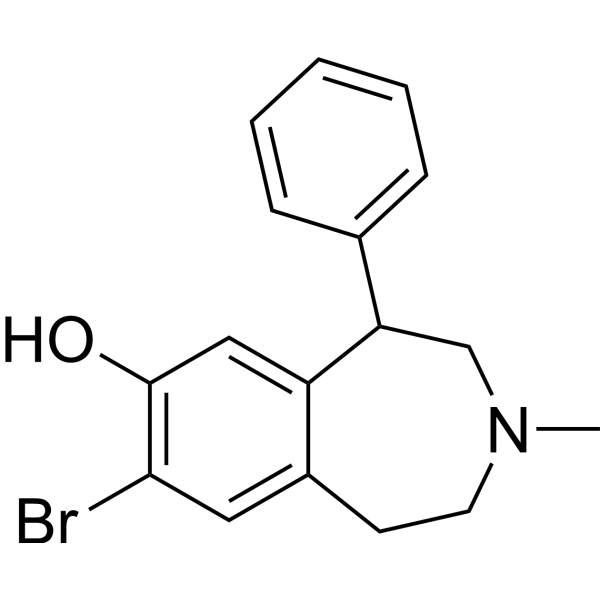
SKF-83566
Based on 3 publication(s) in Google Scholar
SKF-83566 is an orally active, blood-brain barrier-permeable D1/D5 dopamine receptor antagonist with a Ki value of approximately 0.4-0.56 nM. SKF-83566 modulates locomotor behavior and spatial memory by blocking D1 receptors and inhibits glioblastoma progression by targeting the DRD1/c-Myc/UHRF1 pathway. SKF-83566 acts as an inhibitor of the dopamine transporter (DAT) and adenylyl cyclase 2 (AC2). SKF-83566 competitively binds to DAT to inhibit dopamine reuptake and non-competitively inhibits AC2 activity, thereby reducing cAMP accumulation. SKF-83566 is used in research areas such as dopaminergic system mechanisms, learning and memory, targeted intervention for glioblastoma, AC2 pathophysiology, antiparasitic drug screening, and synaptic plasticity (the "gating effect").
For research use only. We do not sell to patients.
- Purity: 99.66%
- CAS No.: 99295-33-7
- Formula: C17H18BrNO
- Molecular Weight:332.23
-
Storage:Powder -20°C, 3 years , 4°C, 2 years ; In solvent -80°C, 2 years , -20°C, 1 year

To place orders, for customer services and technical support, please contact: MedChemExpress USA
Tel: 609-228-6898 E-mail: [email protected] [email protected]


-
 Biological Activity
-
Chemical Information
-
Solvent & Solubility
- Purity & Documentation
- References
-
 Help & FAQs



Publications Citing Use of MedChemExpress (MCE) SKF-83566
MoreAll Dopamine Receptor Isoforms
MoreAll Parasite Isoforms
More

Biological Activity
|
Dopamine D1 receptor |
Dopamine D5 receptor |
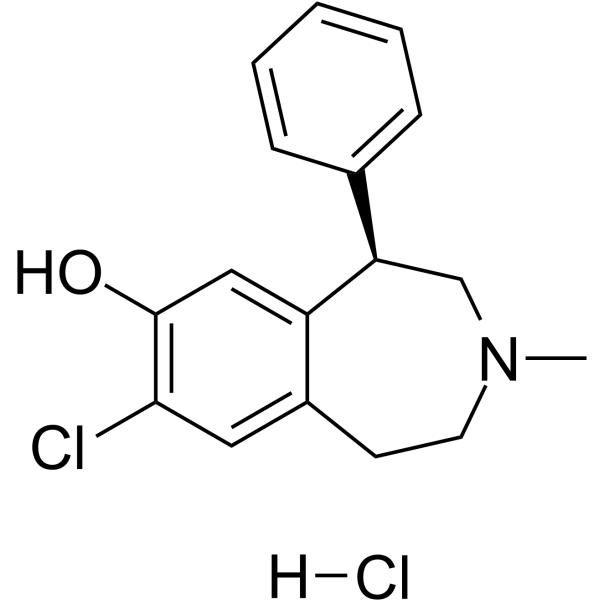
SKF-83566 (5 μM; 5 min pre-incubation) hydrochloride acts as a competitive inhibitor of DAT in LLc-PK cells expressing rat dopamine transporter (rDAT), with an IC50 value of 5.73 µM[2].
SKF-83566 (10 pM-1 mM; 15 min) hydrochloride inhibits [3H]CFT binding in intact LLc-PK-rDAT cells and cell membrane preparations, with IC50 values of 0.51 μM and 0.77 μM, respectively[2].
SKF-83566 (10-30 μM; 30 min pre-incubation + 1 h co-stimulation) hydrochloride potently and completely inhibits the suppression of cAMP accumulation induced by PMA (HY-18739), PGE2 (HY-101952) and Forskolin (HY-15371) in HEK-hAC2 cells, with an IC50 value ranging from 10 to 21 μM[7].
SKF-83566 (75-200 µM; pre-incubated for 10 min) hydrochloride non-competitively inhibits AC2 activity in Sf9 insect cell membranes expressing AC2[7].
SKF-83566 (pre-incubated for 30 min, stimulated for 1 h) hydrochloride inhibits Forskolin-stimulated cAMP accumulation in mouse C2C12 skeletal muscle myotubes, with an IC50 of 15 μM[7].
SKF-83566 (30 µM; pre-incubated for 20 min, stimulated for 1 h) hydrochloride inhibits Forskolin-stimulated IL-6 mRNA expression in human bronchial smooth muscle cells (hBSMCs)[7].
SKF-83566 (1-100 μM; pre-incubation for 10 min, followed by stimulation with bile acid for 2 h) hydrochloride almost completely inhibits bile acid-induced chemotaxis of adult Clonorchis sinensis in vitro[3].
SKF-83566 (50-100 μM; 14 days) hydrochloride dose-dependently inhibits the self-renewal and tumorsphere-forming ability of P3, BG5 and BG7 glioma stem cells[6].
SKF-83566 (0-400 µM; 48-72 h) hydrochloride inhibits the viability of U251, LN18, LN229, A172, P3, BG5 and BG7 cells, with IC50 values ranging from 119.4 to 381.7 μM, which are significantly lower than the IC50 of 986 μM measured in normal human astrocytes[6].
SKF-83566 (100 µM; 72-96 h) hydrochloride significantly inhibits tumor invasion in human GSCs (P3, BG5, BG7) co-cultured with brain organoids, and exerts the same effect in the 3D tumor sphere invasion model[6].
SKF-83566 (50-100 μM) hydrochloride dose-dependently downregulates the mRNA and protein expression of c-Myc and UHRF1 in P3, BG5 and BG7 glioma stem cells, but exerts no such effect on normal human astrocytes[6].
SKF-83566 (50-100 µM) hydrochloride induces G0/G1 cell cycle arrest and promotes apoptosis in human GSCs (P3, BG5, BG7)[6].
MedChemExpress (MCE) has not independently confirmed the accuracy of these methods. They are for reference only.
-
Cell Line:Human GSCs P3, BG5, BG7
-
Concentration:50, 100 µM
-
Incubation Time:14 days
-
Result:Dose-dependently inhibited stem cell self-renewal, leading to a significant reduction or near absence of tumorsphere formation rates after drug treatment.
-
Cell Line:Human GSCs P3, BG5, BG7
-
Concentration:100 µM
-
Incubation Time:96 h
-
Result:Significantly reduced the area and distance of tumor cells invading outward into the Matrigel.
SKF-83566 (0.02-0.2 mg/kg; i.m.; once daily for 3 consecutive days) hydrochloride does not significantly alter the ability to learn the eccentric spatial maze in young and aged rhesus monkeys[4].
SKF-83566 (10-100 µg/kg; i.p.; single administration 15 min prior to memory testing or ghrelin injection) hydrochloride reverses ghrelin-induced memory enhancement in male rat models, but has no effect on its orexigenic action [5].
SKF-83566 (20 mg/mL; p.o.; administered consecutively for 7 days) hydrochloride blocks the priming effect of nicotine on cocaine-induced long-term potentiation (LTP) in the hippocampal dentate gyrus (DG) in male mouse models[6].
SKF-83566 (20 mg/kg/day; i.p.; once daily, administered continuously until symptom onset followed by euthanasia) hydrochloride inhibits tumor growth and invasion, reduces the expression of key proteins, and prolongs overall survival in athymic nude mice bearing intracranial orthotopic xenograft tumors of GSC[6].
MedChemExpress (MCE) has not independently confirmed the accuracy of these methods. They are for reference only.
-
Animal Model:Male Sprague-Dawley rats (2-3 months old), habituated singly, were injected with a non-selective agonist Apomorphine (0.5 mg/kg) or a D2-selective agonist RU24213 (15 mg/kg) to induce a syndrome of stereotyped behavior[1]
-
Dosage:0.04 mg/kg, 0.2 mg/kg
-
Administration:systemic administration; a single pre-treatment dose was given 30 min before agonist challenge
-
Result:Dose-dependently antagonized apomorphine-induced stereotyped behavior syndrome, and dose-dependently antagonized stereotyped sniffing and locomotor responses induced by RU24213.
-
Animal Model:4 young Rhesus monkeys (8.25 ± 1.26 years old) and 4 aged Rhesus monkeys (22.75 ± 7.63 years old) subjected to baseline navigation training in a large-scale maze (consisting of four individual small maze units)[4]
-
Dosage:0.02 mg/kg, 0.2 mg/kg
-
Administration:i.m.; once daily; 3 consecutive days
-
Result:Did not significantly alter the total cup errors, cue errors, or spatial working memory errors during the target-searching task compared to baseline in both young and aged monkeys. The compound had no significant impact on the latency to complete the maze task in either animal group.
-
Animal Model:Sprague-Dawley (male, 275-300 g at surgery)[5]
-
Dosage:10 µg/kg, 100 µg/kg
-
Administration:i.p.; single injection; 15 min pre-test (single-agent); 15 min pre-ghrelin administration (combination)
-
Result:Ddid not alter the rats' performance in the object location memory task.
Pre-treatment with the SKF-83566 hydrochloride completely reversed the ghrelin-induced enhancement of object location memory performance.
Did not alter food intake and failed to block the orexigenic (appetite-stimulating) effect elicited by ghrelin.
-
Animal Model:Foxn1nu mut/mut (4-week-old male, thymus-free, orthotopic xenograft via intracranial injection of 5×10⁵ luciferase-expressing P3 or BG5 human glioma stem cells)[6]
-
Dosage:20 mg/kg/day
-
Administration:i.p.; once daily; starting on day 10 (for P3) or day 30 (for BG5) post-implantation until mice exhibited obvious neurological signs and weight loss and were euthanized
-
Result:Significantly decreased tumor size and bioluminescence intensity as monitored by in vivo imaging, and significantly prolonged the overall survival of tumor-bearing mice. H&E staining and immunohistochemical analysis revealed that the compound markedly decreased tumor volume and local invasion, and significantly reduced the expression levels of the proliferation marker Ki-67, as well as c-Myc and UHRF1 proteins.
-
Animal Model:C57BL6/J mice (male, 6-9 weeks old) were given nicotine (10 mg/mL) continuously in drinking water for 7 days, followed by an intraperitoneal injection of cocaine (30 mg/kg) 10 minutes before sacrifice, to induce the priming enhancement effect (Gateway effect) of LTP in the hippocampal dentate gyrus (DG) [cite: 15].[6]
-
Dosage:20 mg/mL
-
Administration:p.o.; continuously administered for 7 days
-
Result:Significantly blocked the enhancement of LTP in the DG region induced by nicotine pre-treatment and cocaine injection .
Did not alter the baseline LTP induction in mice.


Chemical Information
-
CAS No. 99295-33-7
-
Appearance Solid
-
Molecular Weight 332.23
-
Formula C17H18BrNO
-
Color Off-white to light yellow
-
SMILES
OC1=C(Br)C=C2CCN(C)CC(C3=CC=CC=C3)C2=C1
-
Shipping
Room temperature in continental US; may vary elsewhere.
-
Storage
Powder -20°C 3 years 4°C 2 years In solvent -80°C 2 years -20°C 1 year


Publications (3)
-
Journal Impact Factor
-
Most Recent
-
Adv Sci (Weinh)
Nigra-Subthalamic Dopaminergic Circuitry Modulates and Represents Distinct Pain Modality in Physiological and Pain States in Mice. [Abstract]2026 Jul;13(37):e19913. PMID: 41944312 -
ACS Chem Neurosci
Estimation of Dopamine D1 Receptor Agonist Binding Kinetics Using Time-Resolved Functional Assays: Relation to Agonist-Induced Receptor Internalization by Investigational Antiparkinsonian Therapeutics. [Abstract]2025 Jul 2;16(13):2502-2512. PMID: 40537032 -


Solvent & Solubility
DMSO : 33.33 mg/mL (100.32 mM; Need ultrasonic; Hygroscopic DMSO has a significant impact on the solubility of product, please use newly opened DMSO)
Please refer to the solubility information to select the appropriate solvent. Once prepared, please aliquot and store the solution to prevent product inactivation from repeated freeze-thaw cycles.
Storage method and period of stock solution: -80°C, 2 years; -20°C, 1 year. When stored at -80°C, please use it within 2 years. When stored at -20°C, please use it within 1 year.
Please refer to the solubility information to select the appropriate solvent. Once prepared, please aliquot and store the solution to prevent product inactivation from repeated freeze-thaw cycles.
Storage method and period of stock solution: -80°C, 2 years; -20°C, 1 year. When stored at -80°C, please use it within 2 years. When stored at -20°C, please use it within 1 year.
Concentration (start) × Volume (start) = Concentration (final) × Volume (final)
Select the appropriate dissolution method based on your experimental animal and administration route.
- For the following dissolution methods, please ensure to first prepare a clear stock solution using an In Vitro approach and then sequentially add co-solvents:
- To ensure reliable experimental results, the clarified stock solution can be appropriately stored based on storage conditions. As for the working solution for In Vivo experiments, it is recommended to prepare freshly and use it on the same day.
- The percentages shown for the solvents indicate their volumetric ratio in the final prepared solution. If precipitation or phase separation occurs during preparation, heat and/or sonication can be used to aid dissolution.
Add each solvent one by one: 10% DMSO 40% PEG300 5% Tween-80 45% Saline
Solubility: ≥ 2.5 mg/mL (7.52 mM); Clear solution
This protocol yields a clear solution of ≥ 2.5 mg/mL (saturation unknown).
Taking 1 mL working solution as an example, add 100 μL DMSO stock solution (25.0 mg/mL) to 400 μL PEG300, and mix evenly; then add 50 μL Tween-80 and mix evenly; then add 450 μL Saline to adjust the volume to 1 mL.
Preparation of Saline: Dissolve 0.9 g sodium chloride in ddH₂O and dilute to 100 mL to obtain a clear Saline solution.
Add each solvent one by one: 10% DMSO 90% (20% SBE-β-CD in Saline)
Solubility: ≥ 2.5 mg/mL (7.52 mM); Clear solution
This protocol yields a clear solution of ≥ 2.5 mg/mL (saturation unknown).
Taking 1 mL working solution as an example, add 100 μL DMSO stock solution (25.0 mg/mL) to 900 μL 20% SBE-β-CD in Saline, and mix evenly.
Preparation of 20% SBE-β-CD in Saline (4°C, storage for one week): 2 g SBE-β-CD powder is dissolved in 10 mL Saline, completely dissolve until clear.
Please enter the basic information of animal experiments:
-
-
-
-
Recommended: Prepare an additional quantity of animals to account for potential losses during experiments.
Please enter your animal formula composition:
-
%DMSO +
Recommended: Keep the proportion of DMSO in working solution below 2% if your animal is weak.
-
%+
-
+%Tween-80 + +
-
%Saline +
The co-solvents required include: DMSO, . All of co-solvents are available by MedChemExpress (MCE). , Tween 80. All of co-solvents are available by MedChemExpress (MCE).
Working solution concentration: 0.22 mg/mL
Method for preparing stock solution: mg drug dissolved in μL DMSO. Stock solution concentration: mg/mL.
1. Take μL DMSO stock solution;
2. Add μL .
μL , mix evenly;
3. Then add μL Tween 80, mix evenly;
4. Then add μL
Please ensure that the stock solution in the first step is dissolved to a clear state, and add co-solvents in sequence. You can use ultrasonic heating (ultrasonic cleaner, recommended frequency 20-40 kHz), vortexing, etc. to assist dissolution.


Purity & Documentation
-
Data Sheet (310 KB)
-
SDS (254 KB)
- English - EN (254 KB)
- Français - FR (254 KB)
- Deutsch - DE (254 KB)
- Norwegian - NO (254 KB)
- Español - ES (254 KB)
- Swedish - SV (254 KB)
- Italian - IT (254 KB)
- Korean - KR (254 KB)
- Portuguese - PT (254 KB)
-
Handling Instructions (2659 KB)
References
[2]. Stouffer MA, et al. SKF-83566, a D1-dopamine receptor antagonist, inhibits the dopamine transporter. Journal of neurochemistry. 2011 Sep;118(5):714-20. [Content Brief]
[7]. Conley JM, et al. Development of a high-throughput screening paradigm for the discovery of small-molecule modulators of adenylyl cyclase: identification of an adenylyl cyclase 2 inhibitor. The Journal of pharmacology and experimental therapeutics. 2013 Nov;347(2):276-87. [Content Brief]
[8]. Huang YY, et al. D1/D5 receptors and histone deacetylation mediate the Gateway Effect of LTP in hippocampal dentate gyrus. Learn Mem. 2014 Feb 18;21(3):153-60. [Content Brief]


Complete Stock Solution Preparation Table
Please refer to the solubility information to select the appropriate solvent. Once prepared, please aliquot and store the solution to prevent product inactivation from repeated freeze-thaw cycles.
Storage method and period of stock solution: -80°C, 2 years; -20°C, 1 year. When stored at -80°C, please use it within 2 years. When stored at -20°C, please use it within 1 year.
| Optional Solvent | Concentration Solvent Mass | 1 mg | 5 mg | 10 mg | 25 mg |
|---|---|---|---|---|---|
| DMSO | 1 mM | 3.0100 mL | 15.0498 mL | 30.0996 mL | 75.2491 mL |
| 5 mM | 0.6020 mL | 3.0100 mL | 6.0199 mL | 15.0498 mL | |
| 10 mM | 0.3010 mL | 1.5050 mL | 3.0100 mL | 7.5249 mL | |
| 15 mM | 0.2007 mL | 1.0033 mL | 2.0066 mL | 5.0166 mL | |
| 20 mM | 0.1505 mL | 0.7525 mL | 1.5050 mL | 3.7625 mL | |
| 25 mM | 0.1204 mL | 0.6020 mL | 1.2040 mL | 3.0100 mL | |
| 30 mM | 0.1003 mL | 0.5017 mL | 1.0033 mL | 2.5083 mL | |
| 40 mM | 0.0752 mL | 0.3762 mL | 0.7525 mL | 1.8812 mL | |
| 50 mM | 0.0602 mL | 0.3010 mL | 0.6020 mL | 1.5050 mL | |
| 60 mM | 0.0502 mL | 0.2508 mL | 0.5017 mL | 1.2542 mL | |
| 80 mM | 0.0376 mL | 0.1881 mL | 0.3762 mL | 0.9406 mL | |
| 100 mM | 0.0301 mL | 0.1505 mL | 0.3010 mL | 0.7525 mL |


SKF-83566 Related Classifications
HY-103430A Related Classifications
 Powered by Bioz