



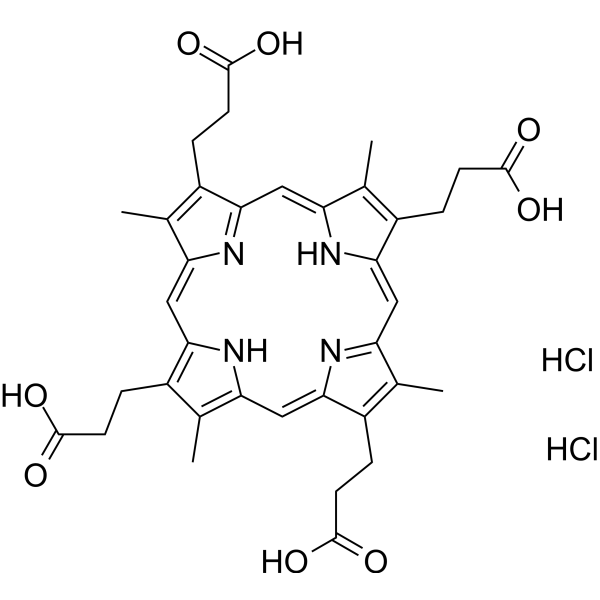
Coproporphyrin III dihydrochloride
Based on 4 publication(s) in Google Scholar
Coproporphyrin III dihydrochloride (Zincphyrin dihydrochlorid) is a naturally occurring porphyrin derivative that is mainly found in urine.
For research use only. We do not sell to patients.
- Purity : 99.57%
- CAS No.: 68938-73-8
- Formula: C36H40Cl2N4O8
- Molecular Weight:727.63
-
Storage:
4°C, sealed storage, away from moisture
* In solvent : -80°C, 6 months; -20°C, 1 month (sealed storage, away from moisture)


To place orders, for customer services and technical support, please contact: MedChemExpress USA
Tel: 609-228-6898 E-mail: [email protected] [email protected]


-
 Biological Activity
-
Chemical Information
-
Solvent & Solubility
- Purity & Documentation
- References
-
 Help & FAQs


Publications Citing Use of MedChemExpress (MCE) Coproporphyrin III dihydrochloride
MoreAll Endogenous Metabolite Isoforms
More

Biological Activity
Description
IC50 & Target
|
Human Endogenous Metabolite |
In Vitro
Coproporphyrin III dihydrochloride methyl ester is repeatedly isolated in considerable amount from both feces and urine. A great increase of Coproporphyrin III dihydrochloride excretion is unaccompanied by symptoms or signs of porphyria, metal or chemical poisoning or liver disease[1]. Primary cultures of chick embryo hepatocytes have been used to study the mechanism by which chemicals cause accumulation of intermediates of the heme synthetic pathway. In the presence of the porphyrin precursor, 5-aminolevulinate (ALA), addition of insulin causes a striking increase in accumulation of uroporphyrin I and Coproporphyrin III dihydrochloride. Antioxidants abolishes the uroporphyrin I accumulation and increases Coproporphyrin III dihydrochloride[2].
MedChemExpress (MCE) has not independently confirmed the accuracy of these methods. They are for reference only.
In Vivo
MedChemExpress (MCE) has not independently confirmed the accuracy of these methods. They are for reference only.


Chemical Information
-
CAS No. 68938-73-8
-
Appearance Solid
-
Molecular Weight 727.63
-
Formula C36H40Cl2N4O8
-
Color Purple to purplish red
-
SMILES
O=C(O)CCC1=C2/C=C3C(CCC(O)=O)=C(C)C(/C=C(N/4)/C(C)=C(CCC(O)=O)C4=C\C5=N/C(C(CCC(O)=O)=C5C)=C\C(N2)=C1C)=N/3.[H]Cl.[H]Cl
-
Synonyms
Zincphyrin dihydrochloride
-
Shipping
Room temperature in continental US; may vary elsewhere.
-
Storage
4°C, sealed storage, away from moisture
* In solvent : -80°C, 6 months; -20°C, 1 month (sealed storage, away from moisture)


Publications (4)
-
Journal Impact Factor
-
Most Recent
-
Cell Host Microbe
Rothia mucilaginosa membrane vesicles stabilize labile iron to alleviate UVB-induced ferroptosis. [Abstract]2026 Jan 14;34(1):35-51.e9. PMID: 41500222 -
Int J Biol Macromol
Molecular basis of BACE1 modulation revealed by machine learning, molecular simulations, and experimental validation. [Abstract]2026 May 6:152409. PMID: 42103119 -
J Agric Food Chem
Engineering Corynebacterium glutamicum with Effective Heme Supply for the Synthesis of High-Activity Hemoglobins and Myoglobins. [Abstract]2025 Jun 18;73(24):15235-15244. PMID: 40466036 -
Mar Drugs
Seaweed-Derived Extract Targets Porphyr'ageing to Modulate the Visible Signs of Aging in Human Skin. [Abstract]2026 Jun 18;24(6):220. PMID: 42346805


Solvent & Solubility
In Vitro:
DMSO : 83.33 mg/mL (114.52 mM; Need ultrasonic; Hygroscopic DMSO has a significant impact on the solubility of product, please use newly opened DMSO)
Please refer to the solubility information to select the appropriate solvent. Once prepared, please aliquot and store the solution to prevent product inactivation from repeated freeze-thaw cycles.
Storage method and period of stock solution: -80°C, 6 months; -20°C, 1 month (sealed storage, away from moisture). When stored at -80°C, please use it within 6 months. When stored at -20°C, please use it within 1 month.
Please refer to the solubility information to select the appropriate solvent. Once prepared, please aliquot and store the solution to prevent product inactivation from repeated freeze-thaw cycles.
Storage method and period of stock solution: -80°C, 6 months; -20°C, 1 month (sealed storage, away from moisture). When stored at -80°C, please use it within 6 months. When stored at -20°C, please use it within 1 month.
Concentration (start) × Volume (start) = Concentration (final) × Volume (final)


Purity & Documentation
-
Data Sheet (280 KB)
-
SDS (394 KB)
- English - EN (394 KB)
- Français - FR (394 KB)
- Deutsch - DE (394 KB)
- Norwegian - NO (394 KB)
- Español - ES (394 KB)
- Swedish - SV (394 KB)
- Italian - IT (394 KB)
- Korean - KR (394 KB)
- Portuguese - PT (394 KB)
-
Handling Instructions (2659 KB)
References
[1]. Watson CJ, et al. Studies of coproporphyrin. iii. idiopathic coproporphyrinuria; a hitherto unrecognized form characterized by lack of symptoms in spite of the excretion of large amounts of coproporphyrin. J Clin Invest. 1949 May;28(3):465-8. [Content Brief]
[2]. Trask HW, et al. Effect of insulin and glucagon on accumulation of uroporphyrin and coproporphyrin from 5-aminolevulinate in hepatocyte cultures. Arch Biochem Biophys. 2005 Jul 1;439(1):1-11. [Content Brief]
[3]. Krishnamohan M, et al. Urinary arsenic and porphyrin profile in C57BL/6J mice chronically exposed to monomethylarsonous acid (MMAIII) for two years. Toxicol Appl Pharmacol. 2007 Oct 1;224(1):89-97. [Content Brief]


Complete Stock Solution Preparation Table
Please refer to the solubility information to select the appropriate solvent. Once prepared, please aliquot and store the solution to prevent product inactivation from repeated freeze-thaw cycles.
Storage method and period of stock solution: -80°C, 6 months; -20°C, 1 month (sealed storage, away from moisture). When stored at -80°C, please use it within 6 months. When stored at -20°C, please use it within 1 month.
| Optional Solvent | Concentration Solvent Mass | 1 mg | 5 mg | 10 mg | 25 mg |
|---|---|---|---|---|---|
| DMSO | 1 mM | 1.3743 mL | 6.8716 mL | 13.7432 mL | 34.3581 mL |
| 5 mM | 0.2749 mL | 1.3743 mL | 2.7486 mL | 6.8716 mL | |
| 10 mM | 0.1374 mL | 0.6872 mL | 1.3743 mL | 3.4358 mL | |
| 15 mM | 0.0916 mL | 0.4581 mL | 0.9162 mL | 2.2905 mL | |
| 20 mM | 0.0687 mL | 0.3436 mL | 0.6872 mL | 1.7179 mL | |
| 25 mM | 0.0550 mL | 0.2749 mL | 0.5497 mL | 1.3743 mL | |
| 30 mM | 0.0458 mL | 0.2291 mL | 0.4581 mL | 1.1453 mL | |
| 40 mM | 0.0344 mL | 0.1718 mL | 0.3436 mL | 0.8590 mL | |
| 50 mM | 0.0275 mL | 0.1374 mL | 0.2749 mL | 0.6872 mL | |
| 60 mM | 0.0229 mL | 0.1145 mL | 0.2291 mL | 0.5726 mL | |
| 80 mM | 0.0172 mL | 0.0859 mL | 0.1718 mL | 0.4295 mL | |
| 100 mM | 0.0137 mL | 0.0687 mL | 0.1374 mL | 0.3436 mL |


Coproporphyrin III dihydrochloride Related Classifications
HY-W412175 Related Classifications
 Powered by Bioz