



Alpha-Fetoprotein Protein, Human (HEK293, His)
Based on 3 publication(s) in Google Scholar
Alpha-Fetoprotein, Human (HEK293, His) is a major plasma protein produced by the yolk sac and the fetal liver during fetal development.
- Species: Human
- Source: HEK293
-
Storage:Stored at -20°C for 2 years from date of receipt. After reconstitution, it is stable at 4°C for 1 week or -20°C for longer (with carrier protein). It is recommended to freeze aliquots at -20°C or -80°C for extended storage.


To place orders, for customer services and technical support, please contact: MedChemExpress USA
Tel: 609-228-6898 E-mail: [email protected] [email protected]


-
 Biological Activity
-
Technical Parameters
-
Product Properties
- Documentation
- References
- Help & FAQs




Biological Activity
Description
Alpha-Fetoprotein, Human (HEK293, His) is a major plasma protein produced by the yolk sac and the fetal liver during fetal development.
Background
Alpha-Fetoprotein is one of several tumor markers, such as hepatocellular carcinomas, cirrhosis, and chronic acute hepatitis. Tumor markers mean that molecules in the blood are higher when one has certain cancers[1].Alpha-Fetoprotein can be detected in liver cancer, nonseminomatous germ cell tumors, cirrhosis or chronic active hepatitis lso have higher blood levels of AFP[1].
MCE Validation Data
-
Purity - SDS-PAGE
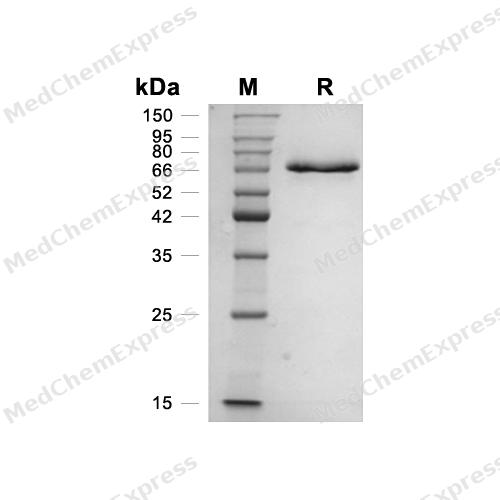
Purity - SDS-PAGE


Publications (3)
-
Journal Impact Factor
-
Most Recent
-
Med
Real-time diagnosis of cholangiocarcinoma by combining digestive endoscopy and optic fiber biosensors based on bile clusterin. [Abstract]2025 Sep 2:100843. PMID: 40930098 -
Talanta
Rapid and portable detection of hepatocellular carcinoma marker alpha-fetoprotein using a droplet evaporation-based biosensor. [Abstract]2025 Nov 1:294:128189. PMID: 40262341 -


Technical Parameters
-
Species Human
-
Source HEK293
-
Tag C-6*His
-
Accession
P02771 (T20-V609)
-
Molecular Construction
-
N-term
-
Alpha-Fetoprotein (T20-V609)
Accession # P02771 -
6*His
-
C-term
-
-
Protein Length
Full Length of Mature Protein
-
Synonyms
AFP; Alpha-Fetoglobulin; Prev. HPAFP; Fetoglobulin; Alpha-Fetoprotein; AFPD; Alpha-1-Fetoprotein; Alpha Fetoprotein; FETA
-
AA Sequence
TLHRNEYGIASILDSYQCTAEISLADLATIFFAQFVQEATYKEVSKMVKDALTAIEKPTGDEQSSGCLENQLPAFLEELCHEKEILEKYGHSDCCSQSEEGRHNCFLAHKKPTPASIPLFQVPEPVTSCEAYEEDRETFMNKFIYEIARRHPFLYAPTILLWAARYDKIIPSCCKAENAVECFQTKAATVTKELRESSLLNQHACAVMKNFGTRTFQAITVTKLSQKFTKVNFTEIQKLVLDVAHVHEHCCRGDVLDCLQDGEKIMSYICSQQDTLSNKITECCKLTTLERGQCIIHAENDEKPEGLSPNLNRFLGDRDFNQFSSGEKNIFLASFVHEYSRRHPQLAVSVILRVAKGYQELLEKCFQTENPLECQDKGEEELQKYIQESQALAKRSCGLFQKLGEYYLQNAFLVAYTKKAPQLTSSELMAITRKMAATAATCCQLSEDKLLACGEGAADIIIGHLCIRHEMTPVNPGVGQCCTSSYANRRPCFSSLVVDETYVPPAFSDDKFIFHKDLCQAQGVALQTMKQEFLINLVKQKPQITEEQLEAVIADFSGLLEKCCQGQEQEVCFAEEGQKLISKTRAALGV
-
Molecular Weight
Approximately 65-70 kDa, based on SDS-PAGE under reducing conditions.
-
Glycosylation
Yes
-
Purity
≥ 95%, as determined by reducing SDS-PAGE.


Product Properties
Lyophilized powder.
1.Lyophilized from a 0.22 μm filtered solution of PBS, pH 7.4.
2.Lyophilized from a 0.22 μm filtered solution of 20 mM PB, 150 mM NaCl, pH 7.4.
Please refer to the lot-specific COA for specific buffer information.
<1 EU/μg, determined by LAL method.
It is not recommended to reconstitute to a concentration less than 100 μg/mL in ddH2O. For long term storage it is recommended to add a carrier protein (0.1% BSA, 5% HSA, 10% FBS or 5% Trehalose).
Stored at -20°C for 2 years from date of receipt. After reconstitution, it is stable at 4°C for 1 week or -20°C for longer (with carrier protein). It is recommended to freeze aliquots at -20°C or -80°C for extended storage.
Room temperature in continental US; may vary elsewhere.


Documentation
-
Data Sheet (265 KB)
-
SDS (251 KB)
- English - EN (251 KB)
- Français - FR (251 KB)
- Deutsch - DE (251 KB)
- Norwegian - NO (251 KB)
- Español - ES (251 KB)
- Swedish - SV (251 KB)
- Italian - IT (251 KB)
- Korean - KR (251 KB)
- Portuguese - PT (251 KB)
-
Handling Instructions (2659 KB)


References
[1]. Jing-Yue Yang, et al. Co-transfection of Dendritic Cells With AFP and IL-2 Genes Enhances the Induction of Tumor Antigen-Specific Antitumor Immunity. Exp Ther Med. 2012 Oct;4(4):655-660. [Content Brief]
[2]. Mingyue Zhu, et al. Hepatitis B Virus X Protein Induces Expression of Alpha-Fetoprotein and Activates PI3K/mTOR Signaling Pathway in Liver Cells.Oncotarget. 2015 May 20;6(14):12196-208. [Content Brief]

Calculators
Concentration (start) × Volume (start) = Concentration (final) × Volume (final)


 Powered by Bioz

