



CEACAM5 Protein, Human (HEK293, His)
Based on 2 publication(s) in Google Scholar
CEACAM5 protein is a cell surface glycoprotein that cooperates with carcinoembryonic antigen-related molecules (such as CEACAM6) to participate in cell adhesion, intracellular signaling, and tumor progression. CEACAM5 Protein, Human (HEK293, His) is the recombinant human-derived CEACAM5 protein, expressed by HEK293 , with C-6*His labeled tag.
- Species: Human
- Source: HEK293
-
Storage:Stored at -20°C for 2 years from date of receipt. After reconstitution, it is stable at 4°C for 1 week or -20°C for longer (with carrier protein). It is recommended to freeze aliquots at -20°C or -80°C for extended storage.


To place orders, for customer services and technical support, please contact: MedChemExpress USA
Tel: 609-228-6898 E-mail: [email protected] [email protected]


-
 Biological Activity
-
Technical Parameters
-
Product Properties
- Documentation
- Help & FAQs




Biological Activity
Description
CEACAM5 protein is a cell surface glycoprotein that cooperates with carcinoembryonic antigen-related molecules (such as CEACAM6) to participate in cell adhesion, intracellular signaling, and tumor progression. CEACAM5 Protein, Human (HEK293, His) is the recombinant human-derived CEACAM5 protein, expressed by HEK293 , with C-6*His labeled tag.
Background
CEACAM5 protein, a cell surface glycoprotein, assumes a multifaceted role in cell adhesion, intracellular signaling, and tumor progression. Functioning as a mediator of both homophilic and heterophilic cell adhesion, CEACAM5 interacts with other carcinoembryonic antigen-related cell adhesion molecules, such as CEACAM6. In the context of tumor progression, CEACAM5 acts as an oncogene, promoting tumor advancement and inducing resistance to anoikis in colorectal carcinoma cells. Additionally, during microbial infection, CEACAM5 serves as a receptor for E. coli Dr adhesins, and the binding of these adhesins results in the dissociation of the CEACAM5 homodimer. These diverse functions underscore the versatility of CEACAM5 in regulating cellular processes and highlight its significance in both physiological and pathological contexts.
Verified Bioactivity
1. Measured by its binding ability in a functional ELISA. Immobilized Galectin-4 protein (HY-P72638) at 2 μg/mL (100 μL/well) can bind CEACAM5. The Kd for this effect is 3.123 nM.
2. Loaded Precemtabart (HY-P990940) on AHC2 biosensor, can bind CEACAM5 Protein, Human (HEK293, His) with an affinity constant of 3.214E-09 M as determined in BLI assay.
3. Loaded Atrosimab (HY-P991049) on ProA biosensor, can bind TNFR-1/CD120a Protein, Human (HEK293, His) with an affinity constant of 2.076E-09 M as determined in BLI assay.
Results
-
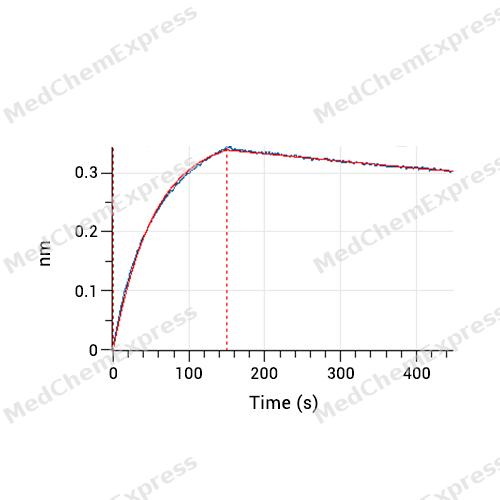 Loaded Atrosimab (HY-P991049) on ProA biosensor, can bind TNFR-1/CD120a Protein, Human (HEK293, His) with an affinity constant of 2.076E-09 M as determined in BLI assay.
MCE Validation Data
-
Bioactivity - ELISA
Bioactivity - ELISA
-
Biological Activity
Biological Activity
-
Bioactivity - BLI
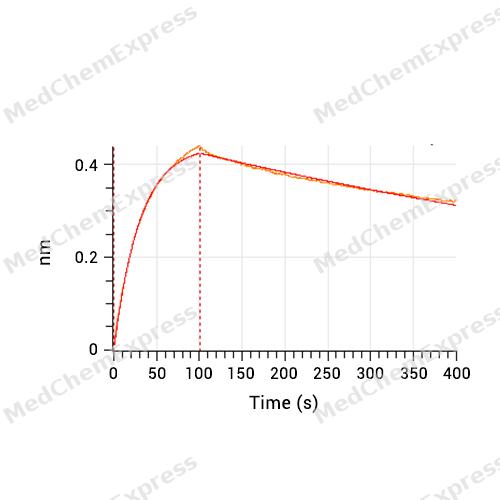
Bioactivity - BLI


Publications (2)


Technical Parameters
-
Species Human
-
Source HEK293
-
Tag C-6*His
-
Accession
P06731-1 (K35-A685)
-
Molecular Construction
-
N-term
-
CEACAM5 (K35-A685)
Accession # P06731-1 -
6*His
-
C-term
-
-
Protein Length
Full Length of CEACAM5 Chain
-
Synonyms
CEACAM5; Cell Adhesion Molecule CEACAM5; Prev. CEA; Meconium Antigen 100; Carcinoembryonic Antigen-Related Cell Adhesion Molecule 5; Carcinoembryonic Antigen-Related Cell Adhesion Molecule 5 Isoform 5D; CD66e; Carcinoembryonic Antigen-Related Cell Adhesio
-
AA Sequence
KLTIESTPFNVAEGKEVLLLVHNLPQHLFGYSWYKGERVDGNRQIIGYVIGTQQATPGPAYSGREIIYPNASLLIQNIIQNDTGFYTLHVIKSDLVNEEATGQFRVYPELPKPSISSNNSKPVEDKDAVAFTCEPETQDATYLWWVNNQSLPVSPRLQLSNGNRTLTLFNVTRNDTASYKCETQNPVSARRSDSVILNVLYGPDAPTISPLNTSYRSGENLNLSCHAASNPPAQYSWFVNGTFQQSTQELFIPNITVNNSGSYTCQAHNSDTGLNRTTVTTITVYAEPPKPFITSNNSNPVEDEDAVALTCEPEIQNTTYLWWVNNQSLPVSPRLQLSNDNRTLTLLSVTRNDVGPYECGIQNELSVDHSDPVILNVLYGPDDPTISPSYTYYRPGVNLSLSCHAASNPPAQYSWLIDGNIQQHTQELFISNITEKNSGLYTCQANNSASGHSRTTVKTITVSAELPKPSISSNNSKPVEDKDAVAFTCEPEAQNTTYLWWVNGQSLPVSPRLQLSNGNRTLTLFNVTRNDARAYVCGIQNSVSANRSDPVTLDVLYGPDTPIISPPDSSYLSGANLNLSCHSASNPSPQYSWRINGIPQQHTQVLFIAKITPNNNGTYACFVSNLATGRNNSIVKSITVSASGTSPGLSA
-
Molecular Weight
Approximately 95-150 kDa, based on SDS-PAGE under reducing conditions, due to the glycosylation.
-
Glycosylation
Yes
-
Purity
≥ 95%, as determined by reducing SDS-PAGE.


Product Properties
Lyophilized powder
Lyophilized from a 0.2 μm filtered solution of PBS, pH 7.4.
<1 EU/μg, determined by LAL method.
It is not recommended to reconstitute to a concentration less than 100 μg/mL in ddH2O. For long term storage it is recommended to add a carrier protein (0.1% BSA, 5% HSA, 10% FBS or 5% Trehalose).
Stored at -20°C for 2 years from date of receipt. After reconstitution, it is stable at 4°C for 1 week or -20°C for longer (with carrier protein). It is recommended to freeze aliquots at -20°C or -80°C for extended storage.
Room temperature in continental US; may vary elsewhere.


Documentation
-
Data Sheet (240 KB)
-
SDS (252 KB)
- English - EN (252 KB)
- Français - FR (252 KB)
- Deutsch - DE (252 KB)
- Norwegian - NO (252 KB)
- Español - ES (252 KB)
- Swedish - SV (252 KB)
- Italian - IT (252 KB)
- Korean - KR (252 KB)
- Portuguese - PT (252 KB)
-
Handling Instructions (2659 KB)

Calculators
Concentration (start) × Volume (start) = Concentration (final) × Volume (final)


 Powered by Bioz

