



Glypican-3/GPC3 Protein, Human (HEK293, His)
Based on 1 publication(s) in Google Scholar
The Glypican-3 (GPC3) protein is a cell surface proteoglycan that plays complex regulatory roles in key signaling pathways critical to developmental processes. Through its GPI anchoring, GPC3 negatively regulates the Hedgehog signaling pathway by competing with the Hedgehog receptor PTC1 for binding to Hedgehog protein, leading to complex internalization and subsequent lysosomal degradation. Glypican-3/GPC3 Protein, Human (HEK293, His) is the recombinant human-derived Glypican-3/GPC3 protein, expressed by HEK293 , with C-His labeled tag.
- Species: Human
- Source: HEK293
-
Storage:Stored at -20°C for 2 years from date of receipt. After reconstitution, it is stable at 4°C for 1 week or -20°C for longer (with carrier protein). It is recommended to freeze aliquots at -20°C or -80°C for extended storage.


To place orders, for customer services and technical support, please contact: MedChemExpress USA
Tel: 609-228-6898 E-mail: [email protected] [email protected]


-
 Biological Activity
-
Technical Parameters
-
Product Properties
- Documentation
- Help & FAQs




Biological Activity
Description
The Glypican-3 (GPC3) protein is a cell surface proteoglycan that plays complex regulatory roles in key signaling pathways critical to developmental processes. Through its GPI anchoring, GPC3 negatively regulates the Hedgehog signaling pathway by competing with the Hedgehog receptor PTC1 for binding to Hedgehog protein, leading to complex internalization and subsequent lysosomal degradation. Glypican-3/GPC3 Protein, Human (HEK293, His) is the recombinant human-derived Glypican-3/GPC3 protein, expressed by HEK293 , with C-His labeled tag.
Background
GMP Glypican-3 (GPC3) Protein, a cell surface proteoglycan, orchestrates intricate regulatory roles in key signaling pathways crucial for developmental processes. Through its GPI-anchor, GPC3 negatively modulates the hedgehog signaling pathway by competing with the hedgehog receptor PTC1 for binding to hedgehog proteins, leading to complex internalization and subsequent lysosomal degradation. Simultaneously, it exerts positive regulation on both canonical and non-canonical Wnt signaling pathways by binding to the Wnt receptor Frizzled, enhancing the interaction between Frizzled and Wnt ligands. GPC3 binds to CD81, reducing the availability of free CD81 for binding to the transcriptional repressor HHEX, resulting in nuclear translocation of HHEX and transcriptional repression. Additionally, GPC3 inhibits the dipeptidyl peptidase activity of DPP4. Functionally, GPC3 plays pivotal roles in limb patterning, skeletal development, renal branching morphogenesis, and coronary vascular development. It also modulates the effects of growth factors BMP2, BMP7, and FGF7 on renal branching morphogenesis and contributes to the regulation of cell movements during gastrulation. GPC3 exists as a heterodimer formed by disulfide linkage and interacts with various molecules, including DPP4, FGF2, WNT5A, WNT3A, WNT7B, hedgehog proteins SHH and IHH, and Wnt receptors FZD4, FZD7, and FZD8, showcasing its pivotal role in coordinating developmental processes.
Verified Bioactivity
1.Immobilized Recombinant Human Glypican 3 at 0.5 μg/mL (100 μl/well) can bind Biotinylated Recombinant Human FGF basic Protein (HY-P7331). The ED50 for this effect is 2-15 ng/mL.
2.Immobilized Human FGF basic (HY-P7004) at 2 μg/mL (100μL/well) can bind Human GPC3. The EC50 for this effect is < 50 ng/mL.
MCE Validation Data
-
Purity - SDS-PAGE
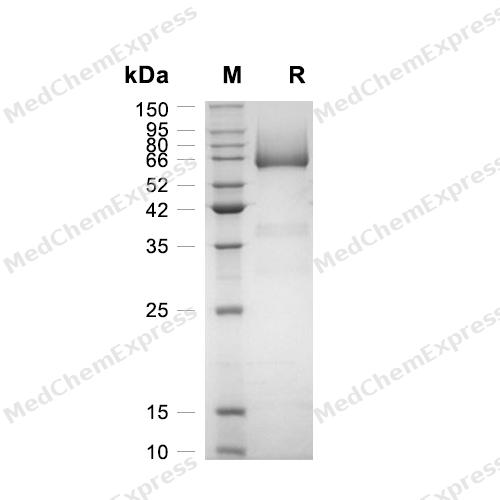
Purity - SDS-PAGE
-
Bioactivity - ELISA
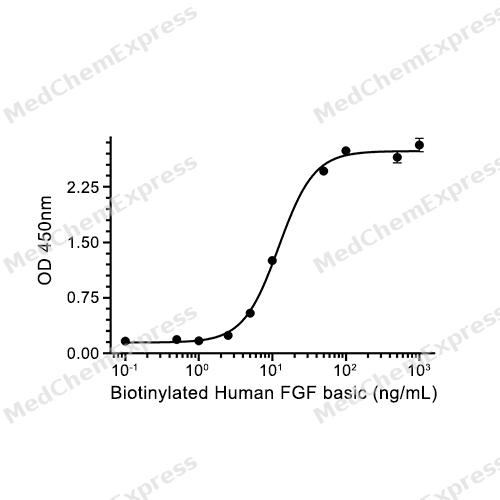
Bioactivity - ELISA


Publications (1)
-
Journal Impact Factor
-
Most Recent
-
Biomed Pharmacother
Astragalus polysaccharide enhances antitumoral effects of chimeric antigen receptor- engineered (CAR) T cells by increasing CD122+CXCR3+PD-1- memory T cells. [Abstract]2024 Oct:179:117401. PMID: 39243425


Technical Parameters
-
Species Human
-
Source HEK293
-
Tag C-His
-
Accession
P51654-1 (Q25-H559)
-
Molecular Construction
-
N-term
-
GPC3 (Q25-H559)
Accession # P51654-1 -
His
-
C-term
-
-
Protein Length
Partial
-
Synonyms
GPC3; SGB; Prev. SDYS; Glypican Proteoglycan 3; Glypican-3; GTR2-2; OCI-5; MXR7; SGBS1; Heparan Sulphate Proteoglycan; SGBS; Secreted Glypican-3; DGSX; OCI5; Glypican 3; Intestinal Protein OCI-5
-
AA Sequence
QPPPPPPDATCHQVRSFFQRLQPGLKWVPETPVPGSDLQVCLPKGPTCCSRKMEEKYQLTARLNMEQLLQSASMELKFLIIQNAAVFQEAFEIVVRHAKNYTNAMFKNNYPSLTPQAFEFVGEFFTDVSLYILGSDINVDDMVNELFDSLFPVIYTQLMNPGLPDSALDINECLRGARRDLKVFGNFPKLIMTQVSKSLQVTRIFLQALNLGIEVINTTDHLKFSKDCGRMLTRMWYCSYCQGLMMVKPCGGYCNVVMQGCMAGVVEIDKYWREYILSLEELVNGMYRIYDMENVLLGLFSTIHDSIQYVQKNAGKLTTTIGKLCAHSQQRQYRSAYYPEDLFIDKKVLKVAHVEHEETLSSRRRELIQKLKSFISFYSALPGYICSHSPVAENDTLCWNGQELVERYSQKAARNGMKNQFNLHELKMKGPEPVVSQIIDKLKHINQLLRTMSMPKGRVLDKNLDEEGFESGDCGDDEDECIGGSGDGMIKVKNQLRFLAELAYDLDVDDAPGNSQQATPKDNEISTFHNLGNVH
-
Molecular Weight
Approximately 30-41 kDa & 62-150 kDa, based on SDS-PAGE under reducing conditions, due to the glycosylation.
-
Glycosylation
Yes
-
Purity
≥ 95%, as determined by reducing SDS-PAGE.


Product Properties
Lyophilized powder
1.Lyophilized from a 0.22 μm filtered solution of PBS, pH 7.4.
2.Lyophilized from a 0.22 μm filtered solution of PBS, 4% mannitol, pH 7.4.
Please refer to the lot-specific COA for specific buffer information.
<1 EU/μg, determined by LAL method.
It is not recommended to reconstitute to a concentration less than 100 μg/mL in ddH2O. For long term storage it is recommended to add a carrier protein (0.1% BSA, 5% HSA, 10% FBS or 5% Trehalose).
Stored at -20°C for 2 years from date of receipt. After reconstitution, it is stable at 4°C for 1 week or -20°C for longer (with carrier protein). It is recommended to freeze aliquots at -20°C or -80°C for extended storage.
Room temperature in continental US; may vary elsewhere.


Documentation
-
Data Sheet (240 KB)
-
SDS (252 KB)
- English - EN (252 KB)
- Français - FR (252 KB)
- Deutsch - DE (252 KB)
- Norwegian - NO (252 KB)
- Español - ES (252 KB)
- Swedish - SV (252 KB)
- Italian - IT (252 KB)
- Korean - KR (252 KB)
- Portuguese - PT (252 KB)
-
Handling Instructions (2659 KB)

Calculators
Concentration (start) × Volume (start) = Concentration (final) × Volume (final)


 Powered by Bioz

