



EGF Protein, Rat (CHO)
Based on 1 Customer Validation
EGF Protein, Rat (CHO) is a potent epidermal growth factor, promotes epithelial proliferation and migration, and increases epithelial wound closure and shortens healing time.
- Species: Rat
- Source: CHO
-
Storage:Stored at -20°C for 2 years from date of receipt. After reconstitution, it is stable at 4°C for 1 week or -20°C for longer (with carrier protein). It is recommended to freeze aliquots at -20°C or -80°C for extended storage.


To place orders, for customer services and technical support, please contact: MedChemExpress USA
Tel: 609-228-6898 E-mail: [email protected] [email protected]


-
 Biological Activity
-
Technical Parameters
-
Product Properties
- Documentation
- References
- Help & FAQs




Biological Activity
Description
EGF Protein, Rat (CHO) is a potent epidermal growth factor, promotes epithelial proliferation and migration, and increases epithelial wound closure and shortens healing time.
Background
Epidermal Growth Factor is secreted by epithelial cells, promotes epithelial proliferation and migration in a variety of tissues, and increases epithelial wound closure and shortens healing time[1]. Epidermal Growth Factor plays a key role in skin development and homeostasis, shows a protective function in the epidermal barrier. Epidermal Growth Factor also displays an immunomodulatory activity in the inflamed skin tissue[2].
Verified Bioactivity
The ED50 is <0.1 ng/mL as measured by 3T3 cells.
MCE Validation Data
-
Purity - SDS-PAGE
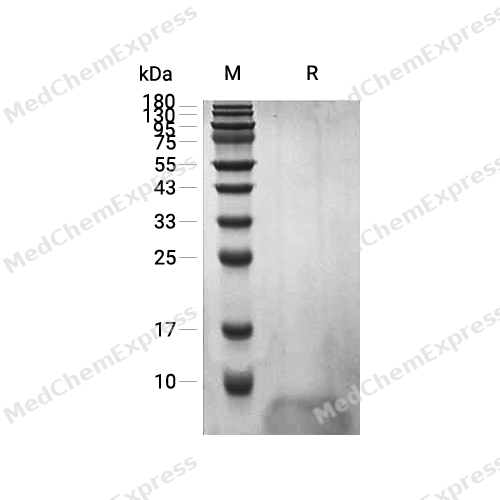
Purity - SDS-PAGE


Technical Parameters
-
Species Rat
-
Source CHO
-
Tag Tag Free
-
Accession
P07522 (N974-R1026)
-
Molecular Construction
-
N-term
-
EGF (N974-R1026)
Accession # P07522 -
C-term
-
-
Protein Length
Full Length of Epidermal growth factor Chain
-
Synonyms
EGF; Alternative Protein EGF; Epidermal Growth Factor; Beta-Urogastrone; Pro-Epidermal Growth Factor; HOMG4; Epidermal Growth Factor (Beta-Urogastrone); URG
-
AA Sequence
NSNTGCPPSYDGYCLNGGVCMYVESVDRYVCNCVIGYIGERCQHRDLRWWKLR
-
Molecular Weight
Approximately 6 kDa, based on SDS-PAGE under reducing conditions.
-
Glycosylation
Yes
-
Purity
≥ 95%, as determined by reducing SDS-PAGE.


Product Properties
Lyophilized powder.
Lyophilized from a 0.22 μm filtered solution of PBS.
<0.2 EU/μg, determined by LAL method.
It is not recommended to reconstitute to a concentration less than 100 μg/mL in ddH2O. For long term storage it is recommended to add a carrier protein (0.1% BSA, 5% HSA, 10% FBS or 5% Trehalose).
Stored at -20°C for 2 years from date of receipt. After reconstitution, it is stable at 4°C for 1 week or -20°C for longer (with carrier protein). It is recommended to freeze aliquots at -20°C or -80°C for extended storage.
Room temperature in continental US; may vary elsewhere.


Documentation
-
Data Sheet (261 KB)
-
SDS (251 KB)
- English - EN (251 KB)
- Français - FR (251 KB)
- Deutsch - DE (251 KB)
- Norwegian - NO (251 KB)
- Español - ES (251 KB)
- Swedish - SV (251 KB)
- Italian - IT (251 KB)
- Korean - KR (251 KB)
- Portuguese - PT (251 KB)
-
Handling Instructions (2659 KB)


References
[1]. Palencia L, et al. Epidermal growth factor mediated healing in stem cell-derived vocal fold mucosa. J Surg Res. 2015 Jul;197(1):32-8. [Content Brief]
[2]. Choi SY, et al. Epidermal Growth Factor Relieves Inflammatory Signals in Staphylococcus aureus-Treated Human Epidermal Keratinocytes and Atopic Dermatitis-Like Skin Lesions in Nc/Nga Mice. Biomed Res Int. 2018 May 15;2018:9439182. [Content Brief]

Calculators
Concentration (start) × Volume (start) = Concentration (final) × Volume (final)


 Powered by Bioz

