



RNA Polymerase II Subunit B1 Antibody (YA090)
(Synonyms: POLR2A; POLR2; DNA-directed RNA polymerase II subunit RPB1; RNA polymerase II subunit B1; DNA-directed RNA polymerase II subunit A; DNA-directed RNA polymerase III largest subunit; RNA-directed RNA polymerase II subunit RPB1)Based on 1 Customer Validation
RNA Polymerase II Subunit B1 Antibody (YA090) is a Rabbit-derived and non-conjugated IgG monoclonal antibody, targeting to RNA Polymerase II Subunit B1.
-
Host:
Rabbit
-
Isotype:
IgG
-
Application:
WB, IHC-F, IHC-P, ICC/IF, IP
-
Reactivity :
Human
-
Formulation:
Supplied in 50 mM Tris-Glycine (pH 7.4), 0.15 M NaCl, 40% Glycerol and 0.05% BSA. Preservative: 0.01% Sodium azide
-
Conjugation:
Non-conjugated


To place orders, for customer services and technical support, please contact: MedChemExpress USA
Tel: 609-228-6898 E-mail: [email protected] [email protected]





Applications
| Application |
WB

WB: Western Blot
|
IHC-P
IHC-P: Immunohistochemistry-Paraffin
|
IHC-F
IHC-F: Immunohistochemistry-Frozen
|
ICC/IF
ICC/IF: Immunocytochemistry/
Immunofluorescence |
IP
IP: Immunoprecipitation
|
|---|---|---|---|---|---|
| Dilution Ratio | 1:500-1:1000 | 1:50-1:100 | 1:50-1:100 | 1:50-1:200 | 1:20 |


Product Details
RNA Polymerase II Subunit B1 Antibody (YA090) is a Rabbit-derived and non-conjugated IgG monoclonal antibody, targeting to RNA Polymerase II Subunit B1.
-
Host Rabbit

-
Clonality Recombinant,Monoclonal

-
Species ReactivityHuman
-
Observed Molecular WeightObserved band size: 250 kDa
Note: Due to possible protein modifications or aggregation, the molecular weight should be confirmed by actual measurement, and the predicted value is for reference only.

-
Calculated Molecular Weight Predicted band size: 217 kDa

Synthetic peptide corresponding to Human RNA polymerase II CTD repeat YSPTSPS aa1602-1610.
Endogenous
affinity purified
Non-conjugated
Unmodified
IgG


Product Properties
-
Appearance
Solution
-
Formulation
Supplied in 50 mM Tris-Glycine (pH 7.4), 0.15 M NaCl, 40% Glycerol and 0.05% BSA. Preservative: 0.01% Sodium azide
-
Concentration
Batch-dependent, Please check the COA for the concentration of each lot. Check Lot Concentration
-
Storage & Stability
Stored at -20°C for 1 year. Avoid repeated freeze / thaw cycles.
-
Shipping
Shipping with blue ice.


Verification Images
-
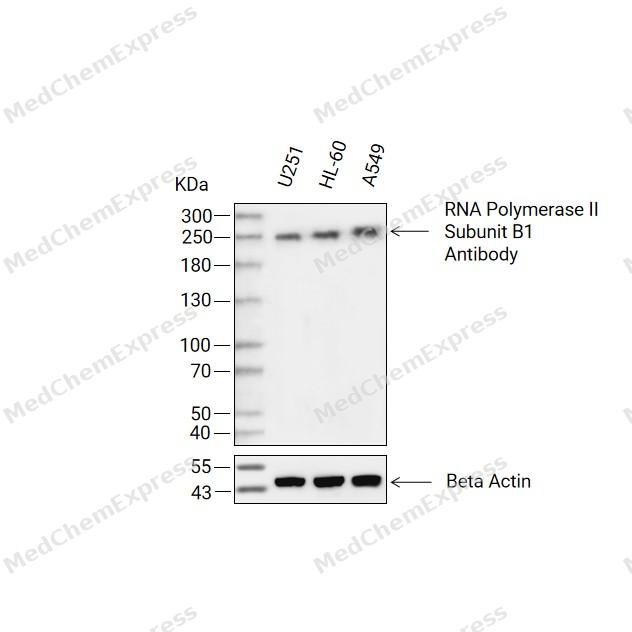 Western blot analysis of extracts from U251(lane 2(20ug) , HL-60(lane 3(20ug) and A549(lane 4(20ug) using RNA Polymerase II Subunit B1 Antibody (HY-P80883) Rabbit mAb. Proteins were transferred to a PVDF membrane and blocked with 5% non-fat milk in TBST for 2 hour at room temperature. The primary antibody (1/1000) and Loading control antibody (Beta Actin, HY-P83730, 1/10000) was used in 5% non-fat milk in TBST at 4°C overnight. Goat Anti-Mouse/Rabbit IgG-HRP Secondary Antibody (1/10000) was used for 1 hour at room temperature.
 -
 Immunocytochemistry analysis of Hela cells labeling RNA Polymerase II Subunit B1 with RNA Polymerase II Subunit B1 Antibody (HY-P80883) at 1/100 dilution. Cells were fixed in 4% paraformaldehyde for 15 minutes at room temperature, permeabilized with 0.1% Triton X-100 in PBS for 15 minutes at room temperature, then blocked with quick block buffer for 10 minutes at room temperature. Cells were then incubated with RNA Polymerase II Subunit B1 Antibody (HY-P80883) at 1/100 dilution in quick block buffer overnight at 4 ℃. AF488-conjugated Goat Anti-Rabbit IgG H&L (HY-P8002, Green) was used as the secondary antibody at 1/1,000 dilution. PBS instead of the primary antibody was used as the secondary antibody only control. The Nuclear counterstain was DAPI (Blue).
 -
 Immunocytochemistry analysis of Hela cells labeling RNA Polymerase II Subunit B1 with RNA Polymerase II Subunit B1 Antibody (HY-P80883) at 1/200 dilution. Cells were fixed in 4% paraformaldehyde for 15 minutes at room temperature, permeabilized with 0.1% Triton X-100 in PBS for 15 minutes at room temperature, then blocked with quick block buffer for 10 minutes at room temperature. Cells were then incubated with RNA Polymerase II Subunit B1 Antibody (HY-P80883) at 1/200 dilution in quick block buffer overnight at 4 ℃. AF488-conjugated Goat Anti-Rabbit IgG H&L (HY-P8002, Green) was used as the secondary antibody at 1/1,000 dilution. PBS instead of the primary antibody was used as the secondary antibody only control. The Nuclear counterstain was DAPI (Blue).


Background
-
Function
RNA Polymerase II Subunit B1 is a Catalytic core component of RNA polymerase II (Pol II), a DNA-dependent RNA polymerase which synthesizes mRNA precursors and many functional non-coding RNAs using the four ribonucleoside triphosphates as substrates. Pol II-mediated transcription cycle proceeds tH2O2gh transcription initiation, transcription elongation and transcription termination stages. During transcription initiation, Pol II pre-initiation complex (PIC) is recruited to DNA promoters, with focused-type promoters containing either the initiator (Inr) element, or the TATA-box found in cell-type specific genes and dispersed-type promoters that often contain hypomethylated CpG islands usually found in housekeeping genes. Once the polymerase has escaped from the promoter it enters the elongation phase during which RNA is actively polymerized, based on complementarity with the template DNA strand. Transcription termination involves the release of the RNA transcript and polymerase from the DNA. Forms Pol II active center together with the second largest subunit POLR2B/RPB2. Appends one nucleotide at a time to the 3' end of the nascent RNA, with POLR2A/RPB1 most likely contributing a Mg(2+)-coordinating DxDGD motif, and POLR2B/RPB2 participating in the coordination of a second Mg(2+) ion and providing lysine residues believed to facilitate Watson-Crick base pairing between the incoming nucleotide and template base. Typically, Mg(2+) ions direct a 5' nucleoside triphosphate to form a phosphodiester bond with the 3' hydroxyl of the preceding nucleotide of the nascent RNA, with the elimination of pyrophosphate. The reversible pyrophosphorolysis can occur at high pyrophosphate concentrations. Can proofread the nascent RNA transcript by means of a 3' -> 5' exonuclease activity. If a ribonucleotide is mis-incorporated, backtracks along the template DNA and cleaves the phosphodiester bond releasing the mis-incorporated 5'-ribonucleotide. TH2O2gh its unique C-terminal domain (CTD, 52 heptapeptide tandem repeats) serves as a platform for assembly of factors that regulate transcription initiation, elongation and termination. CTD phosphorylation on Ser-5 mediates Pol II promoter escape, whereas phosphorylation on Ser-2 is required for Pol II pause release during transcription elongation and further pre-mRNA processing. Additionally, the regulation of gene expression levels depends on the balance between methylation and acetylation levels of the CTD-lysines. Initiation or early elongation steps of transcription of growth-factor-induced immediate early genes are regulated by the acetylation status of the CTD. Methylation and dimethylation have a repressive effect on target genes expression. Cooperates with mRNA splicing machinery in co-transcriptional 5'-end capping and co-transcriptional splicing of pre-mRNA; RNA-dependent RNA polymerase that catalyzes the extension of a non-coding RNA (ncRNA) at the 3'-end using the four ribonucleoside triphosphates as substrates. An internal ncRNA sequence near the 3'-end serves as a template in a single-round Pol II-mediated RNA polymerization reaction. May decrease the stability of ncRNAs that repress Pol II-mediated gene transcription; (Microbial infection) Acts as an RNA-dependent RNA polymerase when associated with small delta antigen of Hepatitis delta virus, acting both as a replicase and transcriptase for the viral RNA circular genome[1][2][3][4][5][6][7][8].
-
Subcellular Localization
Nucleus; Cytoplasm; CH2O2osome
-
Isoforms & Post-Translational Modification
P24928 has 2 isomers: P24928-1: 217176 Da (predicted); P24928-2: 63641 Da (predicted).
The tandem heptapeptide repeats in the C-terminal domain (CTD) can be highly phosphorylated (PubMed:17234882, PubMed:19450536, PubMed:19667075, PubMed:19136461, PubMed:26566685, PubMed:28076779, PubMed:32142654, PubMed:33243860, PubMed:34004147). The phosphorylation activates Pol II (PubMed:33243860). Phosphorylation occurs mainly at residues 'Ser-2' and 'Ser-5' of the heptapeptide repeat and is mediated, at least, by CDK7 and CDK9 (PubMed:19450536, PubMed:19667075, PubMed:19136461, PubMed:21127351). POLR2A associated with DNA is specifically phosphorylated at 'Ser-5' of the CTD by CDK7, promoting transcription initiation by triggering dissociation from DNA (PubMed:19136461, PubMed:26257281, PubMed:28768201). Phosphorylated at 'Ser-2', Ser-5' and 'Ser-7' of the CTD by CDK9 (P-TEFb complex), promoting transcription elongation (PubMed:19667075, PubMed:21127351). Phosphorylation also takes place at 'Ser-7' of the heptapeptide repeat, which is required for efficient transcription of snRNA genes and processing of the transcripts (PubMed:22137580). The phosphorylation state is believed to result from the balanced action of site-specific CTD kinases and phosphatases, and a 'CTD code' that specifies the position of Pol II within the transcription cycle has been proposed (PubMed:19450536, PubMed:19667075, PubMed:19136461, PubMed:33243860, PubMed:34004147). Dephosphorylated by the INTAC complex when transcripts are unfavorably configured for transcriptional elongation, leading to premature transcription termination: dephosphorylation is mediated by the PPP2CA component of the INTAC complex (PubMed:33243860, PubMed:34004147, PubMed:37080207). In response to replication stress, dephosphorylated at 'Ser-5' of the CTD by the PNUTS-PP1 complex, promoting RNA polymerase II degradation (PubMed:33264625). Dephosphorylated by the protein phosphatase CTDSP1 (PubMed:17157258). Dephosphorylated at 'Ser-2' following UV irradiation;Among tandem heptapeptide repeats of the C-terminal domain (CTD) some do not match the Y-S-P-T-S-P-S consensus, the seventh serine residue 'Ser-7' being replaced by a lysine. 'Lys-7' in these non-consensus heptapeptide repeats can be alternatively acetylated, methylated and dimethylated. EP300 is one of the enzyme able to acetylate 'Lys-7'. Acetylation at 'Lys-7' of non-consensus heptapeptide repeats is associated with 'Ser-2' phosphorylation and active transcription. Regulates initiation or early elongation steps of transcription specially for inducible genes;Methylated at Arg-1810 prior to transcription initiation when the CTD is hypophosphorylated, phosphorylation at Ser-1805 and Ser-1808 preventing this methylation. Symmetrically or asymmetrically dimethylated at Arg-1810 by PRMT5 and CARM1 respectively. Symmetric or asymmetric dimethylation modulates interactions with CTD-binding proteins like SMN1/SMN2 and TDRD3. SMN1/SMN2 interacts preferentially with the symmetrically dimethylated form while TDRD3 interacts with the asymmetric form. TH2O2gh the recruitment of SMN1/SMN2, symmetric dimethylation is required for resolving RNA-DNA hybrids created by RNA polymerase II, that form R-loop in transcription terminal regions, an important step in proper transcription termination. CTD dimethylation may also facilitate the expression of select RNAs. Among tandem heptapeptide repeats of the C-terminal domain (CTD) some do not match the Y-S-P-T-S-P-S consensus, the seventh serine residue 'Ser-7' being replaced by a lysine. 'Lys-7' in these non-consensus heptapeptide repeats can be alternatively acetylated, methylated, dimethylated and trimethylated. Methylation occurs in the earliest transcription stages and precedes or is concomitant to 'Ser-5' and 'Ser-7' phosphorylation. Dimethylation and trimehtylation at 'Lys-7' of non-consensus heptapeptide repeats are exclusively associated with phosphorylated CTD;Following transcription stress, the elongating form of RNA polymerase II (RNA pol IIo) is ubiquitinated by the DCX(ERCC8) complex (also named CSA complex) on Lys-1268 at DNA damage sites without leading to degradation: ubiquitination promotes RNA pol IIo backtracking to allow access by the transcription-coupled nucleotide excision repair (TC-NER) machinery (PubMed:22466610, PubMed:32142649, PubMed:32142654, PubMed:34526721, PubMed:35633597). At stalled RNA pol II where TC-NER has failed, RBX1-mediated polybiquitination at Lys-1268 may lead to proteasome-mediated degradation in a UBAP2- and UBAP2L-dependent manner; presumably to halt global transcription and enable 'last resort' DNA repair pathways (PubMed:35633597). Ubiquitinated by the BCR(ARMC5) complex when transcripts are unfavorably configured for transcriptional elongation: the BCR(ARMC5) complex specifically catalyzes ubiquitination of POLR2A phosphorylated at 'Ser-5' of the C-terminal domain (CTD), leading to POLR2A degradation (PubMed:35687106, PubMed:39504960, PubMed:39667934). Ubiquitination by the BCR(ARMC5) complex takes place at residues distinct from Lys-1268 (PubMed:39667934). Ubiquitinated by WWP2 leading to proteasomal degradation (By similarity) -
Subunit
Component of the RNA polymerase II (Pol II) core complex consisting of 12 subunits
-
SwissProt ID
-
Synonyms
POLR2A; POLR2; DNA-directed RNA polymerase II subunit RPB1; RNA polymerase II subunit B1; DNA-directed RNA polymerase II subunit A; DNA-directed RNA polymerase III largest subunit; RNA-directed RNA polymerase II subunit RPB1
-
Research Field
Epigenetics and Nuclear Signaling


Documentation
-
Data Sheet (262 KB)
-
SDS (252 KB)
- English - EN (252 KB)
- Français - FR (252 KB)
- Deutsch - DE (252 KB)
- Norwegian - NO (252 KB)
- Español - ES (252 KB)
- Swedish - SV (252 KB)
- Italian - IT (252 KB)
- Korean - KR (252 KB)
- Portuguese - PT (252 KB)
-
User Guide for Antibodies (1077 KB)
References
[1]. Kassube SA, et al. Structural mimicry in transcription regulation of human RNA polymerase II by the DNA helicase RECQL5. Nat Struct Mol Biol. 2013 Jul;20(7):892-9. [Content Brief]
[2]. He Y, et al. Near-atomic resolution visualization of human transcription promoter opening. Nature. 2016 May 19;533(7603):359-65. [Content Brief]
[3]. Jishage M, et al. Architecture of Pol II(G) and molecular mechanism of transcription regulation by Gdown1. Nat Struct Mol Biol. 2018 Sep;25(9):859-867. [Content Brief]
[4]. Kershnar E, et al. Immunoaffinity purification and functional characterization of human transcription factor IIH and RNA polymerase II from clonal cell lines that conditionally express epitope-tagged subunits of the multiprotein complexes. J Biol Chem. 1998 Dec 18;273(51):34444-53. [Content Brief]
[5]. Vo Ngoc L, et al. The human initiator is a distinct and abundant element that is precisely positioned in focused core promoters. Genes Dev. 2017 Jan 1;31(1):6-11. [Content Brief]
[6]. Wang D, et al. Identification of a 3'-->5' exonuclease activity associated with human RNA polymerase II. Proc Natl Acad Sci U S A. 1993 Feb 1;90(3):843-7. [Content Brief]
[7]. Schröder S, et al. Acetylation of RNA polymerase II regulates growth-factor-induced gene transcription in mammalian cells. Mol Cell. 2013 Nov 7;52(3):314-24. [Content Brief]
[8]. Yu Y, et al. FUS functions in coupling transcription to splicing by mediating an interaction between RNAP II and U1 snRNP. Proc Natl Acad Sci U S A. 2015 Jul 14;112(28):8608-13. [Content Brief]

 Powered by Bioz
