



Tocofersolan
Based on 6 publication(s) in Google Scholar
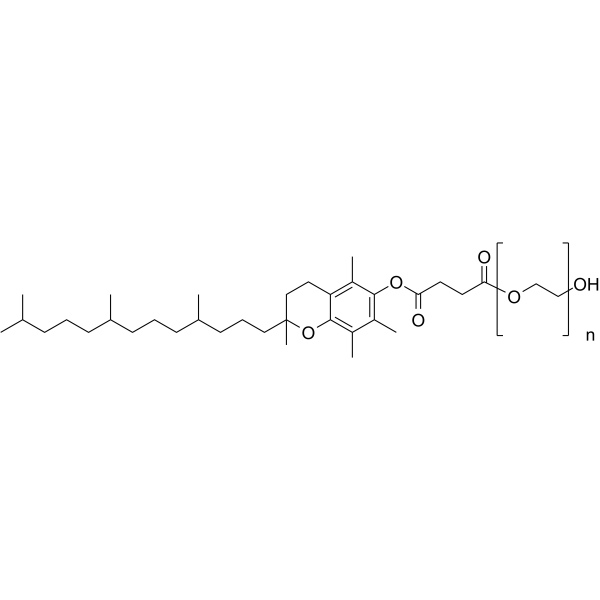
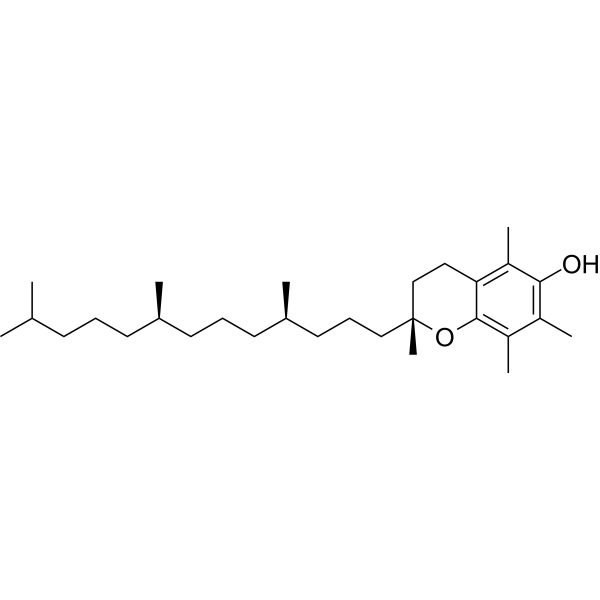
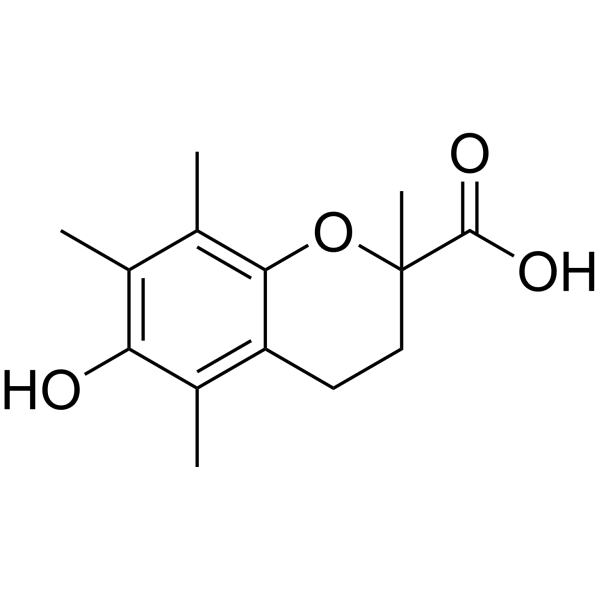
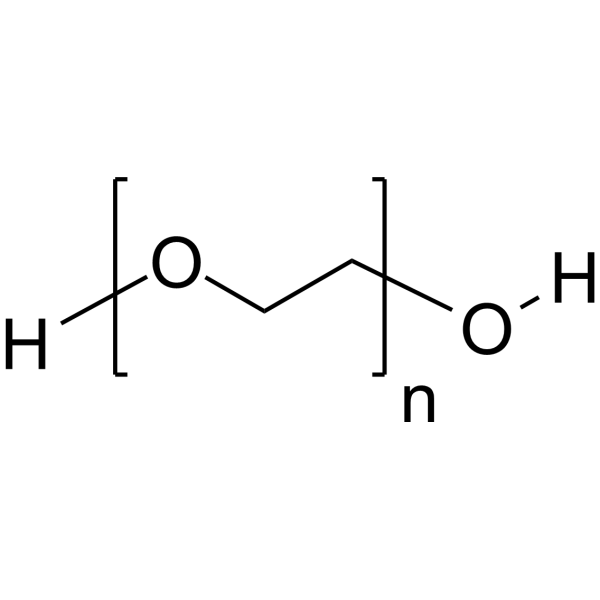
Tocofersolan is synthetic polyethylene glycol derivative of α-tocopherol. Tocofersolan is an orally active and water-soluble analog of vitamin E. Tocofersolan can reduce neurobehavioral deficits in zebrafish embryos exposed to moderate and high concentrations of BaP during early development. Tocofersolan shows antioxidant activity. Tocofersolan can be used to provide an orally bioavailable source of vitamin E.
For research use only. We do not sell to patients.
- Purity: 98.0%
- CAS No.: 9002-96-4
- Formula: C35H58O6
- Molecular Weight:1513.00
-
Storage:Pure form -20°C, 3 years , 4°C, 2 years ; In solvent -80°C, 6 months , -20°C, 1 month

To place orders, for customer services and technical support, please contact: MedChemExpress USA
Tel: 609-228-6898 E-mail: [email protected] [email protected]


-
 Biological Activity
-
Chemical Information
-
Solvent & Solubility
- Purity & Documentation
- References
-
 Help & FAQs




Publications Citing Use of MedChemExpress (MCE) Tocofersolan
More

Biological Activity
Description
In Vivo
MedChemExpress (MCE) has not independently confirmed the accuracy of these methods. They are for reference only.
Clinical Trial
| NCT Number | Sponsor | Condition | Start Date |
Phase

|
|---|---|---|---|---|
| NCT01329991 | Plexxikon| | 2011-05 | PHASE1 |


Chemical Information
-
CAS No. 9002-96-4
-
Appearance <34°C Solid,>38°C Liquid
-
Molecular Weight 1513.00
-
Formula C35H58O6
-
Color Off-white to light yellow
-
SMILES
CC1=C(CCC(CCCC(C)CCCC(C)CCCC(C)C)(C)O2)C2=C(C)C(C)=C1OC(CCC(OCCO)=O)=O.[n]
-
Synonyms
TPGS; D-α-Tocopherol polyethylene glycol 1000 succinate; Vitamin E-TPGS
-
Shipping
Room temperature in continental US; may vary elsewhere.
-
Storage
Pure form -20°C 3 years 4°C 2 years In solvent -80°C 6 months -20°C 1 month


Publications (6)
-
Journal Impact Factor
-
Most Recent
-
Drug Deliv
Oral nanoliposomes functionalized with cRGD and polydopamine for enhanced antimalarial efficacy of disulfide bond-modified dihydroartemisinin prodrug. [Abstract]2025 Dec;32(1):2554079. PMID: 41078131 -
Int J Mol Sci
Vitamin E Modulates Hepatic Extracellular Adenosine Signaling to Attenuate Metabolic Dysfunction-Associated Steatotic Liver Disease (MASLD). [Abstract]2026 Jan 7;27(2):614. PMID: 41596272 -
Eur J Pharm Sci
Understanding the formulation parameters for engineering indocyanine green J-aggregate lipid nanocapsules and solid lipid nanoparticles as promising photothermal agents. [Abstract]2025 Apr 1:207:107034. PMID: 39922238 -
Cancers (Basel)
Optimization of a Luteolin-Loaded TPGS/Poloxamer 407 Nanomicelle: The Effects of Copolymers, Hydration Temperature and Duration, and Freezing Temperature on Encapsulation Efficiency, Particle Size, and Solubility. [Abstract]2023 Jul 24;15(14):3741. PMID: 37509402 -
Reprod Sci
Effects of Solvents, Emulsions, Cosolvents, and Complexions on Ex Vivo Mouse Myometrial Contractility. [Abstract]2022 Feb;29(2):586-595. PMID: 33852137 -


Solvent & Solubility
In Vitro:
H2O : 100 mg/mL (66.09 mM; Need ultrasonic)
DMSO : 100 mg/mL (66.09 mM; Need ultrasonic; Hygroscopic DMSO has a significant impact on the solubility of product, please use newly opened DMSO)
Ethanol : 50 mg/mL (33.05 mM; Need ultrasonic)
Please refer to the solubility information to select the appropriate solvent. Once prepared, please aliquot and store the solution to prevent product inactivation from repeated freeze-thaw cycles.
Storage method and period of stock solution: -80°C, 6 months; -20°C, 1 month. When stored at -80°C, please use it within 6 months. When stored at -20°C, please use it within 1 month.
* Note: If you choose water as the stock solution, please dilute it to the working solution, then filter and sterilize it with a 0.22 μm filter before use.
Please refer to the solubility information to select the appropriate solvent. Once prepared, please aliquot and store the solution to prevent product inactivation from repeated freeze-thaw cycles.
Storage method and period of stock solution: -80°C, 6 months; -20°C, 1 month. When stored at -80°C, please use it within 6 months. When stored at -20°C, please use it within 1 month.
* Note: If you choose water as the stock solution, please dilute it to the working solution, then filter and sterilize it with a 0.22 μm filter before use.
Concentration (start) × Volume (start) = Concentration (final) × Volume (final)
In Vivo:
Select the appropriate dissolution method based on your experimental animal and administration route.
- For the following dissolution methods, please ensure to first prepare a clear stock solution using an In Vitro approach and then sequentially add co-solvents:
- To ensure reliable experimental results, the clarified stock solution can be appropriately stored based on storage conditions. As for the working solution for In Vivo experiments, it is recommended to prepare freshly and use it on the same day.
- The percentages shown for the solvents indicate their volumetric ratio in the final prepared solution. If precipitation or phase separation occurs during preparation, heat and/or sonication can be used to aid dissolution.
Add each solvent one by one: 10% DMSO 40% PEG300 5% Tween-80 45% Saline
Solubility: ≥ 2.5 mg/mL (1.65 mM); Clear solution
This protocol yields a clear solution of ≥ 2.5 mg/mL (saturation unknown).
Taking 1 mL working solution as an example, add 100 μL DMSO stock solution (25.0 mg/mL) to 400 μL PEG300, and mix evenly; then add 50 μL Tween-80 and mix evenly; then add 450 μL Saline to adjust the volume to 1 mL.
Preparation of Saline: Dissolve 0.9 g sodium chloride in ddH₂O and dilute to 100 mL to obtain a clear Saline solution.
Add each solvent one by one: 10% DMSO 90% (20% SBE-β-CD in Saline)
Solubility: ≥ 2.5 mg/mL (1.65 mM); Clear solution
This protocol yields a clear solution of ≥ 2.5 mg/mL (saturation unknown).
Taking 1 mL working solution as an example, add 100 μL DMSO stock solution (25.0 mg/mL) to 900 μL 20% SBE-β-CD in Saline, and mix evenly.
Preparation of 20% SBE-β-CD in Saline (4°C, storage for one week): 2 g SBE-β-CD powder is dissolved in 10 mL Saline, completely dissolve until clear.
For the following dissolution methods, please prepare the working solution directly:
It is recommended to prepare fresh solutions and use them promptly within a short period of time.
The percentages shown for the solvents indicate their volumetric ratio in the final prepared solution. If precipitation or phase separation occurs during preparation, heat and/or sonication can be used to aid dissolution.
Add each solvent one by one: PBS
Solubility: 100 mg/mL (66.09 mM); Clear solution; Need ultrasonic and warming and heat to 60°C
In Vivo Dissolution Calculator
Please enter the basic information of animal experiments:
-
-
-
-
Recommended: Prepare an additional quantity of animals to account for potential losses during experiments.
Working solution concentration: 0.22 mg/mL
This product has good water solubility, please refer to the measured solubility data in water/PBS/Saline for details.


Purity & Documentation
-
Data Sheet (273 KB)
-
SDS (394 KB)
- English - EN (394 KB)
- Français - FR (394 KB)
- Deutsch - DE (394 KB)
- Norwegian - NO (394 KB)
- Español - ES (394 KB)
- Swedish - SV (394 KB)
- Italian - IT (394 KB)
- Korean - KR (394 KB)
- Portuguese - PT (394 KB)
-
Handling Instructions (2659 KB)
References
[1]. Rehim WM, et al. Antioxidant capacity in Fasciola hepatica patients before and after treatment with triclabendazole alone or in combination with ascorbic acid (vitamin C) and tocofersolan (vitamin E). Arzneimittelforschung. 2003;53(3):214-20. [Content Brief]
[2]. Tan S, et al. Recent developments in d-α-tocopheryl polyethylene glycol-succinate-based nanomedicine for cancer therapy [published correction appears in Drug Deliv. 2017 Nov;24(1):1930]. Drug Deliv. 2017;24(1):1831-1842. [Content Brief]
[3]. Holloway Z, et al. The use of tocofersolan as a rescue agent in larval zebrafish exposed to benzo[a]pyrene in early development. Neurotoxicology. 2021 Sep;86:78-84. [Content Brief]


Complete Stock Solution Preparation Table
Please refer to the solubility information to select the appropriate solvent. Once prepared, please aliquot and store the solution to prevent product inactivation from repeated freeze-thaw cycles.
Storage method and period of stock solution: -80°C, 6 months; -20°C, 1 month. When stored at -80°C, please use it within 6 months. When stored at -20°C, please use it within 1 month.
| Optional Solvent | Concentration Solvent Mass | 1 mg | 5 mg | 10 mg | 25 mg |
|---|---|---|---|---|---|
| Ethanol / H2O / DMSO | 1 mM | 0.6609 mL | 3.3047 mL | 6.6094 mL | 16.5235 mL |
| 5 mM | 0.1322 mL | 0.6609 mL | 1.3219 mL | 3.3047 mL | |
| 10 mM | 0.0661 mL | 0.3305 mL | 0.6609 mL | 1.6523 mL | |
| 15 mM | 0.0441 mL | 0.2203 mL | 0.4406 mL | 1.1016 mL | |
| 20 mM | 0.0330 mL | 0.1652 mL | 0.3305 mL | 0.8262 mL | |
| 25 mM | 0.0264 mL | 0.1322 mL | 0.2644 mL | 0.6609 mL | |
| 30 mM | 0.0220 mL | 0.1102 mL | 0.2203 mL | 0.5508 mL | |
| H2O / DMSO | 40 mM | 0.0165 mL | 0.0826 mL | 0.1652 mL | 0.4131 mL |
| 50 mM | 0.0132 mL | 0.0661 mL | 0.1322 mL | 0.3305 mL | |
| 60 mM | 0.0110 mL | 0.0551 mL | 0.1102 mL | 0.2754 mL |
* Note: If you choose water as the stock solution, please dilute it to the working solution, then filter and sterilize it with a 0.22 μm filter before use.


Tocofersolan Related Classifications
HY-B0717 Related Classifications
 Powered by Bioz