



PH Indicators
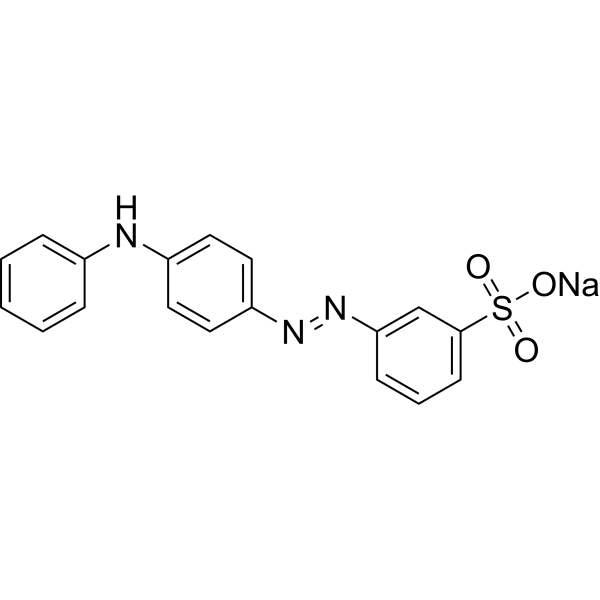
- Formula: C18H14N3NaO3S
- Molecular Weight: 375.38
Acid Yellow 36 (Metanil Yellow) is an azo dye and a pH indicator. Acid Yellow 36 changes its color from red at pH 1.2 to yellow at pH 2.3. Acid Yellow 36 is used in the leather, paper and textile industries. Acid Yellow 36 acts as a bifunctional inducer of specific isozymes of P-450 and cytosolic enzymes.

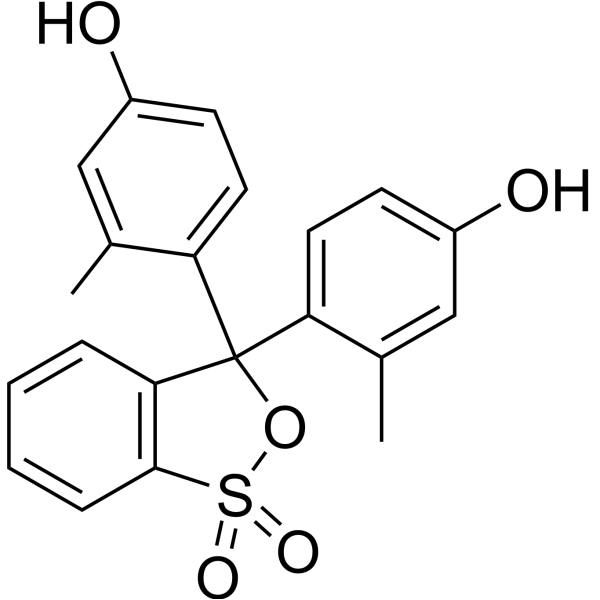
- Formula: C21H18O5S
- Molecular Weight: 382.43
Cresol red, 97% is an acidic phenolsulfonphthalein triphenylmethane dye. Cresol red, 97% generates reactive oxygen species and singlet oxygen under ultrasonic irradiation, interacts with bovine serum albumin, alters the structure of bovine serum albumin, and oxidizes the fluorescent amino acid residues of bovine serum albumin. Cresol red, 97% can be decolorized and biodegraded by *Absidia spinosa* M15, producing phenylacetic acid and benzoic acid metabolites. Cresol red, 97% serves as a pH indicator (orange at pH 1.8-yellow at pH 2.0, yellow at pH 7.0-purple at pH 8.8). Cresol red, 97% can be used to indicate pH, temperature and salinity.
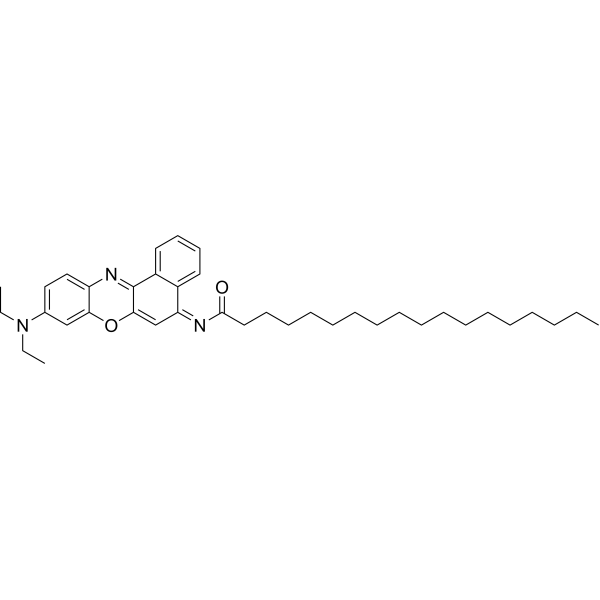
- Formula: C38H53N3O2
- Molecular Weight: 583.85
Chromoionophore I (ETH 5294) is a hydrophobic pH indicator. Chromoionophore I is used as a transmissive or fluorescent probe molecule in many types of hydrophobic sensor membranes. Chromoionophore I is oil-soluble.

- Formula: C45H47ClN2O6S2
- Molecular Weight: 811.45
BTC1070 is an anti-quenching pentamethine cyanine NIR-II fluorescent probe. BTC1070 exhibits high brightness and excellent photostability in aqueous solution (Ex/Em = 1015/1065 nm). BTC1070 can clearly visualize lymphatic structures after intradermal injection, and produces a ratiometric fluorescence response in the acidic range to non-invasively quantify gastric pH. BTC1070 is applicable to studies related to in vivo deep tissue imaging and gastric pH sensing.

- Formula: C37H38N4O5S
- Molecular Weight: 650.79
Golgi-hNR is a cell membrane-permeable Golgi-targeted fluorescent probe containing a sulfonamide group. Golgi-hNR selectively accumulates in the Golgi apparatus of living cells, enabling real-time tracking and homeostasis assessment of reversible pH changes in the Golgi apparatus. Golgi-hNR exhibits a pH-dependent "off-on" fluorescence response mechanism within the pH 7.4-3.0 range, and its red fluorescence intensity decreases with increasing pH. The Ex/Em of Golgi-hNR is 560/664 nm and 580/664 nm, with the maximum emission peak located at 615 nm.

- Formula: C25H24N4
- Molecular Weight: 380.48
CSMPP is a ratiometric lysosomal pH fluorescent probe with aggregation-induced emission (AIE) properties, which is used for real-time quantitative detection of lysosomal pH changes in living cells and in vivo. CSMPP has a cyanodistyrene backbone, and contains N-methylpiperazine and pyridine groups (pH-responsive); protonation of the pyridine group significantly enhances intramolecular charge transfer (ICT), leading to green fluorescence emission (Ex/Em = 405/503 nm) under neutral/basic conditions and red fluorescence emission (Ex/Em = 405/615 nm) under acidic conditions. CSMPP exhibits high selectivity, reversibility, good biocompatibility and excellent photostability.

- Formula: C49H47ClN2O10
- Molecular Weight: 859.36
Ratio-pHCL-1 is a fluorescent probe for quantitative ratiometric pH imaging in biological systems. Ratio-pHCL-1 consists of an acrylamide 1,2-dioxetane chemiluminescent scaffold and a linked pH-sensitive carbon fluorescein fluorophore, and functions via chemically initiated electron exchange luminescence (CIEEL) decomposition and chemiluminescence resonance energy transfer (CRET). Ratio-pHCL-1 can cross cell membranes and accumulate intracellularly, enabling pH measurement within the range of 6.8-8.4.

- Formula: C65H106N10O8S2
- Molecular Weight: 1219.73
Mem-pH is a ratiometric fluorescent probe used for measuring vesicular pH. Mem-pH inserts into the plasma membrane bilayer and localizes to the vesicular lumen, switching between its basic and acidic forms via protonation during vesicular acidification to enable ratiometric pH readout. In aqueous media, Mem-pH forms non-emissive aggregates through aggregation-induced quenching, and then depolymerizes and recovers its fluorescent activity upon binding to the plasma membrane. The excitation/emission wavelengths of the basic form of Mem-pH are 405/450-550 nm, while those of the acidic form are 488/500-700 nm.

- Formula: C36H34N4O2
- Molecular Weight: 554.68
Lyso-MPCB is a two-photon fluorescent probe used for lysosomal pH detection and autophagy monitoring. Lyso-MPCB integrates a benzimidazole pH-responsive group and a morpholine lysosome-targeting group, enabling specific localization to lysosomes. The fluorescence properties of Lyso-MPCB change with protonation, exhibiting blue fluorescence under alkaline conditions and green fluorescence under acidic conditions.

- Formula: C20H20N2O2
- Molecular Weight: 320.39
pH-Ap-1 is a fluorescent probe used for ratiometric monitoring of pH fluctuations during autophagy in living cells, and it can detect intracellular pH changes in the autophagy process. For fluorescence detection of pH-Ap-1, its excitation wavelength is 475 nm, with an emission wavelength of 538 nm under alkaline conditions and 645 nm under acidic conditions. For intracellular imaging, excitation is performed at 488 nm: the emission light ranging from 500-550 nm is collected via the green channel corresponding to 538 nm, while the emission light ranging from 625-750 nm is collected via the red channel corresponding to 645 nm. pH-Ap-1 exhibits excellent photostability and chemical stability.

pH630 Deep Red TFP Ester, Amine reactive is a fluorescent labeling reagent combining pH responsiveness and amine-targeting capabilities. It combines pH sensitivity and amine-specific labeling, primarily used for highly specific, low-background fluorescent labeling and imaging of primary amine-containing biomolecules in acidic environments (Ex/Em = 630/650 nm).

pH630 Deep Red maleimide, Thiol Reactive is a fluorescent labeling reagent combining pH responsiveness and thiol targeting capabilities. It combines pH sensitivity and thiol-specific labeling, primarily used for highly specific, low-background fluorescent labeling and imaging of thiol-containing biomolecules in acidic environments (Ex/Em = 630/650 nm).

- Formula: C20H10Cl2O8S
- Molecular Weight: 481.26

- Formula: C26H24N2O3S2
- Molecular Weight: 476.61
Thiazole Orange (solution) is an asymmetric anthocyanin dye that can be coupled with oligonucleotides (ONs) to prepare fluorescent hybridization probes. Thiazole Orange has been widely used in biomolecular detection and staining of DNA/ RNA in gels and can be used for reticulocyte analysis. Thiazole orange generates a significant fluorescence enhancement and high quantum yield when it binds with nucleic acids, especially RNA. Thiazole orange can permeate living cell membranes. Thiazole orange can use UV light for detection, but can also be detected with blue light. The excitation and emission of Thiazole orange are λex = 510 nm (488 nm and 470 nm also show strong excitation) and λem = 527 nm, respectively.
Solvent and concentration: DMSO: 10 mM
The 1 mL volume is defined as the base specification. All larger sizes correspond to incremental volumes of this base.

- Formula: C54H40O22
- Molecular Weight: 1040.88
BCECF (solution) (2′,7′-Bis(2-carboxyethyl)-5(6)-carboxyfluorescein (solution)) is a cell-impermeant pH-sensitive fluorescent dye. BCECF allows measurements in the physiological pH range 6.0-8.0. Excitation ratio: 490/440 nm; Emission intensity: 535 nm.
Solvent and concentration: DMSO: 10 mM

- Formula: C22H18O4
- Molecular Weight: 346.38
o-Cresolphthalein (ortho-Cresolphthalein) is a biocatalyst and a key enzyme in new biocatalyst technology. Enzyme engineering focuses on enhancing enzyme reaction kinetics, substrate selectivity, and activity under harsh conditions such as low or high pH. By introducing stimulus responsiveness to these enzyme modifications, dynamic control of activity is also possible.
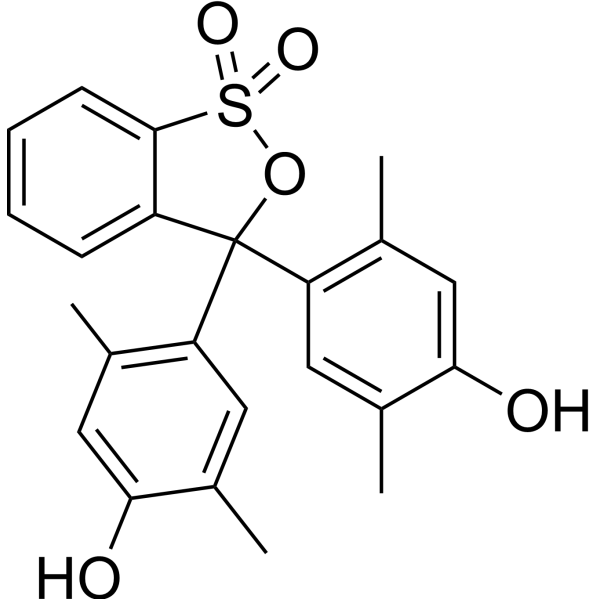
- Formula: C23H22O5S
- Molecular Weight: 410.48
Xylenol Blue is a sulfonephthalein dye. It exhibits observable color changes in response to variations in pH. Xylenol Blue undergoes two distinct color transitions across two specific pH ranges: an acidic range and an alkaline range. In a neutral solution, Xylenol Blue appears yellow (at pH 8); in a strongly acidic medium, its color shifts to red (at pH 2.8); and in an alkaline medium, the yellow hue transitions to blue (at pH 9.6).
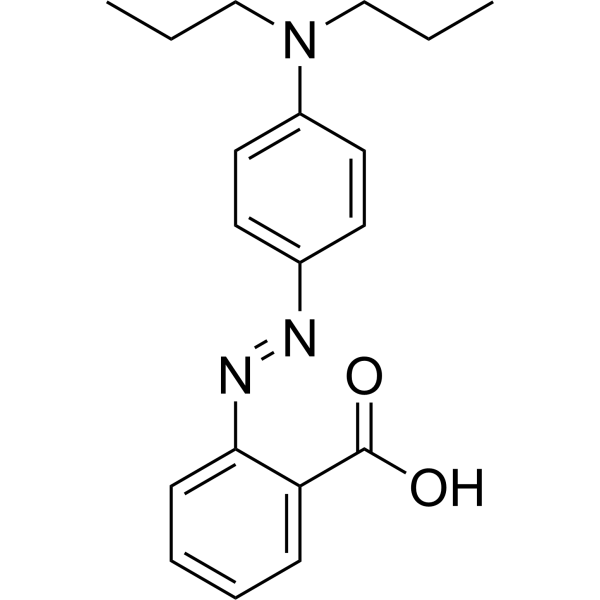
- Formula: C19H23N3O2
- Molecular Weight: 325.40
Propyl red is a multifunctional dye. Dyes are important tools in biological experiments. They can help researchers observe and analyze cell structures, track biomolecules, evaluate cell functions, distinguish cell types, detect biomolecules, study tissue pathology and monitor microorganisms. Their applications range from basic scientific research to clinical A wide range of diagnostics. Dyes are also widely used in traditional fields such as textile dyeing, as well as in emerging fields such as functional textile processing, food pigments and dye-sensitized solar cells.
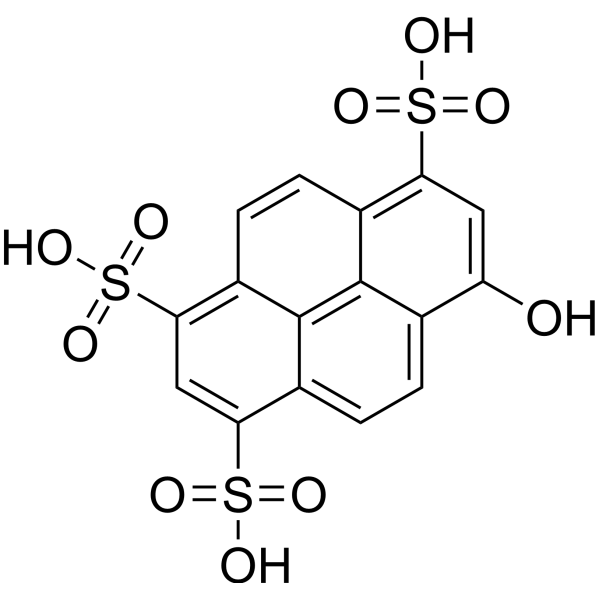
- Formula: C16H10O10S3
- Molecular Weight: 458.44
Pyranine (HPTS; Solvent Green 7) free acid is a pH-sensitive fluorescent indicator. Pyranine free acid acts as a class of fluorescent chemosensor for the Cu+ ion. Pyranine free acid is used as a coloring agent, biological stain, optical detecting reagent, and pH indicator (Ex/Em = 450/510 nm).



