



Quinocetone
Based on 1 publication(s) in Google Scholar
Quinocetone is an orally active animal feed additive used to increase the meat production of livestock and poultry. Quinocetone exhibits antibacterial activity against a variety of pathogenic microorganisms. Quinocetone exhibits tissue-specific (liver, lymphocyte) toxicity. Quinocetone induces autophagy in cells through the ATF6/DAPK1 pathway. Quinocetone activates the NF-κB and iNOS pathways, leading to cell apoptosis, hepatocyte vacuolar degeneration and fibrosis. Quinocetone can inhibit Nrf2/HO-1 and induce the generation of reactive oxygen species (ROS), leading to oxidative stress and DNA damage.
Para uso exclusivo en investigación. No vendemos a pacientes.
- Pureza: 98.25%
- No. CAS: 81810-66-4
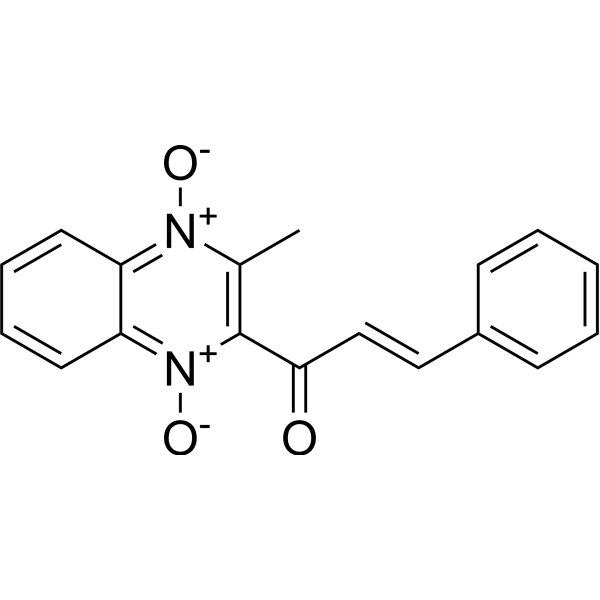
- Fòrmula: C18H14N2O3
- Peso molecular:306.32
-
Almacenamiento:Powder -20°C, 3 years , 4°C, 2 years ; In solvent -80°C, 6 months , -20°C, 1 month

To place orders, for customer services and technical support, please contact: MedChemExpress USA
Tel: 609-228-6898 E-mail: [email protected] [email protected]


-
 Actividad biológica
-
Chemical Information
-
Solvente y solubilidad
- Pureza y Documentación
- Referencias
-
 Help & FAQs
-

Anti-Infection Compound Library
HY-L002
-
Apoptosis Compound Library
HY-L003
-
Cell Cycle/DNA Damage Compound Library
HY-L004
-
Immunology/Inflammation Compound Library
HY-L007
-
Metabolism/Protease Compound Library
HY-L012
-
NF-κB Signaling Compound Library
HY-L014
-
Stem Cell Signaling Compound Library
HY-L017
-
Autophagy Compound Library
HY-L029
-
Anti-Aging Compound Library
HY-L034
-
Antioxidant Compound Library
HY-L037
-
Oxygen Sensing Compound Library
HY-L045
-
Antibacterial Compound Library
HY-L049
-
Ferroptosis Compound Library
HY-L051
-
Endoplasmic Reticulum Stress Compound Library
HY-L054
-
Pyroptosis Compound Library
HY-L059
-
Orally Active Compound Library
HY-L061
-
Antibiotics Library
HY-L067
-
Anti-Breast Cancer Compound Library
HY-L074
-
Anti-Pancreatic Cancer Compound Library
HY-L077
-
Anti-Cancer Metabolism Compound Library
HY-L083
-
Anti-Parkinson's Disease Compound Library
HY-L085
-
Neurodegenerative Disease-related Compound Library
HY-L086
-
Angiogenesis-Related Compound Library
HY-L088
-
Transcription Factor-Targeted Library
HY-L090
-
Anti-Colorectal Cancer Compound Library
HY-L103
-
Human Metabolite Library
HY-L123
-
Anti-Pulmonary Fibrosis Compound Library
HY-L125
-
Pain-Related Compound Library
HY-L139
-
Metabolic Enzyme Compound Library
HY-L146
-
Membrane Protein-targeted Compound Library
HY-L149
-
Highly Selective Inhibitors Library
HY-L158
-
Highly Selective Activators Library
HY-L159
-
Cell Death Library
HY-L162
-
Anti-Ovarian Cancer Compound Library
HY-L173
-
Multi-Target Compound Library
HY-L176
-
Radioprotector Library
HY-L178
-
Bioactive Compound Library Max
HY-L181
-
MCE Bioactive Compound Library
HY-L001V
-
Bioactive Compound Library
HY-L001
-
Protein Kinase Compound Library
HY-L196
-
Non-Alcoholic Fatty Liver Disease (NAFLD) Compound Library
HY-L199
-
Cell Proliferation Compound Library
HY-L201
-
High-Throughput Bioactive Compound Library
HY-L205
-
Mass Spectrometry Human Metabolite Library
HY-L215
-
Lactylation Compound Library
HY-L249


Publications Citing Use of MedChemExpress (MCE) Quinocetone
MoreVer todos los productos específicos de isoformas Antibiotic
More

Actividad biológica
|
NF-κB |
iNOS |
DAPK1 |
HO-1 |
|
Cell Line

|
Type | Value | Description | References |
|---|---|---|---|---|
| CCRF-CEM | IC50 |
5.92 μM
Compound: 3a
|
Growth inhibition of human CEM cells after 3 days
Growth inhibition of human CEM cells after 3 days
|
[PMID: 19427790] |
| HL-60 | CC50 |
4.1 μM
Compound: 3a
|
Cytotoxicity against human HL60 cells after 48 hrs
Cytotoxicity against human HL60 cells after 48 hrs
|
[PMID: 19427790] |
| HSC-2 | CC50 |
8.4 μM
Compound: 3a
|
Cytotoxicity against human HSC2 cells after 48 hrs
Cytotoxicity against human HSC2 cells after 48 hrs
|
[PMID: 19427790] |
| HSC-3 | CC50 |
9.7 μM
Compound: 3a
|
Cytotoxicity against human HSC3 cells after 48 hrs
Cytotoxicity against human HSC3 cells after 48 hrs
|
[PMID: 19427790] |
| HSC-4 | CC50 |
9.6 μM
Compound: 3a
|
Cytotoxicity against human HSC4 cells after 48 hrs
Cytotoxicity against human HSC4 cells after 48 hrs
|
[PMID: 19427790] |
| MOLT-4 | IC50 |
6.76 μM
Compound: 3a
|
Growth inhibition of human Molt4/C8 cells after 3 days
Growth inhibition of human Molt4/C8 cells after 3 days
|
[PMID: 19427790] |
Quinocetone is active against Microsporum canis, Mycoplasma gallisepticum and Mycoplasma hyopneumoniae with MICs of 8, 8 and 16 μg/mL but shows no significant inhibitory effect on various animal viruses including bursal disease virus, porcine reproductive and respiratory syndrome virus, porcine parvovirus and classical swine fever virus[1].
Quinocetone (0-10 μg/mL, 0-24 h) triggers ER stress-induced autophagy via ATF6/DAPK1-modulated mAtg9a trafficking in HepG2 cells[2].
Quinocetone (0-20 μg/mL, 6-24 h) inhibits in human peripheral lymphocytes growth, triggers ROS increase and induced DNA damage[3].
MedChemExpress (MCE) has not independently confirmed the accuracy of these methods. They are for reference only.
-
Cell Line:HepG2 cells
-
Concentration:0, 1.25, 2.5, 5, 7.5, 10 μg/mL
-
Incubation Time:0, 1.5, 3, 6, 9, 12, 24 h
-
Result:Significantly increased the LC3-II/LC3-I ratio.
Dose-dependently upregulated BiP and CHOP expression and increased ATF6 cleavage.
Significantly upregulated DAPK1 expression and MRLC phosphorylation.
-
Cell Line:HepG2 cells
-
Concentration:0, 1.25, 2.5, 5, 7.5, 10 μg/mL
-
Incubation Time:0, 1.5, 3, 6, 9, 12, 24 h
-
Result:Increased BiP, HerpUD and sec24D transcription.
Increased DAPK1 mRNA.
MedChemExpress (MCE) has not independently confirmed the accuracy of these methods. They are for reference only.
-
Animal Model:Hepatocyte damage assay established in adult male SD rats[4]
-
Dosage:50, 800 and 2400 mg/kg
-
Administration:Intragastrical administration (p.o.), once daily for 13 weeks
-
Result:Kept all rats survived and no obviously significant changes were observed in mortality, illness and clinical signs.
Induced liver damage and liver was likely to be the target organ at high dose.
Aggravated ROS accumulation in liver and aggravated DNA damage at high dose.
Aggravated inflammation and apoptosis of hepatocyte at high dose.
Inhibited aggravated inflammation and apoptosis of hepatocyte at high dose.


Chemical Information
-
No. CAS 81810-66-4
-
Appearance Solid
-
Peso molecular 306.32
-
Fòrmula C18H14N2O3
-
Color White to yellow
-
SMILES
O=C(C1=C(C)[N+]([O-])=C2C=CC=CC2=[N+]1[O-])/C=C/C3=CC=CC=C3
-
Envío
Room temperature in continental US; may vary elsewhere.
-
Almacenamiento
Powder -20°C 3 years 4°C 2 years In solvent -80°C 6 months -20°C 1 month


Publications (1)
-
Journal Impact Factor
-
Most Recent
-
Chin Herb Med
Integrated network pharmacology, transcriptomics and experimental validation to explore mechanisms of Wenyang Jiedu Granule on IAV-induced pneumonia. [Abstract]2026 Feb 11;18(2):241-261. PMID: 41971577


Solvente y solubilidad
DMSO : 100 mg/mL (326.46 mM; Need ultrasonic; Hygroscopic DMSO has a significant impact on the solubility of product, please use newly opened DMSO)
Please refer to the solubility information to select the appropriate solvent. Once prepared, please aliquot and store the solution to prevent product inactivation from repeated freeze-thaw cycles.
Storage method and period of stock solution: -80°C, 6 months; -20°C, 1 month. When stored at -80°C, please use it within 6 months. When stored at -20°C, please use it within 1 month.
Please refer to the solubility information to select the appropriate solvent. Once prepared, please aliquot and store the solution to prevent product inactivation from repeated freeze-thaw cycles.
Storage method and period of stock solution: -80°C, 6 months; -20°C, 1 month. When stored at -80°C, please use it within 6 months. When stored at -20°C, please use it within 1 month.
Concentration (start) × Volume (start) = Concentration (final) × Volume (final)


Pureza y Documentación
-
Ficha de datos (279 KB)
-
SDS (418 KB)
- English - EN (418 KB)
- Français - FR (418 KB)
- Deutsch - DE (418 KB)
- Norwegian - NO (418 KB)
- Español - ES (418 KB)
- Swedish - SV (418 KB)
- Italian - IT (418 KB)
- Korean - KR (418 KB)
- Portuguese - PT (418 KB)
-
Instrucciones de manejo (2659 KB)
Referencias
[1]. Zhao Y, et al. In vitro antimicrobial activities of animal-used quinoxaline 1,4-di-N-oxides against mycobacteria, mycoplasma and fungi. BMC Vet Res. 2016 Sep 6;12(1):186. [Content Brief]
[2]. Zhou Y, et al. Quinocetone triggered ER stress-induced autophagy via ATF6/DAPK1-modulated mAtg9a trafficking. Cell Biol Toxicol. 2016 Apr;32(2):141-52. [Content Brief]
[3]. Yang W, et al. Quinocetone triggers oxidative stress and induces cytotoxicity and genotoxicity in human peripheral lymphocytes of both genders. J Sci Food Agric. 2013 Apr;93(6):1317-25. [Content Brief]
[4]. Yu M, et al. Quinocetone-induced Nrf2/HO-1 pathway suppression aggravates hepatocyte damage of Sprague-Dawley rats. Food Chem Toxicol. 2014 Jul;69:210-9. doi: 10.1016/j.fct.2014.04.026. Epub 2014 Apr 30. PMID: 24795230. [Content Brief]


Complete Stock Solution Preparation Table
Please refer to the solubility information to select the appropriate solvent. Once prepared, please aliquot and store the solution to prevent product inactivation from repeated freeze-thaw cycles.
Storage method and period of stock solution: -80°C, 6 months; -20°C, 1 month. When stored at -80°C, please use it within 6 months. When stored at -20°C, please use it within 1 month.
| Optional Solvent | Concentration Solvent Mass | 1 mg | 5 mg | 10 mg | 25 mg |
|---|---|---|---|---|---|
| DMSO | 1 mM | 3.2646 mL | 16.3228 mL | 32.6456 mL | 81.6140 mL |
| 5 mM | 0.6529 mL | 3.2646 mL | 6.5291 mL | 16.3228 mL | |
| 10 mM | 0.3265 mL | 1.6323 mL | 3.2646 mL | 8.1614 mL | |
| 15 mM | 0.2176 mL | 1.0882 mL | 2.1764 mL | 5.4409 mL | |
| 20 mM | 0.1632 mL | 0.8161 mL | 1.6323 mL | 4.0807 mL | |
| 25 mM | 0.1306 mL | 0.6529 mL | 1.3058 mL | 3.2646 mL | |
| 30 mM | 0.1088 mL | 0.5441 mL | 1.0882 mL | 2.7205 mL | |
| 40 mM | 0.0816 mL | 0.4081 mL | 0.8161 mL | 2.0403 mL | |
| 50 mM | 0.0653 mL | 0.3265 mL | 0.6529 mL | 1.6323 mL | |
| 60 mM | 0.0544 mL | 0.2720 mL | 0.5441 mL | 1.3602 mL | |
| 80 mM | 0.0408 mL | 0.2040 mL | 0.4081 mL | 1.0202 mL | |
| 100 mM | 0.0326 mL | 0.1632 mL | 0.3265 mL | 0.8161 mL |


Quinocetone Related Classifications
HY-123581 Related Classifications
 Powered by Bioz