



Inosine-2,8-d2

Based on 1 Customer Validation
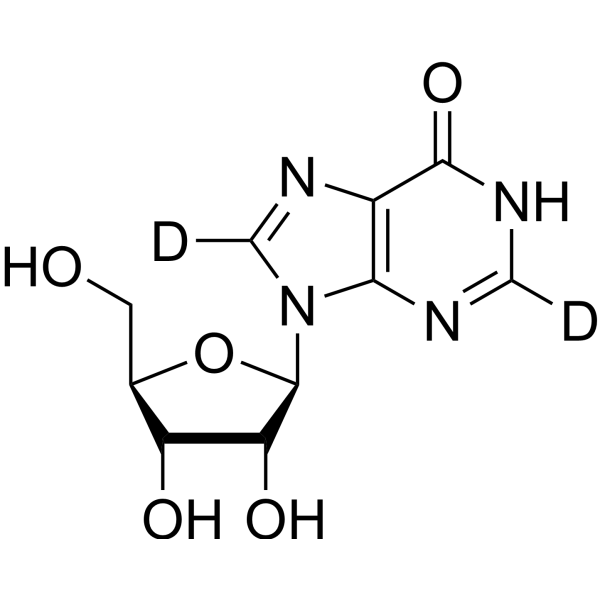
Inosine-2,8-d2 is the deuterium labeled Inosine. Inosine is an endogenous purine nucleoside produced by catabolism of adenosine. Inosine has anti-inflammatory, antinociceptive, immunomodulatory and neuroprotective effects. Inosine is an agonist for adenosine A1 (A1R) and A2A (A2AR) receptors.
For research use only. We do not sell to patients.
- Purity : 99.69%
- CAS No.: 697807-01-5
- Formula: C10H10D2N4O5
- Molecular Weight:270.24
-
Storage:
-20°C, stored under nitrogen
* In solvent : -80°C, 6 months; -20°C, 1 month (stored under nitrogen)

To place orders, for customer services and technical support, please contact: MedChemExpress USA
Tel: 609-228-6898 E-mail: [email protected] [email protected]


-
 Biological Activity
-
Chemical Information
- Protocols
- Purity & Documentation
- References
-
 Help & FAQs




Biological Activity
Description
In Vitro
Stable heavy isotopes of hydrogen, carbon, and other elements have been incorporated into drug molecules, largely as tracers for quantitation during the drug development process. Deuteration has gained attention because of its potential to affect the pharmacokinetic and metabolic profiles of drugs[1].
Inosine dose-dependently stimulates cAMP production mediated through the A2AR[3].
Inosine dose-dependently induces hA2AR-mediated ERK1/2 phosphorylation[3].
Inosine (100 μM; 24 hours) reduces oxidative stress in MES 23.5 cells cultured with astrocytes[4].
MedChemExpress (MCE) has not independently confirmed the accuracy of these methods. They are for reference only.
Application
1. This compound can be used as a tracer
2. This compound can be used as an internal standard for quantitative analysis by NMR, GC-MS, or LC-MS.


Chemical Information
-
CAS No. 697807-01-5
-
Unlabeled CAS 58-63-9
-
Appearance Solid
-
Molecular Weight 270.24
-
Formula C10H10D2N4O5
-
Color White to off-white
-
SMILES
O[C@@H]1[C@H](O)[C@@H](CO)O[C@H]1N2C([2H])=NC3=C2N=C([2H])NC3=O
-
Shipping
Room temperature in continental US; may vary elsewhere.
-
Storage
-20°C, stored under nitrogen
* In solvent : -80°C, 6 months; -20°C, 1 month (stored under nitrogen)


Purity & Documentation
-
Data Sheet (272 KB)
-
SDS (252 KB)
- English - EN (252 KB)
- Français - FR (252 KB)
- Deutsch - DE (252 KB)
- Norwegian - NO (252 KB)
- Español - ES (252 KB)
- Swedish - SV (252 KB)
- Italian - IT (252 KB)
- Korean - KR (252 KB)
- Portuguese - PT (252 KB)
-
Handling Instructions (2659 KB)
References
[1]. Russak EM, et al. Impact of Deuterium Substitution on the Pharmacokinetics of Pharmaceuticals. Ann Pharmacother. 2019;53(2):211-216. [Content Brief]
[2]. Filipe Marques Gonçalves, et al. Signaling pathways underlying the antidepressant-like effect of inosine in mice. Purinergic Signal. 2017 Jun; 13(2): 203-214. [Content Brief]
[3]. Ajith A. Welihinda, et al. The adenosine metabolite inosine is a functional agonist of the adenosine A2A receptor with a unique signaling bias. Cell Signal. 2016 Jun; 28(6): 552-560. [Content Brief]
[4]. Francisney Pinto Nascimento, et al. Adenosine A1 receptor-dependent antinociception induced by inosine in mice: pharmacological, genetic and biochemical aspects. Mol Neurobiol. 2015;51(3):1368-78. [Content Brief]
[5]. Sara Cipriani, et al. Protection by inosine in a cellular model of Parkinson’s disease. Neuroscience. 2014 Aug 22; 274: 242-249. [Content Brief]

Calculators
Concentration (start) × Volume (start) = Concentration (final) × Volume (final)


Inosine-2,8-d2 Related Classifications
HY-N0092S Related Classifications
 Powered by Bioz