



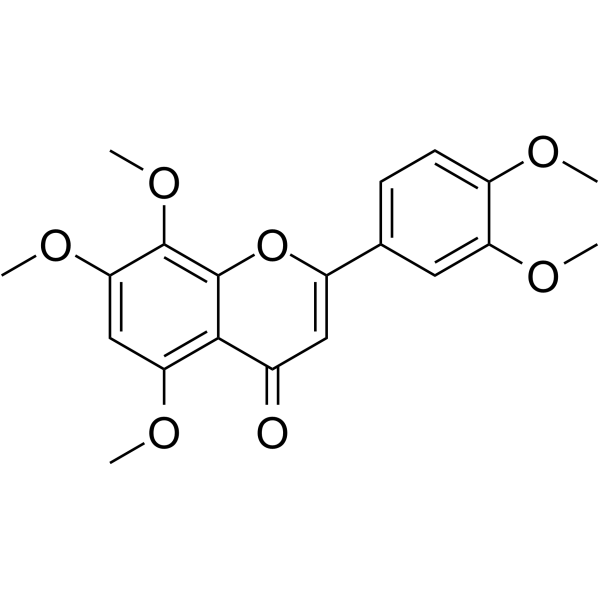
Isosinensetin

Based on 1 Customer Validation
Isosinensetin is a flavonoid compound and an inhibitor of HIV-1 protease and PTP1B (IC50: 2.61 µM; Ki: 0.92 µM). Isosinensetin inhibits P-glycoprotein (P-gp) in MDR1-MDCKII cells. Isosinensetin has multiple activities such as anti-tumor, anti-viral, anti-inflammatory, and antioxidant effects. Isosinensetin can be used in the research of various diseases including cancer, inflammation, osteoporosis, diabetes, etc.
For research use only. We do not sell to patients.
- Purity : 99.90%
- CAS No.: 17290-70-9
- Formula: C20H20O7
- Molecular Weight:372.37
-
Storage:
4°C, protect from light
* In solvent : -80°C, 6 months; -20°C, 1 month (protect from light)

To place orders, for customer services and technical support, please contact: MedChemExpress USA
Tel: 609-228-6898 E-mail: [email protected] [email protected]


-
 Biological Activity
-
Chemical Information
-
Solvent & Solubility
- Protocols
- Purity & Documentation
- References
-
 Help & FAQs




All Calcium Channel Isoforms
More

Biological Activity
Description
Cellular Effect
|
Cell Line

|
Type | Value | Description | References |
|---|---|---|---|---|
| 3T3-L1 | IC50 |
43 μM
Compound: 6
|
Anticorpulence activity against mouse 3T3L1 cells assessed as inhibition of lipid droplet accumulation
Anticorpulence activity against mouse 3T3L1 cells assessed as inhibition of lipid droplet accumulation
|
[PMID: 19054677] |
| HT-29 | IC50 |
28 μM
Compound: 6
|
Anticancer activity against human HT-29 cells after 72 hrs by MTT assay
Anticancer activity against human HT-29 cells after 72 hrs by MTT assay
|
[PMID: 19054677] |
| Monocyte | IC50 |
16 μM
Compound: 5,7,8,3',4'-pentamethoxyflavone
|
Inhibition of TNFalpha expression in LPS-stimulated human monocytes treated 30 mins before LPS challenge measured after 14 hrs by ELISA
Inhibition of TNFalpha expression in LPS-stimulated human monocytes treated 30 mins before LPS challenge measured after 14 hrs by ELISA
|
[PMID: 10096854] |
In Vitro
Isosinensetin (0.1-100 μM; 4-24 h) can significantly inhibit P-gp (IC50: 4.2 μM), and increase the cytotoxicity induced by paraquat in MDR1-MDCKII cells[1].
Isosinensetin (250 μg/mL) can inhibit erythrocyte hemolysis with an inhibition rate of 92.08%[2].
Isosinensetin (40-80 μM; 1 h) can increase the intracellular calcium ion concentration, promote the expression of hTAS2R50 and proglucagon, and stimulate the secretion of GLP-1 in NCI-H716 cells [3].
Isosinensetin (0-10 μM; 0-7 days) can inhibit the formation of osteoclasts and their bone resorption function in BMMs. The mechanism involves the inhibition of the ROS-mediated NF-κB/MAPK signaling pathway[4].
MedChemExpress (MCE) has not independently confirmed the accuracy of these methods. They are for reference only.
-
Cell Line:Bone marrowderived macrophages treated RANKL
-
Concentration:10 μM
-
Incubation Time:0, 5, 10, 20, 30 and 60 min
-
Result:Lowered the phosphorylation of ERK and P38 at the 10-minute and 20-minute time points, respectively.
Blocked JNK phosphorylation at both the 10-minute and 20-minute time points.
In Vivo
MedChemExpress (MCE) has not independently confirmed the accuracy of these methods. They are for reference only.
-
Animal Model:Ovariectomized (OVX) female C57BL/6 J mice[4]
-
Dosage:5 and 10 mg/kg
-
Administration:Intraperitoneal injection; once every two days for 6 weeks
-
Result:Significantly alleviated bone loss in OVX mice.
Increased bone volume per tissue volume (BV/TV), trabecular number (Tb.N), and trabecular thickness (Tb.Th), and decreased trabecular separation (Tb.Sp).
Reduced the number and area of TRAP-positive cells, indicating the inhibition of osteoclast activity.
Activated Nrf2-related antioxidant enzymes, such as HO-1 and CAT, and inhibited the expression of osteoclast-associated protein CTSK.


Chemical Information
-
CAS No. 17290-70-9
-
Appearance Solid
-
Molecular Weight 372.37
-
Formula C20H20O7
-
Color Off-white to light yellow
-
SMILES
O=C1C=C(C2=CC=C(OC)C(OC)=C2)OC3=C(OC)C(OC)=CC(OC)=C13
-
Structure Classification
-
Initial Source
-
Shipping
Room temperature in continental US; may vary elsewhere.
-
Storage
4°C, protect from light
* In solvent : -80°C, 6 months; -20°C, 1 month (protect from light)


Solvent & Solubility
In Vitro:
DMSO : 12.5 mg/mL (33.57 mM; Need ultrasonic; Hygroscopic DMSO has a significant impact on the solubility of product, please use newly opened DMSO)
Please refer to the solubility information to select the appropriate solvent. Once prepared, please aliquot and store the solution to prevent product inactivation from repeated freeze-thaw cycles.
Storage method and period of stock solution: -80°C, 6 months; -20°C, 1 month (protect from light). When stored at -80°C, please use it within 6 months. When stored at -20°C, please use it within 1 month.
Please refer to the solubility information to select the appropriate solvent. Once prepared, please aliquot and store the solution to prevent product inactivation from repeated freeze-thaw cycles.
Storage method and period of stock solution: -80°C, 6 months; -20°C, 1 month (protect from light). When stored at -80°C, please use it within 6 months. When stored at -20°C, please use it within 1 month.
Concentration (start) × Volume (start) = Concentration (final) × Volume (final)


Purity & Documentation
-
Data Sheet (278 KB)
-
SDS (394 KB)
- English - EN (394 KB)
- Français - FR (394 KB)
- Deutsch - DE (394 KB)
- Norwegian - NO (394 KB)
- Español - ES (394 KB)
- Swedish - SV (394 KB)
- Italian - IT (394 KB)
- Korean - KR (394 KB)
- Portuguese - PT (394 KB)
-
Handling Instructions (2659 KB)
References
[1]. Bai J, et al. Inhibitory effects of flavonoids on P-glycoprotein in vitro and in vivo: Food/herb-drug interactions and structure-activity relationships. Toxicol Appl Pharmacol. 2019 Apr 15;369:49-59. [Content Brief]
[2]. Jiang Y, et al. Isolation of adenosine, iso-sinensetin and dimethylguanosine with antioxidant and HIV-1 protease inhibiting activities from fruiting bodies of Cordyceps militaris. Phytomedicine. 2011 Jan 15;18(2-3):189-93. [Content Brief]
[3]. Lee SH, et al. Isosinensetin Stimulates Glucagon-like Peptide-1 Secretion via Activation of hTAS2R50 and the Gβγ-Mediated Signaling Pathway. Int J Mol Sci. 2023 Feb 12;24(4):3682. [Content Brief]
[4]. Qin Y, et al. Isosinensetin alleviates estrogen deficiency-induced osteoporosis via suppressing ROS-mediated NF-κB/MAPK signaling pathways. Biomed Pharmacother. 2023 Apr;160:114347. [Content Brief]


Complete Stock Solution Preparation Table
Please refer to the solubility information to select the appropriate solvent. Once prepared, please aliquot and store the solution to prevent product inactivation from repeated freeze-thaw cycles.
Storage method and period of stock solution: -80°C, 6 months; -20°C, 1 month (protect from light). When stored at -80°C, please use it within 6 months. When stored at -20°C, please use it within 1 month.
| Optional Solvent | Concentration Solvent Mass | 1 mg | 5 mg | 10 mg | 25 mg |
|---|---|---|---|---|---|
| DMSO | 1 mM | 2.6855 mL | 13.4275 mL | 26.8550 mL | 67.1375 mL |
| 5 mM | 0.5371 mL | 2.6855 mL | 5.3710 mL | 13.4275 mL | |
| 10 mM | 0.2686 mL | 1.3428 mL | 2.6855 mL | 6.7138 mL | |
| 15 mM | 0.1790 mL | 0.8952 mL | 1.7903 mL | 4.4758 mL | |
| 20 mM | 0.1343 mL | 0.6714 mL | 1.3428 mL | 3.3569 mL | |
| 25 mM | 0.1074 mL | 0.5371 mL | 1.0742 mL | 2.6855 mL | |
| 30 mM | 0.0895 mL | 0.4476 mL | 0.8952 mL | 2.2379 mL |


Isosinensetin Related Classifications
HY-N1941 Related Classifications
 Powered by Bioz