



Mycophenolic acid sodium
Based on 17 publication(s) in Google Scholar
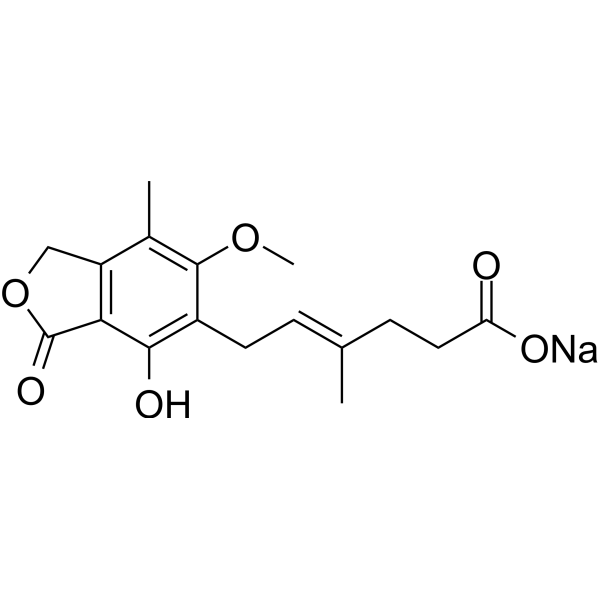
Mycophenolic acid sodium is a potent uncompetitive inosine monophosphate dehydrogenase (IMPDH) inhibitor with an EC50 of 0.24 µM. Mycophenolic acid sodium demonstrates antiviral effects against a wide range of RNA viruses including influenza. Mycophenolic acid sodium is an immunosuppressive agent. Antiangiogenic and antitumor effects.
For research use only. We do not sell to patients.
- Purity : 99.98%
- CAS No.: 37415-62-6
- Formula: C17H19NaO6
- Molecular Weight:342.32
-
Storage:
4°C, sealed storage, away from moisture
* In solvent : -80°C, 6 months; -20°C, 1 month (sealed storage, away from moisture)

To place orders, for customer services and technical support, please contact: MedChemExpress USA
Tel: 609-228-6898 E-mail: [email protected] [email protected]


-
 Biological Activity
-
Chemical Information
-
Solvent & Solubility
- Purity & Documentation
- References
-
 Help & FAQs


Publications Citing Use of MedChemExpress (MCE) Mycophenolic acid sodium
More- Nat Immunol. 2024 Apr;25(4):659-670. [Abstract]
- Nat Commun. 2024 Nov 12;15(1):9515. [Abstract]
- Sci Adv. 2026 Feb 20;12(8):eadz8405. [Abstract]
- J Transl Med. 2024 Feb 3;22(1):133. [Abstract]
- Sci Signal. 2024 Nov 26;17(864):eadp1375. [Abstract]
- J Agric Food Chem. 2024 Jan 10;72(1):326-338. [Abstract]
- Drug Des Devel Ther. 2026 Jul 23:20:622839.
- ACS Omega. 2025 Dec 8;10(50):62145-62156. [Abstract]
- Virol Sin. 2026 Jul 23:S1995-820X(26)00122-7.
- BMC Cancer. 2025 Sep 30;25(1):1463. [Abstract]
- Bone. 2023 Mar:168:116648. [Abstract]
- Viruses. 2021 Jun 28;13(7):1255. [Abstract]
- Drug Metab Dispos. 2026 Jul 14;54(8):100365.
- PLoS Negl Trop Dis. 2019 Aug 20;13(8):e0007681. [Abstract]
- J Viral Hepat. 2026 Jan;33(1):e70118. [Abstract]
- SSRN. 2025 Jul 9.
- Curr Res Virol Sci. 2022;3:100019. [Abstract]
 Customer Validation & Images

-
Cell Proliferation/Viability Assay
-
WB
-
Cell Proliferation/Viability Assay
-
IF
-
Flow Cytometry
All Antibiotic Isoforms
MoreAll Endogenous Metabolite Isoforms
More

Biological Activity
Description
IC50 & Target
|
Human Endogenous Metabolite |
In Vitro
Mycophenolic acid sodium demonstrates antiviral effects against a wide range of RNA viruses including influenza, dengue virus, Zika virus, rotavirus, CCHFV, and hantavirus[1].
IMPDH is the rate-limiting enzyme in the de novo synthesis of guanosine nucleotides[2].
Mycophenolic acid (0.01-1 μM; 72 hours) sodium exhibits preferential antiproliferative activity against the endothelial cells and fibroblasts. Endothelial cells are most sensitive cells to Mycophenolic acid treatment with an IC50 <500 nM for antimitotic effects[2].
Fibroblasts are also prone to Mycophenolic acid-induced cell cycle inhibition but exhibit a higher IC50 (<1 μM) compared with endothelial cells. The two human tumor cell lines A549 non-small cell lung cancer cells and PC3 prostate cancer cells show intermediate sensitivity with an IC50 >1 μM. U87 glioblastoma cells are resistant against Mycophenolic acid sodium treatment up to 1 μM[2].
Mycophenolic acid (0.05-2 μM; 18 hours) sodium exhibits a dose-dependent down-regulation of HDAC2 and MYC, whereas up-regulates NDRG1[2].
MedChemExpress (MCE) has not independently confirmed the accuracy of these methods. They are for reference only.
-
Cell Line:Primary isolated human dermal microvascular endothelial cells (HDMVEC) , fibroblasts, U87 glioblastoma cells, PC3 prostate cancer cells, A549 non-small cell lung cancer cells.
-
Concentration:0.01, 0.1, 1 μM
-
Incubation Time:72 hours
-
Result:Exhibited preferential antiproliferative activity against HDMVEC and fibroblasts. Whereas U87 glioblastoma cells were resistant to treatment, A549 non-small cell lung cancer and PC3 prostate cancer cells showed intermediate sensitivity.
-
Cell Line:HDMVEC
-
Concentration:0, 0.05, 0.1, 0.5, 1, and 2 μM
-
Incubation Time:18 hours
-
Result:Showed a dose-dependent regulation of HDAC2, MYC, and NDRG1.
In Vivo
MedChemExpress (MCE) has not independently confirmed the accuracy of these methods. They are for reference only.
-
Animal Model:Athymic 8-week-old, 20 g BALB/c nu/nu mice bearing Mycophenolic acid-resistant human U87 tumor model[2]
-
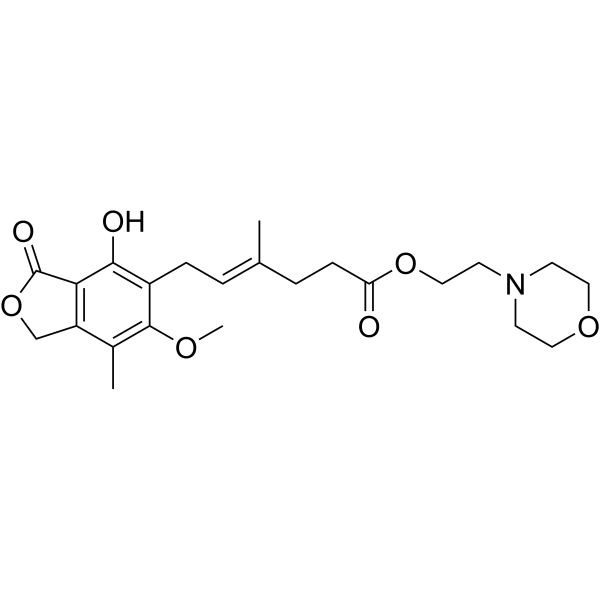
Dosage:120 mg/kg MMF (the morpholinoethyl ester prodrug of Mycophenolic acid)
-
Administration:Oral gavage; b.i.d.
-
Result:MMF (the morpholinoethyl ester prodrug of Mycophenolic acid) significantly inhibited tumor growth (∼70% after day 14 after tumor implantation) in MMF-treated versus control mice.
Microvessel density (CD31 staining) and pericyte coverage determined by α-smooth muscle actin staining were markedly reduced in MMF-treated versus control tumors (44% and 78%, respectively).
Clinical Trial
| NCT Number | Sponsor | Condition | Start Date |
Phase

|
|---|---|---|---|---|
| NCT01329991 | Plexxikon| | 2011-05 | PHASE1 |


Chemical Information
-
CAS No. 37415-62-6
-
Appearance Solid
-
Molecular Weight 342.32
-
Formula C17H19NaO6
-
Color White to off-white
-
SMILES
O=C(O[Na])CC/C(C)=C/CC1=C(O)C2=C(COC2=O)C(C)=C1OC
-
Synonyms
Mycophenolate sodium
-
Structure Classification
-
Initial Source
-
Shipping
Room temperature in continental US; may vary elsewhere.
-
Storage
4°C, sealed storage, away from moisture
* In solvent : -80°C, 6 months; -20°C, 1 month (sealed storage, away from moisture)


Publications (17)
-
Journal Impact Factor
-
Most Recent
-
Nat Immunol
2024 Apr;25(4):659-670. PMID: 38499799 -
Nat Commun
2024 Nov 12;15(1):9515. PMID: 39532854
Mycophenolic acid sodium purchased from MedChemExpress. Usage Cited in: Nat Commun. 2024 Nov 12;15(1):9515. [Abstract]
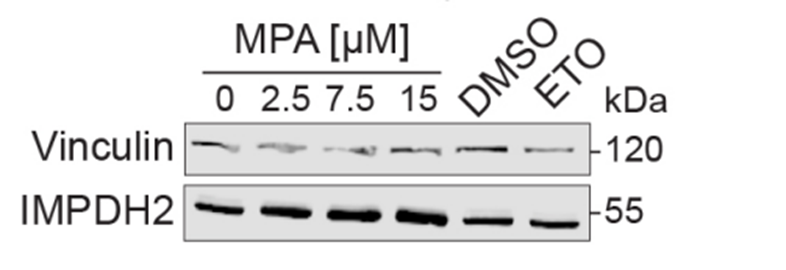
Mycophenolic acid (MPA) (0, 2.5, 7.5, 15 μM) treatment caused a dose-dependent increase of IMPDH2 protein levels.
Mycophenolic acid sodium purchased from MedChemExpress. Usage Cited in: Nat Commun. 2024 Nov 12;15(1):9515. [Abstract]
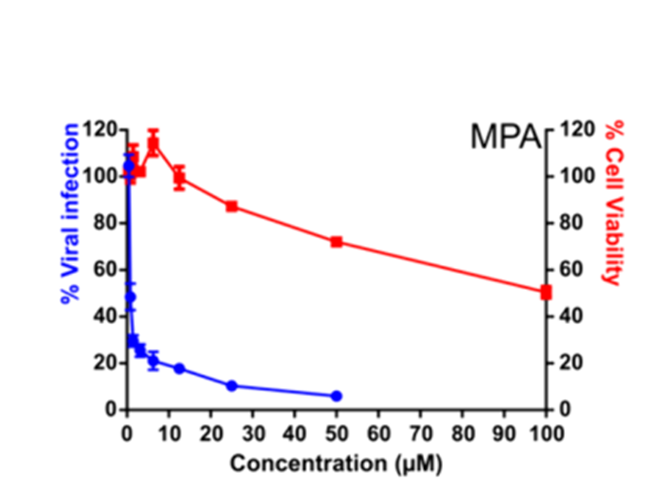
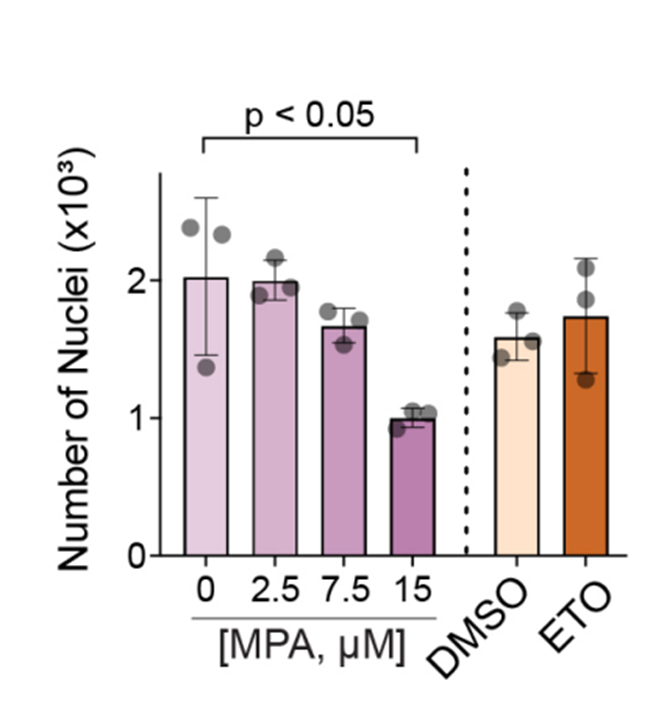
Mycophenolic acid (MPA) (0, 2.5, 7.5, 15 μM) treatment reduced viability at the highest concentration used (15 μM).
Mycophenolic acid sodium purchased from MedChemExpress. Usage Cited in: Nat Commun. 2024 Nov 12;15(1):9515. [Abstract]
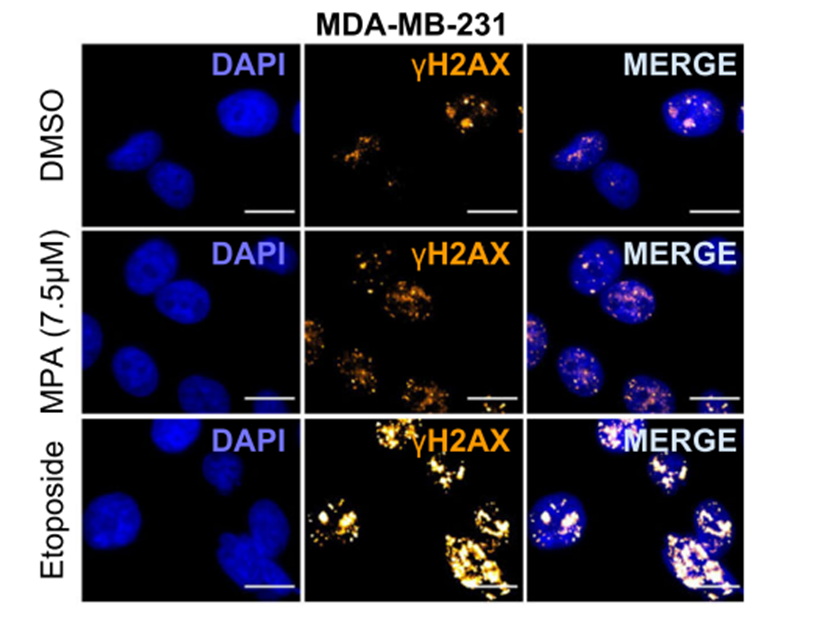
HT-IF showed that there was a significant increase in ɣH2AX signal in Mycophenolic acid (MPA) treated cells already at 7.5 μM.
-
Sci Adv
12R-HETE acts as an endogenous ligand for Nur77 in the intestines and regulates NKp46+ ILC3 development. [Abstract]2026 Feb 20;12(8):eadz8405. PMID: 41719391 -
J Transl Med
Wnt/β-catenin signalling activates IMPDH2-mediated purine metabolism to facilitate oxaliplatin resistance by inhibiting caspase-dependent apoptosis in colorectal cancer. [Abstract]2024 Feb 3;22(1):133. PMID: 38310229
Mycophenolic acid sodium purchased from MedChemExpress. Usage Cited in: J Transl Med. 2024 Feb 3;22(1):133. [Abstract]
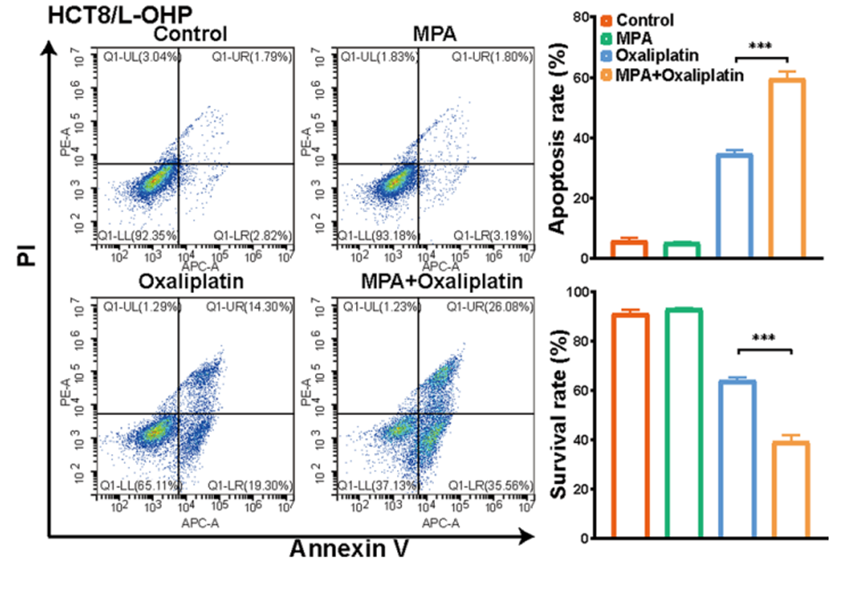
The apoptotic rate was analysed after Mycophenolic acid (MPA) and/or oxaliplatin treatment compared with that of untreated cells for 24 h by flow cytosmetry analysis in HCT8/L-OHP cells.
-
Sci Signal
Coordination between the eIF2 kinase GCN2 and p53 signaling supports purine metabolism and the progression of prostate cancer. [Abstract]2024 Nov 26;17(864):eadp1375. PMID: 39591412 -
J Agric Food Chem
Mechanism of Intestinal Epithelial Absorption and Electrophysiological Regulation of the Shrimp Peptide QMDDQ. [Abstract]2024 Jan 10;72(1):326-338. PMID: 38155399 -
-
ACS Omega
2025 Dec 8;10(50):62145-62156. PMID: 41476561
Mycophenolic acid sodium purchased from MedChemExpress. Usage Cited in: ACS Omega. 2025 Dec 8;10(50):62145-62156. [Abstract]
Dose response curves and % cell viability of mycophenolic acid (MPA) (10-100 μM) by MTT assay.
-
-
BMC Cancer
The integration of transcriptomics and metabolomics elucidates the antitumor mechanisms of mycophenolic acid in bladder cancer cells. [Abstract]2025 Sep 30;25(1):1463. PMID: 41029501 -
Bone
HIF-1α mediates osteoclast-induced disuse osteoporosis via cytoophidia in the femur of mice. [Abstract]2023 Mar:168:116648. PMID: 36563716 -
Viruses
Screening and Identification of Lujo Virus Inhibitors Using a Recombinant Reporter Virus Platform. [Abstract]2021 Jun 28;13(7):1255. PMID: 34203149 -
-
PLoS Negl Trop Dis
Identification of anti-flaviviral drugs with mosquitocidal and anti-Zika virus activity in Aedes aegypti. [Abstract]2019 Aug 20;13(8):e0007681. PMID: 31430351 -
J Viral Hepat
The Differential Effects of Immunosuppressants on Hepatitis E Virus Replication and the Triggered Inflammatory Responses in Macrophages. [Abstract]2026 Jan;33(1):e70118. PMID: 41400072 -
-
Curr Res Virol Sci
Identification of broad anti-coronavirus chemical agents for repurposing against SARS-CoV-2 and variants of concern. [Abstract]2022;3:100019. PMID: 35072124


Solvent & Solubility
In Vitro:
DMSO : 175 mg/mL (511.22 mM; Need ultrasonic; Hygroscopic DMSO has a significant impact on the solubility of product, please use newly opened DMSO)
H2O : 100 mg/mL (292.12 mM; Need ultrasonic)
Please refer to the solubility information to select the appropriate solvent. Once prepared, please aliquot and store the solution to prevent product inactivation from repeated freeze-thaw cycles.
Storage method and period of stock solution: -80°C, 6 months; -20°C, 1 month (sealed storage, away from moisture). When stored at -80°C, please use it within 6 months. When stored at -20°C, please use it within 1 month.
* Note: If you choose water as the stock solution, please dilute it to the working solution, then filter and sterilize it with a 0.22 μm filter before use.
Please refer to the solubility information to select the appropriate solvent. Once prepared, please aliquot and store the solution to prevent product inactivation from repeated freeze-thaw cycles.
Storage method and period of stock solution: -80°C, 6 months; -20°C, 1 month (sealed storage, away from moisture). When stored at -80°C, please use it within 6 months. When stored at -20°C, please use it within 1 month.
* Note: If you choose water as the stock solution, please dilute it to the working solution, then filter and sterilize it with a 0.22 μm filter before use.
Concentration (start) × Volume (start) = Concentration (final) × Volume (final)


Purity & Documentation
-
Data Sheet (278 KB)
-
SDS (701 KB)
- English - EN (701 KB)
- Français - FR (701 KB)
- Deutsch - DE (701 KB)
- Norwegian - NO (701 KB)
- Español - ES (701 KB)
- Swedish - SV (701 KB)
- Italian - IT (701 KB)
- Korean - KR (701 KB)
- Portuguese - PT (701 KB)
-
Handling Instructions (2659 KB)
References
[1]. Stephen R Welch, et al. Screening and Identification of Lujo Virus Inhibitors Using a Recombinant Reporter Virus Platform. Viruses. 2021 Jun 28;13(7):1255. [Content Brief]
[2]. Sophie Domhan, et al. Molecular mechanisms of the antiangiogenic and antitumor effects of mycophenolic acid. Mol Cancer Ther. 2008 Jun;7(6):1656-68. [Content Brief]


Complete Stock Solution Preparation Table
Please refer to the solubility information to select the appropriate solvent. Once prepared, please aliquot and store the solution to prevent product inactivation from repeated freeze-thaw cycles.
Storage method and period of stock solution: -80°C, 6 months; -20°C, 1 month (sealed storage, away from moisture). When stored at -80°C, please use it within 6 months. When stored at -20°C, please use it within 1 month.
| Optional Solvent | Concentration Solvent Mass | 1 mg | 5 mg | 10 mg | 25 mg |
|---|---|---|---|---|---|
| H2O / DMSO | 1 mM | 2.9212 mL | 14.6062 mL | 29.2124 mL | 73.0311 mL |
| 5 mM | 0.5842 mL | 2.9212 mL | 5.8425 mL | 14.6062 mL | |
| 10 mM | 0.2921 mL | 1.4606 mL | 2.9212 mL | 7.3031 mL | |
| 15 mM | 0.1947 mL | 0.9737 mL | 1.9475 mL | 4.8687 mL | |
| 20 mM | 0.1461 mL | 0.7303 mL | 1.4606 mL | 3.6516 mL | |
| 25 mM | 0.1168 mL | 0.5842 mL | 1.1685 mL | 2.9212 mL | |
| 30 mM | 0.0974 mL | 0.4869 mL | 0.9737 mL | 2.4344 mL | |
| 40 mM | 0.0730 mL | 0.3652 mL | 0.7303 mL | 1.8258 mL | |
| 50 mM | 0.0584 mL | 0.2921 mL | 0.5842 mL | 1.4606 mL | |
| 60 mM | 0.0487 mL | 0.2434 mL | 0.4869 mL | 1.2172 mL | |
| 80 mM | 0.0365 mL | 0.1826 mL | 0.3652 mL | 0.9129 mL | |
| 100 mM | 0.0292 mL | 0.1461 mL | 0.2921 mL | 0.7303 mL |
* Note: If you choose water as the stock solution, please dilute it to the working solution, then filter and sterilize it with a 0.22 μm filter before use.


Mycophenolic acid sodium Related Classifications
HY-B0421A Related Classifications
 Powered by Bioz